Las Monedas Cave
A Cantabrian cave where charcoal-drawn reindeer mark a colder Ice Age
Understand sacred places, explore living traditions, and learn how to engage respectfully with Pilgrim Map.
Access has not been verified. Check current local guidance before planning a visit.
Puente Viesgo, Cantabria, Spain
Read the sources
Visit essentials
A quick read before you go
- Duration
- Each guided visit runs approximately forty-five minutes, set by the operator rather than…
- Access
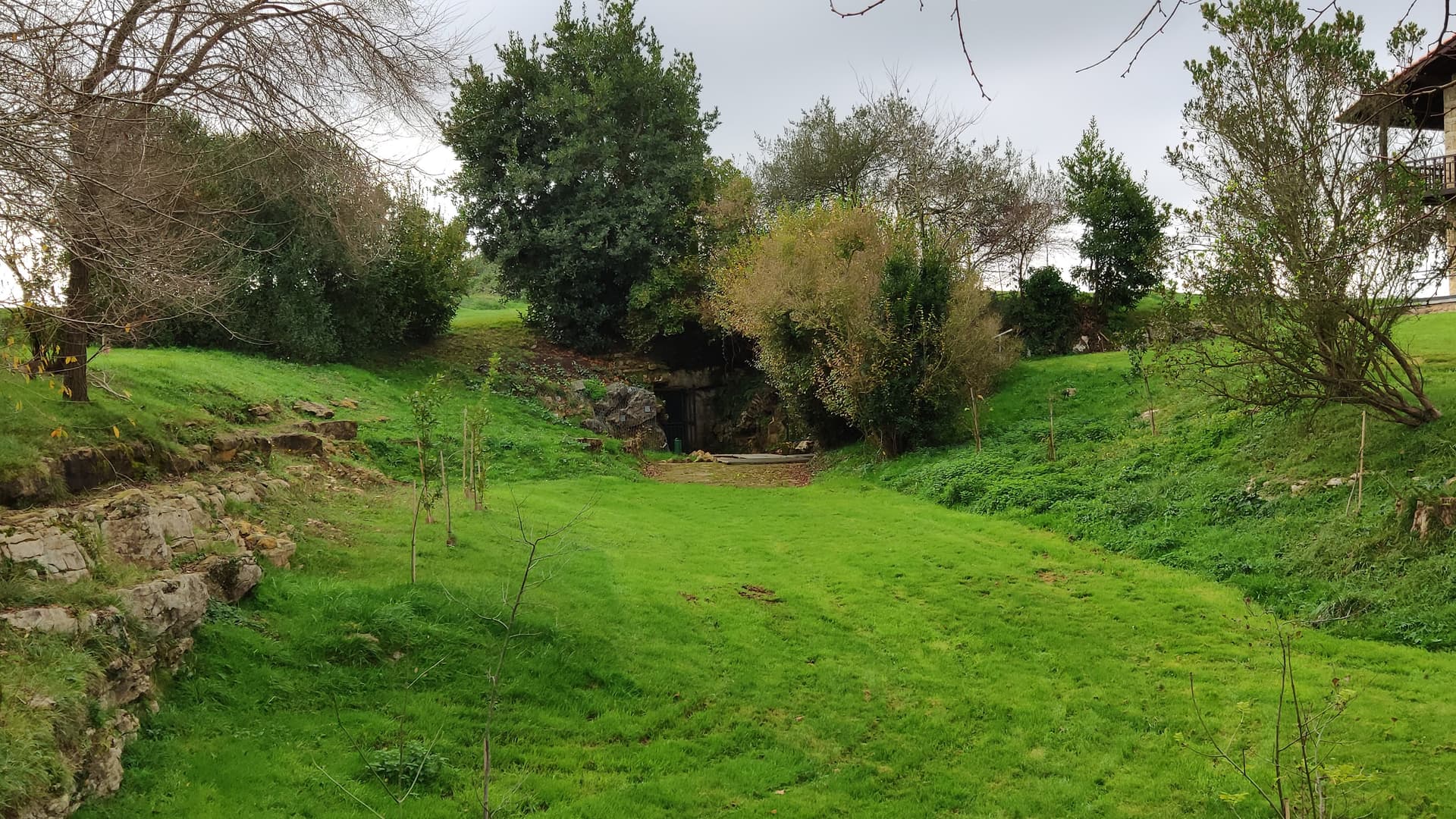
- Las Monedas sits on Monte Castillo hill above Puente Viesgo, Cantabria, sharing the same…
Overview
Felipe Puente and A. García Lorenzo discovered the cave on a Cantabrian hillside in 1952. They first called it the Cave of the Bears after the painted animal that most struck them. It became Las Monedas—Cave of the Coins—after 16th-century coins were later found inside, adding recent history to far older images.
Studied by archaeologist Eduardo Ripoll Perelló and later researchers, the charcoal panel is roughly 12,000 to 13,000 years old and Magdalenian: horses, ibex, bison, bear, and reindeer. Reindeer rarely appears elsewhere in Iberian cave art. Researchers read it as evidence of Cantabria's colder conditions near the last Ice Age's end, when Magdalenian people recorded animals moving through a landscape harsher and colder than that of El Castillo's earlier artists.
Las Monedas shares its hill, reception center, and UNESCO listing with El Castillo but differs in technique and era: charcoal rather than red ochre, made centuries after the older cave's earliest layers were already ancient. No ceremony occurs here now. Guided tours alone enter, disturbing the silence and stable temperature only with footsteps and a lamp.
Why this place is sacred
Compared with El Castillo's vast, multi-period sequence, Las Monedas is a smaller, more tightly bounded site: a single Magdalenian-period animal panel, drawn in charcoal rather than the older cave's red ochre, concentrated in a modest chamber near the entrance. What makes it distinct within Cantabrian rock art is not scale but composition.
The panel groups horses, ibex, bison, and bear with reindeer — an animal that appears only rarely in Iberian cave art generally, and whose presence here researchers connect to the colder Ice Age conditions of the Magdalenian period in this region, a period considerably later and colder than the phases represented at neighboring El Castillo.
Alongside the animal figures, the panel includes a number of abstract signs. Available sources describe these signs as difficult to interpret, and no source consulted offers a confirmed reading of what they meant to the people who made them.
That gap is worth stating plainly rather than filling in: what is documented is the presence and general form of the signs, not their function or intended meaning, and this content does not assert a ritual purpose for them beyond what researchers have themselves been willing to claim.
Las Monedas is best understood in relation to its neighbor. Both caves sit within the same Monte Castillo karst massif, share a UNESCO listing, and were painted by hunter-gatherer groups working the same hillside — but centuries or millennia apart, in different techniques, under different climatic conditions. Seen together, they let a visitor trace how both the art and the world outside the cave had changed between one group's visit and the next.
The cave was never built; it is a natural karst formation decorated by Magdalenian-period hunter-gatherer groups using charcoal, with no single founding moment. Its purpose to those who made the panel is not established in available research beyond the general inference that recording this particular set of animals, in this particular place, mattered enough to return and do it deliberately.
After its Magdalenian-period use, the cave passed out of active memory for millennia; 16th-century coins found within suggest some later, undocumented human presence, before rediscovery by Felipe Puente and A. García Lorenzo in 1952 and subsequent study by Eduardo Ripoll Perelló brought it into the scientific and heritage record.
Experience and orientation
The visit to Las Monedas begins at the same shared Monte Castillo reception that serves El Castillo, and follows the same guided, timed format — a fixed group, a set route, roughly forty-five minutes inside.
Compared with El Castillo's long, layered sequence spread across a large cave system, Las Monedas concentrates its principal imagery in a smaller, more contained space near the entrance, which visitor and guide materials describe as giving the animal panel an intimate, close-quarters presence rather than a monumental one.
What stands out most to visitors, according to available accounts, is the reindeer — an animal seen rarely elsewhere in Iberian cave art — appearing alongside the more commonly depicted horses, ibex, bison, and bear. Seeing all of them together in charcoal, in one compact panel, gives a visitor a fairly direct read on a specific moment in the region's deep climatic history: colder, harder, and reflected in exactly which animals a Magdalenian group thought worth drawing.
Book ahead through the same Cuevas de Cantabria system used for El Castillo, and validate tickets at the shared reception twenty to forty minutes before the scheduled entry. Visitors combining both caves in one day should space their two reservations at least an hour apart. Footwear suited to uneven, damp cave floors is recommended.
Context and lineage
Felipe Puente and A. García Lorenzo found the cave in 1952 and first called it the Cave of the Bears, a name drawn directly from the animals depicted in its painted panel. The name did not last: coins from the 16th century, found within the cave, gave it the name it carries today.
Archaeologist Eduardo Ripoll Perelló subsequently studied and publicized the find — sources vary on whether Ripoll Perelló should be credited as co-discoverer or as the researcher who studied and publicized the cave after its discovery, and this content treats him as the latter, following the more detailed available source.
No continuous ritual or devotional lineage connects the cave's Magdalenian-period use to the present. What continues is a shared scholarly and heritage-management lineage with neighboring El Castillo — both caves are studied, protected, and presented to visitors under the same regional authority and the same UNESCO listing.
Felipe Puente
discoverer
Co-discoverer of the cave in 1952, alongside A. García Lorenzo.
A. García Lorenzo
discoverer
Co-discoverer of the cave in 1952, alongside Felipe Puente.
Eduardo Ripoll Perelló
archaeologist
Archaeologist who studied and publicized the cave's Magdalenian-period animal panel following its 1952 discovery.
Traditions and practice
Researchers note that Magdalenian groups chose this particular chamber and this particular combination of species — reindeer alongside horses, ibex, bison, and bear — for deliberate depiction, and that the choice likely reflects the colder climatic conditions of the period rather than random selection.
Beyond that climatic inference, available sources do not establish what, if any, ritual or ceremonial function the panel served; the accompanying abstract signs are described in research as difficult to interpret, and no confirmed reading of their purpose exists. This content does not extend beyond what researchers have stated.
There is no revived or reconstructed ceremony at Las Monedas. The guided tour is the only structured way the cave is encountered today, run as heritage interpretation rather than spiritual practice.
Let the panel's compactness work in its favor rather than rushing past it — because the chamber is small and the imagery concentrated, a slower look rewards more than a quick scan. Notice which animals appear together and consider, as the guide may point out, what their combination suggests about the world outside the cave at the time the panel was made.
Where abstract signs accompany the animals, it is honest — and more interesting — to sit with the fact that their meaning is genuinely unknown rather than to reach for an explanation the evidence doesn't support.
Upper Paleolithic (Magdalenian) image-making tradition
HistoricalLas Monedas is a UNESCO-inscribed Paleolithic rock-art site within the Monte Castillo complex, notable for a Magdalenian-period charcoal-drawn animal panel — reindeer alongside horses, ibex, bison, and bear — that researchers connect to the colder climatic conditions of that period in Cantabria. No living worship continues at the site today, and no confirmed ritual function has been established for its imagery.
Charcoal-based figurative drawing of Ice Age fauna, applied within a compact chamber near the cave entrance; researchers note the choice of species and placement likely carried significance for its Magdalenian creators, but the specific content of any associated belief or practice is not established in available sources.
Heritage stewardship and guided interpretation
ActiveLas Monedas is managed today as a protected component of the UNESCO 'Cave of Altamira and Paleolithic Cave Art of Northern Spain' listing, sharing conservation infrastructure and guided-access protocols with neighboring El Castillo.
Timed, small-group guided tours through the Cuevas de Cantabria operator, with restrictions on touching and lighting to protect the cave's charcoal imagery.
Perspectives and open questions
Las Monedas raises fewer authorship controversies than its neighbor El Castillo, but it raises its own, quieter open question: what the panel's abstract signs were for, a question researchers have not answered and this content does not attempt to answer on their behalf.
Scholarly perspective
Researchers agree that Las Monedas represents a later, Magdalenian-period phase of Cantabrian cave art, roughly 12,000 to 13,000 years old, distinguished by its charcoal technique and by an unusual emphasis on horses and reindeer that reflects the colder Ice Age climate of the period. Because these dates postdate Neanderthal extinction by tens of thousands of years, no authorship debate comparable to El Castillo's applies here — the panel is confidently attributed to Homo sapiens of the Magdalenian culture.
Alternative interpretations
General, non-site-specific shamanic or trance-based interpretive frameworks exist in broader Paleolithic rock-art scholarship, but no source located applies this framework specifically or definitively to the animal panel or abstract signs at Las Monedas. Several sources explicitly note that the accompanying non-figurative signs here are difficult to interpret; this content follows that assessment rather than proposing a reading the research does not support.
Open questions
The precise meaning of the abstract signs accompanying the animal figures remains unexplained in available sources. Why this particular chamber, and this particular combination of species — with reindeer rare elsewhere in Iberian cave art — was chosen for depiction is not established beyond the general climatic-context inference researchers have offered.
Plan your visit
Access and arrival
Las Monedas sits on Monte Castillo hill above Puente Viesgo, Cantabria, sharing the same reception and ticketing center as El Castillo, which also includes access to the Cantabria Rock Art Center. Admission is a modest fee (around €5 standard, with reductions for seniors, large families, and children aged 4–12; free for children under 4).
Mobile signal on the hillside itself was not specifically confirmed in research; visitors relying on GPS or online booking confirmation should have directions and tickets ready before leaving areas of stronger coverage in Puente Viesgo. For current access arrangements, booking, and any temporary closures, contact Cuevas de Cantabria directly through the official Gobierno de Cantabria site rather than relying on third-party listings.
No lodging information specific to Las Monedas was available at time of writing; check tourism resources for Puente Viesgo and nearby Santander for current accommodation options.
Respectful visit
No formal dress code applies; sturdy, non-slip footwear is recommended for uneven, damp cave terrain, and a layer for the cave's constant cool interior temperature is worth carrying regardless of season.
No Las Monedas-specific photography policy was confirmed in research; treat it similarly to El Castillo, where flash restrictions are likely but unconfirmed — verify current rules with the Cuevas de Cantabria operator before a visit.
None; the site has no active devotional practice and no offerings tradition.
Advance online booking is recommended; tickets are validated at the shared Monte Castillo reception at least twenty to forty minutes before the scheduled entry. Touching painted or engraved surfaces is prohibited. Visitors combining Las Monedas with El Castillo on the same day should space their two reservations at least an hour apart.
There is no offering or ritual practice to observe or improvise here — the cave is a conservation-managed archaeological site, not a devotional one. Visitors should not touch painted or engraved surfaces.
Location
Map loads as you approach this section.
Pilgrim reflections
A portrait of encounter, not a score
Pilgrims describe what they felt, how present they could become, and whether the place would shape a journey. There are no stars and no ranking of traditions.
No reviewed reflections yet
The first pilgrims can help describe the character of being here.
Share a reflection
Available after an account-backed “Been there.” Every reflection is reviewed before publication.
Nearby sacred places
Explore other sacred places in the region. Proximity does not establish access or travel time; check each place’s guidance.


References
Sources consulted for this page. Source categories describe the publication, not a guarantee that every claim is verified. Traditional accounts and outside interpretations may differ.
- 01Cave of Altamira and Paleolithic Cave Art of Northern Spain — UNESCO World Heritage Centre — UNESCOofficialOfficial World Heritage listing (extended 2008) covering the 18-cave grouping including Las Monedas, within Cantabria/northern Spain, spanning Upper Paleolithic cave art 35,000-11,000 years ago.
- 02Las Monedas Cave — Ministerio de Cultura (Arte Rupestre Cantábrico) — Ministerio de Cultura, Gobierno de EspañaofficialSpanish Ministry of Culture's official Cantabrian rock-art portal page for Las Monedas; used to corroborate art description (horses, reindeer, ibex, bison, bear; charcoal technique; ~17 animal figures plus signs) and Magdalenian dating (~12,000 BP by radiocarbon).
- 03Las Monedas — Horarios y Tarifas (Cuevas de Cantabria) — Gobierno de Cantabria / Cuevas Prehistóricas de CantabriaofficialOfficial regional-government page for opening hours, admission prices, and guided-visit booking rules; shared reception/ticketing system with El Castillo at Monte Castillo.
- 04Caves of Monte Castillo — Wikipedia — Wikipedia contributorsacademicComplex-level overview; Las Monedas discovery in 1952, exploration by Eduardo Ripoll Perelló, naming history, Magdalenian dating ~13,000 years, depicted fauna.
- 05Cueva de Las Monedas en Puente Viesgo — PRAT/CARP — Prehistour (European heritage-tourism project)Source contextHeritage-tourism description of discovery history and art content, cross-checked against Wikipedia and official Cantabria culture site.
- 06Show Caves of Spain: Cuevas de El Castillo y Las Monedas — showcaves.comSource contextIndependent show-cave reference database; used for general cross-check of visitor logistics and complex overview.
- 07Cave Las Monedas — vallespasiegos.eu (regional tourism site)Source contextRegional tourism-board description, used as supporting/cross-check source for discovery and art details.
Share a photo
Help visitors recognize Las Monedas Cave. Every submission is reviewed before publication.