El Castillo Cave
A Cantabrian cave holding the oldest dated painted image in Europe
Understand sacred places, explore living traditions, and learn how to engage respectfully with Pilgrim Map.
Access has not been verified. Check current local guidance before planning a visit.
Puente Viesgo, Cantabria, Spain
Read the sources
Visit essentials
A quick read before you go
- Duration
- Each guided visit runs approximately forty-five minutes, set by the operator rather than…
- Access
- El Castillo sits on Monte Castillo hill above the village of Puente Viesgo, Cantabria, roughly…
Overview
A red disk at El Castillo has unsettled a premise of art history. Uranium-thorium dating gives it a minimum age of 40,800 years—earlier, by current estimates, than securely documented Homo sapiens in western Europe—leading one research team to propose Neanderthal authorship. That claim remains contested, and methodological challenges to the dating technique have reopened the question.
Excavation since 1903 reveals possible Late Acheulean deposits over 150,000 years old, followed by Mousterian, Aurignacian, Gravettian, Solutrean, and Magdalenian occupations, then Bronze Age and medieval activity near the surface. Hundreds of stencils on the Panel of Hands overlap across tens of thousands of years, recording repeated returns to the same dark wall.
El Castillo is accessible only by guided tour within UNESCO's Cave of Altamira and Paleolithic Cave Art of Northern Spain. No ceremony continues here; stratigraphy, pigment, and the unresolved question of authorship remain.
Why this place is sacred
Most sacred or significant sites draw their weight from a single story: a vision, a battle, a birth. El Castillo draws its weight from accumulation. The cave's stratigraphy — described by different researchers as roughly nineteen layers or as some twenty-one metres of deposit spanning numbered units — preserves an almost unbroken record of intermittent human occupation from possible Late Acheulean activity more than 150,000 years ago through the full Upper Paleolithic sequence and into historical periods.
Few sites anywhere let archaeologists read so much continuous time in one place.
Within that long record sits one motif that has outsized consequence: a red disk, made by blowing or dabbing ochre pigment onto the rock, sitting beneath a crust of calcite that formed after the paint dried. Uranium-thorium dating of that calcite crust — not of the pigment itself, an important distinction — returned a minimum age of more than 40,800 years, with some secondary sources citing 41,400 ± 570 years.
A nearby hand stencil returned a minimum age of at least 37,290 years. Because current estimates place the secure arrival of Homo sapiens in western Europe at roughly 42,000 years ago, the 2012 dating team, led by Alistair Pike with co-author João Zilhão, argued that art this old in Europe should be attributed to Neanderthals rather than modern humans — the first time anyone had proposed Neanderthal authorship of European cave painting on direct chronometric grounds.
The claim has not settled into consensus. A 2026 report described a French researcher challenging the uranium-thorium method itself, arguing that calcite can lose uranium over time in an open system, which would make some of these minimum-age estimates unreliable and potentially too old. What began as a debate about who painted the disk has become, in part, a debate about whether the clock used to date it can be trusted at all.
Layered onto this scientific tension is the older, harder question that shadows all Paleolithic art: what any of it meant to the people who made it. Repeated superimposition of hand stencils, disks, and later animal figures across the same surfaces, generation after generation, suggests to most researchers something more than idle mark-making — but the specific content of that intention is not recoverable from pigment alone.
The cave was never built; it is a natural karst formation used intermittently by hunter-gatherer groups across an extraordinary span of Paleolithic time, with no single founding moment. Its earliest painted use — the red disk and associated marks — may represent either early Homo sapiens symbolic behavior or, if the contested Neanderthal-authorship hypothesis holds, evidence that image-making was not unique to our species.
Occupation and use continued intermittently through the Mousterian, Aurignacian, Gravettian, Solutrean, and Magdalenian periods, with activity persisting into the Bronze Age and Middle Ages in the uppermost layers, before the cave passed out of active use and into obscurity until its rediscovery by science in 1903.
Experience and orientation
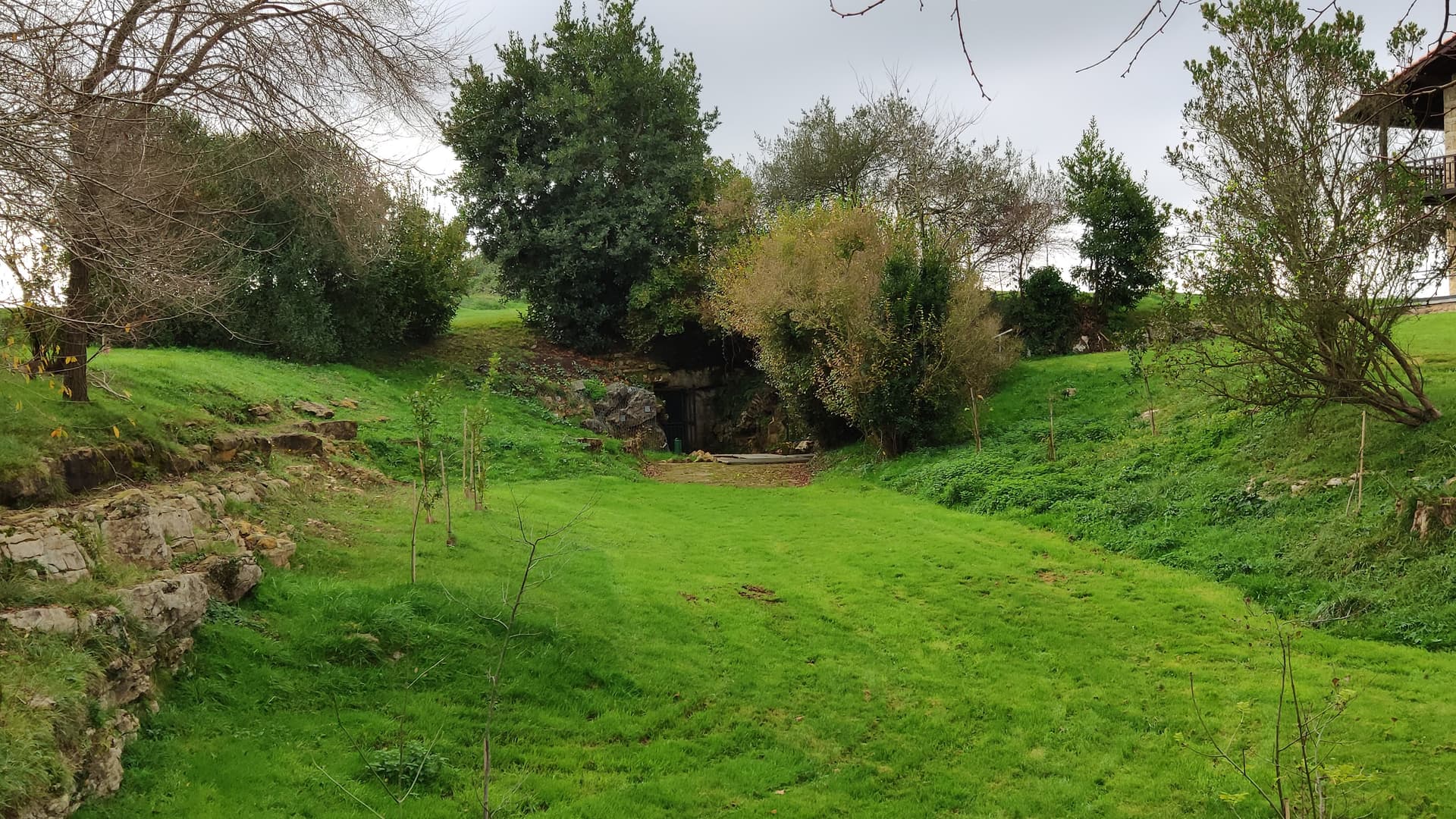
The approach begins outside, on Monte Castillo hill above the village of Puente Viesgo, at a shared reception center serving both El Castillo and neighboring Las Monedas. From there a guide leads a fixed group into the cave on a timed route — roughly forty-five minutes, no more, no less, since fragile pigment and limited air circulation set the pace rather than visitor curiosity.
Inside, the temperature holds steady regardless of season, and the dark is not the dimness of a poorly lit room but a genuine, enveloping absence of light beyond what the guide's lamp permits. Visitor accounts converge on the Panel of Hands as the point where the visit shifts register: hundreds of stencilled hands, some clearly overlapping others applied centuries or millennia apart, cover a single surface that no one photograph can hold. The density is the point.
It is not one hand reaching out of prehistory but many, layered, each one a decision by someone to press ochre-loaded fingers or a hollow reed to that particular patch of wall.
Because the cave functions as a managed heritage site rather than a place of worship, there is no ceremony to witness and no ritual to observe. What the visit offers instead is proximity — to a documented, extraordinarily long record of return, and to the specific, disputed disk that has become a flashpoint in debates about who, in the deep past, was capable of making a mark that meant something.
Arrive at the shared Monte Castillo reception with time to validate a pre-booked ticket — guides recommend twenty to forty minutes ahead of the scheduled entry. Footwear should suit damp, uneven cave floors. Those visiting both El Castillo and Las Monedas on the same day should space their two reservations at least an hour apart, since both draw on the same limited-capacity guided format.
Context and lineage
In 1903, Cantabrian archaeologist Hermilio Alcalde del Río identified the cave's Paleolithic art, opening one of the richest stratigraphic sequences then known in Europe to formal study. From 1910 to 1914, German archaeologist Hugo Obermaier led systematic excavation, establishing much of the layer-by-layer chronology still referenced today. No indigenous or folk origin narrative predating this scientific discovery has been documented in available sources — the cave's known history begins with excavation, not legend.
No continuous ritual or devotional lineage connects the cave's Paleolithic use to the present; what continues instead is a scholarly lineage of excavation and reinterpretation, from Alcalde del Río's 1903 discovery through Obermaier's foundational stratigraphy to the ongoing, unresolved dating debate initiated by Pike and Zilhão in 2012 and challenged again in 2026.
Hermilio Alcalde del Río
discoverer
Cantabrian archaeologist who identified the cave's Paleolithic art in 1903, initiating scientific interest in the site.
Hugo Obermaier
archaeologist
German prehistorian who led the primary excavation of El Castillo from 1910 to 1914, establishing the foundational stratigraphic sequence used by later researchers.
Alistair Pike
researcher
Lead author of the 2012 Science paper applying uranium-thorium dating to El Castillo's red disk, returning a minimum age over 40,800 years and opening the Neanderthal-authorship hypothesis.
João Zilhão
researcher
Co-author of the 2012 dating study, who argued that art exceeding roughly 42,000 years in Europe should be attributed to Neanderthals rather than Homo sapiens, given current arrival-date evidence.
Jean Clottes
scholar
Rock-art specialist whose broader writing on shamanic and trance interpretations of Upper Paleolithic European art provides interpretive context for sites like El Castillo, though not a claim specific to this cave.
Traditions and practice
Researchers infer, from the repeated superimposition of hand stencils, disks, and animal figures across tens of thousands of years, that the cave's painted surfaces carried symbolic or ritual significance for the groups who returned to them — but the specific content of any such practice, and whether Neanderthals as well as Homo sapiens took part in it, cannot be recovered from the physical record alone. This is a scholarly inference about probable ancient behavior, not a documented named tradition.
There is no revived or reconstructed ceremony at El Castillo. The guided tour is the only structured way the cave is encountered today, and it is conducted as heritage interpretation rather than spiritual practice.
Move at the pace the guide sets rather than pulling ahead — the tour's forty-five minutes is calibrated to the cave's limits, not a constraint to work around. At the Panel of Hands, resist the urge to photograph immediately; let your eyes adjust and take in how many individual hands overlap on one surface before reaching for a camera. Notice the constant, unvarying coolness of the air, which has likely differed little from what the cave's earliest visitors felt.
Where the guide points out the red disk, sit with the fact that its authorship — and the reliability of the method used to date it — remain open questions, rather than looking for a settled answer that the site itself cannot offer.
Upper Paleolithic (and possibly late Middle Paleolithic/Neanderthal) symbolic image-making
HistoricalEl Castillo holds one of the oldest known dated cave images in the world — a red disk with a minimum age exceeding 40,800 years — raising the contested possibility that Neanderthals, not only Homo sapiens, made symbolic marks on cave walls. Repeated superimposition of hand stencils, disks, and animal figures across tens of thousands of years suggests sustained symbolic use, though no living devotional tradition survives.
Repeated application of red ochre pigment — disks and hand stencils, some applied by blowing pigment through a tube — and later engraved and painted animal figures across multiple Paleolithic occupation phases, interpreted by researchers as evidence of deliberate, sustained return rather than a single event.
Archaeological and dating-science research tradition
ActiveEl Castillo remains an active site of scientific inquiry, most visibly through the ongoing dispute over uranium-thorium dating reliability and Neanderthal authorship that has drawn renewed international research attention as recently as 2026.
Continued academic publication, re-analysis of existing dating methods, and methodological challenge and counter-challenge among specialists in archaeological chronometry and Paleolithic art.
Heritage stewardship and guided interpretation
ActiveEl Castillo is managed today as a protected component of the UNESCO 'Cave of Altamira and Paleolithic Cave Art of Northern Spain' listing, with guided access designed to balance public interest against conservation of fragile pigment.
Timed, small-group guided tours through the Cuevas de Cantabria operator, with restrictions on touching, lighting, and likely flash photography to protect the cave's surfaces.
Perspectives and open questions
El Castillo sits at the center of a live scientific dispute rather than a settled historical account, and honest engagement with the site means presenting that dispute as open rather than resolving it in either direction.
Scholarly perspective
There is broad agreement that El Castillo preserves an exceptionally long and rich Paleolithic sequence, including some of the oldest reliably dated cave art in Europe. There is no consensus, however, on the claim that the oldest motifs — the red disk and certain hand stencils — were made by Neanderthals rather than early Homo sapiens.
The hypothesis, first proposed by Pike, Zilhão, and colleagues in 2012, rests on uranium-thorium dating of calcite that formed over the pigment, not on the pigment itself, and has since faced renewed methodological challenge over whether that dating technique reliably holds its assumptions over tens of thousands of years.
Alternative interpretations
General, non-site-specific rock-art scholarship — associated with researchers such as Jean Clottes and David Lewis-Williams — has proposed a shamanic or trance framework for interpreting Upper Paleolithic imagery broadly, treating deep cave interiors as liminal spaces and geometric signs as visionary content experienced in altered states. No source located applies this framework specifically or definitively to El Castillo's own imagery; it is offered here as a widely discussed interpretive lens, not a claim about this cave in particular.
Open questions
Who painted the cave's oldest layers — Neanderthal or Homo sapiens — is unresolved and may remain permanently ambiguous, given the difficulty of directly dating mineral pigment rather than the calcite that later formed over it. The reliability of uranium-thorium dating itself is under renewed methodological challenge as of 2026 reporting, which could alter minimum-age estimates here and at other European sites.
And the intended meaning of the disks, hand stencils, and abstract marks — ritual, communicative, mnemonic, or something else entirely — remains fundamentally unknowable from the physical record, one of the enduring open questions of Paleolithic archaeology.
Plan your visit
Access and arrival
El Castillo sits on Monte Castillo hill above the village of Puente Viesgo, Cantabria, roughly 25–30 km south of Santander. Entry is only through pre-booked guided tour via the shared Monte Castillo reception center, which also serves Las Monedas Cave and the Cantabria Rock Art Center. Admission is a modest fee (around €5 standard, with reductions for seniors, large families, and children).
Mobile signal on the hillside itself was not specifically confirmed in research; visitors relying on GPS or online booking confirmation should plan to have directions and tickets ready before leaving areas of stronger coverage in Puente Viesgo. For current access arrangements, booking, and any temporary closures, contact Cuevas de Cantabria directly through the official Gobierno de Cantabria site rather than relying on third-party listings.
No lodging information specific to El Castillo was available at time of writing; check tourism resources for Puente Viesgo and nearby Santander for current accommodation options.
Respectful visit
No formal dress code applies; sturdy, non-slip footwear is recommended given uneven, damp cave terrain, and a layer for the cave's constant cool interior temperature is worth carrying regardless of season.
No El Castillo-specific photography policy was confirmed in research; comparably managed Spanish show-caves typically restrict flash photography to protect pigment, and this should be treated as likely but unconfirmed — check current rules with the Cuevas de Cantabria operator before a visit.
None; the site has no active devotional practice and no offerings tradition.
Advance online booking is strongly recommended; tickets must be validated at the shared Monte Castillo reception at least twenty to forty minutes before the scheduled entry. Tours are guided and timed at approximately forty-five minutes. Touching painted or engraved surfaces is prohibited. Visitors combining El Castillo with Las Monedas on the same day should space their two reservations at least an hour apart.
There is no offering or ritual practice to observe here, and none should be improvised. Touching painted or engraved surfaces is prohibited to protect fragile pigment and calcite; visitors should also expect firm restrictions on photography and lighting once inside.
Location
Map loads as you approach this section.
Pilgrim reflections
A portrait of encounter, not a score
Pilgrims describe what they felt, how present they could become, and whether the place would shape a journey. There are no stars and no ranking of traditions.
No reviewed reflections yet
The first pilgrims can help describe the character of being here.
Share a reflection
Available after an account-backed “Been there.” Every reflection is reviewed before publication.
Nearby sacred places
Explore other sacred places in the region. Proximity does not establish access or travel time; check each place’s guidance.


References
Sources consulted for this page. Source categories describe the publication, not a guarantee that every claim is verified. Traditional accounts and outside interpretations may differ.
- 01Cave of Altamira and Paleolithic Cave Art of Northern Spain — UNESCO World Heritage Centre — UNESCOofficialOfficial World Heritage listing (1985, extended 2008) covering 18 caves in northern Spain including El Castillo; criteria for inscription as masterpieces of creative genius / outstanding testimony to Upper Paleolithic cultural tradition.
- 02The technology of the earliest European cave paintings: El Castillo Cave, Spain — ScienceDirect (peer-reviewed journal article)academicPeer-reviewed technical study of pigment application methods (blown-pigment technique for disks and hand stencils) at El Castillo.
- 03Hand Stencils in El Castillo Cave (Puente Viesgo, Cantabria, Spain). An Interdisciplinary Study — ResearchGate (peer-reviewed)academicDetailed academic study of the Panel of Hands / hand-stencil corpus at El Castillo, including 2013 finger-ratio gender analysis referenced by Wikipedia summary.
- 04Cueva de El Castillo — Horarios y Tarifas (Cuevas de Cantabria) — Gobierno de Cantabria / Cuevas Prehistóricas de CantabriaofficialOfficial regional-government site for opening hours, admission prices, guided-visit rules and the requirement to pre-book. Basis for practicalities.access and best_times.
- 05Cave of El Castillo — Wikipedia — Wikipedia contributorsacademicDiscovery by Hermilio Alcalde del Río in 1903; excavation by Hugo Obermaier 1910-1914; stratigraphy overview; 2012 U-Th dating results; hand-stencil gender study; UNESCO ref 310-009.
- 06Caves of Monte Castillo — Wikipedia — Wikipedia contributorsacademicComplex-level overview of El Castillo, Las Monedas, La Pasiega, Las Chimeneas; UNESCO 1985/2008 listing history.
- 07Ancient Cave Paintings Clinch the Case for Neandertal Symbolism — Scientific AmericanSource contextScience journalism on the 2012 Pike et al. findings and their implications for Neanderthal symbolic capacity.
- 08World's Oldest Cave Art Found—Made by Neanderthals? — National GeographicSource contextReports Alistair Pike-led team's Science paper; João Zilhão's statement that art >42,000 years old in Europe should be attributed to Neanderthals since H. sapiens is not thought to have reached western Europe until ~42,000 years ago; explains U-Th dating of overlying calcite rather than the pigment itself.
- 09Neanderthals: The Oldest Cave Painters? — NPRSource contextContemporary (2012) reporting on the same Science study, useful for corroborating dates and framing of the debate at time of publication.
- 10Scientist questions dating of world's oldest cave art and Neanderthal paintings — Archaeology News Online MagazineSource context2026 report on a French researcher's methodological challenge to U-Th dating (open-system uranium loss in calcite) used for El Castillo and other sites; represents the contested/ongoing side of the debate. Used to source the 'disputed dating methodology' framing rather than as a settled counter-claim.
- 11The Paleolithic Cave Art of France — Meaning(s) — Jean Clottes / Bradshaw FoundationacademicScholarly essay by rock-art specialist Jean Clottes summarizing the shamanic/trance interpretive framework applied broadly to Upper Paleolithic European cave art (not El Castillo-specific, used for general interpretive context, flagged as one interpretation among several, not consensus).
Share a photo
Help visitors recognize El Castillo Cave. Every submission is reviewed before publication.