Kilmacduagh
Where Ireland's tallest round tower leans over the ruins of a hermit saint's monastery at the edge of the Burren
Understand sacred places, explore living traditions, and learn how to engage respectfully with Pilgrim Map.
Access has not been verified. Check current local guidance before planning a visit.
County Galway, County Galway, Ireland
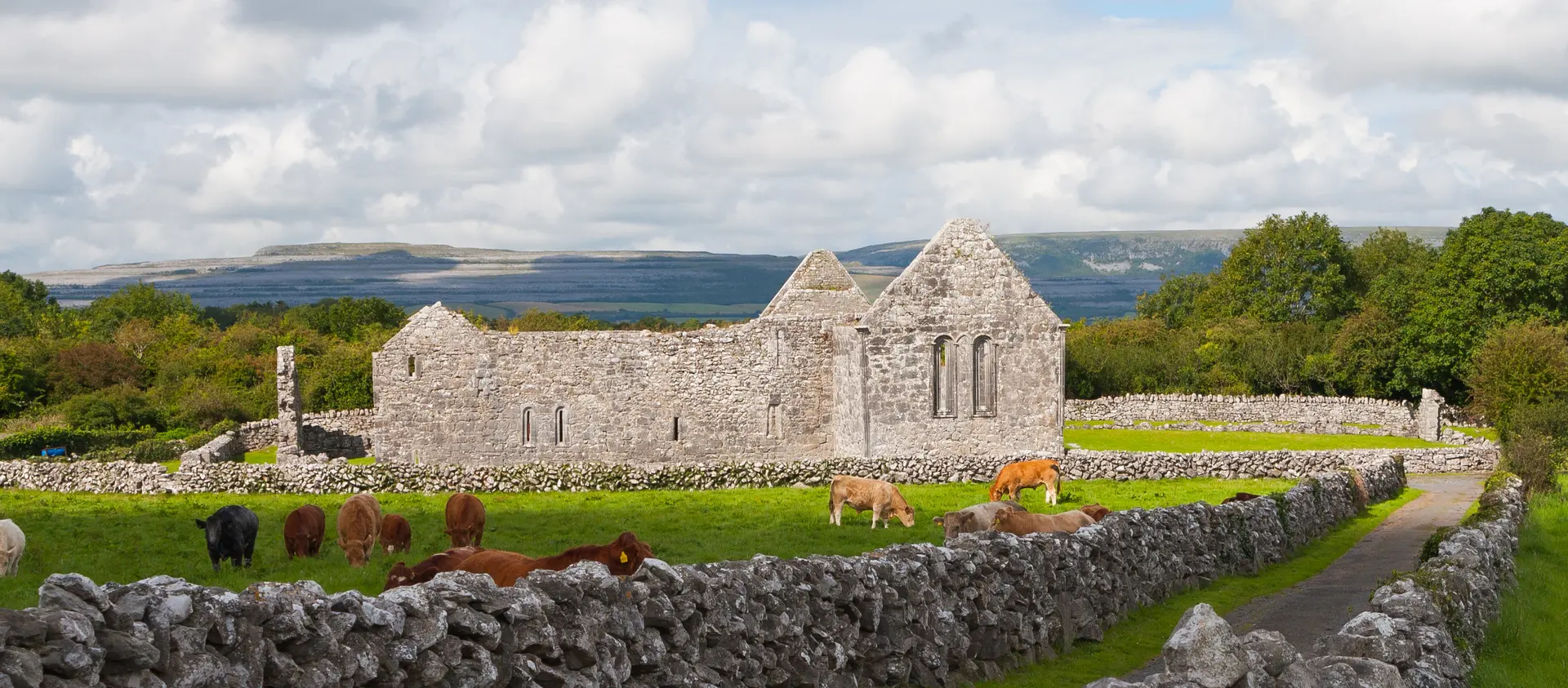
Image of Kilmacduagh. Image source · CC-BY-SA-4.0
Visit essentials
A quick read before you go
- Duration
- Allow 1 to 2 hours to explore the full site including the cathedral, round tower, graveyard, and…
- Access
- Leave the M18 motorway (Galway-Limerick) at Exit 16 and head into Gort.
Overview
Ireland's tallest round tower does not stand straight. At Kilmacduagh, the tower leans more than half a meter from true, its silhouette against the Galway sky carrying a quality of determined imperfection that somehow suits a place founded by a man who lived on herbs and water for seven years.
St Colman mac Duagh came to this borderland between the limestone Burren and the fertile lowlands around 610 AD, after emerging from his long hermitage. The founding legend says his belt fell to the ground as he walked through the woods, and he took this as a divine sign to build his monastery on that spot.
His cousin, King Guaire of Connacht, provided the land, moved by an encounter that is itself the stuff of legend: on Easter morning, the dishes from Guaire's banquet at Kinvara were spirited away by invisible hands and laid before the fasting hermit in the Burren. The road the dishes took is still called Bohir na Maes, 'the road of the dishes.'
What grew from Colman's belt-drop became one of the most important ecclesiastical centers in the west of Ireland, significant enough to serve as the seat of its own diocese. The cathedral, the round tower, O'Heyne's Church, and the scattering of lesser ruins represent over a thousand years of continuous sacred use, from early monastic simplicity through the medieval reforms that brought the Augustinian canons.
Today, Kilmacduagh is quiet in a way that few Irish monastic sites achieve. There is no visitor center, no admission fee, no queue. Cattle graze in the surrounding fields. The graveyard still receives burials. The ruins sprawl across the landscape without the constraint of heritage railings, inviting the kind of unhurried exploration that the site rewards.
In 2018, a heat wave revealed something extraordinary: grass died more quickly at a doorway sealed five hundred years ago, tracing the path monks had worn over centuries of walking to prayer. The ground itself remembers.
Kilmacduagh does not shout its significance. It waits, as Colman waited in the Burren, for those who come seeking what silence and stone can teach.
Why this place is sacred
The site sits on a low rise at the boundary between two landscapes: the bare limestone of the Burren to the west and the green agricultural lowlands to the east. This is border country in every sense, a place where geological, cultural, and ecclesiastical boundaries converge. The Diocese of Kilmacduagh straddled the same division between Galway and Clare that the landscape marks.
St Colman's story deepens the site's liminal quality. He came from seven years of extreme asceticism in the Burren, that otherworldly limestone desert where the boundaries between surface and depth, stone and sky, seem unusually thin. His transition from hermit to abbot-bishop, from solitary contemplation to institutional leadership, mirrors the site's position between wilderness and settlement.
The ruins themselves create a complex sacred topography. The cathedral, the round tower, the smaller churches, and the more distant O'Heyne's Church are spread across the landscape rather than contained within a single compound. Moving between them requires walking through fields, crossing the graveyard, navigating gates. The experience is ambulatory, processional, a walking meditation through accumulated centuries of devotion.
The round tower's lean adds an element of vulnerability to the scene. At approximately 34.5 meters, it is the tallest in Ireland, yet its visible deviation from vertical gives it a quality of humanity, of imperfection that endures. Whether the lean results from ground subsidence, construction error, or some other cause has not been conclusively determined.
The 2018 crop mark discovery, reported in Archaeology Magazine, provides perhaps the most visceral evidence of the site's accumulated presence. At a doorway that was sealed five hundred years ago, the grass still grows differently, still marks the threshold that monks crossed daily for centuries. The ground holds memory in mineral form.
Kilmacduagh was founded as a monastic settlement following the patterns of early Irish Christianity: a saint's personal holiness attracting followers, royal patronage providing land and resources, and organic growth into a major ecclesiastical center. The monastery served as a center for prayer, study, manuscript production, and agricultural self-sufficiency. Its importance led to its elevation as the seat of a diocese in the 12th century.
The site's history spans the full arc of Irish monasticism. St Colman's 7th-century foundation gave way to Viking-era raids, medieval rebuilding, the arrival of the Augustinian canons in the 13th century, destruction by Anglo-Norman forces, and eventual abandonment as a functioning religious institution.
Yet the site was never fully abandoned: the graveyard continued in use, the pattern day pilgrimage to St Colman's holy well persisted until the 20th century, and the ruins continued to attract those drawn to the atmosphere of accumulated prayer. The Diocese of Kilmacduagh, though now incorporated into the Diocese of Galway, represents a line of episcopal succession stretching back to Colman himself.
Experience and orientation
The round tower declares itself from a distance. Driving the Gort-Corofin road, you see it rising above the hedgerows, its lean visible even from the car, and you know you have arrived at something significant before you leave the road.
The car park is informal. An information board provides context, but there is no ticket office, no turnstile, no gift shop. You walk through a gate into the graveyard, and the ruins open around you with the casual grandeur of a place that has nothing to prove.
The cathedral is the natural starting point, its walls roofless but substantial, its interior now open to the sky. Light falls where it was never meant to, illuminating masonry that was designed for shadows. The transition from enclosed medieval worship to open-air ruin changes the quality of the space without diminishing it.
The round tower stands adjacent, its lean immediately apparent and oddly moving. There is something about a structure that has stood for a thousand years while slowly deviating from the vertical that speaks to the persistence of imperfect things. The doorway, elevated several meters above ground as was standard for Irish round towers, speaks of the practical reality of Viking raids.
Walking through the graveyard toward the smaller churches, you pass headstones both ancient and recent. The continuity is stark: people are still being buried in a graveyard that has served this purpose for over a millennium. The dead of the 21st century rest among the dead of the 7th.
O'Heyne's Church, set apart from the main cluster, requires a deliberate walk across fields. The reward is one of the finest surviving medieval churches on the site, built by the O'Heyne family for the Augustinian canons in the 13th century. The architectural details, the quiet separation from the main group, and the walk itself create a distinct experience within the larger visit.
Begin at the cathedral and round tower, allowing the scale and lean of the tower to settle into your awareness. Move through the graveyard slowly, reading headstones, noticing the layers of time. Seek out the smaller churches, each with its own character. Save O'Heyne's Church for last, making the walk across the fields a deliberate pilgrimage within the pilgrimage. If buildings are locked, the key is available from the house across the road with a deposit.
Allow at least an hour, preferably two. The site reveals itself in proportion to the time you give it.
Context and lineage
The founding of Kilmacduagh is inseparable from the legend of St Colman mac Duagh. Born around 560 AD, Colman was the subject of prophesy from birth: druids foretold he would surpass all others of his clan, provoking such jealousy in his father that his pregnant mother Rhinagh fled into the woods to give birth in safety.
Colman retreated to the Burren for seven years of hermitage, living on herbs and water, wearing a deerskin, accompanied by three legendary animals: a rooster to wake him for prayer, a mouse to prevent him from oversleeping, and a fly to mark his place in manuscripts. This hermitage in the limestone wilderness of the Burren established the foundation of his sanctity.
The founding moment came through the legend of the 'Flight of the Dishes.' On Easter morning, after Colman and his servant had fasted through Lent, the dishes from King Guaire's Easter banquet at Kinvara were miraculously carried through the air by invisible hands and laid before the starving hermit. King Guaire followed the path of the flying dishes, a road still called Bohir na Maes, and finding the holy man, was so moved that he granted land for a monastery.
As Colman walked to the site, his belt fell to the ground, and he took this as a sign to build on that very spot.
Kilmacduagh's lineage traces from St Colman's personal holiness through the growth of a major monastic community, its elevation to diocesan center in the 12th century, the arrival of the Augustinian canons, destruction and rebuilding through the medieval period, and eventual abandonment as a functioning religious institution. The Diocese of Kilmacduagh, though now merged into the Diocese of Galway, preserves Colman's episcopal succession.
The graveyard's continued use and the pattern day tradition, however diminished, maintain threads of living connection to the saint and his monastery.
St Colman mac Duagh
founder
Hermit saint who founded the monastery around 610 AD after seven years of ascetic solitude in the Burren. His crozier is preserved in the National Museum of Ireland. Feast day: October 29.
King Guaire Aidne mac Colmain
historical
King of Connacht and Colman's cousin, who granted the land for the monastery after following the miraculously flying dishes to the hermit's retreat. His castle at Kinvara (Dunguaire) still stands.
Owen O'Heyne
historical
Local lord who died in 1253 and founded the Abbey of St Mary de Petra for the Augustinian canons. O'Heyne's Church, one of the finest buildings at the site, bears his family name.
Traditions and practice
The monastic community followed the daily round of prayer, study, and manual labor characteristic of early Irish monasticism. The round tower served as a bell tower summoning monks to prayer, a storage facility for treasures and manuscripts, and a refuge during attacks. Its elevated doorway could be reached only by a removable ladder, providing security in an age of Viking raids.
St Colman's crozier was preserved as a sacred relic and used for the taking of oaths into the late medieval period, a practice that bound legal and spiritual authority together. The crozier is now in the National Museum of Ireland in Dublin.
The pattern day on October 29, St Colman's feast, involved visiting the saint's church and holy well, performing prescribed prayers and circumambulation, followed by communal celebration with singing, dancing, and feasting. This blend of deep devotion with festive community gathering was characteristic of Irish pattern days.
Enter through the graveyard gate and pause. You are walking into a space that has been used for burial for over a thousand years, and that use continues. The oldest headstones may be illegible; the newest are fresh. Allow this continuity to register.
At the cathedral, stand in the nave and look up. The sky now occupies the space where vaulting once held the sound of chanting. The walls frame an absence that is itself eloquent. Notice the stonework, the window openings, the scale of what was built here.
The round tower rewards sustained attention. From directly below, the lean is most pronounced, and the height most impressive. Imagine the bell that once hung at the top, calling monks from fields and cells to prayer eight times daily. Imagine the same tower as a refuge, ladder pulled up, raiders below.
Walk to O'Heyne's Church across the fields. The separation from the main group creates a natural pause, a transition. The church's architectural refinement, the work of 13th-century craftsmen, repays close observation.
If visiting on or near October 29, consider that you are walking where pattern-day pilgrims walked, following the same paths between the same stones, seeking something that the passage of centuries has not entirely erased.
October 29, St Colman's feast day, is the most historically resonant time to visit. Early morning arrivals, before any other visitors, offer the best chance of experiencing the site in the kind of silence that its monastic founders prized. After rain, when mist hangs low over the fields and the round tower emerges from it, the atmosphere approaches the quality of a vision.
Early Irish Monasticism / Celtic Christianity
HistoricalKilmacduagh was founded around 610 AD by St Colman mac Duagh and became one of the most important monastic centers in western Ireland, significant enough to serve as the seat of its own diocese. It embodies the characteristic Irish monastic pattern: a saint's personal holiness attracting followers, royal patronage, and growth into a major ecclesiastical center.
Monastic life followed the patterns of early Irish Christianity: communal prayer, study, manuscript production, and agricultural self-sufficiency. The round tower served as bell tower, treasury, and refuge. St Colman's crozier was preserved as a relic for the taking of oaths. The monastery was led by an abbot-bishop combining monastic authority with episcopal functions.
Augustinian Canons Regular
HistoricalIn the 13th century, after the early monastery was destroyed by Anglo-Norman forces, the local O'Heyne family founded a house for Augustinian canons. O'Heyne's Church, one of the finest buildings at the site, represents the medieval reform of Irish monastic life and the transition from the earlier Irish model to continental religious orders.
The Augustinian canons followed the Rule of St Augustine, combining communal prayer with pastoral ministry. Their church, with its Romanesque and Gothic architectural elements, served as the center of their religious life.
Heritage and Archaeological Stewardship
ActiveKilmacduagh is a National Monument managed by Heritage Ireland (OPW). The site represents an important case study in the preservation of early medieval ecclesiastical architecture and the ongoing use of ancient graveyards.
Conservation and maintenance of the ruins by the OPW. The graveyard remains in active use, maintaining a living connection to the site's original burial function. Local community engagement with the site through continued burials and informal visitation.
Perspectives and open questions
Kilmacduagh invites engagement through the lens of monastic history, architectural heritage, hagiographic legend, and the quiet witness of a landscape that has held sacred purpose for over fourteen centuries. Each perspective reveals different dimensions of what Colman's belt-drop set in motion.
Scholarly perspective
Scholars recognize Kilmacduagh as one of the most important early medieval monastic sites in the west of Ireland. The foundation by St Colman mac Duagh around 610 AD is broadly accepted, though no 7th-century structures survive; all visible buildings date from the 10th century or later. The round tower, built between the 10th and 12th centuries, is confirmed as Ireland's tallest at approximately 34.5 meters, with a lean exceeding 0.5 meters.
The 2018 discovery of a crop mark at the monastery doorway, sealed five hundred years earlier, was reported in Archaeology Magazine as remarkable evidence of centuries of monastic foot traffic. The site's promotion to diocesan center in the 12th century reflects its historical importance. The ruins are traditionally called 'the seven churches,' though the actual count of buildings varies and not all structures were churches.
Living and traditional perspectives
In Irish Catholic and Orthodox Christian tradition, St Colman mac Duagh is venerated as a wonder-worker and model of ascetic holiness. His seven years of hermitage in the Burren, sustained only by herbs and water, represent the Irish monastic ideal of radical simplicity. The legend of the flying dishes connecting him to King Guaire illustrates the providential relationship between royal power and monastic sanctity.
His prophecy that no person or animal would die of lightning in the Diocese of Kilmacduagh is said to hold true to this day. His three legendary animal companions, the rooster, the mouse, and the fly, are among the most beloved details of Irish hagiography, conveying both holiness and humanity.
Alternative interpretations
The lean of the round tower is sometimes attributed to earth energies or deliberate symbolic design rather than ground subsidence. The site's position on the boundary between the Burren and the lowlands is interpreted by some as deliberately chosen for its liminal quality, where different geological and spiritual energies meet. The seven churches tradition is sometimes connected to numerological symbolism.
St Colman's hermitage in the Burren is viewed by some as a Celtic Christian equivalent of desert monasticism, with the Burren's karst landscape functioning as a spiritual wilderness.
Open questions
No 7th-century structures survive, and the exact form of St Colman's original monastery is unknown. The precise construction dates of the individual buildings remain debated. Whether the site had pre-Christian sacred significance has not been confirmed. The reason for the round tower's lean has not been conclusively determined. The full extent of the monastic enclosure and its outlying dependencies has not been comprehensively excavated. Whether the pattern day pilgrimage on October 29 continues in any form is unclear.
Plan your visit
Access and arrival
Leave the M18 motorway (Galway-Limerick) at Exit 16 and head into Gort. The monastery is on the R460 (Gort-Corofin road), approximately 3 km southwest of Gort. Free parking at the site. Free entry. Keys to locked buildings available from the house across the road with a deposit. No visitor center or guided tours; the experience is entirely self-guided. Information signs at the car park entrance provide basic context. Mobile phone signal is generally available in the Gort area.
No seasonal closures; the site is accessible year-round, though ground conditions vary.
Gort, 3 km northeast, offers hotels, guesthouses, and B&Bs. Kinvara, approximately 20 km north on Galway Bay, provides an attractive alternative base with more dining options. The Burren region to the west offers rural accommodation and is well-positioned for visiting multiple sacred and heritage sites.
Respectful visit
Sturdy footwear is essential. The ground can be waterlogged, particularly in the graveyard and around the outlying ruins. The site is exposed and can be windy; bring layers.
Photography is freely permitted and the site offers exceptional opportunities, particularly the leaning round tower against the sky. Be mindful of visitors at gravesites and do not photograph mourners without permission.
No offering traditions exist at the site. Do not leave objects at the ruins or in the graveyard beyond those appropriate to active graves.
Do not climb on or disturb the ruins. Many buildings are locked for safety; get key from the house across the road with a deposit. Do not bring dogs into fields with cattle. Keep dogs on lead at all times. Respect the active graveyard. Exercise caution around unstable structures.
The ruins can be dangerous. Exercise caution when exploring, particularly inside buildings where floors may be uneven and walls may be unstable. Many buildings are locked for safety; keys are available from the house across the road with a deposit. Do not climb on the structures. The graveyard is an active burial ground and should be treated with corresponding respect. Cattle sometimes graze in surrounding fields; keep dogs on leads and do not bring dogs into fields with cattle.
Current practical details
Address
Kilmacduagh, Co. Galway, Ireland
Hours, fees, and access can change — verify on the official source before you travel. Practical details last checked Jun 2026.
Location
Map loads as you approach this section.
Pilgrim reflections
A portrait of encounter, not a score
Pilgrims describe what they felt, how present they could become, and whether the place would shape a journey. There are no stars and no ranking of traditions.
No reviewed reflections yet
The first pilgrims can help describe the character of being here.
Share a reflection
Available after an account-backed “Been there.” Every reflection is reviewed before publication.
Nearby sacred places
Explore other sacred places in the region. Proximity does not establish access or travel time; check each place’s guidance.

Share a photo
Help visitors recognize Kilmacduagh. Every submission is reviewed before publication.