Kuhmoinen Linnavuori
An Iron Age refuge above two lakes that yielded more finds than any Finnish hillfort
Understand sacred places, explore living traditions, and learn how to engage respectfully with Pilgrim Map.
Access has not been verified. Check current local guidance before planning a visit.
Kuhmoinen, Pirkanmaa, Finland
Read the sources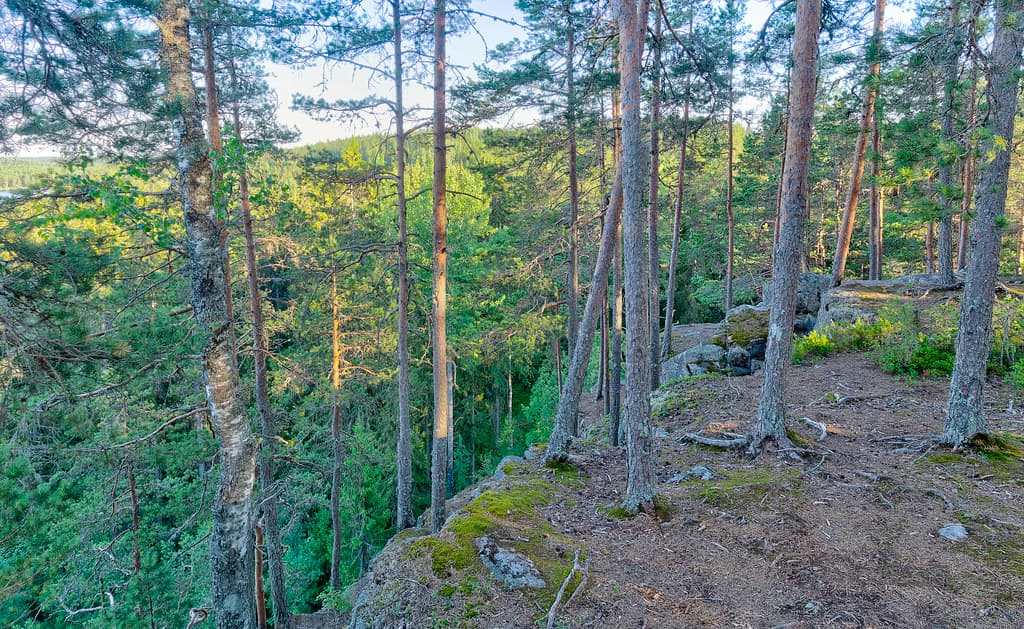
Image of Kuhmoinen Linnavuori. Image source
Visit essentials
A quick read before you go
- Duration
- Around 1 to 1.5 hours round trip from the parking area to the summit and back, including time to…
- Access
- Address: Linnavuorentie, 17800 Kuhmoinen, in the Päijälä village area of Kuhmoinen municipality,…
Overview
Locally called “Finland's Machu Picchu,” Kuhmoinen Linnavuori occupies a rocky promontory about 25 metres above the forest and 45 metres above Lake Saaresjärvi, on the narrow divide from Linnajärvi. Three of four slopes fall almost vertically. The gentler fourth approach was defended by a wooden palisade backed by a low stone wall still traceable today.
The fort belonged to a refuge network built by Häme (Tavastian) communities during centuries of tribal contest, when Häme and Karelian groups disputed this wilderness hunting ground. Its architecture is modest beside larger Häme strongholds, but 1980s excavations recovered roughly 340 objects—an unmatched haul among Finnish hillfort excavations—and found eleven summit cairns whose purpose remains unknown.
Evidence points to fire in the early 1100s, yet occupation continued into the 1200s before final abandonment. Regional heritage researchers have proposed further conflict, but gradual attrition remains possible. Whoever departed never returned for what had been buried, hidden, or lost in the ash.
Why this place is sacred
Most hillforts in Finland yield a handful of finds, if any. Kuhmoinen Linnavuori yielded 340 — spearheads, smithing debris, structural fittings, hearth remains — pulled from a rocky summit no larger than half a hectare.
That imbalance between the site's physical modesty and the density of what it held is the first thing that gives the place its charge: whoever lived and worked here left behind an unusually complete record of daily and martial life, compressed into a small, defensible space between two lakes.
The second source of that charge is the eleven stone cairns scattered across the summit plateau, structures nobody has yet been able to explain. They are not obviously graves, not obviously markers, not obviously anything — and their presence alongside the burned foundations and smithing waste suggests activity that the excavation record captured in fact but not in meaning.
Regional heritage researchers have floated the idea that the community here fought a decisive battle against Karelian or Novgorodian rivals contesting the surrounding wilderness, and that the site's abandonment afterward carried enough weight in local memory to keep it undisturbed for centuries. That is a plausible reading of thin evidence, not a settled account.
What is not in doubt is the setting itself: a rock rising sheer from between two lakes, defensible on three sides by nature alone, chosen — as so many refuge sites of this era were — for what the landscape already offered before a single stone was moved.
A defensive refuge and fortified settlement for Häme (Tavastian) communities during Finland's tribal-conflict era, used for shelter, habitation, and metalworking rather than any ceremonial or devotional function.
First scholarly notice came in Hjalmar Appelgren's 1891 dissertation. The Finnish Heritage Agency's ancient monuments register places main occupation at roughly 1000/1050–1300 CE. Jussi-Pekka Taavitsainen's 1983–1989 excavations produced the definitive artifact record and his subsequent 1990 monograph on Finnish hillforts. Since 2018, the Kuhmoisten kotiseutuyhdistys (local heritage association) has maintained the site under the national Adoptoi monumentti (Adopt-a-Monument) programme, and a wooden staircase to the summit was completed in 2020.
Experience and orientation
The approach begins at a small unpaved parking area off Linnavuorentie, well outside Kuhmoinen's small town centre, in a landscape of forest and lake with no other buildings in sight. The marked trail is short — well under a kilometre — but climbs quickly, and the final stretch uses wooden stairs, built in 2020, that replace what was once a scramble over exposed rock.
At the top, the ground opens into the summit plateau: roughly a hundred metres across, flat enough to walk without difficulty, but ringed on three sides by drops that make the site's defensive logic immediately legible without needing to be explained. The fourth, gentler side is where the stone wall foundations survive, low and half-buried, running for twenty-five to forty metres along the only line an attacker could have used.
Scattered across the plateau are the eleven stone cairns — easy to miss underfoot if you are not looking for them, and just as easy to spend an hour puzzling over once you are.
The view east over Lake Saaresjärvi, and the sense of height above the water — some forty-five metres — gives the site its scenic reputation locally, but the more lasting impression for most visitors is quieter: standing on ground that housed and fed people for two centuries, that burned once, and that was then left alone for roughly seven hundred years before anyone returned to dig.
Interpretive signage stands at the trailhead and near the summit wall remains, installed as part of a regional guided-access project. There is no ticket booth, staffing, or fee; the site is open-access at all times, though the climb is not lit or maintained for winter conditions.
Context and lineage
No founding legend survives in the way it might for a temple or shrine — this was a practical refuge, not a devotional foundation, and its builders left no names.
The strongest historical thread researchers have offered is that Kuhmoinen sat on contested ground between Häme communities and Karelian or Novgorodian groups competing for wilderness hunting rights, and that the fort's eventual burning and abandonment mark the end of that contest at this particular place, though the full sequence of events is not established with certainty.
Kuhmoinen Linnavuori sits within a broader family of Late Iron Age and early medieval refuge hillforts built across the Häme region during the same centuries of contested settlement, though it is distinguished from its peers by the sheer volume of material its excavation produced.
Hjalmar Appelgren(-Kivalo)
Gave the site its first scholarly documentation in an 1891 dissertation, decades before formal excavation began
Jussi-Pekka Taavitsainen
Led the principal 1983–1989 excavations that recovered roughly 340 artifacts and made the site the subject of his landmark 1990 monograph on Finnish hillforts; later served as professor of archaeology at the University of Turku
Kuhmoisten kotiseutuyhdistys (Kuhmoinen Local Heritage Association)
Adopted the site in 2018 under the national Adoptoi monumentti programme and continues its ongoing trail and monument maintenance
Traditions and practice
Historical activity at the site was practical rather than ritual: shelter during raids, day-to-day habitation, and ironworking, evidenced by the smithing debris found in excavation. No offerings, ceremonies, or devotional practices are recorded or implied by the archaeological record.
The Kuhmoisten kotiseutuyhdistys maintains the trail, stairs, and interpretive signage under the Adoptoi monumentti programme, and the site is periodically the subject of regional heritage-outreach articles and guided walks. No festivals or organised events take place on-site.
Walk the perimeter of the summit plateau before crossing it — the sudden drop-off on three sides is easiest to appreciate at the edge, where the ground simply stops. Trace the low stone wall on the northern approach with your eyes rather than your feet, since it is fragile and original.
Spend time near the cairns without expecting an answer; they are one of the site's genuine open questions, and sitting with that uncertainty is arguably the most honest way to engage with the place.
Finnish Iron Age / early-medieval hillfort tradition (Häme region, Baltic-Finnic)
HistoricalThe hillfort belongs to a network of refuge fortifications built by Häme (Tavastian) communities during Finland's centuries of tribal-era conflict, and stands out within that tradition for producing, in excavation, the largest single artifact assemblage recovered from any Finnish hillfort.
Refuge during conflict, day-to-day habitation on the fortified summit, and ironworking/smithing, alongside construction and maintenance of a wooden palisade backed by a stone wall on the only vulnerable approach.
Archaeological and heritage-stewardship tradition (contemporary)
ActiveSince Taavitsainen's 1983–1989 excavations, the site has become a reference case in Finnish hillfort archaeology, and since 2018 it has been formally adopted and maintained by the Kuhmoisten kotiseutuyhdistys under the national Adoptoi monumentti programme.
Ongoing trail and signage maintenance, periodic heritage-outreach writing and guided interpretation, and the 2020 construction of wooden stairs to improve safe public access.
Perspectives and open questions
Interpretation of Kuhmoinen Linnavuori comes almost entirely from archaeology and regional heritage outreach, rather than from any surviving oral or devotional tradition — a reflection of the site's purely defensive origin.
Scholarly perspective
Archaeologists agree the site was a fortified refuge and settlement of the Late Iron Age and early medieval Häme community, exceptional chiefly for the scale of its excavated artifact assemblage. Jussi-Pekka Taavitsainen's 1983–1989 fieldwork and his 1990 monograph remain the reference study, establishing the occupation span, the fire event of the early 1100s, and continued use into the 1200s before final abandonment.
Living and traditional perspectives
No distinct living tradition is attached to the site; it is understood locally as Tavastian (Häme) heritage from the region's tribal-conflict era and is cared for today as a marker of Kuhmoinen's identity by its local heritage association.
Alternative interpretations
No esoteric or mystical interpretive tradition was found in the sources reviewed. The site's popular framing — 'Finland's Machu Picchu' — is scenic and touristic rather than spiritual, drawing on the drama of the rock-between-two-lakes setting rather than any claimed numinous quality.
Open questions
The purpose of the eleven stone cairns on the summit remains unexplained. The precise sequence and cause of the early-1100s fire, and the final circumstances of the site's abandonment sometime in the 1200s, are not fully resolved. The exact nature of the conflict between Häme and Karelian or Novgorodian groups proposed as context for the site's fate is inferred rather than directly documented.
Plan your visit
Access and arrival
Address: Linnavuorentie, 17800 Kuhmoinen, in the Päijälä village area of Kuhmoinen municipality, Pirkanmaa region, roughly 7.5–8 km from Kuhmoinen's church and town centre. A small unpaved parking area with an information sign marks the trailhead; a maintained path and 2020-built wooden stairs lead to the summit. No public transport serves the trailhead directly, so a car is effectively necessary.
No mobile-signal information for the site itself was available at time of writing; given the rural forest-and-lake setting, visitors should not assume reliable coverage and should tell someone their plans before setting out — the nearest settlement with dependable signal and services is Kuhmoinen's town centre, about 8 km away.
No keyholder or booking contact applies, since the site has free, unstaffed, year-round access; no confirmed seasonal closure dates were available at time of writing — check with Kuhmoinen municipality (kuhmoinen.fi) for current conditions before visiting in winter.
No accommodation is available at the site itself. Kuhmoinen's town centre, about 8 km away, has the nearest lodging and services; the wider Päijänne lake district offers additional cottage and hotel options for visitors combining the hillfort with a longer stay in the region.
Respectful visit
No formal requirement. Sturdy, grippy footwear is worth the effort given the steep final approach and exposed rock at the summit.
Unrestricted for personal use.
Not applicable; the site has no tradition of offerings.
Protected under Finland's Antiquities Act (1963) as a nationally significant ancient monument: digging, metal-detecting, or removing any object is illegal without a permit. Stay on the marked trail and stairs, and do not climb on, move, or disturb the stone wall remains or the eleven summit cairns.
The rock faces on three sides of the summit are a real fall hazard, especially in wet or icy conditions; keep to the marked path and stairs. The wall foundations and cairns are protected archaeological structures — do not step on, move, or dig near any stonework.
Location
Map loads as you approach this section.
Pilgrim reflections
A portrait of encounter, not a score
Pilgrims describe what they felt, how present they could become, and whether the place would shape a journey. There are no stars and no ranking of traditions.
No reviewed reflections yet
The first pilgrims can help describe the character of being here.
Share a reflection
Available after an account-backed “Been there.” Every reflection is reviewed before publication.
Nearby sacred places
Explore other sacred places in the region. Proximity does not establish access or travel time; check each place’s guidance.


References
Sources consulted for this page. Source categories describe the publication, not a guarantee that every claim is verified. Traditional accounts and outside interpretations may differ.
- 01Kulttuuriympäristön palveluikkuna — Päijälän linnavuori (KOHDE_ID 291010007) — Museovirasto (Finnish Heritage Agency)officialOfficial national ancient monuments register entry; coordinates, dating, protection status
- 02Päijälän linnavuori — Adoptoi monumentti — Adoptoi monumentti (Monument Adoption Programme, Finnish Heritage Agency / Pirkanmaa regional museum network)officialConfirms stewardship: adopted in 2018 by Kuhmoisten kotiseutuyhdistys (local heritage association) under national Adopt-a-Monument scheme
- 03Päijälän linnavuori — Kuhmoinen kunta — Kuhmoinen municipalityofficialOfficial municipal tourism page; page returned 403 on direct fetch attempt during research but is cited in multiple secondary sources for address and access details
- 04Huomisesta alkaen Kuhmoinen kuuluu Pirkanmaahan — YlenewsConfirms Kuhmoinen's administrative transfer from Central Finland (Keski-Suomi) to Pirkanmaa region effective 1 Jan 2021
- 05Päijälän linnavuori — Wikipedia (Finnish) — Wikipedia contributorsencyclopediaDetailed overview: location, dating, excavation history, physical description
- 06Kuhmoisten Linnavuoren opastus — Maaseutuverkosto (Finnish Rural Network)officialProject documentation on visitor signage/interpretation development, incl. 2020 wooden stairs
- 07Jussi-Pekka Taavitsainen — Wikipedia (Finnish) — Wikipedia contributorsencyclopediaBiography of the archaeologist who led the 1983–1989 excavations; later professor of archaeology, University of Turku
- 08Päijälä hillfort — Wikidata (Q18682486) — Wikidata contributorsencyclopediaStructured metadata cross-check for coordinates
- 09Suomen Machu Picchu – Päijälän linnavuori Kuhmoisissa — Mikko Sees, Retkipaikka.figuideVisitor guide: trail, access, historical framing, local nickname
- 10Päijälä Hill Fort, Kuhmoinen, Finland — SpottingHistorySource contextConcise summary of physical description and dating
- 11Kuhmoisten Linnavuoren mysteeriä ratkomassa — Keski-Suomen Leader-ryhmät / Keski-Suomen maaseutunewsDiscusses open archaeological questions: unexplained cairns, abandonment mystery, Häme–Karelian conflict theory
Share a photo
Help visitors recognize Kuhmoinen Linnavuori. Every submission is reviewed before publication.