Jaca Cathedral
The first Romanesque cathedral in Aragon, still marking the Camino's mountain gateway
Understand sacred places, explore living traditions, and learn how to engage respectfully with Pilgrim Map.
Access has not been verified. Check current local guidance before planning a visit.
Jaca, Huesca, Spain
Read the sources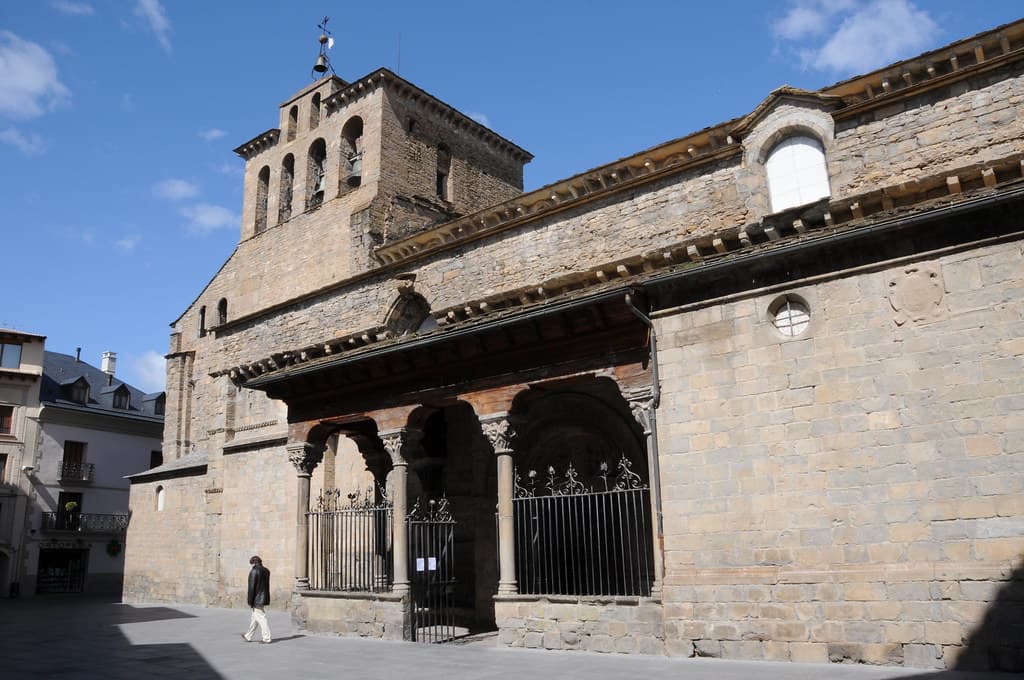
Image of Jaca Cathedral. Image source
Visit essentials
A quick read before you go
- Duration
- 45 minutes to 1.5 hours for the cathedral and chrismon portal; add 1-1.5 hours for the Diocesan…
- Access
- Centrally located at Plaza de la Catedral in Jaca, Huesca province, Aragón; reachable by road…
Overview
Jaca Cathedral was the first Romanesque cathedral raised in Aragon, commissioned by King Sancho Ramírez after he secured episcopal status for Jaca from Pope Alexander II in 1077. Its low, solid form announced a kingdom's arrival as much as it housed a diocese.
The west portal's carved tympanum bears a chrismon—the monogram of Christ—flanked by lions and is likely the earliest carved tympanum surviving in Europe. It staged a rite rather than serving only as decoration: penitents were excluded from the church until Lenten purification, giving the stone liturgical work.
At the high altar are the relics of Santa Orosia, a Bohemian princess locally venerated as protector against affliction. Her cult draws the Jaca valley each June in a way the art-historically important Romanesque stonework no longer does alone; medieval and continuing significance share the nave without competing.
Why this place is sacred
Two claims to sacredness run through this building, and neither depends on the other. The first is architectural and historical: art historians treat Jaca's chrismon tympanum and its ajedrezado jaqués chessboard frieze as prototypes that Romanesque builders carried outward along the Camino, replicated in churches across Aragon and beyond. The cathedral's significance here is as origin point — a place where a visual and liturgical vocabulary was worked out and then exported.
The second is devotional and ongoing: the cathedral is the seat of the Diocese of Jaca, in continuous use for Mass and sacraments, and its high altar holds the relics of Santa Orosia. Her cult did not arrive with the Romanesque builders and has outlasted the period when the chrismon's penitential liturgy was still enacted at the west door. What draws crowds to Jaca each June is not the tympanum but the silver reliquary carried through the streets.
The cathedral's position on the Camino Aragonés threads a third strand through the other two: pilgrims descending from the Somport pass met Jaca first, and the building's role as pilgrim-support hub — hospitals, stamps, shelter — shaped how its architecture and its relics both entered wider circulation.
Sancho Ramírez built the cathedral to seat a bishopric he had just secured from Rome, embedding a royal and ecclesiastical claim into a single structure at the edge of his kingdom's mountain approach.
The Romanesque core, largely complete by the early twelfth century, absorbed Gothic, Renaissance, and Baroque chapels between the fifteenth and eighteenth centuries, including Manuel Bayeu's 1790s apse painting. The building never left liturgical use; its evolution has been one of accretion around a still-functioning cathedral rather than abandonment and rediscovery.
Experience and orientation
The cathedral reads smaller from outside than the history inside it suggests. Visitors and pilgrims consistently single out the west portal first: the chrismon's geometry is plain enough to read at a glance, but staying with it longer surfaces the PAX inscription and the flanking lions, carved with a confidence unusual for a building this early in the Romanesque sequence.
Inside, the nave's alternating cruciform and cylindrical piers set a rhythm that later Gothic and Baroque insertions never quite absorb — the additions sit within the Romanesque frame rather than replacing it. The adjoining Diocesan Museum, housed in the cloister since 1970, holds the Bagüés murals, medieval frescoes often described by visitors as the collection's standout, extending a visit by an hour or more beyond the cathedral itself.
A first visit benefits from starting outside at the chrismon before moving in — the portal is easy to walk past quickly on the way to the door, and its detail rewards a few unhurried minutes. Inside, the museum and cloister require a separate ticket and a slower pace than the nave alone.
Context and lineage
Sancho Ramírez sought and received papal recognition of Jaca as an episcopal see in 1077, and construction of the cathedral began in the same period, around 1076. No firsthand account of the founding ceremony or the identity of the first master builder survives; what remains is the building itself and its consequences — a Romanesque vocabulary that later Aragonese churches along the Camino would echo.
The cathedral has functioned continuously as the seat of the Diocese of Jaca since the eleventh century, its Romanesque core absorbing Gothic, Renaissance, and Baroque additions without interruption of use — a continuity distinct from the many pilgrimage sites whose original function lapsed and had to be reconstructed by later scholarship.
Sancho Ramírez
founder/patron
King of Aragon who secured the diocese's papal recognition in 1077 and commissioned the cathedral's construction.
Santa Orosia (Eurosia)
venerated saint
Bohemian princess venerated as martyr and regional protector; her relics rest at the cathedral's high altar and her annual procession remains the cathedral's most active living tradition.
Manuel Bayeu
artist
Painted the central apse decoration in 1792-1793; brother-in-law of Francisco Goya.
Traditions and practice
The west chrismon portal once staged Lenten penitential liturgy: penitents were symbolically excluded from the church until ritual purification, a rite the carved tympanum was apparently designed to frame. This specific practice has not continued into the present.
Regular Mass and sacraments are administered under the Diocese of Jaca. Each June 25th, a silver reliquary containing Santa Orosia's remains is carried in procession through Jaca's streets, accompanied by cross-bearers, offering-bearers in traditional Aragonese dress, and dancers performing stick and castanet routines, closing with a public display of centuries-old embroidered ceremonial cloaks.
Pilgrims walking the Camino Aragonés typically visit the cathedral on arrival in Jaca, obtain a credential stamp, and use the building as a milestone marking the descent from the Somport pass — a role it has played for travelers on this route for centuries.
Roman Catholicism
ActiveJaca Cathedral is the seat of the Diocese of Jaca, dedicated to Saint Peter the Apostle, functioning as a cathedral since Sancho Ramírez secured episcopal-see status for Jaca from Pope Alexander II in 1077.
Regular Mass, sacraments, and diocesan liturgical functions under the Diocese of Jaca, within the Archdiocese of Pamplona and Tudela.
Camino de Santiago pilgrimage (Camino Aragonés)
ActiveJaca is the principal town on the Camino Aragonés, the branch of the Way of St. James descending from the Somport pass; the cathedral was a key waypoint and pilgrim-support hub, and traveling pilgrims helped carry its Romanesque style and chessboard motif across northern Spain.
Pilgrims traditionally visit the cathedral on arrival, obtain a credential stamp, and historically relied on Jaca's network of pilgrim hospitals.
Veneration of Santa Orosia
ActiveThe cathedral's high altar preserves the relics of Santa Orosia, patron of the Jaca mountains and, by tradition, protector against affliction; her cult draws communities from across the region annually.
An annual procession on 25 June carries a silver reliquary through Jaca's streets, with pilgrims, cross-bearers, offering-bearers in traditional dress, stick and castanet dances, and a closing display of embroidered ceremonial cloaks.
Perspectives and open questions
Jaca Cathedral is read differently depending on whether the lens is art history or living devotion, and the building supports both without needing to resolve them.
Scholarly perspective
Art historians broadly agree that Jaca Cathedral is among the earliest and most influential Romanesque buildings in Spain, functioning as a stylistic export center: its chrismon tympanum, chessboard frieze, and capital-carving vocabulary are treated as prototypes that spread across Aragonese and wider Iberian Romanesque architecture via the Camino de Santiago. Sources differ slightly on construction dates (1076 versus 1077, completion estimates ranging from c.1100 to 1130), likely reflecting distinct building phases rather than genuine contradiction.
Living and traditional perspectives
The relevant living tradition here is local Aragonese Catholic devotional culture, centered on the enduring communal cult of Santa Orosia as regional patron and protector — a framework separate from, and older in local memory than, the art-historical account of the building's Romanesque innovations.
Alternative interpretations
Some writers on Romanesque symbolism read the chrismon's PAX inscription and flanking lions as carrying deeper geometric or numerological programs typical of medieval sacred architecture. This is presented as symbolic theology rather than established art-historical fact.
Open questions
The identity of the cathedral's original master builder and the exact consecration date of the earliest structure are not documented in available sources. Whether the chrismon carving directly influenced later Aragonese chrismons, or merely paralleled a wider regional style, remains an open art-historical question. The cathedral does not hold an independent UNESCO listing; it sits within the broader Camino de Santiago inscription only via its position on the Camino Aragonés.
Plan your visit
Access and arrival
Centrally located at Plaza de la Catedral in Jaca, Huesca province, Aragón; reachable by road and bus from Huesca and Pamplona, and situated on the Camino Aragonés about a day's walk from the Somport pass. The Diocesan Museum is stated to be fully wheelchair accessible.
Respectful visit
Covered shoulders and knees are recommended, particularly during Mass or other services.
Personal photography is generally permitted in the nave; flash and photography may be restricted during active services and inside the Diocesan Museum's fresco rooms, per on-site signage.
No formal offering ritual applies to general visitors; candle-lighting is customary as in most Catholic cathedrals. Traditional embroidered cloaks are offered and displayed specifically during the Santa Orosia festival by devotees.
Museum and cloister access requires a separate ticket (6€ for the permanent collection); avoid visiting purely for sightseeing during active services.
Location
Map loads as you approach this section.
Pilgrim reflections
A portrait of encounter, not a score
Pilgrims describe what they felt, how present they could become, and whether the place would shape a journey. There are no stars and no ranking of traditions.
No reviewed reflections yet
The first pilgrims can help describe the character of being here.
Share a reflection
Available after an account-backed “Been there.” Every reflection is reviewed before publication.
Nearby sacred places
Explore other sacred places in the region. Proximity does not establish access or travel time; check each place’s guidance.

Monastery of San Juan de la Peña
Santa Cruz de la Serós, Huesca, Spain
22.7 km away

Monastery of Leyre
Yesa, Zaragoza, Spain
48.8 km away

Sanctuary of Notre-Dame de Bétharram
Lestelle-Bétharram, Lestelle-Bétharram, Pyrénées-Atlantiques / Nouvelle-Aquitaine, France
67.6 km away
Lourdes Sanctuary
Lourdes, Hautes-Pyrénées, France
71.1 km away
References
Sources consulted for this page. Source categories describe the publication, not a guarantee that every claim is verified. Traditional accounts and outside interpretations may differ.
- 01Jaca Cathedral in Jaca | spain.info — Turespaña (Spanish national tourism board)officialOfficial Spanish tourism authority; confirms founding by Sancho Ramírez, status as first Romanesque cathedral in Aragon and pilgrimage link.
- 02Museo Diocesano de Jaca (MDJ) — official site — Museo Diocesano de Jaca / Diócesis de JacaofficialOfficial diocesan museum housed in the cathedral cloister; confirms 1970 inauguration, Romanesque/Gothic fresco collection including the Bagüés murals, visiting practicalities.
- 03Jaca Cathedral — Wikipedia — Wikipedia contributorsencyclopediaComprehensive overview: history timeline, architecture, chapels, key figures (Sancho Ramírez, Manuel Bayeu), coordinates, current diocesan status.
- 04The Romanesque Tympanum of the Chrismon of Jaca — COMPOSTELA: The Joining of Heaven & EarthacademicDetailed iconographic analysis of the west-portal chrismon: PAX inscription meaning, lions, Lenten penitential liturgy function, claim of earliest carved tympanum in Europe.
- 05The Chrismon of Aragon — COMPOSTELA: The Joining of Heaven & EarthacademicEstablishes Jaca's chrismon as the probable original source/prototype for the wider Aragonese chrismon tradition.
- 06The French Way: Jaca and the Camino Aragonés — Fundación JacobeaspiritualCamino de Santiago pilgrim-support foundation; documents Jaca's role as principal town on the Camino Aragonés and its historical pilgrim hospital network.
- 07Jaca | Romanesque Spain — Romanesque SpainacademicArt-historical resource on Spanish Romanesque; corroborates Jaca's status as dissemination center for Romanesque style and ajedrezado jaqués chessboard motif along the Camino.
- 08The Aragonese Way | Stages and Map | Camino de Santiago — Pilgrim.esguideRoute/stage detail confirming Jaca as largest town on the 152km Camino Aragonés between Somport and Puente la Reina.
- 09Fiestas de Santa Orosia y San Pedro, en Jaca — DescubreHuesca.comguideDescribes the annual 25 June Santa Orosia festival: relic procession, traditional dress, stick and castanet dances, exhibition of embroidered cloaks.
- 10Eurosia — Wikipedia — Wikipedia contributorsencyclopediaBackground on Saint Orosia (Eurosia) legend — Bohemian princess martyred for refusing forced marriage; venerated as protector against affliction/possession.
Share a photo
Help visitors recognize Jaca Cathedral. Every submission is reviewed before publication.