Cairn of Get
A Neolithic threshold between worlds, standing watch over Caithness moorland for five millennia
Understand sacred places, explore living traditions, and learn how to engage respectfully with Pilgrim Map.
Access has not been verified. Check current local guidance before planning a visit.
Ulbster, Scotland, United Kingdom
Read the sources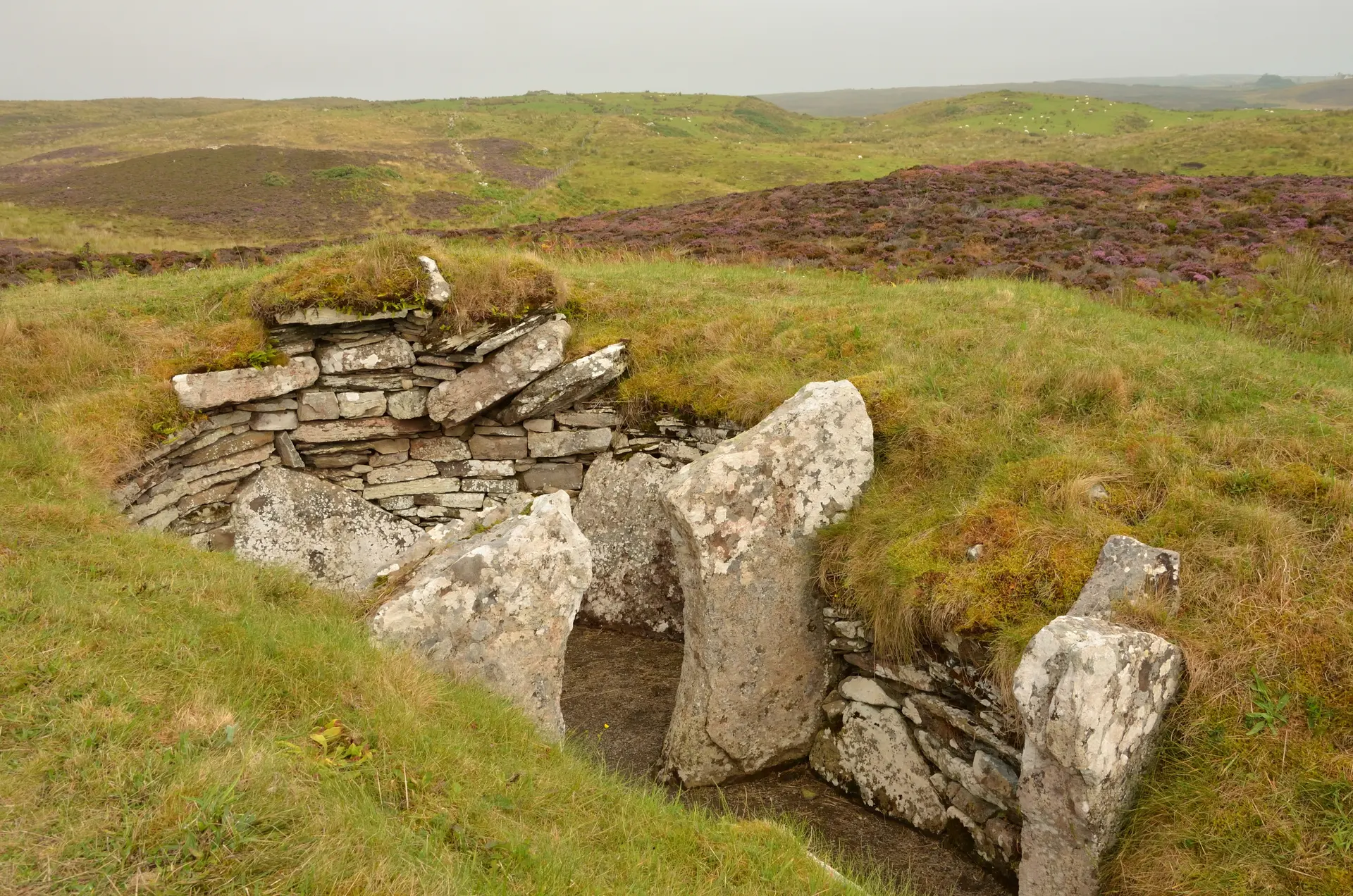
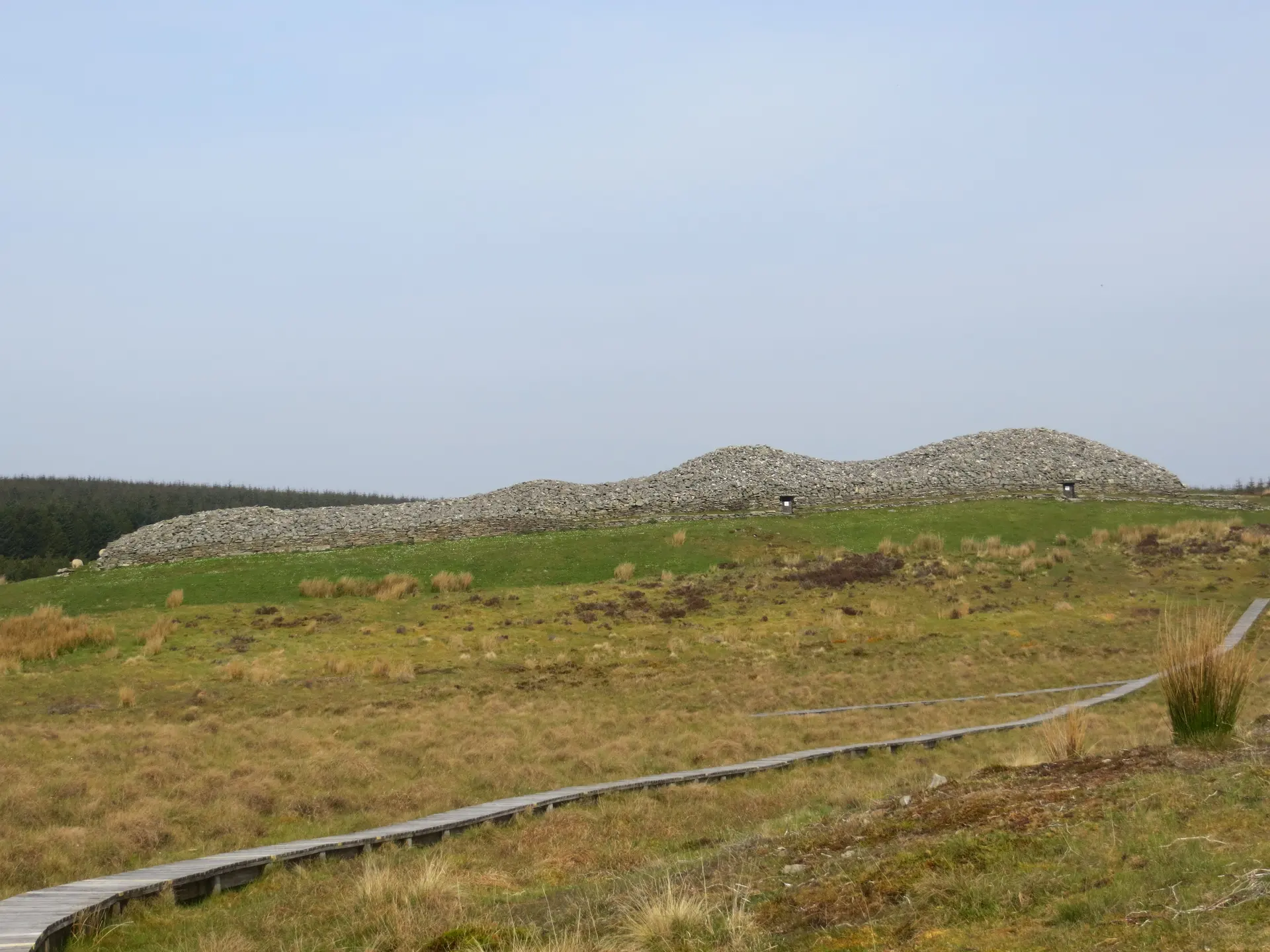
Image of Cairn of Get. Image source · CC-BY-SA-2.0
Visit essentials
A quick read before you go
- Duration
- Two to three hours to explore the cairn thoroughly and investigate the nearby Garrywhin hill…
- Access
- The site lies near Ulbster, Caithness, in the Scottish Highlands.
Overview
Cairn of Get begins with a fifteen-minute walk across boggy moorland, following black-and-white posts through grass and heather without a paved path. Built between 3750 and 2500 BCE, the chambered tomb predates the Egyptian pyramids, Stonehenge in its final form, and the earliest alphabets. Its builders left no written record; their language and beliefs cannot be reconstructed with certainty. Their engineered stone slabs, corbelled roof, standing portal stones, and burial chamber remain accessible to those willing to crawl inside.
Caithness holds one of Britain's densest concentrations of prehistoric monuments. Cairn of Get belongs to a ritual landscape of stone rows, hill forts, brochs, and burial cairns: the Grey Cairns of Camster lie five miles away and Hill o' Many Stanes three miles south. Its enduring construction records Neolithic honour for the dead without claiming beliefs the evidence cannot recover.
Why this place is sacred
The concept of thin places, locations where ordinary and sacred reality seem to interpenetrate, finds particular expression at sites of deep antiquity and intentional construction. Cairn of Get possesses both. The Neolithic communities who built it understood the site as a threshold between worlds, and they engineered that understanding into stone. The portal stones at the entrance created a formal boundary. The narrow passage demanded transition, a literal narrowing before the chamber opened.
The corbelled roof enclosed the space in deliberate darkness.
Time itself contributes to the thinness here. To touch these stones is to touch something older than writing, older than recorded history, older than civilisation as we commonly define it. The hands that placed them belonged to people whose names, languages, and beliefs vanished millennia ago. Yet their intention remains palpable in the careful construction, the considered orientation, the massive investment of labour for the sake of their dead.
The landscape amplifies the effect. Caithness is not gentle country. Wind scours the moorland. Weather shifts without warning. The walk to the cairn cannot be rushed. This enforced slowness, this exposure to the elements, creates a kind of preparation. By the time you reach the monument, you have already stepped outside ordinary time.
Visitor accounts consistently describe the experience as moving, though the precise quality varies. Some report a sense of presence in the burial chamber. Others speak of connection to ancestors, to the long line of humans who have lived and died and been remembered. The unrestored condition of the site engages imagination: you must visualise what once stood here, participate in reconstruction rather than passively receiving a curator's interpretation. This active engagement may itself contribute to the site's power.
Archaeological consensus holds that Cairn of Get functioned as a communal burial monument, a place where the dead were interred and could be accessed by the living. Joseph Anderson's 1866 excavation found remains of at least seven individuals, along with cremated bone fragments, suggesting both inhumation and cremation were practised. The presence of both types of burial indicates complex mortuary rituals whose specific forms remain unknown.
The design of the passage, allowing repeated entry, suggests the dead were not simply deposited and forgotten but remained available for ongoing relationship.
The monument itself evolved over centuries. Initial construction likely created a simple round cairn with a central burial chamber. Later, horn-shaped projections were added to the north and south faces, creating concave forecourts that may have served as gathering spaces for ceremony. This elaboration reflects either changing ritual needs or shifting social organisation. After active use ceased, the cairn stood largely undisturbed until 1866, when antiquarian Joseph Anderson conducted the first excavation.
The site came into state guardianship in 1961 and is now managed by Historic Environment Scotland as a heritage monument.
Experience and orientation
The approach matters. From the small car park, where perhaps three vehicles can fit, you walk. Duckboards help with the wettest sections, but the ground remains uneven, often muddy, requiring attention. The wind is nearly constant at this latitude. Weather may shift while you cross. This is not a site that accommodates haste or demands spectacle. It requires presence.
When the cairn comes into view, it does not overwhelm. This is not a monument designed to impress from distance. Its power reveals itself gradually: the horn-shaped projections creating shallow forecourts, the portal stones still standing at the southern entrance, the rough texture of stones placed by hands five millennia gone. The scale is human rather than monumental. A person could almost mistake it for natural formation, until they look more closely and see the intentionality in every placement.
The entrance passage is narrow, lined with stone walls. You bend, or crawl, depending on your height. This is deliberate architecture, not later collapse. The builders wanted transition, wanted those entering to become smaller, to humble themselves before the dead. Beyond the small square antechamber, portal stones up to 1.3 metres high mark another threshold. The main chamber beyond retains evidence of its original corbelled roof.
This is the space where the dead were placed, where bones accumulated, where Neolithic communities maintained relationship with their ancestors.
Standing in that chamber, you are inside the past in a way that no museum can replicate. The stone is cool. The silence is particular, insulated from the wind outside. Light enters only through the passage you traversed. Whatever you believe or do not believe, the fact remains: this space was built for the dead, and you are standing in it, alive.
Most visitors arrive by car, following the A99 to the signposted turn near Loch Watenan. The small car park includes an information board providing historical context. From there, marker posts guide you across the moorland. Allow at least an hour for the round trip plus time at the cairn itself. Those wishing to explore the wider archaeological landscape, including the nearby Garrywhin hill fort and stone rows, should plan for two to three hours.
The Grey Cairns of Camster and Hill o' Many Stanes can be combined into a half-day circuit of Caithness prehistoric sites.
Context and lineage
The Neolithic communities who built Cairn of Get left no origin narratives, no founding texts. What we know comes entirely from what they constructed and left behind. Beginning sometime around 3750 BCE, they began building chambered cairns throughout Caithness, part of a broader tradition spanning Orkney and the Scottish mainland. These monuments required substantial labour: sourcing and transporting stone slabs, engineering corbelled roofs, constructing passages and chambers to precise specifications.
The investment indicates profound importance, though the specific beliefs motivating such effort remain genuinely lost. Archaeological understanding suggests ancestor veneration was central. In Neolithic society, the dead were not removed from community life but remained present as honoured figures, possibly consulted for wisdom, possibly believed to influence the fertility of land and livestock. The cairns were not merely graves but houses for the dead, places where the boundary between living and departed could be crossed.
The lineage connecting present-day visitors to the Neolithic builders is broken and unrecoverable. No continuous tradition of practice survived the millennia. The beliefs of those who placed their dead in this chamber died with them. What remains is the physical evidence of their devotion, stones arranged with care by people whose names we will never know. The site passed through unknown centuries before entering recorded history. Anderson's 1866 excavation marked its recovery for modern understanding.
State guardianship beginning in 1961 ensured its preservation. Today, the site is managed as heritage rather than active sacred space, though individual visitors may engage with it spiritually according to their own traditions.
Joseph Anderson
Traditions and practice
Original Neolithic practices remain unknown in their specifics. Archaeological evidence indicates both cremation and inhumation were practised, suggesting complex mortuary rituals. The accessible passage design allowed repeated entry, implying ongoing relationship with the dead rather than single deposition. The forecourt areas may have served as gathering spaces for community ceremony. Some researchers speculate about possible solar or seasonal alignments, common in similar monuments, though none have been definitively established for this site.
No established spiritual communities maintain regular practice at Cairn of Get. Some visitors interested in earth-based spirituality or ancestral connection may engage in personal ritual or meditation. The site's remote location and lack of formal programming mean visitors create their own experience. Some contemporary Pagans include Cairn of Get in pilgrimages through Scotland's prehistoric landscape.
For individual seekers, the site rewards unhurried engagement. Allow the walk across the moorland to become a kind of preparation, a transition from ordinary time. At the cairn, take time to observe the construction, the careful placement of portal stones, the engineering of passage and chamber. If moved to enter the burial chamber, do so with awareness of what the space was designed for. Silence and stillness are appropriate.
Some visitors find value in acknowledging the unknown builders, in recognising the unbroken thread of human mortality that connects us across millennia.
Neolithic Ancestor Veneration
HistoricalCairn of Get represents the burial practices of Neolithic farming communities in Caithness, dating from approximately 3750 to 2500 BCE. For these communities, the dead were understood as the most important members of society, honoured with monuments designed to endure beyond any individual lifetime. The cairn functioned as a fixed point in the landscape, an enduring marker of identity, ancestry, and perhaps territorial claim.
The cairn was designed for repeated access, allowing bones to be added, removed, and possibly used in rituals. Evidence of both cremation and inhumation suggests complex mortuary practices whose specific forms remain unknown. The forecourt areas may have served as gathering spaces for community ceremony. The passage entrance design possibly related to solar or seasonal alignments common in similar monuments, though none have been definitively established here.
Orkney-Cromarty Burial Tradition
HistoricalCairn of Get exemplifies the Orkney-Cromarty cairn type, an architecturally distinct form found primarily in northeast Scotland and Orkney. This tradition represents sophisticated understanding of stone construction and ceremonial practice. The short-horned design with forecourts and portal stone entrances reflects cultural connections across the region.
The tomb architecture itself embodied ritual meaning. Paired portal stones created thresholds between the world of the living and the realm of the dead. Horn-shaped forecourts provided gathering spaces for ceremonies. The corbelled roof enclosed the burial chamber in deliberate darkness. The cairn's later elaboration with projecting horns indicates evolution in ritual practice over time.
Perspectives and open questions
Cairn of Get invites interpretation while resisting definitive answers. Archaeological evidence establishes what was built and when, and provides glimpses of how the space was used. But the beliefs that motivated its construction, the ceremonies conducted within its chambers, the cosmology of its builders, all remain genuinely unknown. This uncertainty is not a gap to be filled with speculation but an honest acknowledgment of what time has taken from us.
Scholarly perspective
Archaeological consensus identifies Cairn of Get as a significant example of the Orkney-Cromarty cairn type, a regionally distinct form of chambered tomb found throughout northeast Scotland. Construction occurred during the Neolithic period, roughly 3750 to 2500 BCE. Joseph Anderson's 1866 excavation recovered remains of at least seven individuals, along with cremated bone fragments, pottery, and flint artefacts. Evidence of both cremation and inhumation suggests complex mortuary practices.
The monument's elaboration over time, from simple round cairn to horned structure, indicates evolving ritual needs. Minor excavations in 1985 confirmed earlier findings but noted that limited in situ deposits remained due to nineteenth-century removal. The cairn functioned within a rich ceremonial landscape, suggesting the area was a focal point for settlement and ritual activity throughout prehistory.
Living and traditional perspectives
No indigenous oral tradition survives from the Neolithic builders. The specific beliefs and worldview of those who constructed and used Cairn of Get are lost to history. Comparative archaeology suggests ancestor veneration was central to Neolithic society in Britain and Ireland. The dead were likely understood not as absent but as present in a different mode, accessible through the tombs built to house them, possibly consulted for wisdom, possibly believed to influence the living community's welfare.
But these are inferences from material evidence, not transmitted knowledge.
Alternative interpretations
Some contemporary spiritual practitioners view sites like Cairn of Get as places where the boundary between worlds remains thin. Earth-energy theories propose that ancient peoples sited monuments according to patterns of telluric force. Others see chambered cairns as designed for visionary experience, the darkness and enclosure facilitating altered states of consciousness. These interpretations cannot be proved or disproved; they represent frameworks through which contemporary seekers engage with monuments whose original meaning has been lost.
Open questions
What remains unknown is substantial. We do not know why Neolithic communities chose this particular location for the cairn. We cannot reconstruct the beliefs that motivated centuries of labour. The relationship between cremation and inhumation burials at the site remains unexplained. Whether the monument had astronomical alignments, what role the forecourt areas played in ceremony, how long the cairn remained in active use, all these questions remain open.
The identity of those buried here, their relationships to each other and to the wider community, their names and stories, are irrecoverably lost. What survives is the monument itself: evidence of devotion to the dead that transcended individual lifetimes.
Plan your visit
Access and arrival
The site lies near Ulbster, Caithness, in the Scottish Highlands. From the A99, turn at the signpost near Loch Watenan. A single-track road leads to a small car park accommodating approximately three vehicles. From there, follow marker posts across the moorland for approximately fifteen minutes. Public transport is limited; Stagecoach buses run from Wick and Thurso to Lybster but service is infrequent, especially on weekends. From Lybster, the site is approximately 1.5 miles northeast.
The walking route is not accessible to wheelchairs or those with significant mobility limitations.
Limited accommodation is available in Lybster, including The Portland Hotel and local bed and breakfasts. More options exist in Wick, approximately eleven miles to the northeast. Camping is available at various sites throughout Caithness.
Respectful visit
No specific requirements beyond practical outdoor clothing. Sturdy, waterproof walking boots are essential for the approach across boggy terrain. Wind and rain are common; layered, weatherproof clothing is advisable.
Photography is permitted throughout the site. The remote location and dramatic sky make for atmospheric images. Interior photography of the burial chamber requires a light source.
As a heritage monument, leaving offerings is discouraged. If you feel moved to leave something, ensure it is natural and biodegradable, and will not harm the environment or livestock.
Do not climb on the cairn structure or remove any stones, vegetation, or artefacts. Dogs should be kept under close control due to grazing sheep. The site is accessible year-round but has no lighting; visit during daylight hours.
The site is managed as a heritage monument; leaving offerings is discouraged to preserve its integrity. If you feel called to leave something, ensure it is small, natural, and biodegradable. The burial chamber requires crawling through a narrow passage; those with claustrophobia or mobility limitations may find entry difficult. Be mindful of weather conditions, which can change rapidly at this latitude.
Current practical details
Address
Lybster KW2 6AA, UK
Hours
Hours, fees, and access can change — verify on the official source before you travel. Practical details last checked Jun 2026.
Location
Map loads as you approach this section.
Pilgrim reflections
A portrait of encounter, not a score
Pilgrims describe what they felt, how present they could become, and whether the place would shape a journey. There are no stars and no ranking of traditions.
No reviewed reflections yet
The first pilgrims can help describe the character of being here.
Share a reflection
Available after an account-backed “Been there.” Every reflection is reviewed before publication.
Nearby sacred places
Explore other sacred places in the region. Proximity does not establish access or travel time; check each place’s guidance.
References
Sources consulted for this page. Source categories describe the publication, not a guarantee that every claim is verified. Traditional accounts and outside interpretations may differ.
- 01Cairn o'Get History — Historic Environment ScotlandofficialOfficial Scottish heritage body managing the site
- 02Cairn o'Get Prices and Opening Times — Historic Environment ScotlandofficialOfficial visitor information
- 03Cairn o'Get Getting There — Historic Environment ScotlandofficialOfficial directions and access information
- 04Cairn of Get, chambered cairn — Ancient Monuments UKacademicDetailed archaeological monument record
- 05Cairn o' Get — Caithness Broch ProjectacademicLocal archaeological research organization
- 06The Cairn of Get — Gazetteer for ScotlandSource contextOfficial Scottish geographical reference
- 07Garrywhin — Canmore (Historic Environment Scotland)academicNational Record of the Historic Environment
- 08The chambered cairns of Orkney — Archaeology OrkneyacademicContext on Orkney-Cromarty cairn type
- 09Cairn o' Get, Caithness — Britain ExpressguideHistorical travel guide with archaeological context
- 10Garrywhin Chambered Cairn — The Megalithic PortalencyclopediaComprehensive megalithic sites database
- 11Cairn O Get Reviews — TripAdvisorguideVisitor experience accounts
- 12Cairn O Get Trail — AllTrailsguideTrail and hiking information
- 13Chambered cairn — WikipediaencyclopediaGeneral context on chambered cairn typology
- 14Cairn of Get Index — Caithness Community WebsiteSource contextLocal historical society documentation
Share a photo
Help visitors recognize Cairn of Get. Every submission is reviewed before publication.