Grishneshwar Jyotirlinga
The twelfth jyotirlinga, where a devotee's grief and grace remain in stone
Understand sacred places, explore living traditions, and learn how to engage respectfully with Pilgrim Map.
Access has not been verified. Check current local guidance before planning a visit.
Verul, Maharashtra, India
Read the sources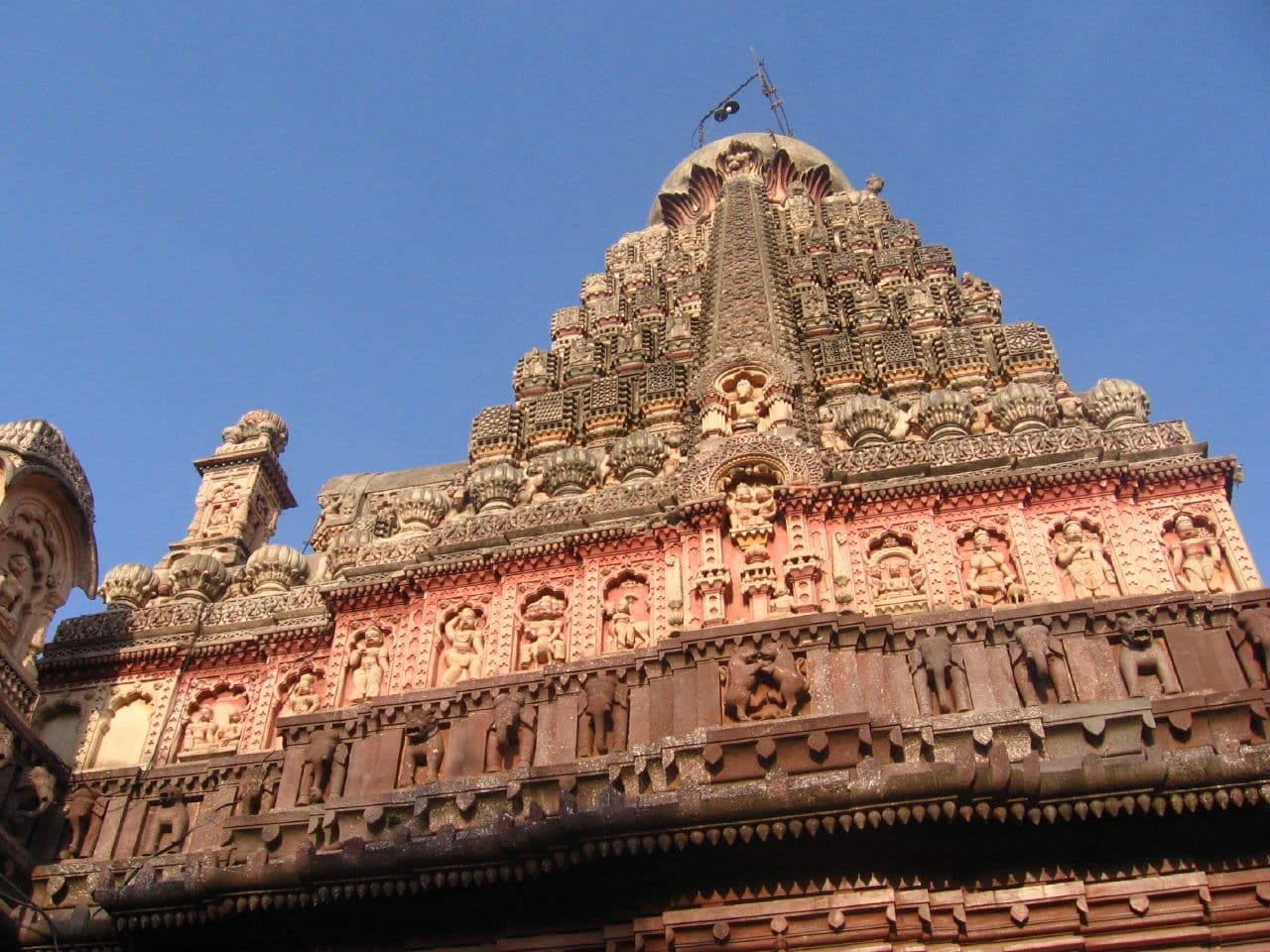
Image of Grishneshwar Jyotirlinga. Image source
Visit essentials
A quick read before you go
- Duration
- 45 minutes to 1.5 hours for darshan; many pilgrims combine the temple with a half-day or…
- Access
- Located in Verul village, approximately 1-1.5 km from the Ellora Caves, about 30 km northwest of…
Overview
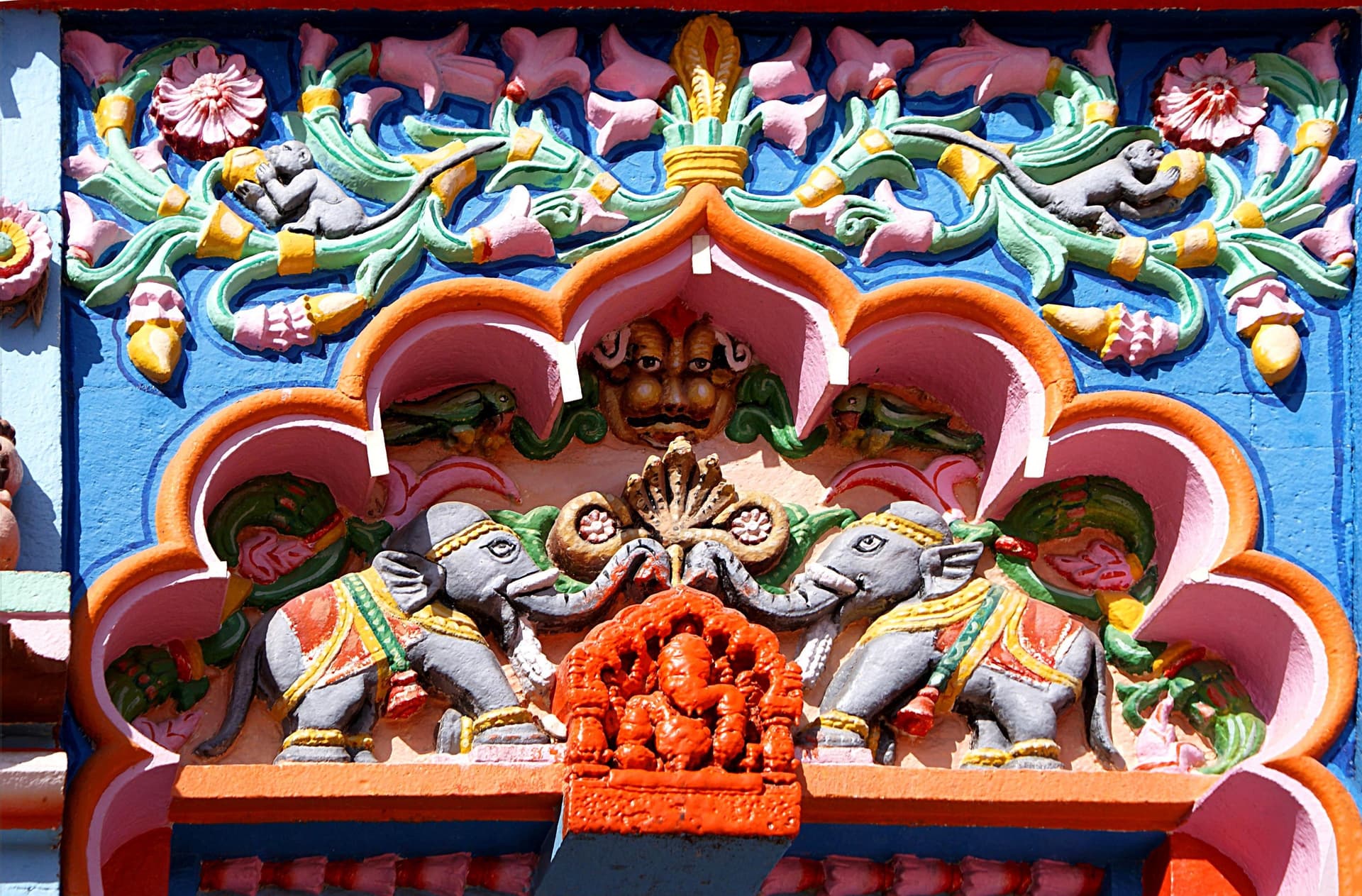
Grishneshwar is both one of Hinduism's most important pilgrimage destinations and one of its least imposing buildings. Its roughly 44,000 square feet of red-black basalt, five-tiered shikhara, and twenty-four-pillared hall are compact by Jyotirlinga standards and almost domestic beside Ellora's vast excavated cliff face one kilometre away. Yet the mandapa is dense with Ramayana and Mahabharata scenes, while abhishekam, low chanting, and the queue sound an active Shaiva temple.
Tradition holds that Shiva manifested as an infinite column of light at twelve jyotirlingas; Grishneshwar is counted twelfth and last. Many pilgrims therefore end a personal circuit here, making it completion rather than one stop among many. The present building is largely an eighteenth-century reconstruction: the older shrine referenced in the Puranas did not survive the medieval centuries intact.
Why this place is sacred
A pilgrim who has spent years or decades visiting the other eleven jyotirlingas arrives carrying eleven encounters with the same divine manifestation. As the twelfth and final temple, Grishneshwar need not be grandest; its established place in the sequence closes something no earlier site can.
Here devotees may also touch the linga during darshan, an intimacy restricted at some other Jyotirlinga shrines. That access recalls Ghushma, who continued worship through unbearable grief until her steadfastness moved Shiva to manifest permanently here. Against the enormous rock-cut caves next door, the temple's small footprint reinforces that sacred consequence is not a function of size.
The site's original purpose, per Puranic tradition, was to mark the place where Shiva rewarded Ghushma's unbroken devotion by manifesting there permanently as a jyotirlinga, so that all future devotees could receive that same presence.
A shrine at this location is referenced across the Shiva Purana and Skanda Purana traditions and is popularly described as over two thousand years old, though no independent archaeological dating of the original structure has been confirmed. The building was destroyed during the Delhi Sultanate period (13th-14th centuries) and again amid later Mughal-Maratha conflict.
Restoration was first undertaken in the 16th century by Maloji Bhosale, grandfather of Chhatrapati Shivaji Maharaj, with the structure standing today generally dated to an eighteenth-century Maratha-era rebuild — sources differ on whether this was completed in 1729 under Gautama Bai Holkar of Indore or credited instead to Rani Ahilyabai Holkar, who is independently documented for rebuilding the Kashi Vishwanath Temple.
Experience and orientation
From Ellora's larger crowds, a short drive or auto ride reaches Verul village and Grishneshwar's gopuram-style entrance. The queue grows dramatically around Mahashivratri and through Shravan's monsoon month but is manageable on an ordinary weekday morning. Remove footwear at the gate.
Inside, the twenty-four-pillared sabha mandapa rewards waiting with Ramayana and Mahabharata carvings. The line narrows toward the east-facing garbhagriha, where men remove their shirts as a condition of approaching the linga, not a general grounds dress code. Devotees may touch the jyotirlinga and, under priest direction, pour water or milk during abhishekam—an intimacy several of the other eleven jyotirlingas do not allow.
Priests keep the line moving without making it feel rushed. Beyond the large sculpted Nandi facing the sanctum, the courtyard restores ordinary light and the temple's small human scale beside the neighboring caves.
Darshan runs approximately 5:30 a.m. to noon and 4 p.m. to 9 p.m., with a midday closure. Weekday mornings outside Mahashivratri and Shravan are markedly calmer than the same hours during those periods. A visit takes 45 minutes to 90 minutes depending on queue length; many pilgrims combine it with a half or full day at the neighboring Ellora Caves.
Context and lineage
The dominant legend, drawn from the Shiva Purana, concerns a devout woman named Ghushma (sometimes rendered Grishna) who lived near the Devagiri hills and who fashioned and worshipped 101 clay Shiva lingas every day as an act of devotion. Her sister-in-law, consumed by jealousy over her piety, murdered Ghushma's son and disposed of the body in the same pond used for the daily ritual. Ghushma, devastated but unwavering, continued her worship without pause.
Shiva, moved by this steadfastness, restored her son to life and, at her request, manifested permanently at that place as the Grishneshwar Jyotirlinga so that all future devotees could receive his presence there. A secondary, less common tradition instead traces the name to Parvati rubbing kumkum into a form that became the linga.
Layered onto this legendary founding is a documented historical arc: the shrine referenced in the Puranas was destroyed during the Delhi Sultanate period in the 13th-14th centuries, restoration began in the 16th century under Maloji Bhosale, and further destruction occurred amid the Mughal-Maratha conflicts before the temple was rebuilt into essentially its present form during the Maratha ascendancy of the 18th century.
Puranic-era shrine (undated, referenced in Shiva Purana and Skanda Purana) → destroyed under Delhi Sultanate rule (13th-14th c.) → 16th-century restoration under Maloji Bhosale → further destruction amid Mughal-Maratha conflict → 18th-century Maratha-era rebuild (Holkar dynasty patronage) that stands substantially as the current structure → 20th-21st century designation as a nationally protected heritage site alongside continuous active worship
Traditions and practice
Worship at Grishneshwar follows standard Shaiva temple practice — daily abhishekam in which the linga is bathed with water, milk, honey, and bilva leaves, accompanied by aarti and the recitation of Puranic verses associated with Shiva. What distinguishes the practice here from several of the other jyotirlingas is direct access: devotees are permitted to touch the linga and, subject to priest guidance and crowd conditions, to personally pour offerings over it rather than observing the ritual performed at a remove.
The temple maintains continuous daily darshan across its two opening periods, with priests managing queue flow that can range from brief on an ordinary weekday to hours-long during Mahashivratri (February or March) and throughout the Shravan month (typically July-August), when observance intensifies markedly.
Visitors arriving without a specific ritual intention are welcome simply to join the darshan queue and observe the pace the temple itself sets — this is not a site designed for lingering outside the queue's rhythm. Those who wish to participate more fully can ask temple priests about performing a personal abhishekam; English-language guidance is inconsistent, and patience with logistics matters more than familiarity with the ritual vocabulary.
Shaivite Hinduism (Jyotirlinga pilgrimage tradition)
ActiveGrishneshwar is venerated as the twelfth and final of the twelve jyotirlingas, the sites where Shiva is held to have manifested as a self-luminous pillar of light to settle a dispute between Brahma and Vishnu over cosmic supremacy. Its position as the last stop in the traditional sequence gives it a completion-oriented weight distinct from the other eleven, and the site is unusual among them in permitting devotees to touch the linga directly.
Daily abhishekam and darshan with direct devotee contact with the linga; priest-led puja; peak observance during Mahashivratri and the Shravan month.
Perspectives and open questions
Grishneshwar can be read as a documented case study in Maratha-era temple restoration, as the emotionally weighted closing point of a twelve-site pilgrimage tradition, or as a devotional site whose modest scale is itself treated as a teaching — three lenses that do not require reconciling.
Scholarly perspective
Historians treat Grishneshwar's documented history as part of a broader pattern of 18th-century Hindu temple reconstruction under Maratha patronage, following a period of repeated destruction under the Delhi Sultanate and during Mughal-Maratha conflict — a pattern most visibly associated with Ahilyabai Holkar's extensive temple-building programme across the subcontinent, though her direct role at this specific site is not conclusively established across sources and remains genuinely disputed rather than settled fact.
Living and traditional perspectives
Within Shaiva devotional practice, Grishneshwar's standing as the twelfth and final jyotirlinga carries a distinct completion-oriented meaning: pilgrims often deliberately sequence a personal, sometimes multi-year pilgrimage to the twelve sites so that Grishneshwar marks the close of that undertaking rather than an arbitrary stop within it.
Alternative interpretations
Some devotional readings treat the Ghushma legend allegorically — the murdered and restored son as a symbol of faith that outlasts grief and betrayal — and read the temple's modest physical scale, set against its high devotional rank, as an illustration that sanctity is not a function of size.
Open questions
The exact date and patron of the current temple structure remain unresolved between sources, with the 1729 rebuild credited to Gautama Bai Holkar in some accounts and a later rebuild credited to Ahilyabai Holkar in others. No independent archaeological dating of the original Puranic-era shrine has been located to corroborate the traditional claim that a shrine has stood on this site for over two thousand years.
Plan your visit
Access and arrival
Located in Verul village, approximately 1-1.5 km from the Ellora Caves, about 30 km northwest of Chhatrapati Sambhaji Nagar (formerly Aurangabad) city, and roughly 11 km from Daulatabad Fort. Reachable by car, taxi, or local bus from Chhatrapati Sambhaji Nagar, which also hosts the nearest airport and major railway station. Darshan is open approximately 5:30 a.m.-12:00 p.m. and 4:00 p.m.-9:00 p.m., with a midday closure.
Chhatrapati Sambhaji Nagar (formerly Aurangabad), about 30 km away, is the standard base for visiting Grishneshwar and Ellora, with a full range of hotels and guesthouses and the nearest airport and rail connections; Verul village itself offers limited lodging oriented to pilgrim traffic.
Respectful visit
Men are expected to remove shirts or vests before entering the garbhagriha (inner sanctum); this is specific to the sanctum rather than the temple grounds generally. Women are advised to wear modest, traditional Indian attire; there is no rigid enforcement outside the sanctum, but modesty is expected throughout.
Cameras and mobile phones are generally not permitted inside the temple interior or sanctum.
Traditional offerings during abhishekam include water, milk, bilva (bel) leaves, and flowers; temple priests can assist visitors in making a formal offering.
Footwear must be removed before entering the temple grounds. Leather items, mobile phones, and cameras are not permitted inside the temple interior. Smoking and alcohol are strictly prohibited anywhere on the premises. Visitors are asked to keep a quiet, unhurried bearing, particularly given how many pilgrims may be moving through the queue at the same time.
Crowds during Mahashivratri and Shravan can be dense enough to make the queue itself the primary experience of the visit; those seeking a quieter encounter should plan for a weekday outside these periods. Because the sanctum permits direct contact with the linga, visitors should follow priest direction closely rather than approach independently.
Current practical details
Address
Ghrushneshwar, Ghrushneshwar Mandir Rd, Ellora, Verul, Maharashtra 431102, India
Phone
Hours
Hours, fees, and access can change — verify on the official source before you travel. Practical details last checked Jun 2026.
Location
Map loads as you approach this section.
Pilgrim reflections
A portrait of encounter, not a score
Pilgrims describe what they felt, how present they could become, and whether the place would shape a journey. There are no stars and no ranking of traditions.
No reviewed reflections yet
The first pilgrims can help describe the character of being here.
Share a reflection
Available after an account-backed “Been there.” Every reflection is reviewed before publication.
Nearby sacred places
Explore other sacred places in the region. Proximity does not establish access or travel time; check each place’s guidance.

References
Sources consulted for this page. Source categories describe the publication, not a guarantee that every claim is verified. Traditional accounts and outside interpretations may differ.
- 01Grishneshwar Temple — Wikipedia — Wikipedia contributorsacademicCoordinates, destruction/reconstruction history (Delhi Sultanate destruction, Maloji Bhosale 16th-century restoration, 1729 rebuild under Gautama Bai Holkar), architecture (Hemadpanthi style, black stone, 44,000 sq ft), etymology, mythology, Puranic textual references, National Protected Monument status
- 02Jyotirlinga — Wikipedia — Wikipedia contributorsacademicConfirms Grishneshwar's place as the 12th and final of the twelve Jyotirlingas; general Jyotirlinga cosmology (Shiva Purana pillar-of-light legend, Brahma-Vishnu dispute)
- 03Visit the Grishneshwar Temple in Chhatrapati Sambhaji Nagar — Incredible India (Ministry of Tourism, Government of India)officialOfficial government tourism listing confirming location, pilgrimage status, and proximity to Ellora Caves
- 04Ghrishneshwar — Department of Tourism, Government of MaharashtraofficialState tourism department official listing of the temple among Maharashtra's protected temple sites
- 05Category:Grishneshwar Temple — Wikimedia CommonsofficialSource category for freely licensed photographs of the temple
- 06Maratha Legacy: Shivaji's Ancestors and Ahilyabai Holkar Restored Grishneshwar Temple — Deccan HeraldSource contextNewspaper coverage citing a sculpture/heritage expert on Maratha-era restoration lineage (Bhosale family and Holkar dynasty involvement); corroborates multi-stage restoration but does not resolve the exact 1729 vs. 1754 date discrepancy
- 07Ghrushneshwar / Grishneshwar Jyotirlinga Temple, Ellora Caves — Timings, Festivals, History, Darshan, Pooja Timings — Trawell.inSource contextDarshan timings, dress code, footwear removal, prohibition on leather/electronics inside sanctum, Mahashivratri festival crowding
- 08Grishneshwar Temple Dress Code & Visitor Rules: A 2025 Guide — Poojn.inSource contextDetails on men required bare-chested in garbhagriha, modest dress for women, no smoking/alcohol on premises
- 09Grishneshwar TempleSource contextSecondary aggregator; used only to cross-check widely repeated details, not as a primary citation for disputed facts
Photo gallery
4 curated photos
Share a photo
Help visitors recognize Grishneshwar Jyotirlinga. Every submission is reviewed before publication.