Kashi Vishwanath Temple, Varanasi, Uttar Pradesh
The jyotirlinga at the centre of the city Shiva is said never to leave
Understand sacred places, explore living traditions, and learn how to engage respectfully with Pilgrim Map.
Access has not been verified. Check current local guidance before planning a visit.
Varanasi, Uttar Pradesh, India
Read the sources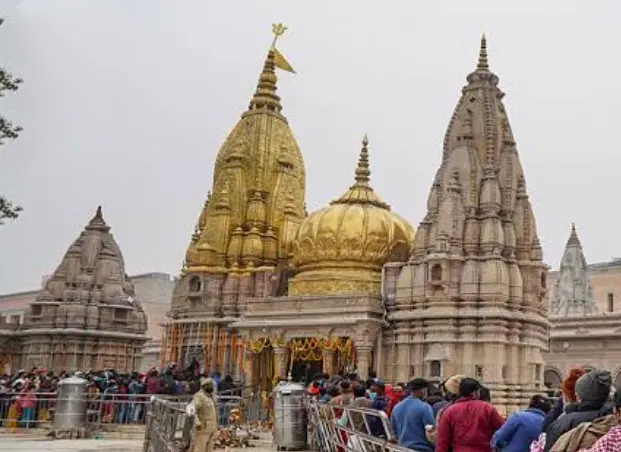
Image of Kashi Vishwanath Temple, Varanasi, Uttar Pradesh. Image source · CC-BY-SA-4.0
Visit essentials
A quick read before you go
- Duration
- Two to four hours on a normal day including queue time; six to ten hours on Mondays in Sawan or…
- Access
- Lal Bahadur Shastri International Airport is 25 km from the temple — about 45 minutes by road.
Overview
Kashi Vishwanath is the jyotirlinga around which Hindu sacred geography pivots. The Shiva Purana says one darshan here carries the merit of visiting all twelve jyotirlingas combined, drawing pilgrims for centuries from across the subcontinent by foot, road, and now air. Its lingam is svayambhu, self-manifested from the earth rather than installed by human hands.
The temple is Maharani Ahilyabai Holkar's 1780 reconstruction beside the Gyanvapi structure on the previous shrine's site. Two gold-plated spires added in 1839 by Maharaja Ranjit Singh catch dawn over Vishwanath Gali.
The surrounding city distinguishes this jyotirlinga. Pilgrims bathe in the Ganga at Dashashwamedh, walk three minutes through narrow lanes to the temple, and find Manikarnika cremation ghat a few minutes beyond. The Shiva Purana holds that Shiva whispers the tarakamantra—the mantra of liberation—into the ear of every person who dies within Kashi's sacred boundary. Darshan after Ganga snana completes a circuit pilgrims have walked, by tradition, for two millennia.
Why this place is sacred
What gives Kashi Vishwanath its weight is geography as much as theology. The jyotirlinga is svayambhu — self-manifested, not installed — and the Shiva Purana names Kashi as the one place Shiva will never abandon, even when the rest of the universe dissolves. The city is said to rest on the tip of his trident, lifted above cosmic dissolution.
Within a few hundred metres of the sanctum stand the Annapurna shrine (Shiva's consort as the goddess of food), the Vishalakshi Shakti Pitha, the Dashashwamedh Ghat where the evening Ganga aarti unfolds, and the Manikarnika cremation ghat where the funeral pyres have not gone out in living memory. The 2021 corridor cleared a five-lakh-square-foot axis connecting the lingam directly to Lalita Ghat on the river — a physical enactment of the ancient pilgrim circuit.
The temple has been destroyed and rebuilt at least four times since 1194, most recently after Aurangzeb's 1669 demolition. To Hindu tradition this is theologically beside the point: the jyotirlinga is the pillar of light, indestructible, regardless of what is built around it.
Worship of Shiva as Vishweshwar — Lord of the Universe — and as the sovereign of Kashi, the moksha-granting kshetra where the dying receive the mantra of liberation.
From the Puranic-era svayambhu shrine to medieval reconstruction cycles, the 1780 Ahilyabai temple, the 1839 gold plating by Maharaja Ranjit Singh, the 1983 takeover by the Uttar Pradesh government, and the December 2021 corridor opening the sanctum onto the Ganga.
Experience and orientation
Most pilgrims arrive at Vishwanath after a Ganga bath at Dashashwamedh or Manikarnika, walking the last 500 metres through narrow lanes where the air thickens with marigold, incense, and the metallic note of bells. The corridor has changed the approach for many visitors — it is now possible to walk a clean axis from Lalita Ghat to the sanctum without entering the old gali — but most experienced pilgrims still take the older path.
Phones, cameras, leather, and bags are deposited at the security counter; the body becomes simpler before crossing the threshold. Inside, the sanctum is intimate and dense. The lingam itself is small — smooth black stone in a silver receptacle — and continuously bathed by the temple priests with milk, curd, ghee, honey, and Ganga water. Bilva leaves accumulate at the base.
Visitors who book a sparsh darshan slot may briefly touch the lingam; most experience the more distant darshan from a few feet away. Visitors describe the Mangala Aarti at 03:00 as the most transporting — pre-dawn cold, the temple lit only by oil lamps, the rhythmic Sanskrit recitation moving the body before the mind catches up. Many report a dissolution of the boundary between pilgrim and place: the city's continuous worship for two thousand years arrives in the room.
Allow extra time. Even on a quiet morning the queue can take two to three hours; on Mondays in Shravan or on Mahashivaratri it can stretch to ten. Plan the visit as one part of a larger Kashi morning that includes Ganga snana, an Annapurna darshan, and a slow walk along the ghats afterward.
Context and lineage
When Brahma and Vishnu argued over which of them was supreme, Shiva appeared between them as an infinite pillar of light — a jyotirlinga. They each set out to find its ends, Brahma rising as a swan and Vishnu descending as a boar. Both failed. Where this pillar first pierced the earth, twelve jyotirlingas manifested. Vishweshwar at Kashi is described in the Shiva Purana as the eternal axis around which the other eleven radiate.
A second tradition holds that Shiva chose Kashi as his permanent home after his marriage to Parvati, calling it the city he would never abandon, and that he whispers the tarakamantra into the ear of every person who dies within the sacred boundary of the kshetra.
The temple is administered by the Shri Kashi Vishwanath Temple Trust under the Government of Uttar Pradesh. Ritual lineage descends from the Pashupata and Kalamukha traditions of medieval Kashi through to the present Smarta and Shaiva pandit families who conduct the daily five aartis.
Maharani Ahilyabai Holkar
Patron and builder of the present 1780 temple after the 1669 demolition
Maharaja Ranjit Singh
Donated approximately 820 kg of gold for the spires in 1839
Raja Todar Mal
Earlier 1585 reconstruction under Akbar's permission
Diana L. Eck
Scholar whose 'Banaras: City of Light' remains the standard academic treatment of Vishwanath and Kashi
Traditions and practice
The five-aarti cycle has been maintained without interruption through the modern era: Mangala Aarti at 03:00, Bhog Aarti at 11:15, Sandhya Aarti at 19:00, Shringar Aarti at 21:00, and Shayan Aarti at 22:30. Rudrabhishek and Maharudrabhishek — extended Vedic recitations with continuous abhishekam — are offered by pilgrims taking specific sankalpa (vows). During Sawan (the month of Shravan), saffron-clad kanwariyas carry Ganga water from collection points along the river to pour over the lingam on each Monday.
Mahashivaratri brings a 24-hour vigil with continuous abhishekam.
The 2021 Vishwanath Dham corridor has shaped contemporary practice. Pilgrims can now walk from Lalita Ghat to the sanctum on a single uninterrupted axis, and the temple trust offers online booking for the Mangala and Shringar aartis through its official portal. Sparsh darshan windows — when the lingam may be touched — are gated and timed. The trust also coordinates the Sawan Mela and Dev Deepawali (Kartik Purnima) celebrations that light the corridor and adjoining ghats.
For a first visit, plan an early-morning Ganga snana at Dashashwamedh followed by darshan at Vishwanath, then a slow walk to the Annapurna shrine adjacent to the temple and the Vishalakshi Shakti Pitha on Mir Ghat. The traditional Kashi morning ends with a quiet moment at Manikarnika. If time and constitution allow, book a Mangala Aarti slot at least a week in advance through the official trust website.
Shaivism — Jyotirlinga Veneration
ActiveKashi Vishwanath houses one of the twelve jyotirlingas — self-manifested pillars of light through which Shiva first revealed his infinite form. In the Shiva Purana, Kashi is the place Shiva will never abandon, where moksha is granted to anyone who dies within its sacred boundary. Vishwanath is the Lord of the Universe and the supreme node in the Saptapuri pilgrimage network.
Abhishekam with Ganga water, milk, honey, curd and ghee; Rudrabhishek recitation; bilva-patra offering; Mangala Aarti at 03:00; Mahashivaratri night-long vigil; Sawan Somvar Mondays of Shravan.
Kashi Yatra and Antyeshti Tradition
ActiveVaranasi is the city where dying grants instant liberation (kashi labha). Vishwanath stands at the symbolic centre of this geography. Pilgrims complete the Panchakroshi Parikrama — a 50-mile circumambulation of Kashi — and end with darshan at Vishwanath. Many elderly Hindus relocate to Varanasi specifically to die within the kshetra and receive the tarakamantra.
Panchakroshi Parikrama; Ganga snana followed by Vishwanath darshan; pind daan at Manikarnika Ghat; antyeshti rites at Manikarnika.
Tantric and Shakta Shaivism
ActiveVishwanath is paired with Annapurna and Vishalakshi (one of the Shakti Pithas), forming a Shiva-Shakti complex at the heart of Kashi. Tantric texts describe the city as Shiva's body itself, with Vishwanath as the head and Manikarnika kund as the navel. The Aghora and Kapalika lineages historically maintained a presence at the cremation ghats nearby.
Shiva-Shakti yugala worship; visits to the Annapurna and Vishalakshi shrines adjacent to Vishwanath; aghori darshan at Manikarnika.
Perspectives and open questions
Vishwanath is held simultaneously as a Puranic axis of cosmic geography, a historically dated 18th-century reconstruction, a tantric mandala of the city, and a politically contested site. These readings do not resolve into a single account; pilgrims and scholars generally let them stand together.
Scholarly perspective
Historians agree the present temple is the 1780 reconstruction by Ahilyabai Holkar on a site adjacent to — not on — the original sanctum, which lies beneath the Gyanvapi structure built by Aurangzeb in 1669. Varanasi shows continuous urban settlement from at least the 8th century BCE, and the Vishwanath cult is attested in Puranic literature by the early medieval period. Diana Eck's 'Banaras: City of Light' remains the standard scholarly treatment.
Living and traditional perspectives
For practising Hindus, the present temple's recent date is theologically irrelevant. The jyotirlinga is svayambhu — self-arisen and indestructible regardless of the structure built around it. The Shiva Purana states that the Kashi jyotirlinga is the original axis from which all twelve radiate. Destruction is read as a test of devotion, not a defeat of the divine.
Alternative interpretations
Tantric tradition maps Kashi onto the human body: Vishwanath at the sahasrara (crown), Annapurna at the heart, Manikarnika at the muladhara. Some Aghora lineages teach that the entire city is a mandala of Shiva's consciousness and that the Panchakroshi parikrama is an outer enactment of an inner kundalini ascent.
Open questions
The depth of the original shrine beneath the Gyanvapi structure remains archaeologically unresolved as of 2026, with ongoing court-ordered surveys. Why this specific bend of the Ganga was chosen as Shiva's eternal home — when the river touches dozens of other holy sites — is a question Hindu tradition answers only through myth.
Plan your visit
Access and arrival
Lal Bahadur Shastri International Airport is 25 km from the temple — about 45 minutes by road. Varanasi Junction and Banaras railway stations are both around 5 km, 20 to 30 minutes by auto. Vehicles cannot enter Vishwanath Gali; pilgrims walk the last 500 m to 1 km from Godowlia Chowk, or approach via the new corridor from Lalita Ghat. Temple opens at 02:30 for Mangala Aarti and closes after Shayan Aarti at around 23:00.
The Shri Kashi Vishwanath Temple Trust does not run pilgrim dharamshalas directly, but a wide range of guesthouses and hotels operate within walking distance — from simple yatri niwas along the lanes to riverfront heritage properties at Assi and Brij Rama ghats. Booking ahead is essential during Sawan, Mahashivaratri, and Dev Deepawali.
Respectful visit
Traditional Indian attire (dhoti-kurta, sari, salwar-kameez) is preferred. Western clothing is acceptable if modest — covered shoulders and knees. Abhishekam sponsorships require men to wear only a dhoti, no upper garment.
Strictly forbidden inside the temple. Mobile phones and cameras must be deposited at the locker counters before entry. Exterior corridor and ghat photography is permitted.
Bilva (bael) leaves, dhatura flowers, milk, Ganga water, honey, curd, ghee, white flowers, and sweets — especially peda. Coconuts, rudraksha mala, and chandan are commonly offered.
No leather items inside the sanctum, no bags, no electronics. Sparsh darshan is limited to specific hours. Separate queues run for general, paid, and senior-citizen darshan. Non-Hindus may be subject to additional security screening.
Crowds during Sawan Mondays and Mahashivaratri are intense and physically demanding. Visitors with claustrophobia, mobility limits, or heart conditions should avoid peak days. Photography inside the temple is strictly forbidden and electronic devices must be deposited; carry only what you can hand over at the counter.
Current practical details
Address
Lahori Tola, Varanasi, Uttar Pradesh 221001, India
Phone
Hours
Hours, fees, and access can change — verify on the official source before you travel. Practical details last checked Jun 2026.
Location
Map loads as you approach this section.
Pilgrim reflections
A portrait of encounter, not a score
Pilgrims describe what they felt, how present they could become, and whether the place would shape a journey. There are no stars and no ranking of traditions.
No reviewed reflections yet
The first pilgrims can help describe the character of being here.
Share a reflection
Available after an account-backed “Been there.” Every reflection is reviewed before publication.
Dates and observances
Upcoming festivals, feast days, and pilgrimages connected to this place. Add any to your calendar, or browse the full observance calendar.
- Add to calendar
Dev Deepawali
Sun, Nov 15, 2026Festival
The "Diwali of the gods" on the ghats of Varanasi; the riverfront steps are lit with lakhs of oil lamps on Kartik Purnima. Date is lunar.
- Add to calendar
Dev Deepawali
Mon, Nov 15, 2027Festival
The "Diwali of the gods" on the ghats of Varanasi; the riverfront steps are lit with lakhs of oil lamps on Kartik Purnima. Date is lunar.
Nearby sacred places
Explore other sacred places in the region. Proximity does not establish access or travel time; check each place’s guidance.



References
Sources consulted for this page. Source categories describe the publication, not a guarantee that every claim is verified. Traditional accounts and outside interpretations may differ.
- 01Kashi Vishwanath Temple — Wikipedia — Wikipedia contributorsencyclopediaComprehensive history including destruction/rebuilding cycles and 2021 corridor
- 02Shri Kashi Vishwanath Temple — Official Website — Shri Kashi Vishwanath Temple TrustofficialOfficial temple trust website with darshan timings, rituals, and aarti schedule
- 03Shri Kashi Vishwanath Dham — Project Page, Government of India — Government of Uttar PradeshofficialOfficial tourism information including the corridor project
- 04Jyotirlinga — Wikipedia — Wikipedia contributorsencyclopediaCanonical list of twelve jyotirlingas and their order
- 05Banaras: City of Light — Diana L. EckacademicStandard scholarly work on Varanasi's sacred geography and the Vishwanath cult
- 06Kashi Vishwanath Dham Corridor Inaugurated — The HindunewsDecember 2021 inauguration of the 5-lakh-sq-ft corridor
- 07The Temples of India — Krishna DevaacademicArchitectural and historical analysis of major Hindu temples including Kashi Vishwanath
- 08Kashi Vishwanath Temple — Uttar Pradesh Tourism — Uttar Pradesh Tourism DepartmentguideVisitor guide with timings, etiquette, and access
Photo gallery
3 curated photos
Pilgrim glossary
- Mandala
- A symbolic diagram of the cosmos used in meditation and ritual.
- Mantra
- A sound, word, or phrase repeated as part of meditation or ritual.
Share a photo
Help visitors recognize Kashi Vishwanath Temple, Varanasi, Uttar Pradesh. Every submission is reviewed before publication.