Great Zimbabwe
Stone testimony to African civilization, rising from granite hills where ancestors still watch
Understand sacred places, explore living traditions, and learn how to engage respectfully with Pilgrim Map.
Access has not been verified. Check current local guidance before planning a visit.
Nemanwa Growth Point, Masvingo, Zimbabwe
Read the sources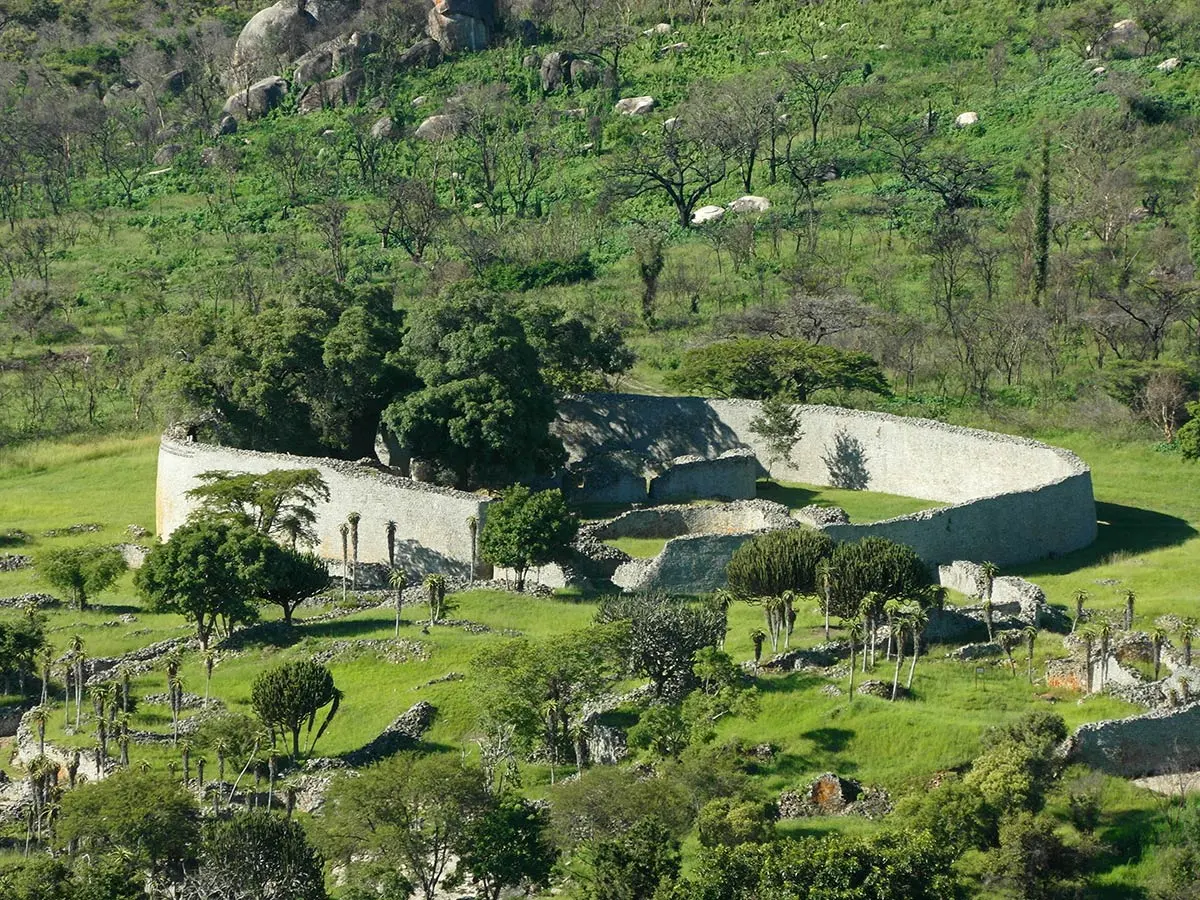
Image of Great Zimbabwe. Image source · CC-BY-SA-4.0
Visit essentials
A quick read before you go
- Duration
- A thorough visit requires 2-4 hours.
- Access
- Great Zimbabwe is located approximately 30 km from Masvingo, in Masvingo Province.
Overview
The stones speak a truth that colonizers spent centuries trying to silence. Rising from the granite hills of southeastern Zimbabwe, these walls—built without mortar, fitted with precision that has endured a millennium—are testimony to what African civilization achieved while Europe still languished in its Dark Ages.
Great Zimbabwe was the heart of a kingdom that controlled gold trade routes stretching to the Swahili coast and beyond, its reach extending to China and Persia. The Shona ancestors who built these structures understood something about stone, landscape, and the relationship between earthly power and spiritual authority. The Hill Complex rises on a natural granite outcrop, its walls echoing the rock's contours. The Great Enclosure below, with its mysterious Conical Tower, remains the largest ancient structure in sub-Saharan Africa.
Colonial claims that Africans could not have built the city persisted even after archaeological refutation; liberation movements reclaimed the houses of stone as their symbol and the new nation's name.
Something persists here beyond architecture. Local Shona people speak of spirits guarding the ruins. The soapstone birds that once watched from the Hill Complex—messengers between human and divine realms—now appear on Zimbabwe's flag, its currency, its national identity. You walk through history here, but also through something present. The ancestors, according to tradition, have not left.
Why this place is sacred
The Shona who built Great Zimbabwe did not separate the political from the sacred. Their kings were intermediaries with the spiritual realm. The Hill Complex, perched on its granite outcrop, served both as royal residence and ritual center—a place where communication with Mwari, the supreme deity, and with ancestral spirits could occur. The soapstone bird carvings found there likely represented messengers between worlds, perhaps depicting the bateleur eagle that Shona tradition holds sacred as Mwari's emissary.
The site's placement was not accidental. Granite kopjes rise from the landscape like natural altars, and the builders incorporated these formations into their walls, creating a continuity between stone-as-found and stone-as-shaped. Water sources emerge from the rock. The relationship between built structure and natural feature suggests a cosmology that understood landscape itself as alive, as participant in sacred relationship.
For the kingdom's inhabitants, this was a thin place—a point where the boundary between the visible and invisible worlds grew permeable. Rainmaking ceremonies, ancestor veneration, consultation with spirit mediums: these practices connected the community to powers that ensured fertility, prosperity, and protection. The Great Enclosure, with its Conical Tower rising from within, may have symbolized fertility and abundance, though scholars continue to debate its precise meaning.
The colonial attempt to deny African origin adds another dimension to the site's thinness. Something in Great Zimbabwe resisted erasure—not just the stones themselves, but the truth they embodied. For visitors today, particularly those of African descent, walking these grounds can be an experience of ancestral reclamation, of touching what centuries of distortion could not destroy. The spirits that local tradition says guard the ruins seem to guard something larger: the memory of what was built, and who built it.
Archaeological evidence indicates that Great Zimbabwe served as the capital of the Kingdom of Zimbabwe from approximately the 13th century onward. The site combined political, economic, and religious functions in ways that resist our modern separations. The Hill Complex appears to have been the ritual and residential center, where kings performed ceremonies and maintained relationships with ancestral spirits. The Great Enclosure likely served as a royal compound, perhaps housing the king's wives or serving ceremonial purposes.
The Valley Ruins accommodated the broader population of this city of 10,000 to 20,000 people. Trade in gold, ivory, and other goods connected the kingdom to international networks reaching the Swahili coast, the Indian Ocean, and beyond.
Settled from around 1000 CE, Great Zimbabwe reached its height in the 13th and 14th centuries before declining in the 15th century—likely due to resource exhaustion, overpopulation, or shifting trade routes. The Portuguese learned of the ruins in the 16th century but never visited. Local Shona communities knew the site throughout the centuries that followed, continuing to farm nearby lands while the ruins themselves became enveloped in vegetation.
European colonizers arrived in the 1890s, bringing with them a racism so thorough that it could not accept African achievement. The myths they constructed—Phoenician builders, King Solomon's gold—served to justify colonial exploitation. When archaeologist David Randall-MacIver confirmed African origin in 1905, and Gertrude Caton-Thompson reconfirmed it in 1929, colonial authorities worked to suppress the findings.
The liberation movements that emerged in the mid-20th century reclaimed Great Zimbabwe as a symbol of African capability and dignity. At independence in 1980, the new nation took its name from these ruins—'Zimbabwe' meaning 'houses of stone' in Shona. The site's meaning had evolved from capital to ruin to contested symbol to national sacred ground. Today, as UNESCO World Heritage Site and repository of national identity, Great Zimbabwe holds layered significances that continue to accumulate.
Experience and orientation
The first encounter is often visceral. The walls themselves—rising to 11 meters in places, built of precisely fitted granite blocks without a trace of mortar—command respect that transcends cultural background. This is architecture that has stood for nearly a thousand years, constructed with a technique so refined that the stones need only gravity and precision to hold. Your hand wants to touch them, to feel what has endured.
Climbing the Hill Complex places you where the kingdom's spiritual and political life centered. The views from here extend across the valley to distant kopjes. The Eastern Enclosure, where the soapstone birds were found, holds a quality of enclosure that visitors often describe as sanctuary-like. Whether or not you subscribe to traditional beliefs, there is something about standing where royal ceremonies once occurred that invites a pause, a listening.
The Great Enclosure below offers a different experience. Walking through the narrow passage between its double walls, visitors often speak of feeling held, channeled, processed through space in a way that feels intentional. The Conical Tower rises from within, its purpose uncertain but its presence undeniable. Some see phallic symbolism; others, a grain store rendered monumental; others, something we lack vocabulary to name. The uncertainty is part of the experience—a reminder that we approach mysteries, not solved puzzles.
For visitors of African descent, Great Zimbabwe frequently provokes profound emotional responses. To touch stones that ancestors carved, to walk where they walked, to encounter physical proof of what racist narrative denied—this can be transformative in ways that surprise even skeptical travelers. The reclamation is personal before it is political.
The on-site museum, displaying replicas of the Zimbabwe Birds (most originals were looted by colonizers), adds context but also grief. The originals scattered across European collections represent a theft that continues. When visitors see the bird on Zimbabwe's flag and then encounter its source, something clicks into place about how symbols acquire power and how their absence wounds.
Great Zimbabwe rewards those who arrive early, when the morning light falls across the granite and the site has not yet filled with tour groups. The Hill Complex is physically demanding—steep stairs and rocky terrain require sturdy shoes and reasonable fitness—but reaching the Eastern Enclosure before the heat of midday makes the effort worthwhile.
Consider approaching the site as the Shona understood it: as a place where ancestors dwell, where the boundary between visible and invisible thins. You need not hold this as literal belief; holding it as orientation shifts how you move, how you listen, what you notice.
The Great Enclosure invites slowness. Walk the outer wall's full circumference before entering. Let the scale register. When you pass through the passages, attend to how the space shapes your movement. At the Conical Tower, resist the urge to immediately explain it. Sit with not-knowing.
If possible, stay overnight in the area and return for a second visit. The first day handles the logistics of navigation, the photo impulses, the initial overwhelm. The second day allows something subtler to emerge—a relationship with the site rather than just an encounter with it.
Context and lineage
The Shona people trace their presence in this land back centuries. Their ancestors arrived as part of the great Bantu migrations, eventually settling in what is now Zimbabwe and establishing communities that would grow into kingdoms. The name itself—Zimbabwe, from 'Dzimba-dza-mabwe,' meaning 'houses of stone'—tells you what they built and why it mattered.
Great Zimbabwe began as a settlement around 1000 CE, growing over centuries into a city that at its height housed perhaps 20,000 people. The Hill Complex, the oldest section, took shape in the 11th to 13th centuries. The Great Enclosure followed in the 13th to 15th centuries, its walls representing the refined culmination of the zimbabwe tradition of dry-stone construction.
The kingdom that ruled from here controlled the gold trade that connected African interior to Swahili coast to Indian Ocean to China and Persia. Wealth flowed through these walls—and with wealth, power, and the religious authority to maintain it.
The decline came in the 15th century. Perhaps the land could no longer support such a population. Perhaps trade routes shifted. Perhaps political upheaval fractured the kingdom. The reasons remain debated. What is clear is that by the time Portuguese traders learned of the ruins in the 16th century, the city had been abandoned. Local communities knew of it, continued to farm nearby lands, but the great buildings stood empty.
When European colonizers arrived in the late 1800s, they brought assumptions that would shape interpretation for nearly a century. Africans, in their view, could not have built such structures. So they invented alternatives: Phoenician merchants, King Solomon's mines, lost white civilizations. These myths served colonial ideology, justifying the theft of land and resources from people deemed incapable of civilization.
Archaeologists David Randall-MacIver in 1905 and Gertrude Caton-Thompson in 1929 definitively established African origin. The colonial government suppressed or minimized their findings. It was not until independence in 1980 that Great Zimbabwe could fully claim its rightful place as testimony to African achievement. The new nation's name was its answer to centuries of denial.
From the 13th to 15th centuries, the Kingdom of Zimbabwe ruled from this capital, its power extending across a vast territory. The ruling dynasty—whose names are largely lost to us, oral history having been disrupted by colonization—combined political authority with religious function. Spirit mediums, royal ceremonies, and ancestor veneration wove together the fabric of governance.
When the kingdom declined, successor states emerged: the Torwa dynasty at Khami, the Mutapa state to the north. The zimbabwe tradition of stone building continued in these successor states, each adapting the architectural vocabulary to new circumstances.
The colonial period brought rupture. Richard Hall's destructive 'restoration' in 1902 removed vast quantities of archaeological evidence in his zeal to find proof of non-African builders. What he destroyed can never be recovered. The looting of soapstone birds scattered the site's most sacred objects across European collections.
Since independence, Great Zimbabwe has been reclaimed as national heritage. UNESCO inscription in 1986 brought international recognition. Ongoing conservation work, supported by UNOPS and UNESCO, addresses the damage of centuries. The site now serves as pilgrimage destination, tourist attraction, and national symbol—layers of meaning accumulating around the original stones.
Mwari
deity
The supreme deity or creator god in Shona tradition. Mwari is understood as the source of all life, communicating through oracles and spirit mediums. Great Zimbabwe was likely a center of Mwari worship, and the tradition continues today, particularly at Matobo Hills.
Vadzimu
deity
Ancestral spirits who mediate between the living and Mwari. The Shona maintain relationships with vadzimu through offerings and ceremonies. At Great Zimbabwe, royal ancestors would have held particular significance.
The Mhondoro
deity
Spirits of dead clan founders and kings who watch over their descendants. The rulers of Great Zimbabwe would have been connected to mhondoro upon death, joining the spiritual hierarchy that protected the Shona people.
Gertrude Caton-Thompson
historical
British archaeologist whose 1929 excavation definitively confirmed the African origin of Great Zimbabwe. Her work refuted racist colonial theories but was politically suppressed for decades.
Traditions and practice
During the Kingdom of Zimbabwe's height, religious practice would have been woven into daily life. Rainmaking ceremonies, known as mukwerera, addressed Mwari through ritual and offering, seeking the rains essential for agriculture and prosperity. Spirit mediums, or svikiro, served as bridges between the physical world and the realm of ancestors and deity. The king, or Mambo, held religious as well as political authority, performing ceremonies that maintained the kingdom's relationship with spiritual powers.
The soapstone birds found at the Hill Complex likely served ritual purposes, representing the connection between earthly and divine realms. Some scholars suggest they depict the bateleur eagle, which Shona tradition holds sacred as a messenger of Mwari. Others propose the African fish eagle. The birds' exact meaning remains debated, but their placement in the Eastern Enclosure—apparently a ritual space—indicates their ceremonial significance.
Offerings to Mwari and ancestral spirits would have included grain, beer, and other gifts. The reciprocal relationship between human community and spiritual powers required maintenance through regular practice. When that maintenance failed—through neglect, improper behavior, or loss of harmony—misfortune could follow.
The Kingdom of Zimbabwe fell centuries ago, but Shona religious tradition continues as a living practice. Mwari worship remains active, centered particularly at the Matonjeni sanctuary in Matobo Hills, where rainmaking ceremonies still occur and where Mwari's voice is said to emerge from the rocks. Spirit mediums continue to serve Shona communities, maintaining connection with ancestral wisdom.
At Great Zimbabwe itself, active ceremony is limited. The site is managed as a national monument rather than an active temple. However, some Shona people continue to regard it as sacred ground, visiting to connect with ancestors. The site is used for national celebrations and cultural events, adding new layers of meaning to old stones.
The annual return of descendants to pay respects to their heritage constitutes a form of pilgrimage. For Zimbabweans and members of the African diaspora, visiting Great Zimbabwe can be an act of spiritual and cultural reclamation—touching what colonialism could not erase.
If you come seeking more than history, consider these approaches.
Before entering, pause at the threshold. Acknowledge that you are entering a place that holds meaning beyond the archaeological. Whether or not you subscribe to traditional beliefs, approaching with respect opens possibilities that approaching as mere tourist forecloses.
At the Hill Complex, find a quiet moment in the Eastern Enclosure, where the soapstone birds once stood. Sit with the absence. Consider what it means that the originals were taken, that the nation had to reclaim its own symbols. Notice what arises when you stay with this history.
At the Great Enclosure, walk slowly. Let the walls shape your movement. At the Conical Tower, resist easy explanation. Hold the mystery rather than solving it.
If you come from the African diaspora, this visit may carry particular weight. Allow space for whatever emotions arise. The stones have witnessed much. They can hold whatever you bring.
Shona Traditional Religion (Chivanhu)
ActiveGreat Zimbabwe was the political and spiritual heart of a major Shona kingdom. Shona traditional religion centers on Mwari (the supreme creator) and the vadzimu (ancestral spirits). The Hill Complex served ritual functions, likely including communication with Mwari and ancestor veneration. The kingdom's rulers combined political and religious authority, performing ceremonies that maintained cosmic balance. The soapstone bird carvings likely represented messengers between human and divine realms. While Great Zimbabwe itself is now a heritage site, Shona religious practice continues actively in the region, particularly at Matobo Hills.
Traditional practices included mukwerera (rainmaking ceremonies), offerings to Mwari and ancestral spirits, and consultation with spirit mediums (svikiro). The king controlled religious rituals that maintained harmony between the community and spiritual powers. Today, these practices continue in Shona communities, with Matobo Hills serving as the primary center for Mwari worship. Spirit mediums remain active, maintaining connection between living and ancestral realms.
Pan-African and National Identity
ActiveGreat Zimbabwe became a powerful symbol for African liberation movements, representing proof of sophisticated precolonial African civilization that directly contradicted racist colonial narratives. At independence in 1980, Zimbabwe took its name from the site. The soapstone bird carvings were adopted as national symbols, appearing on the flag, coat of arms, and currency. For Zimbabweans and the African diaspora, the site holds sacred significance as testimony to what Africa achieved and what colonialism tried to deny.
Visiting Great Zimbabwe serves as cultural pilgrimage for Zimbabweans and members of the African diaspora seeking connection with ancestral heritage. The site hosts national celebrations and cultural events. Educational programs emphasize African achievement and the restoration of history from colonial distortion. The return of looted artifacts, including the original Zimbabwe Birds, remains an ongoing concern.
Perspectives and open questions
Great Zimbabwe invites interpretation from multiple angles: archaeological, traditional Shona, pan-African, and contemporary. Each perspective illuminates something genuine, and honest engagement requires holding them together without forcing resolution. The site is large enough—in physical scale and historical weight—to contain these different understandings.
Scholarly perspective
Archaeological consensus establishes beyond doubt that Great Zimbabwe was built by the Bantu-speaking ancestors of the Shona people between the 11th and 15th centuries. David Randall-MacIver's 1905 investigation and Gertrude Caton-Thompson's 1929 excavation definitively refuted colonial-era attributions to Phoenicians, Egyptians, or other non-African builders. Radiocarbon dating, artifact analysis, and architectural comparison with other Zimbabwe-tradition sites confirm the indigenous African origin.
The site is understood as having served political, economic, and religious functions for the Kingdom of Zimbabwe, a major trading state that controlled gold routes to the Swahili coast. At its height in the 13th-14th centuries, the city housed 10,000-20,000 people. The dry-stone construction technique—granite blocks fitted without mortar, each course slightly recessed for stability—represents sophisticated engineering. The decline in the 15th century was likely due to resource depletion, population pressure, or trade route shifts.
Debate continues about specific interpretations. The Conical Tower's purpose remains uncertain: grain storage symbolism, fertility representation, phallic monument, or royal authority symbol are all proposed. The exact rituals performed at the Eastern Enclosure, where the soapstone birds were found, can only be inferred. Much archaeological evidence was destroyed by Richard Hall's 1902 'restoration,' which removed stratified deposits in search of evidence supporting non-African origin theories.
Living and traditional perspectives
For the Shona people, Great Zimbabwe is sacred ancestral ground—the place where their forebears built a civilization that endured for centuries. The site connects the present generation to the mhondoro (spirits of royal ancestors) and to the vadzimu (family ancestors) who preceded them. Traditional understanding holds that spirits continue to guard the ruins, that the soapstone birds represented messengers between human and divine realms, and that the site remains a place of power despite its abandonment as a living city.
This perspective does not conflict with archaeological findings but adds dimensions that excavation cannot measure. For traditional practitioners, the question is not only what was built and when, but what relationship the living maintain with the ancestors who built it. Great Zimbabwe's significance is not merely historical but present—a place where connection with ancestral wisdom remains possible.
The Mwari cult, which likely centered at Great Zimbabwe during the kingdom's height, continues today in the Matobo Hills region. Spirit mediums still serve Shona communities. The practices have adapted to new circumstances—including the disruption of colonialism and the reconfigurations of independence—while maintaining continuity with what was practiced at Great Zimbabwe centuries ago.
Alternative interpretations
Great Zimbabwe has drawn alternative interpretations since Europeans first encountered it. Colonial-era theories—Phoenician builders, King Solomon's mines, Atlantean refugees—have been thoroughly debunked but persist in some fringe literature. More recent alternative perspectives include suggestions of astronomical alignments or sacred geometry, though these lack systematic verification.
Some contemporary spiritual seekers describe Great Zimbabwe as an 'energy site' or 'power place,' reporting experiences of unusual presence or clarity. These reports parallel what visitors describe at other sites considered sacred, though the language of 'energy' is not traditional to Shona understanding.
For visitors of African descent, particularly from the diaspora, Great Zimbabwe often serves as a site of spiritual homecoming—a pilgrimage to ancestral ground that colonialism tried to sever them from. This experience, while personal rather than traditionally religious, carries its own form of sacredness.
Open questions
Genuine mysteries persist. Why exactly was Great Zimbabwe abandoned in the 15th century? What specific ceremonies were performed at the Eastern Enclosure where the soapstone birds stood? What was the precise meaning and function of the Conical Tower? Did the builders intend astronomical alignments, and if so, which ones?
The soapstone birds themselves raise unresolved questions. Do they represent the bateleur eagle, the African fish eagle, or a composite spiritual being? Were they clan totems, royal symbols, or representations of messenger spirits? The eight birds found at the site show variations that may indicate different meanings or periods of creation.
How much was lost to Richard Hall's destructive 1902 'restoration'? What might the archaeological record have told us that now can never be known? What oral traditions were disrupted by colonialism, and how complete is our understanding of what Great Zimbabwe meant to those who built and inhabited it?
These uncertainties deserve preservation. They keep the site alive to questioning rather than pinned down by false certainty.
Plan your visit
Access and arrival
Great Zimbabwe is located approximately 30 km from Masvingo, in Masvingo Province. From Masvingo, taxis and organized tours provide transport to the site. From Harare, the distance is approximately 300 km (4-5 hours by road). From Bulawayo, approximately 290 km. Tour operators including This and That Safaris and Black Rhino Safaris offer day trips and multi-day itineraries.
Entry fees are approximately US$5 for Zimbabwean residents and US$15 for non-residents. Children pay reduced rates. Guided tours are available for approximately US$10 per person and are recommended for the depth of interpretation they provide. The on-site museum is included in entry fees.
The Great Zimbabwe Hotel is located minutes from the ruins, offering convenient access for those wishing to visit early morning or multiple times. Additional accommodation is available in Masvingo, 30 km away. For those combining Great Zimbabwe with Matobo Hills, planning an overnight in the Bulawayo area allows time for both sites.
Respectful visit
No formal dress code exists, but practical clothing is essential. Comfortable walking shoes with good grip are necessary—the terrain includes uneven surfaces, steep stairs, and areas that may be slippery. The Hill Complex requires physical exertion; dress for movement and the weather. Respectful attire appropriate to a site of cultural significance is advisable; overly casual beach wear or revealing clothing may be viewed as disrespectful by local visitors.
Personal photography is permitted throughout most of the site. Tripods and professional equipment may require advance arrangement. Drones are typically prohibited or require special permits. Flash should not be used in enclosed spaces. Be present before being productive—the site deserves direct attention, not just mediated encounter.
Physical offerings are not appropriate within the archaeological site. If you wish to offer something, make it internal: a moment of silence, a prayer, an acknowledgment of those who built and those who protect. If ceremony with physical offerings is important to your visit, it should be arranged separately and appropriately, not within the monument itself.
The site is open daily from 6:00 AM to 6:00 PM. Entry fees apply. Some areas may be closed for conservation. Do not remove any stones, artifacts, or natural materials from the site. Respect all barriers and signage. The Hill Complex requires significant climbing—assess your physical capability honestly.
Do not attempt to perform rituals involving physical offerings within the site. Respect the site's management as a heritage monument. If you seek traditional ceremony, it is more appropriately arranged with practitioners in the Matobo Hills region, where Shona religious practice remains actively centered.
Be wary of any tour operator promising 'shamanic' or 'spiritual' ceremonies at the ruins themselves. Legitimate traditional practice does not occur in this way.
Approach the site's colonial history with appropriate gravity. The denial of African achievement was not merely academic error but ideological weapon. Understanding this context is part of respectful engagement.
Current practical details
Address
PWHM+C39, Zimbabwe
Phone
Hours
Hours, fees, and access can change — verify on the official source before you travel. Practical details last checked Jun 2026.
Location
Map loads as you approach this section.
Pilgrim reflections
A portrait of encounter, not a score
Pilgrims describe what they felt, how present they could become, and whether the place would shape a journey. There are no stars and no ranking of traditions.
No reviewed reflections yet
The first pilgrims can help describe the character of being here.
Share a reflection
Available after an account-backed “Been there.” Every reflection is reviewed before publication.
Nearby sacred places
Explore other sacred places in the region. Proximity does not establish access or travel time; check each place’s guidance.

References
Sources consulted for this page. Source categories describe the publication, not a guarantee that every claim is verified. Traditional accounts and outside interpretations may differ.
- 01Great Zimbabwe National Monument — UNESCO World Heritage CentreofficialOfficial UNESCO documentation and heritage status
- 02Great Zimbabwe — BritannicaencyclopediaComprehensive historical and archaeological overview
- 03Great Zimbabwe (11th-15th Century) — The Metropolitan Museum of ArtacademicArt historical perspective with archaeological context
- 04Great Zimbabwe — SmarthistoryacademicArt historical analysis of architecture and significance
- 05The Impact of Prejudice on the History of Great Zimbabwe — World History EncyclopediaacademicColonial history and archaeology controversy
- 06Shona Religion — Encyclopedia.comacademicAcademic overview of Shona religious practices
- 07Supporting the rehabilitation and development of Great Zimbabwe — UNOPSofficialCurrent conservation and development projects
- 08Great Zimbabwe — National Geographic EducationacademicEducational overview
- 09Great Zimbabwe — Scientific AmericanacademicArchaeological and scientific perspective
- 10Great Zimbabwe — Wikipedia contributorsencyclopediaGeneral overview with extensive references
- 11Zimbabwe Bird — Wikipedia contributorsencyclopediaHistory and symbolism of the soapstone bird carvings
- 12Shona Religion — Zimbabwe Field GuideSource contextTraditional Shona religious beliefs and practices
- 13The Great Zimbabwe: Pilgrimage to an Ancient African Wonder — PilgrimapsSource contextPilgrimage and spiritual significance perspective
- 14Great Zimbabwe Ruins: Everything You Need to Know Before You Go — VisitZimbabwe.comguidePractical visitor information
Photo gallery
3 curated photos
Share a photo
Help visitors recognize Great Zimbabwe. Every submission is reviewed before publication.