Rock-Hewn Churches, Lalibela
Where King Lalibela carved a New Jerusalem from living rock, and angels worked through the night
Understand sacred places, explore living traditions, and learn how to engage respectfully with Pilgrim Map.
Access has not been verified. Check current local guidance before planning a visit.
ላሊበላ / Lalibela, Amhara, Ethiopia
Read the sources
Visit essentials
A quick read before you go
- Duration
- Two full days minimum to visit all eleven churches without rushing.
- Access
- Ethiopian Airlines operates direct flights from Addis Ababa to Lalibela Airport (approximately 1…
Overview
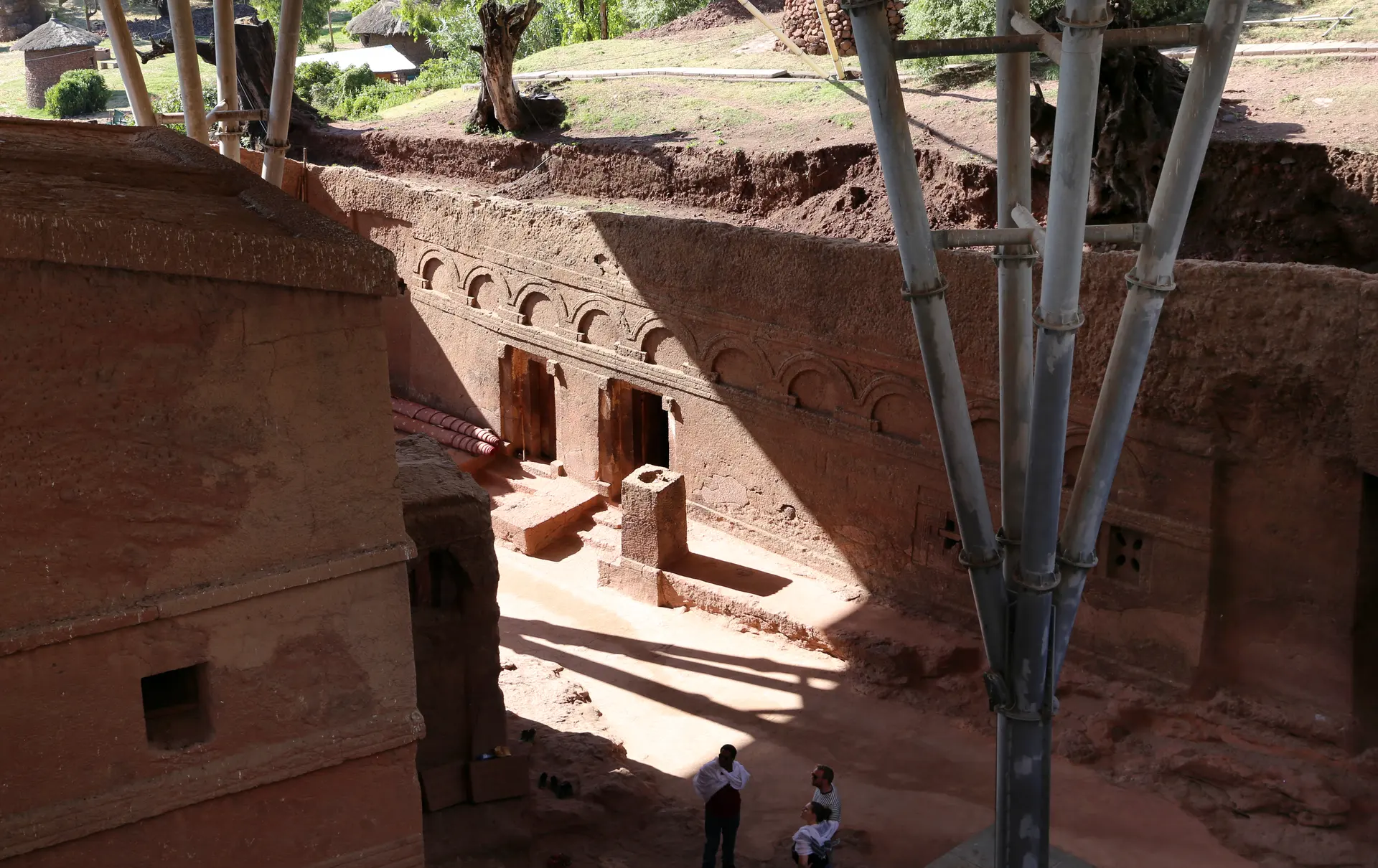
Lalibela's eleven churches were each carved from a single block of volcanic rock, descending into the earth rather than rising skyward. Tunnels and trenches join them into a subterranean sacred city that has served as a “New Jerusalem” for eight hundred years.
Tradition says King Lalibela saw Jerusalem in a divinely given sleep and was told to build the holy city in his mountains for people who could no longer reach it. Four-storey churches were excavated downward from living rock, reportedly completed in twenty-four years with angels continuing the work through the night.
Priests in white robes still chant liturgy in Ge'ez. Pilgrims walk for weeks, many barefoot and fasting. At Ethiopian Christmas, nearly two hundred thousand gather in the rock trenches for all-night worship. These churches are not merely monuments to faith but faith in continuous practice, carved into Africa's bones.
Why this place is sacred
The churches of Lalibela are thin because they are Jerusalem. Not metaphorically—for Ethiopian Orthodox Christians, pilgrimage to Lalibela is equivalent to pilgrimage to the Holy Land. When you cannot go to Jerusalem, Jerusalem comes to you.
The architecture itself produces thinness through inversion. Almost every sacred building in history rises upward. Lalibela descends. The churches are carved from the surface down, creating spaces you reach by going into the earth. This aligns with Christian theology of burial and resurrection but also with older, deeper patterns—the understanding that the sacred often lies below.
The legend of angelic construction adds another dimension. Whether one accepts the literal claim or understands it as metaphor, the story speaks to the sense that what was accomplished here exceeds ordinary human capacity. Something beyond normal experience was required to carve these churches from rock. That sense of exceeded possibility—of the impossible made actual—persists in the space.
Finally, there is the accumulated weight of continuous devotion. For eight hundred years, priests have conducted liturgy here. Pilgrims have walked for weeks to reach these stones. Generations have been baptized, married, and buried in these rock-hewn chambers. The churches are saturated with human intention in a way few places on earth can match.
King Lalibela conceived the site as a 'New Jerusalem' after Muslim conquests prevented Christian pilgrimage to the Holy Land. The layout recreates sacred geography: churches represent Golgotha, the Tomb of Christ, and other holy sites. A stream was renamed the River Jordan. The complex was designed to provide Ethiopian Christians full access to sacred sites they could no longer physically reach. As a royal project, it also consolidated the Zagwe dynasty's religious legitimacy.
The churches have functioned continuously since the 13th century. Unlike many sacred sites that fell into ruin and were later rediscovered, Lalibela never lost its community. Priests and monks have maintained the liturgy without interruption. Over centuries, additional structures were added—ceremonial pavilions, living quarters for clergy, protective canopies. UNESCO inscription in 1978 brought international attention and conservation efforts, including controversial modern shelters to protect the churches from erosion.
The challenge remains balancing preservation with the living worship that gives the site meaning.
Experience and orientation
You approach Lalibela's churches by going down. Trenches and tunnels carved from rock lead to entrances below ground level. The descent is both physical and psychological—a preparation for encounter with something that does not follow ordinary rules.
Bete Giyorgis, the Church of Saint George, is typically the final visit but the most striking. Carved in the shape of a perfect Greek cross, it stands alone in its pit, reached by a tunnel through rock. From above, the cross-shaped roof appears to emerge from the earth like a geometric vision. Below, the interior is surprisingly spacious, its columns and arches carved from the same block of stone.
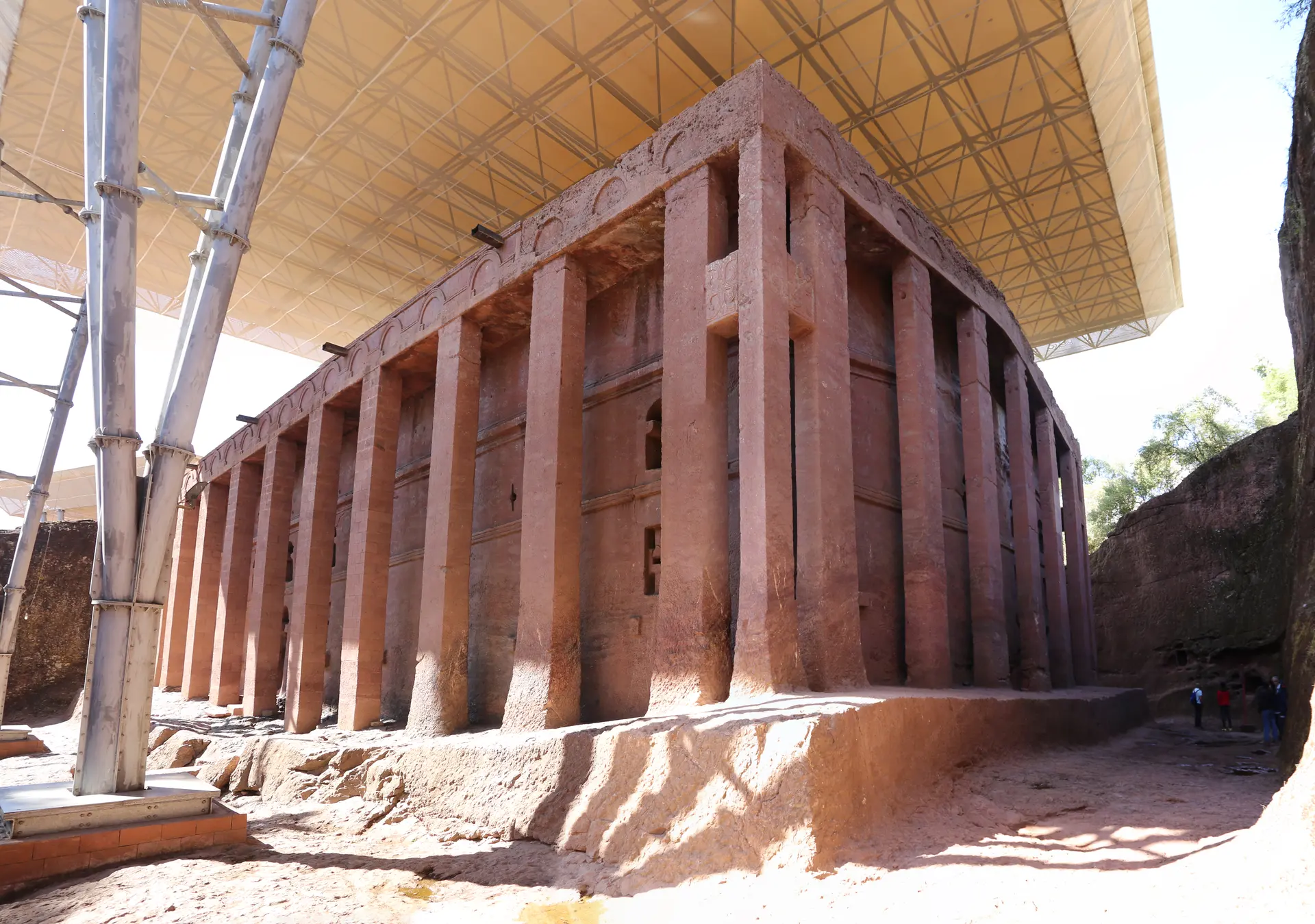
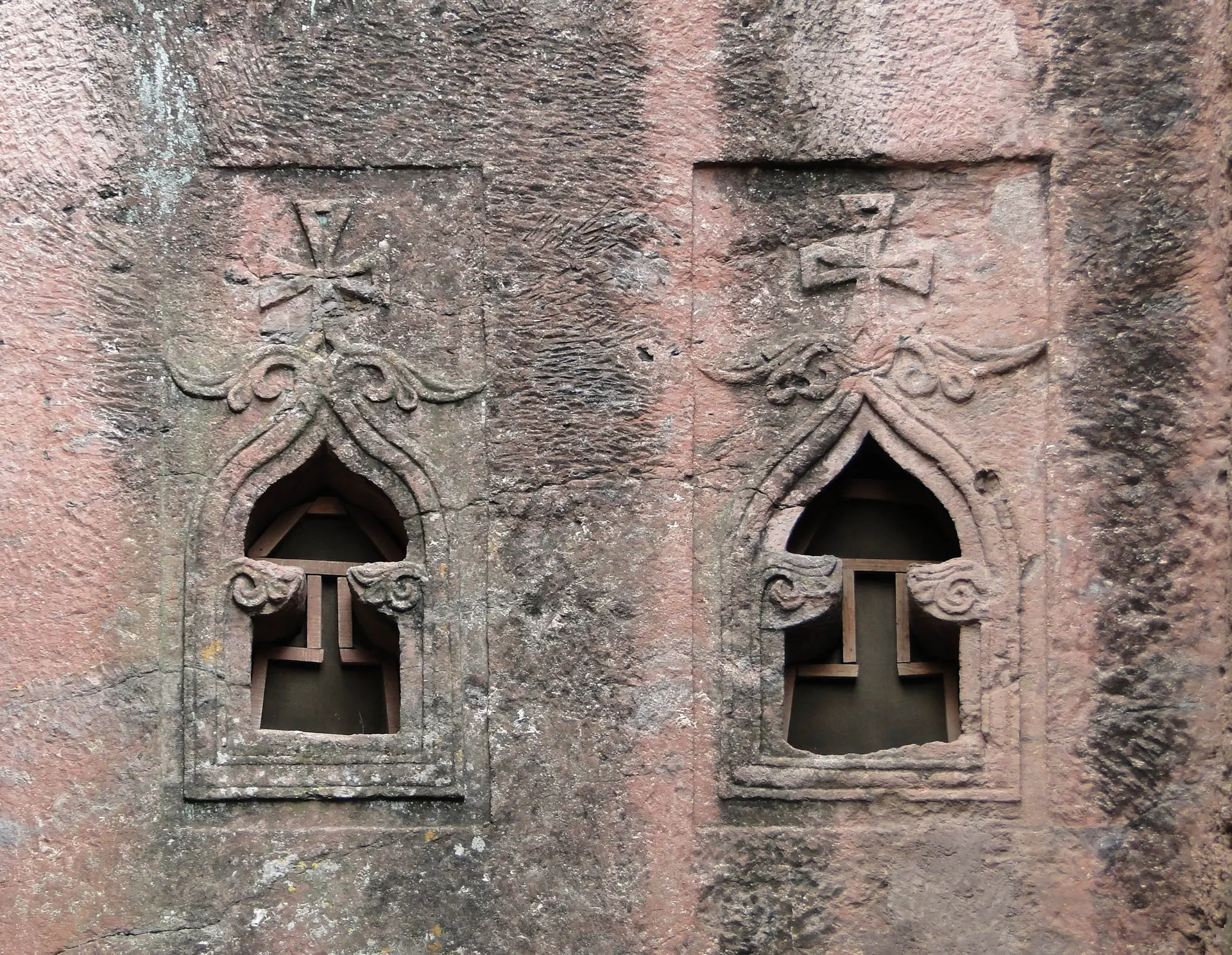
The other churches cluster in two groups separated by the stream King Lalibela named the Jordan. The northern group includes Bete Medhane Alem, the largest rock-hewn church in the world, with its exterior colonnade suggesting Greek temple architecture carved in Ethiopian stone. Bete Maryam, said to be the first church Lalibela built, retains original frescoes and a window that admits light in the shape of a cross.
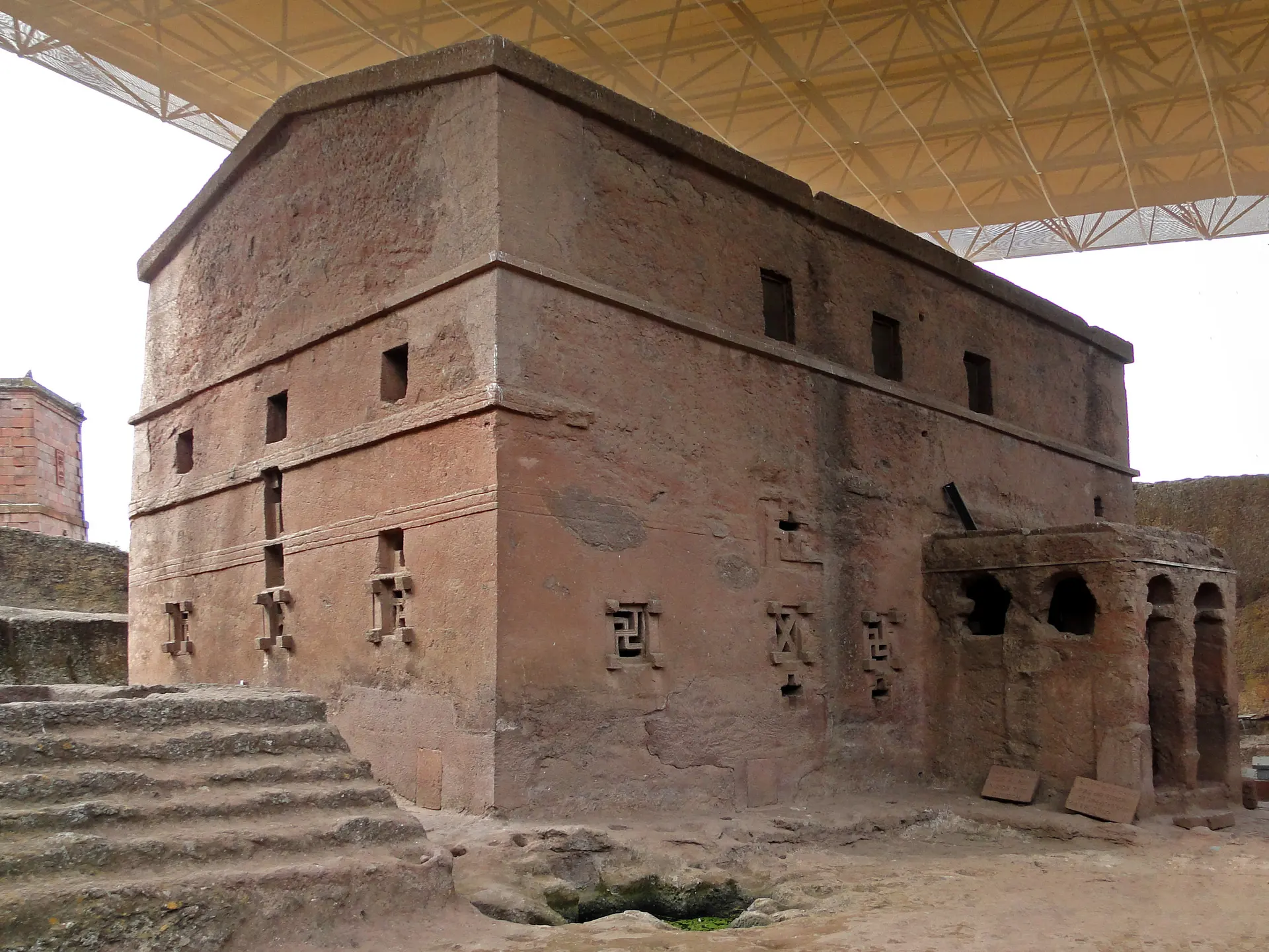
The southern group includes Bete Emmanuel, often considered the finest in architectural detail, and Bete Abba Libanos, which legend says was built in a single night by angels and King Lalibela's wife. Tunnels connect the churches, creating passages where darkness and echo amplify the sense of entering another world.
But the architecture is only half the experience. The churches remain fully active, the daily liturgy still chanted in their chambers and the smell of frankincense pervading the rock. This is not a museum but a functioning spiritual ecosystem.
Begin at the main entrance where guides can be arranged. The northern group of churches is usually visited first, followed by the southern group, with Bete Giyorgis as the climax. Plan for a full day or spread visits over two days. Morning visits offer cooler temperatures and active services. Remove shoes at every church—bring socks as floors are cold. Dress modestly with covered shoulders and knees. The site involves significant walking on uneven surfaces and through narrow tunnels.
Those with claustrophobia should be aware of confined passages.
Context and lineage
The story begins with bees and poison. When the child who would become King Lalibela was born, a swarm of bees surrounded him. His mother named him 'Lalibela,' meaning 'the bees recognize his sovereignty'—a sign of future greatness.
This prophecy threatened his brother, King Harbay, who ruled the Zagwe dynasty. Harbay attempted to eliminate the threat by poisoning Lalibela. But the poison did not kill—it induced a three-day sleep during which, tradition says, an angel carried Lalibela's soul to heaven. There, Christ himself guided the prince through the streets of Jerusalem, showing him every holy site: Golgotha, the tomb, the places of his suffering and triumph.
Return to Ethiopia, Christ instructed. Build my city in your mountains. Make these places accessible to your people, who can no longer reach them.
Lalibela awoke transformed. When he eventually became king, he dedicated his reign to fulfilling the divine commission. Workers began carving from the surface of volcanic rock, excavating downward to create the sacred forms. By day, humans labored. By night, angels continued the work. In twenty-four years, the impossible was complete.
The Ethiopian Orthodox Tewahedo Church traces its origins to the 4th century CE, making it one of the oldest Christian churches in the world. The church claims continuity from the Queen of Sheba's visit to Solomon and the consequent arrival of the Ark of the Covenant in Ethiopia. Lalibela's churches represent the Zagwe dynasty's contribution to this ancient tradition, creating pilgrimage sites that kept Ethiopian Christianity connected to its Holy Land roots when physical access was blocked.
The churches have been maintained by an unbroken succession of priests and monks for over eight centuries.
King Gebre Meskel Lalibela
Founder and visionary
Maskal Kebra
Queen and builder
Bete Giyorgis (Saint George)
Patron saint
Traditions and practice
Ethiopian Orthodox worship at Lalibela follows the ancient liturgy preserved from early Christianity. Services are conducted in Ge'ez, the classical language that remains sacred even though no longer spoken in daily life. Priests chant from illuminated manuscripts, accompanied by sistrums (metal rattles) and prayer sticks used to maintain rhythm during long services. The liturgy includes elaborate prostrations, censing with frankincense, and processions with tabot—replicas of the Ark of the Covenant that are the holiest objects in each church.
The cycle of fasting is rigorous: Ethiopian Orthodox Christians fast from animal products approximately 180 days per year, including all Wednesdays and Fridays and long fasts before Easter and Christmas. Pilgrims to Lalibela often fast during their entire journey, which may last weeks.
The churches continue their original function without significant modification. Daily services follow the liturgical calendar. Major celebrations include Genna (Ethiopian Christmas, January 7 in the Gregorian calendar), when nearly 200,000 pilgrims gather for all-night services and dawn celebrations. Timkat (Epiphany, January 19) commemorates Christ's baptism with processions to water for blessing. Meskel (Finding of the True Cross, September 27) features bonfires. Easter, calculated by the Julian calendar, draws major pilgrimages.
The monastic community at Lalibela maintains the churches, conducts services, and preserves manuscript traditions. Priests-in-training study the ancient texts and chanting traditions.
Visitors seeking more than tourism should attend a service. Early morning is best—arrive before dawn to witness the priests in their white robes chanting by candlelight as light gradually fills the rock-hewn spaces. Let the liturgy wash over you without understanding; the sound and rhythm communicate what translation cannot. If possible, time your visit to coincide with a major feast, understanding that crowds will be intense but the spiritual atmosphere incomparable. Walk the path pilgrims have walked for eight centuries.
Consider what it means that people still travel for weeks on foot to reach these stones.
Ethiopian Orthodox Tewahedo Christianity
ActiveLalibela is one of the holiest sites in Ethiopian Orthodoxy, second only to Axum where the Ark of the Covenant is said to reside. King Lalibela created the churches as a 'New Jerusalem' after Muslim conquests prevented pilgrimage to the Holy Land. For Ethiopian Christians, visiting Lalibela fulfills the spiritual obligation of Jerusalem pilgrimage. The churches house tabot (replicas of the Ark of the Covenant), the holiest objects in Ethiopian worship. The site represents the unique character of Ethiopian Christianity—an ancient tradition that developed in relative isolation, preserving practices and texts lost elsewhere.
Daily liturgy in Ge'ez with traditional chanting, sistrums, and prayer sticks. Major pilgrimages at Genna (Ethiopian Christmas, January 7) and Timkat (Epiphany, January 19). Processions with tabot on major feasts. Continuous fasting traditions (approximately 180 days per year). Baptisms, weddings, and funerals conducted in the churches. Priests and monks maintain the site and study ancient manuscripts. Pilgrims often walk for weeks, fasting, to demonstrate devotion.
Perspectives and open questions
Lalibela invites interpretation through multiple lenses: as one of Africa's greatest architectural achievements, as living Ethiopian Orthodox sacred space, as attempted recreation of Jerusalem, and as testimony to what faith and organized labor can accomplish. These perspectives layer upon each other, each illuminating aspects the others might miss.
Scholarly perspective
Art historians and archaeologists recognize Lalibela as one of the most remarkable architectural achievements of the medieval world, comparable in ambition to the Gothic cathedrals of Europe but using entirely different techniques. The rock-cutting demonstrates sophisticated engineering: beginning at surface level and carving downward, workers had to visualize the complete structure before starting. The precision of interior columns, arches, and windows carved from solid rock indicates master craftsmen of exceptional skill.
Some scholars suggest the complex evolved over centuries rather than 24 years, with earlier cave churches modified and expanded. Influences from Aksumite architecture, Coptic Egypt, and possibly Byzantine traditions are evident. UNESCO's 1978 inscription recognized the site's universal significance.
Living and traditional perspectives
For Ethiopian Orthodox Christians, scholarly debates about dating are secondary to the lived experience of these churches as holy ground. The legend of King Lalibela's vision and angelic assistance is not metaphor but historical truth. The churches' completion in 24 years despite their scale proves divine involvement. Lalibela is not merely a substitute for Jerusalem—it is Jerusalem, spiritually equivalent to the Holy Land, fulfilling Christ's promise to bring salvation to all nations including Africa.
The continuous chain of worship over eight centuries demonstrates God's faithfulness. Every surface, proportion, and detail carries theological meaning understood through ongoing interpretation within the tradition.
Alternative interpretations
Some interpreters have suggested Templar or other external influences on the construction, noting similarities to medieval Western architecture. Others point to astronomical alignments or sacred geometry in the layout. These interpretations generally lack scholarly support but reflect genuine wonder at what was accomplished. The legend of angelic construction, while not literally credible to many visitors, speaks to the universal sense that what exists here exceeds normal human capacity.
Open questions
Significant mysteries remain. What tools and techniques accomplished the rock-cutting with such precision? If construction took 24 years as tradition claims, how was the labor of thousands organized and sustained? If construction spanned centuries, how was continuity of vision maintained? What was the original appearance before centuries of weathering? How did craftsmen carve downward while maintaining accurate proportions? What manuscripts, artworks, and liturgical objects have been lost? Why does the Church of Saint George stand apart from the other groups?
Plan your visit
Access and arrival
Ethiopian Airlines operates direct flights from Addis Ababa to Lalibela Airport (approximately 1 hour), located 23 km from town. Flights also available from Gondar and other northern circuit cities. Road access from Addis Ababa takes approximately 2 days through spectacular highland scenery. Lalibela town is small and navigable on foot. Taxis available from airport.
Lalibela offers accommodations ranging from simple guesthouses to comfortable hotels. Options include Mezena Lodge, Mountain View Hotel, and several community-based tourism initiatives. During major festivals, book months in advance. The town is small but tourism infrastructure has developed significantly.
Respectful visit
Shoulders and knees must be covered. Loose, comfortable clothing is practical for the physical demands of the site. Shoes must be removed at every church—bring socks and wear shoes that are easy to remove. Sandals are practical. Avoid revealing or attention-drawing clothing. Head coverings, while not required, show additional respect.
Photography is permitted in most churches when services are not active. Flash photography is prohibited everywhere. Ask permission before photographing people—priests, monks, pilgrims. Some inner sanctuaries prohibit all photography. Drones are not permitted. Consider spending some time without your camera to simply be present.
Donations are welcomed and support the church community. There may be opportunities to purchase crosses, icons, and religious items from church shops. These purchases support the local economy and monastic community.
Inner sanctuaries (the holy of holies in each church) are accessible only to clergy. Some areas may close during services. Do not touch wall paintings, manuscripts, or religious objects. Maintain appropriate silence. Do not eat or drink inside churches.
Visitors should not approach Lalibela as a tourist site. It is a functioning church with an active community. Services take priority over photography. Some pilgrims have walked for weeks in religious dedication—approach their devotion with appropriate respect. The churches are not performance spaces but houses of worship. Loud conversation, casual behavior, and treating the site as a backdrop for photos diminishes both your experience and the sacred character of the place.
Current practical details
Address
22MV+79C, Unnamed Road, Lalibela, Ethiopia
Phone
Hours
Hours, fees, and access can change — verify on the official source before you travel. Practical details last checked Jun 2026.
Location
Map loads as you approach this section.
Pilgrim reflections
A portrait of encounter, not a score
Pilgrims describe what they felt, how present they could become, and whether the place would shape a journey. There are no stars and no ranking of traditions.
No reviewed reflections yet
The first pilgrims can help describe the character of being here.
Share a reflection
Available after an account-backed “Been there.” Every reflection is reviewed before publication.
Dates and observances
Upcoming festivals, feast days, and pilgrimages connected to this place. Add any to your calendar, or browse the full observance calendar.
- Add to calendar
Genna (Ethiopian Christmas)
Thu, Jan 7, 2027Festival
Ethiopian Orthodox Christmas (Jan 7), after 43 days of Advent fasting. Tens of thousands of pilgrims fill the rock-hewn churches of Lalibela for an all-night procession through this 'New Jerusalem.'
- Add to calendar
Timkat (Epiphany)
Tue, Jan 19, 2027Festival
Ethiopia's celebration of Epiphany (Jan 19), commemorating the baptism of Christ, with processions of the tabots draped in embroidered cloth carried around the town amid chanting.
- Add to calendar
Genna (Ethiopian Christmas)
Fri, Jan 7, 2028Festival
Ethiopian Orthodox Christmas (Jan 7), after 43 days of Advent fasting. Tens of thousands of pilgrims fill the rock-hewn churches of Lalibela for an all-night procession through this 'New Jerusalem.'
- Add to calendar
Timkat (Epiphany)
Wed, Jan 19, 2028Festival
Ethiopia's celebration of Epiphany (Jan 19), commemorating the baptism of Christ, with processions of the tabots draped in embroidered cloth carried around the town amid chanting.
Nearby sacred places
Explore other sacred places in the region. Proximity does not establish access or travel time; check each place’s guidance.
References
Sources consulted for this page. Source categories describe the publication, not a guarantee that every claim is verified. Traditional accounts and outside interpretations may differ.
- 01Rock-Hewn Churches, Lalibela - UNESCO World Heritage Centre — UNESCOofficialOfficial UNESCO listing with criteria and significance
- 02The Rock-hewn Churches of Lalibela - The Metropolitan Museum of Art — Metropolitan Museum of ArtofficialScholarly art historical analysis
- 03Rock-Hewn Churches, Lalibela - Wikipedia — Wikipedia contributorsencyclopediaComprehensive overview with citations
- 04Churches Carved From Ethiopian Hills - The Mystery of Lalibela — CNEWAofficialReligious perspective on the churches
- 05Lalibela: 11 churches, each sculpted out of a single block of stone 800 years ago — CBS News 60 MinutesacademicDocumentary coverage of site and pilgrimages
Photo gallery
3 curated photos
Share a photo
Help visitors recognize Rock-Hewn Churches, Lalibela. Every submission is reviewed before publication.