Glebe Cairn
A Bronze Age cairn standing sentinel at the threshold of Scotland's deepest ritual valley
Understand sacred places, explore living traditions, and learn how to engage respectfully with Pilgrim Map.
Access has not been verified. Check current local guidance before planning a visit.
Kilmartin, Scotland, United Kingdom
Read the sources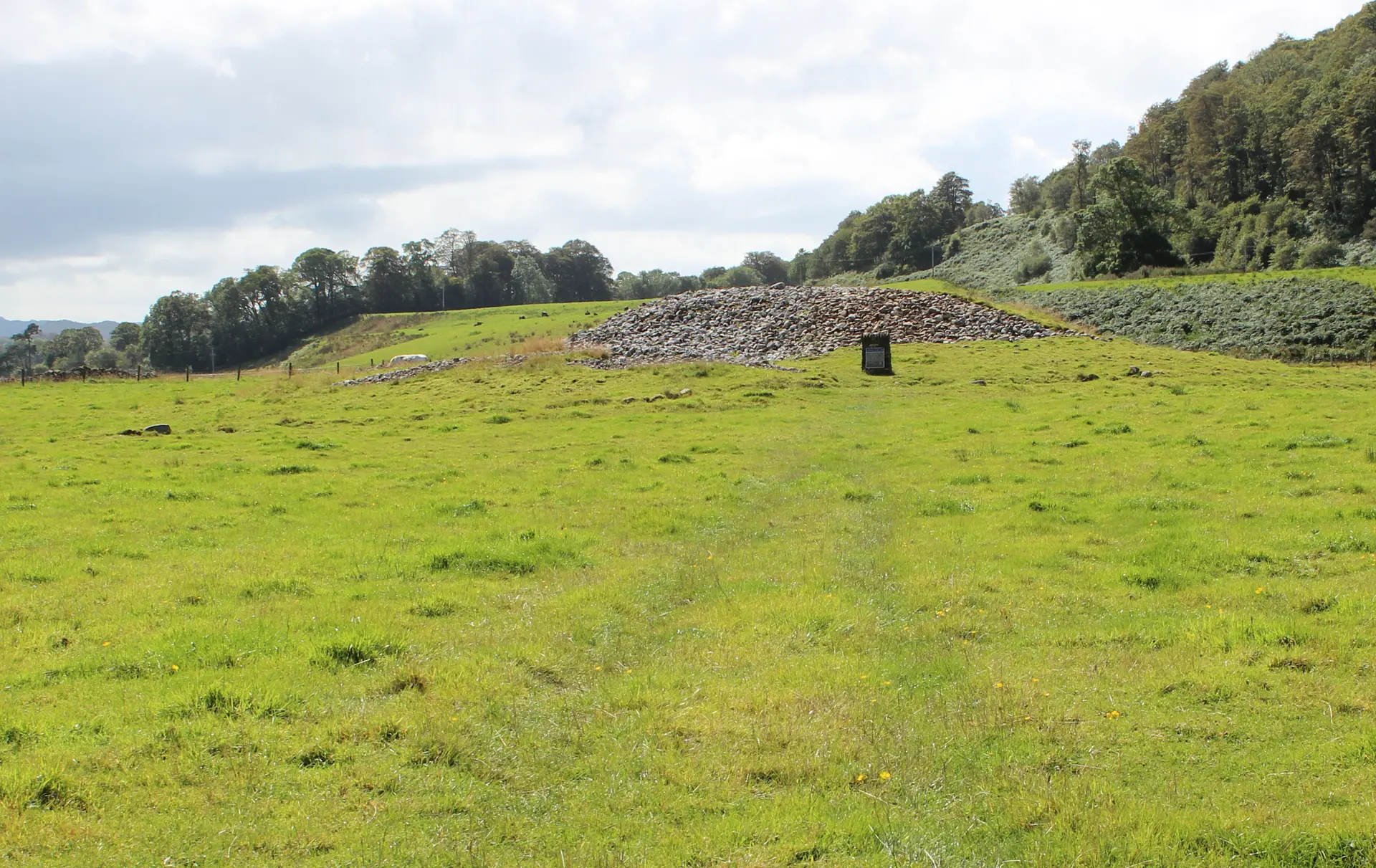
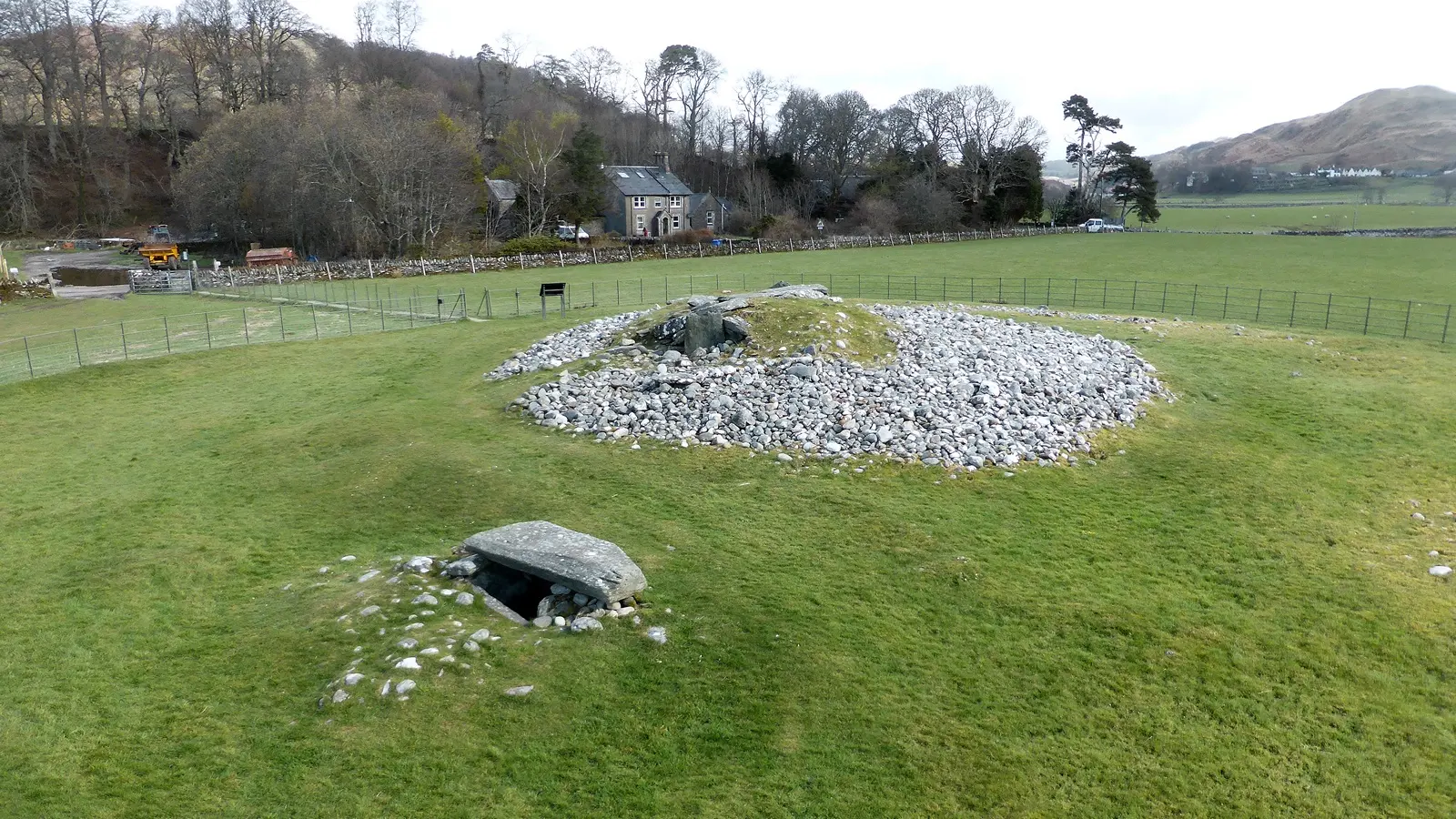
Image of Glebe Cairn. Image source · CC-BY-SA-2.0
Visit essentials
A quick read before you go
- Duration
- 30-60 minutes for Glebe Cairn alone.
- Etiquette
- Treat the cairn with respect as a burial monument and scheduled ancient monument.
Overview
At Kilmartin Glen's head, where the valley opens toward the village, Glebe Cairn rises three metres from the grass. Thirty metres across and four thousand years old, it is the first cairn encountered but the last chronologically—the northern end of a two-kilometre alignment through one of Scotland's most sacred prehistoric landscapes.
In 1864 Canon William Greenwell uncovered two concentric rings of upright boulders around a burial cist. Its occupant had a delicate jet-bead necklace, later lost in the Poltalloch House fire, and an Irish-style ceramic food vessel now in Kilmartin Museum—provision for whatever journey followed. Archaeology shows generations added to or reshaped the cairn across centuries, sustaining a conversation between living and dead rather than one act of grief.
More than eight hundred ancient sites lie within six miles of Kilmartin village. Stone circles, rock art, standing stones, and burial cairns record millennia of gathering, mourning, celebration, and meaning-making; looking south from Glebe along the monuments makes time visible in the land.
Why this place is sacred
There is a quality at Glebe Cairn that has nothing to do with grandeur. The cairn is not the largest in the alignment, not the most dramatic, not the oldest. Its power is positional. Standing at the northern edge of the linear cemetery, it functions as a threshold, the point where the everyday landscape of Kilmartin village yields to something older and more deliberate.
The two-kilometre alignment of cairns stretching south from this point represents an extraordinary commitment to place. Over at least fifteen hundred years, communities returned to this valley to bury their dead, to build and rebuild monuments, to lay jet beads and ceramic vessels beside the bodies of those they honoured. Each cairn in the line carries its own stories, its own dead, its own phase of construction. Together they form a visible chronology of devotion.
What makes a place thin is often accumulation rather than singularity. Glebe Cairn is not a single moment of revelation but a palimpsest of ritual, layer upon layer of human intention pressed into the earth. The concentric stone circles found beneath the cairn may represent an earlier phase of ceremony, a sacred enclosure that preceded the burial monument. The cairn was built upon ground already hallowed by use.
The glen amplifies this quality. Surrounded by hills, contained by the valley's gentle walls, Kilmartin Glen creates a sense of enclosure that separates it from the wider world. The concentration of monuments here, over eight hundred within six miles, transforms the landscape itself into a sacred text, one that can be walked and read but never fully translated.
Constructed between approximately 2000 and 1500 BC as a burial monument for high-status individuals. The presence of jet necklace beads from Whitby and Irish-style food vessels indicates long-distance trade connections and elaborate funerary ritual.
The cairn was built in multiple phases over centuries, with earlier structures (including two concentric stone circles) incorporated into later construction. Excavated by Canon Greenwell in 1864. Reconstructed from original dimensions of 33.5 metres diameter and 4.1 metres height to current 30 metres diameter and 3 metres height. Now managed as a scheduled ancient monument by Historic Environment Scotland.
Experience and orientation
The cairn is close to the village, just a hundred and eighty metres northwest of Kilmartin Parish Church. This proximity is itself instructive. The medieval church was built beside a Bronze Age monument, and before that the monument was built in a place already marked by ritual use. Layers of sacred intention, separated by millennia, share the same ground.
Approach on foot. The cairn rises from level ground, a rounded mound of grey stones softened by grass and lichen. It is substantial but not imposing, its mass felt rather than proclaimed. Walk around its perimeter. Notice the scale of the stones. Consider that each was carried and placed by hand, and that this work was repeated across centuries.
From the cairn, look south. The next monument in the alignment becomes visible, and beyond it, the next. The valley draws the eye along a line that human intention created four thousand years ago. This is the experience that repays attention: the sense of a designed landscape, a sacred geography where the placement of each monument relates to the others and to the contours of the glen itself.
If time allows, walk the full alignment. Move south from Glebe Cairn through Nether Largie North and Mid, to Nether Largie South, the oldest of the group, then to Ri Cruin. The walk takes ninety minutes at a contemplative pace and covers terrain that generations of mourners and celebrants traversed before you. Temple Wood Stone Circle lies nearby, adding another layer to the ritual landscape.
Return to Kilmartin Museum to stand before the surviving food vessel from Glebe Cairn. Hold in mind the fact that someone made it, filled it, and placed it beside their dead. The vessel has outlasted everything except the stones.
The cairn is located 180 metres northwest of Kilmartin Parish Church, accessible from the village on foot. The A816 passes through Kilmartin, and parking is available in the village. The linear cemetery extends south from Glebe Cairn for approximately 2 kilometres.
Context and lineage
The communities who built Glebe Cairn left no written records, so the cairn's origin must be read from the stones themselves. Between approximately 2000 and 1500 BC, Bronze Age people chose this location at the northern threshold of Kilmartin Glen to construct a monumental burial. They may have begun with the two concentric rings of upright boulders that archaeologists found beneath the cairn's mass, creating a ritual enclosure before committing it to the purpose of the dead.
The burials were elaborate. At least two cists, stone-built coffins of carefully shaped slabs, held the remains of individuals who merited not only the labour of cairn construction but precious grave goods. One cist contained a jet necklace of delicate beads and spacer-plates, likely traded from Whitby on the far side of the country. Both cists held food vessels of a type associated with Ireland, suggesting cultural connections across the sea.
The cairn was not a finished work. Archaeological evidence indicates multiple phases of construction spanning centuries. Each generation chose to augment the monument rather than build anew, adding their dead and their labour to the accumulated weight of ancestral presence.
No continuous tradition survives from the Bronze Age communities who built and used the cairn. The site's significance is now understood through archaeological investigation and heritage management. Kilmartin Museum, redesigned in 2023, serves as the primary interpreter of the cairn's meaning and context.
Canon William Greenwell
Excavator
Traditions and practice
The Bronze Age communities who built Glebe Cairn practiced elaborate funerary rites. The dead were placed in stone-built cists and accompanied by food vessels, suggesting belief in an afterlife requiring sustenance. Personal adornments such as the jet necklace indicate the importance of status and identity in death. The multi-phase construction of the cairn suggests repeated ritual activity at the site across centuries.
Visitors walk the linear cemetery route, beginning at Glebe Cairn and moving south through the alignment. The walk functions as an informal pilgrimage through deep time. Kilmartin Museum provides archaeological education and displays surviving artefacts from the cairn. Some visitors treat the landscape as a place of quiet meditation or contemplation.
Walk slowly. Begin at Glebe Cairn and look south along the alignment before setting out. Allow the walk through the linear cemetery to become a meditation on time and the human need to mark the places of the dead. Visit Kilmartin Museum to see the food vessel recovered from the cairn. Sit with the scale of what was built here and the patience required to build it.
Bronze Age Funerary and Ancestor Veneration
HistoricalThe cairn was built and used over centuries as a place of high-status burial, accompanied by elaborate grave goods including jet jewellery and ceramic food vessels. The multi-phase construction indicates that the cairn served as a focus of ancestral veneration across many generations, with each period of building reaffirming the connection between the living and the dead.
Cist burial with grave goods; ritual deposition of food vessels; personal adornment offerings; multi-phase monument construction and elaboration.
Perspectives and open questions
Glebe Cairn can be understood as an archaeological monument, as the threshold of a ritual landscape, as evidence of Bronze Age beliefs about death and ancestry, or as an invitation to contemplate the human relationship with mortality and place.
Scholarly perspective
Archaeologists identify Glebe Cairn as a multi-phase Early Bronze Age cairn with two concentric stone circles predating or forming part of the earliest burial phase. The Irish-style food vessels and Whitby jet necklace indicate long-distance cultural and trade connections. The linear arrangement of cairns in Kilmartin Glen is recognised as one of the most significant concentrations of prehistoric ritual monuments in mainland Scotland, though the precise meaning of the linear alignment remains debated.
Living and traditional perspectives
No continuous oral tradition survives from the communities who built and used the cairn. The medieval church built nearby suggests awareness of the site's significance persisted, though the nature of that awareness across the intervening millennia cannot be recovered.
Alternative interpretations
Some visitors and writers interested in earth energies and sacred geography note the linear alignment of the cairns as potentially significant beyond simple chronological or practical explanation. The extraordinary concentration of monuments in Kilmartin Glen has attracted interest from those exploring ideas of sacred landscape and telluric currents.
Open questions
The identity and status of those buried in the cists remain unknown. The precise ritual practices that accompanied the burials cannot be recovered. Whether the concentric stone circles represent an earlier phase of monument or a component of the cairn's design is debated. The reason for the linear arrangement of cairns, and whether additional monuments in the alignment have been lost, are open questions.
Plan your visit
Access and arrival
Kilmartin Hotel in the village. The Cairn restaurant serves Scottish and European cuisine. Kilmartin Museum cafe. Further accommodations in Lochgilphead (7 miles south) and Oban (35 miles north).
Respectful visit
Outdoor clothing suitable for Scottish weather. Waterproofs and sturdy footwear recommended, especially if walking the full linear cemetery route.
Permitted. The cairn photographs well from ground level, and the alignment of cairns southward provides a striking composition.
Do not leave offerings, coins, or objects on the cairn. It is a scheduled monument and disturbance is a legal offence.
The cairn is a scheduled ancient monument under Scottish law. Any disturbance, excavation, or use of metal detectors is prohibited without permission from Historic Environment Scotland.
The cairn is a scheduled ancient monument. Do not remove stones, dig, or use metal detectors. Do not leave offerings on the monument. Respect the site as a place of ancient burial.
Current practical details
Address
Kilmartin, Lochgilphead PA31 8RQ, UK
Hours
Hours, fees, and access can change — verify on the official source before you travel. Practical details last checked Jun 2026.
Location
Map loads as you approach this section.
Pilgrim reflections
A portrait of encounter, not a score
Pilgrims describe what they felt, how present they could become, and whether the place would shape a journey. There are no stars and no ranking of traditions.
No reviewed reflections yet
The first pilgrims can help describe the character of being here.
Share a reflection
Available after an account-backed “Been there.” Every reflection is reviewed before publication.
Nearby sacred places
Explore other sacred places in the region. Proximity does not establish access or travel time; check each place’s guidance.
References
Sources consulted for this page. Source categories describe the publication, not a guarantee that every claim is verified. Traditional accounts and outside interpretations may differ.
- 01Kilmartin Glen: Glebe Cairn - Historic Environment Scotland — Historic Environment ScotlandofficialOfficial heritage body with detailed history and visitor information
- 02Glebe Cairn: History - Historic Environment Scotland — Historic Environment ScotlandofficialDetailed archaeological history of the cairn
- 03Kilmartin Glebe - Canmore — Historic Environment Scotland / CanmoreSource contextNational Record of the Historic Environment with detailed excavation records
- 04Kilmartin Museum — Kilmartin MuseumofficialLocal museum housing artefacts from Glebe Cairn excavations
- 05Kilmartin Glen - Wikipedia — Wikipedia contributorsencyclopediaComprehensive overview of the broader glen landscape
- 06Glebe Cairn [Kilmartin Glebe] - The Megalithic Portal — The Megalithic PortalacademicSpecialist megalithic site database with coordinates and descriptions
- 07Glebe Cairn, Kilmartin - Ancient Monuments UK — Ancient Monuments UKSource contextScheduled monument database entry
- 08Glebe Cairn, Kilmartin Glen - Britain Express — Britain ExpressguideVisitor-oriented guide with historical context
- 09Saints and Stones: Glebe Cairn — Saints and StonesacademicExperiential guide to sacred landscape
- 10Kilmartin Glen Prehistoric Monuments - Atlas Obscura — Atlas ObscuraguideOverview of the broader monument complex
Share a photo
Help visitors recognize Glebe Cairn. Every submission is reviewed before publication.