Giant Springs, Great Falls, Montana
Water that fell as snow 3,000 years ago emerges crystal clear, flowing at 156 million gallons per day
Understand sacred places, explore living traditions, and learn how to engage respectfully with Pilgrim Map.
Access has not been verified. Check current local guidance before planning a visit.
Great Falls, Montana, United States
Read the sources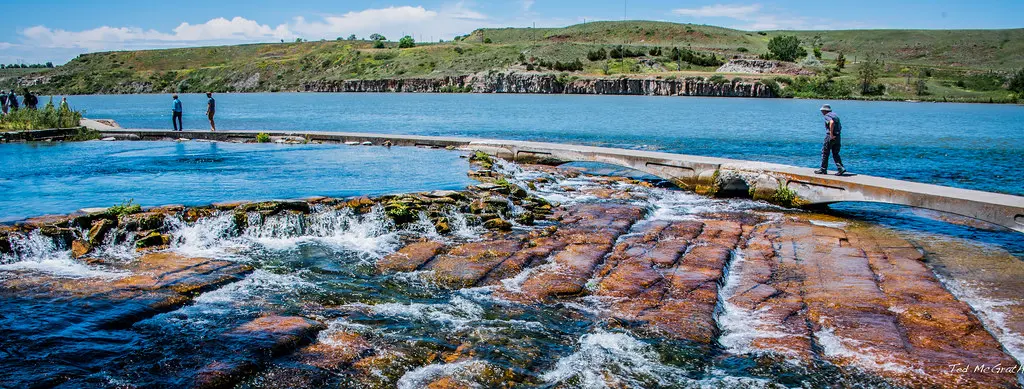
Image of Giant Springs, Great Falls, Montana. Image source
Visit essentials
A quick read before you go
- Duration
- 1 hour to see the spring.
- Etiquette
- Giant Springs is a state park welcoming visitors.
Overview
At Giant Springs, water that fell as snow on the Little Belt Mountains roughly three thousand years ago emerges after traveling sixty miles through the Madison aquifer, crystal clear at a constant 54 degrees Fahrenheit and 156 million gallons per day. One of the United States' largest freshwater springs, its flow could fill an Olympic pool every few minutes.
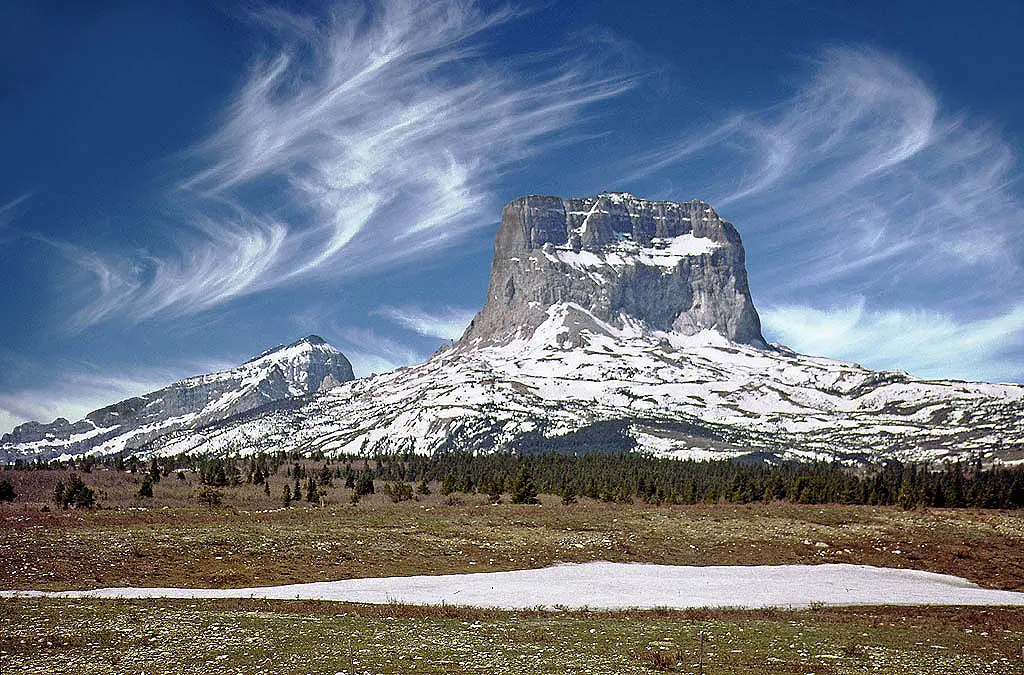
It is listed alongside Chief Mountain and the Sweet Grass Hills among Montana's Native American sacred places, although available sources do not extensively document specific tribal traditions here; across Indigenous cultures, springs have long carried significance as life-giving water emerging from below, and peoples of the Great Falls region knew this place for millennia. On June 18, 1805, William Clark called it “the largest fountain or Spring I ever Saw.”
Two centuries later, it flows as it did then—unchanged and undiminished. Its continuing flow brings to daylight water whose underground journey began before Rome fell or the Middle Ages began.
Why this place is sacred
The thinness at Giant Springs is a matter of time made visible. The water emerging here is not contemporary water. It is ancient water, snowmelt from approximately 1000 BCE, traveling underground for three thousand years through the Madison aquifer—one of the largest aquifers in North America, underlying five U.S. states and three Canadian provinces.
To stand at the spring is to witness a kind of temporal collapse. The water before you connects to a past so distant that no written record from this continent exists. Whatever was happening on the surface when this water began its journey—the cultures, the creatures, the climates—all have transformed utterly. The water has not. It emerges unchanged, the same temperature, the same clarity, carrying whatever minerals and memory it gathered in those three thousand years of darkness.
Springs hold sacred significance across many traditions because they represent emergence—water rising from the underworld, from the realm beneath. The earth drinks rain and snow; springs are where the earth gives it back. At Giant Springs, this giving back occurs at a scale that approaches the overwhelming. The daily flow could supply the water needs of a small city indefinitely. The aquifer shows no signs of depletion.
For visitors seeking a thin place, Giant Springs offers something different from mountaintops or ancient temples. It offers the thinness of continuity, of something that flows and flows and flows, connecting moment to moment across spans of time that dwarf human comprehension.
Giant Springs has served different purposes across time. For the tribes who inhabited the Great Falls region—including the Salish, Blackfeet, and others—the spring would have been known and likely revered as an extraordinary water source in a landscape where water determined survival. Springs were often sacred in Indigenous understanding as places of emergence.
European contact came in 1805 when Lewis and Clark documented the spring. Clark's awe at its size suggests that even without traditional knowledge, the spring's power was evident. The Lewis and Clark National Historic Trail now recognizes Giant Springs as a High Potential Historic Site.
Montana established Giant Springs State Park in 1967, making the spring accessible to visitors while protecting it from development. Today it is Montana's most visited state park, with over 300,000 visitors annually. The park includes a fish hatchery and extensive trails, integrating the spring into a broader recreational landscape while preserving its central presence.
Experience and orientation
The approach to Giant Springs comes through Montana's state park system—a well-developed facility with visitor center, trails, and the Giant Springs Trout Hatchery. The park encompasses nearly 14 miles of Missouri River shoreline with over 30 miles of trails, but the spring itself is the center.
Walking to the viewing area, you first notice the clarity. The water emerging from underground has been filtered through miles of limestone and sandstone, leaving it transparent beyond what seems possible. You can see the bottom, the rocks, the wavering shapes of fish. The color is a blue-green that photographs cannot quite capture—the color of depth made visible.
The spring forms a pool before flowing into what was once called the Roe River, listed in the Guinness Book of World Records as the world's shortest river at approximately 200 feet before it joins the Missouri. The designation has been challenged, but the geography remains: water emerging from three thousand years underground, flowing briefly through daylight, then joining a river that will carry it eventually to the Gulf of Mexico.
The temperature holds constant at 54 degrees Fahrenheit, regardless of season. In summer, the water feels cold to the touch. In winter, when the surrounding landscape freezes, the spring steams—warm relative to the air, though unchanged in absolute temperature. This constancy is part of what the spring offers: something that does not fluctuate, does not respond to the weather of the moment, but continues according to its own deep rhythms.
The fish hatchery uses the spring water to raise rainbow trout, leveraging the constant temperature and purity. Visitors can watch the fish, tour the facility, and see how the spring's gift supports life beyond the pool. The trails extend along the Missouri River, offering space to walk and reflect after encountering the spring itself.
Giant Springs State Park is located just outside Great Falls, Montana, easily accessible by car. The park is open year-round during daylight hours. An entrance fee applies. The visitor center provides orientation and information. Trails range from easy paved paths to more challenging routes along the river bluffs. Allow 2-3 hours to see the spring, explore trails, and visit the fish hatchery. The spring itself requires only minutes to view, but the park rewards longer exploration.
Context and lineage
Giant Springs is listed among Native American sacred sites in Montana, though specific tribal traditions are not well-documented in available sources. The Salish, Blackfeet, and other tribes historically inhabited the Great Falls region. Springs were commonly sacred in Indigenous traditions as places where water emerges from the earth.
William Clark
First recorded the spring during the Lewis and Clark Expedition on June 18, 1805, describing it as 'the largest fountain or Spring I ever Saw.'
Traditions and practice
Giant Springs State Park provides nature programs and educational opportunities focused on the spring's geology, hydrology, and ecology. The fish hatchery offers tours explaining how the constant-temperature spring water supports trout production. Lewis and Clark interpretation connects visitors to the 1805 expedition that first documented the spring for Western audiences.
The practice available at Giant Springs is contemplation. Stand at the viewing area and watch the water emerge. Consider that this water began its journey three thousand years ago—before written history on this continent, before Rome, before most of what we call civilization. Let the spring's patience become visible.
Walk the trails. The park offers over 30 miles of paths along the Missouri River, providing space for reflection away from the spring itself. Return to the spring. Notice how it has not changed in the time you were gone. It will not change tomorrow, or next year, or in your lifetime. Something continues here.
Native American Sacred Spring
HistoricalGiant Springs is listed among Native American sacred places in Montana, alongside Chief Mountain and the Sweet Grass Hills. Springs were commonly sacred in Indigenous traditions as places of emergence, where water—the source of life—rises from the world below.
Specific practices not documented in available sources.
Perspectives and open questions
Giant Springs is understood primarily through its hydrology—the remarkable journey of water from snowmelt to emergence—and its documentation by Lewis and Clark. Its inclusion among Native American sacred sites points to significance that predates Western understanding, though specific traditions are not extensively recorded.
Scholarly perspective
Hydrologically, Giant Springs is classified as a first-magnitude spring, discharging at least 100 cubic feet per second. It is fed by the Madison aquifer, a massive underground water source spanning five states and three Canadian provinces. Isotopic analysis indicates the water is approximately 3,000 years old, having traveled roughly 60 miles underground from recharge areas in the Little Belt Mountains.
Historically, the spring was documented during the Lewis and Clark Expedition in 1805. The expedition journals describe the spring's size and note its position along the Missouri River portage route around the Great Falls. The site is designated a High Potential Historic Site on the Lewis and Clark National Historic Trail.
Living and traditional perspectives
Giant Springs is listed among Native American sacred sites in Montana. The Salish, Blackfeet, Crow, and other tribes historically inhabited the Great Falls region, and springs were commonly sacred in Indigenous traditions as places where water emerges from the underworld. However, specific traditions, ceremonies, or origin stories associated with Giant Springs are not extensively documented in available sources.
Open questions
The specific Indigenous traditions associated with Giant Springs remain largely undocumented in accessible sources. The tribes who knew this place for thousands of years before European contact would have had their own understanding of its significance—knowledge that may exist within tribal communities but is not available in public records.
Plan your visit
Access and arrival
Hotels and services in Great Falls, Montana.
Respectful visit
Standard outdoor clothing appropriate for the season. Temperatures can vary significantly. Comfortable walking shoes for trails.
Photography is permitted throughout the park.
Not applicable for this site as currently managed.
{"Stay on designated trails","No swimming or wading in the spring","State park entrance fee required","Dogs must be leashed","Follow posted regulations"}
Follow state park regulations. Stay on designated trails to protect vegetation and archaeological resources. The spring water is cold; do not swim or wade in the pool.
Current practical details
Address
Giant Springs, Montana 59405, USA
Hours, fees, and access can change — verify on the official source before you travel. Practical details last checked Jun 2026.
Location
Map loads as you approach this section.
Pilgrim reflections
A portrait of encounter, not a score
Pilgrims describe what they felt, how present they could become, and whether the place would shape a journey. There are no stars and no ranking of traditions.
No reviewed reflections yet
The first pilgrims can help describe the character of being here.
Share a reflection
Available after an account-backed “Been there.” Every reflection is reviewed before publication.
Nearby sacred places
Explore other sacred places in the region. Proximity does not establish access or travel time; check each place’s guidance.

Sweet Grass Hills, Montana
Whitlash, Montana, United States
159.8 km away
Writing-on-Stone Provincial Park
Milk River, Alberta, Canada
176.7 km away
Two Medicine Lake, Montana
East Glacier Park, Montana, United States
194.6 km away
Chief Mountain (Ninaistakis), Glacier County, Montana
Babb, Montana, United States
253.0 km away
References
Sources consulted for this page. Source categories describe the publication, not a guarantee that every claim is verified. Traditional accounts and outside interpretations may differ.
- 01Giant Springs State Park — Montana Fish, Wildlife & ParksofficialOfficial state park
- 02Giant Springs - Discover Lewis & Clark — Discover Lewis & ClarkSource contextLewis and Clark Trail documentation
- 03Giant Springs — WikipediaencyclopediaGeneral reference
- 04Native American Sacred Places — Notes from the FrontierblogLists Giant Springs as a Native American sacred site
Share a photo
Help visitors recognize Giant Springs, Great Falls, Montana. Every submission is reviewed before publication.