Geoglyphs of Acre, Brazil
Where a lost civilization scored its cosmology into the earth, hidden for centuries beneath the Amazon canopy
Understand sacred places, explore living traditions, and learn how to engage respectfully with Pilgrim Map.
Access has not been verified. Check current local guidance before planning a visit.
Rio Branco, Acre, Brazil
Read the sources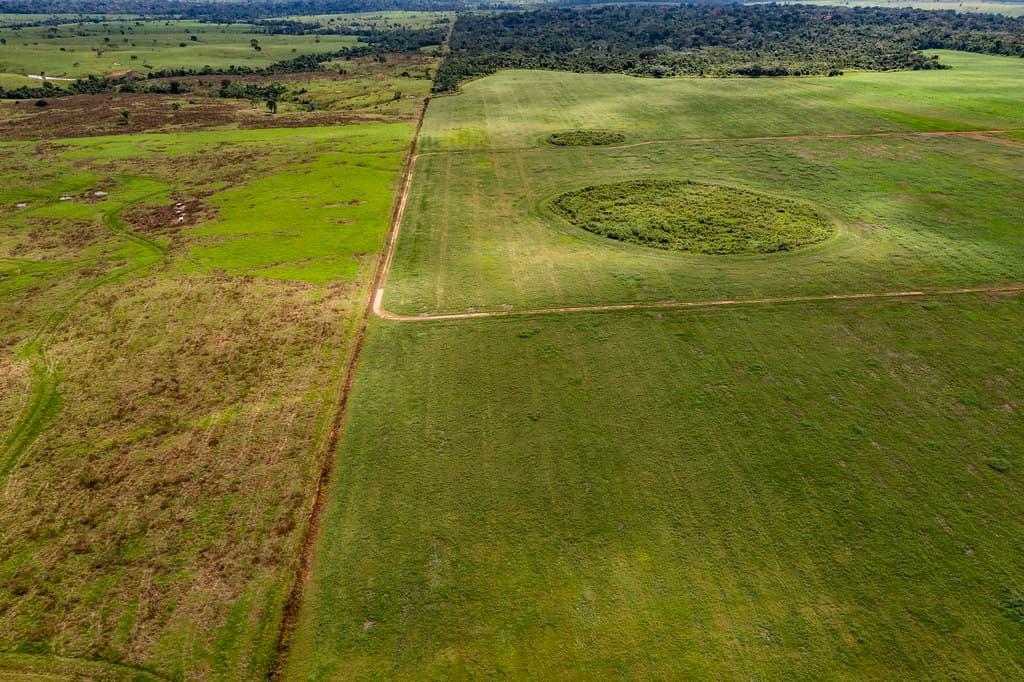
Image of Geoglyphs of Acre, Brazil. Image source
Visit essentials
A quick read before you go
- Duration
- A half-day to full-day excursion from Rio Branco covers the most accessible sites.
- Access
- Fly into Rio Branco via Placido de Castro International Airport, which receives domestic flights…
Overview
For centuries the Amazon canopy hid a civilization's monumental geometry beneath what outsiders assumed was untouched wilderness: ditches eleven meters wide and four meters deep forming circles, squares, octagons, and compound shapes across an area larger than some European nations. Cattle ranching, chainsaws, and fire exposed not isolated sites but a network of more than four hundred earthworks and formal roads along the Acre, Iquiri, and Abuna river valleys.
At its center, Tequinho served as a gathering place where roads converged and ceremonies unfolded. Long before carving ditches, the builders practiced millennia of agroforestry, selectively burning and cultivating bamboo and palm forests in ways modern ecologists are only beginning to appreciate. The geoglyphs emerged from a ten-thousand-year relationship with managed land, not pristine wilderness.
Their exact meanings remain unknown; researchers propose symbolic doors and paths connecting communities with beings of the forest, while their forms imply cosmological knowledge and coordinated labor across generations. An estimated sixteen thousand may remain undiscovered. The forest still holds what it holds.
Why this place is sacred
Something about these sites resists the usual language of sacred places. There are no standing stones, no temple walls, no altars. The sacredness here is subtractive — carved downward into the earth rather than built upward toward the sky. The ditches create absence, enclosing space without filling it. What was meant to happen inside those enormous circles and squares is precisely the question the land holds open.
The Tequinho site offers the clearest evidence of ceremonial function. Roads radiate outward from its central enclosure like spokes from a hub, connecting it to outlying sites across the region. These roads were not utilitarian pathways but, according to researchers, central elements in ritualistic ceremonies — processional routes that transformed the act of walking into something formal and charged with meaning. The geometry of movement mattered as much as the geometry of space.
Then there is the concealment itself. For centuries, the Amazon canopy covered these forms entirely. Local people may have known. But the wider world saw only forest — confirming the persistent assumption that pre-Columbian Amazonia was sparsely populated wilderness. The geoglyphs' emergence into visibility, paradoxically through destruction, overturned that assumption entirely. A civilization capable of coordinating monumental construction across thirteen thousand square kilometers does not fit the story of a pristine, empty jungle.
The thinness here is temporal as much as spatial. Standing at the edge of a ditch that took generations to carve, now exposed because someone cleared the forest for cattle, the visitor encounters multiple time scales at once — ten-thousand-year land management, two millennia of construction, five centuries of concealment, and the rapid, ongoing destruction that revealed what was hidden.
The scholarly consensus holds that the geoglyphs served as ceremonial gathering places rather than permanent settlements or fortifications. Excavations have yielded little evidence of domestic refuse or continuous habitation. Instead, the sites appear to have functioned as places where dispersed communities came together periodically for cultural and religious events.
The geometric forms — circles, squares, compound shapes — may have functioned as symbolic doors and paths connecting participants with different beings of the environment, reflecting an animistic cosmology in which the built landscape mediated between human communities and spiritual forces.
The tradition of land management at geoglyph sites stretches back approximately ten thousand years, far predating the earthworks themselves. The earliest geoglyph construction began around 3500 BP, with peak activity between 2000 and 900 BP. Construction appears to have ceased around 650 BP, roughly a century before European contact. The reasons for this cessation remain debated — climate change, population shifts, and social reorganization have all been proposed.
The geoglyphs then entered a long period of invisibility. The Amazon colonization project of the 1980s, which cleared vast stretches of forest for agriculture, inadvertently revealed them. Researcher Alceu Ranzi, spotting the forms from an aircraft, began the systematic documentation that brought them to international attention. Today, the sites exist in an uncomfortable tension: their visibility depends on the very deforestation that threatens their survival.
Experience and orientation
From ground level, a geoglyph can be difficult to read. You stand at the edge of a broad, shallow depression — a ditch that may be eleven meters wide and three or four meters deep, now softened by erosion and vegetation. The geometry that is so striking from the air resolves on the ground into something more ambiguous: a curve in the earth, a subtle bank, a change in the quality of the soil. The full form requires distance.
This is part of what makes the sites so disorienting — they were designed to be understood at a scale that exceeds the human eye at ground level.
Balloon flights from Rio Branco offer the aerial perspective the forms demand. From above, the geometric precision becomes suddenly, startlingly clear — perfect circles, precise right angles, compound shapes nested inside each other. The ditches, which seemed subtle from the ground, reveal themselves as monumental. The realization that these were carved by hand, by people using stone and wooden tools, across an area the size of a small country, tends to land with a particular force.
The remoteness of the Acre region amplifies the encounter. This is not a manicured archaeological park with interpretive signage and gift shops. Most sites sit on private farmland, often beside active cattle pastures. The contrast between the geometric formality of a three-thousand-year-old ceremonial enclosure and the mundane presence of grazing cattle is jarring, and instructive. These sites exist in the present tense of the Brazilian agricultural frontier, not in a preserved past.
What visitors report most consistently is a shift in understanding. The Amazon, which most outsiders imagine as primordial wilderness, reveals itself as a shaped landscape — one that has been managed, cultivated, and ceremonially marked by human communities for far longer than Western civilization has existed. The geoglyphs do not just challenge assumptions about the Amazon. They challenge assumptions about what a civilization can look like when it works with the forest rather than against it.
Come prepared for the discrepancy between aerial and ground-level experience. If possible, take a balloon flight before visiting a site on the ground — the aerial view provides the conceptual framework that makes the ground-level encounter legible. Alternatively, study satellite imagery beforehand so you know what shapes to look for.
On the ground, walk the perimeter of a ditch slowly. Feel how the earth drops away. Notice the soil — the excavated material was piled into banks alongside the ditches, and in some places these are still visible. Consider the labor. Consider the coordination. Consider what mattered enough to a community that they would sustain this kind of effort across generations.
The drive along the BR-317 from Rio Branco toward Xapuri passes through the heart of geoglyph territory. The road itself has been called the Geoglyph Highway, though no signs mark the sites. This is part of the experience — the forms are there, on either side of the road, but you have to know to look.
Context and lineage
The builders' specific narratives have not survived. No oral traditions directly describing the construction or purpose of the geoglyphs have been recorded, and the European contact that might have captured such accounts arrived too late — or too destructively — to preserve them.
What archaeology reveals instead is a story of deep continuity. Charcoal and palm phytolith records at geoglyph sites show human land management beginning approximately ten thousand years ago. For millennia, people selectively burned, planted palms, transplanted saplings, and cultivated bamboo forests — practicing a form of agroforestry so sophisticated that the resulting landscape appeared natural to later observers. The forest that twentieth-century colonists cleared was not pristine. It was a garden, tended across hundreds of human generations.
The geoglyphs themselves emerged from this tradition of landscape shaping, with the earliest construction dating to approximately 3500 BP. Over the following two millennia, communities carved increasingly elaborate geometric forms — circles, squares, U-shapes, ellipses, octagons — into the managed forest floor. The Tequinho site, with its radiating road system and central enclosure, appears to have served as a regional ceremonial hub. Construction continued until approximately 650 BP, then ceased for reasons that remain unclear.
The lineage of human presence at these sites is staggeringly long. Ten thousand years of land management preceded the first ditch. Two thousand years of construction followed. Then five centuries of silence beneath the canopy. The modern chapter — discovery, documentation, growing alarm at agricultural destruction — spans barely fifty years.
The Manchineri and Apurina peoples, tentatively identified as descendants of the builders, still live in the region. The degree to which they carry cultural memory of the geoglyphs remains an area requiring further research. Contemporary indigenous communities in Acre face their own pressures from the same agricultural frontier that threatens the sites.
The academic lineage now includes researchers from Brazilian, British, and international institutions, working through remote sensing, excavation, phytolith analysis, and radiocarbon dating to reconstruct a story that the builders themselves could have told — had anyone thought to ask.
The Builders
historical
The ethnic identity of the geoglyph builders has not been precisely determined. Research tentatively associates them with Arawak and Takana-affiliated peoples, specifically the Manchineri and Apurina, who historically occupied the territories between the Acre and Iquiri rivers. Alceu Ranzi estimates the region may have supported a population of approximately one million people.
Ondemar Dias
historical
Made the first documented discovery of the geoglyphs in 1977, though the sites would not receive sustained academic attention for another two decades.
Alceu Ranzi
historical
Paleontologist at the Federal University of Acre who spotted geoglyphs from an aircraft and became their most persistent advocate. His systematic documentation through aerial photography brought the sites to international attention and catalyzed the research that followed.
Jennifer Watling
historical
Lead author of the landmark 2017 PNAS study demonstrating that geoglyph builders practiced sophisticated agroforestry rather than clear-cutting, fundamentally changing the understanding of pre-Columbian Amazonian land use.
Jose Iriarte
historical
Lead author of the 2020 Antiquity study linking geoglyph sites to ten thousand years of continuous land management, establishing the deep temporal context for the earthwork tradition.
Traditions and practice
The geoglyph builders came together at these sites for cultural and religious events, though the specific nature of those events can only be inferred. At Tequinho, formal road systems connected the central enclosure to outlying sites, with roads serving as what researchers describe as central elements in ritualistic ceremonies — processional paths that structured movement through the landscape according to some pattern we can no longer fully read.
The geometric forms themselves appear to have functioned as symbolic doors and paths to gain knowledge and strength from different beings of the environment. This interpretation, drawn from comparative analysis of Amazonian cosmologies, suggests an animistic framework in which the built landscape mediated between human communities and the spiritual dimensions of the natural world. Circles may have signified different relationships than squares; compound forms — a circle nested inside a square, for instance — may have layered these meanings.
Alongside the ceremonial earthworks, the builders practiced millennia-long agroforestry — selective burning, palm cultivation, bamboo forest management — that shaped the very ground on which the geoglyphs were built. The distinction between practical land management and spiritual practice may not have existed for these communities. Cultivation and ceremony were likely aspects of a single relationship with the forest.
No active ceremonial use has been documented at the geoglyph sites. Archaeological excavation and remote sensing surveys continue to identify and document new sites across the region. Conservation advocacy, led by researchers including Alceu Ranzi, works to protect the earthworks from agricultural destruction — a form of stewardship that, while not ceremonial, carries its own urgency and moral weight.
Stand at the rim of a ditch and look across. The space enclosed by these earthworks is not small — some span the area of several football pitches. Try to hold the full shape in your mind, knowing that from where you stand you cannot see it. This gap between the ground-level experience and the aerial form is worth sitting with. The builders knew the full shape. They designed it. They carved it by hand over years or decades.
What did it mean to participate in construction you could never see whole?
Walk the perimeter if access allows. Notice how the ditch curves or turns at precise angles. Notice the bank of excavated earth alongside. Run your hand across the soil if you wish — this is earth that was moved by human hands three thousand years ago.
If you take a balloon flight, let the first moment of recognition — the moment the geometric form becomes visible from above — register fully. That instant recapitulates the discovery itself: the sudden understanding that what looked like undifferentiated forest from the ground conceals deliberate, monumental intention.
Consider what it means that these forms were hidden for centuries. Consider what else the forest might still hold.
Pre-Columbian Amazonian Ceremonial Earthwork Building
HistoricalThe geoglyphs represent one of the most significant archaeological discoveries in the Americas, revealing that pre-Columbian Amazonian societies built monumental geometric earthworks across a vast area for at least two millennia. The scale of construction — ditches up to eleven meters wide and four meters deep forming precise geometric shapes up to 350 meters in diameter — required sophisticated planning, coordinated labor, and cosmological knowledge. The Tequinho site functioned as a public center for cultural and religious events, with roads serving as central elements in ritualistic ceremonies. The geometric patterns are interpreted as symbolic doors and paths connecting human communities with the spiritual dimensions of the natural world.
Construction of monumental geometric ditched enclosures for ceremonial purposes. Use of formal road systems connecting sites, with processional paths serving as ritual elements. Periodic gathering at public ceremonial centers for cultural and religious events. Millennia-long agroforestry practices including selective burning, palm cultivation, and bamboo forest management. The geometric forms may have encoded astronomical alignments, though this remains under investigation.
Archaeological Research and Conservation
ActiveSince Ondemar Dias's initial discovery in 1977 and Alceu Ranzi's systematic aerial documentation, the geoglyphs have become a major focus of archaeological research in Amazonia. The sites have reshaped scholarly understanding of pre-Columbian Amazonian societies, demonstrated the deep history of human land management in the region, and challenged the persistent myth of the Amazon as pristine wilderness. Conservation of the sites has become increasingly urgent as agricultural expansion threatens to destroy earthworks that survived five centuries beneath the forest canopy.
Ongoing archaeological excavation, remote sensing surveys, phytolith analysis, and radiocarbon dating to document and interpret the sites. Systematic aerial photography and satellite imagery analysis to identify previously unknown geoglyphs. Conservation advocacy to protect sites from agricultural destruction. Efforts to secure UNESCO World Heritage inscription for the sites. Collaborative research with Brazilian institutions and international partners.
Amazonian Agroforestry Heritage
ActiveThe geoglyph builders practiced a form of agroforestry that shaped the Amazon forest for ten thousand years — selective burning, palm cultivation, seed planting, and sapling transplanting that created what appeared to outsiders as natural forest. This tradition, documented through phytolith and charcoal analysis at geoglyph sites, represents one of the longest continuous land management practices known to science. Contemporary interest in sustainable forest management and indigenous land stewardship gives this ancient practice renewed relevance.
Modern research into ancient agroforestry techniques at geoglyph sites, including phytolith analysis of palm and bamboo cultivation patterns. Ecological studies of the lasting impact of pre-Columbian land management on current forest composition. Growing recognition of indigenous land management knowledge in contemporary conservation and climate discussions. The managed forests that the geoglyph builders created continue to influence the ecology of the region today.
Perspectives and open questions
The Geoglyphs of Acre sit at the intersection of multiple interpretive frameworks — archaeological, ecological, indigenous, and speculative. Each illuminates something genuine about the sites while leaving essential questions unanswered. The honest position is to hold these perspectives together, acknowledging both what they reveal and what remains beyond their reach.
Scholarly perspective
Archaeological consensus holds that the Acre geoglyphs were ceremonial gathering places rather than permanent settlements or fortifications. Built between approximately 3500 BP and 650 BP, they required coordinated labor by complex societies practicing sophisticated agroforestry.
The landmark 2017 study by Watling and colleagues, published in the Proceedings of the National Academy of Sciences, demonstrated that geoglyph builders did not clear-cut forests but instead managed bamboo and palm forests through selective burning and cultivation — a tradition extending back ten thousand years. This finding fundamentally challenged the view that pre-Columbian Amazonia was sparsely populated wilderness.
The Tequinho site is understood as a central ceremonial node connected by formal roads to outlying enclosures. Spatial analysis of the earthwork distribution reveals patterns suggesting organized, possibly hierarchical, relationships between sites. The builders are tentatively associated with Arawak and Takana-affiliated peoples, specifically the Manchineri and Apurina, though this identification requires further confirmation.
Scholars continue to debate the relative importance of ceremonial, astronomical, and social functions. Some sources document 410 earthen structures at 306 sites; others cite over 450 — the numbers vary by survey date as new sites continue to be identified through remote sensing.
Living and traditional perspectives
The specific spiritual beliefs of the geoglyph builders have not been preserved in documented oral traditions. The gap between these monumental constructions and any surviving narrative about their meaning is one of the site's most significant silences.
Interpretive research, drawing on comparative Amazonian ethnography, suggests the geometric forms functioned as symbolic doors and paths to gain knowledge and strength from different beings of the environment — reflecting an animistic cosmology in which the built landscape mediated between human and spiritual worlds.
The Manchineri and Apurina peoples, tentatively identified as the builders' descendants, maintain their own cultural traditions in the Acre region. Whether these traditions carry memory of the geoglyphs is a question that deserves careful, respectful inquiry rather than assumption. The connection between contemporary indigenous communities and the archaeological sites represents an area where further collaborative research — led by indigenous communities themselves — is needed.
Alternative interpretations
Popular accounts have linked the geoglyphs to theories about advanced lost civilizations in the Amazon, sacred geometry traditions, and extraterrestrial construction. These interpretations are not supported by archaeological evidence. The geometric precision of the earthworks is better explained by the builders' demonstrated sophistication in landscape engineering, community organization, and what appears to have been deep cosmological knowledge.
The temptation to attribute such achievements to external sources reflects the same underestimation of Amazonian peoples that the geoglyphs themselves have helped to correct.
Open questions
The full cosmological meaning of the specific geometric shapes remains unknown. Why circles in some locations and squares in others? What did compound forms signify? The exact ceremonial activities performed at the sites are a matter of inference, not documentation. An estimated sixteen thousand geoglyphs may remain undiscovered beneath surviving forest — a number that, if confirmed, would transform the already significant scale of the phenomenon.
The relationship between different geoglyph sites — whether they formed a unified political or spiritual network, or represented independent communities sharing a common tradition — is not fully understood. The reasons for the cessation of construction around 650 BP remain debated. And the oldest dates at some sites push back earlier than expected, raising questions about the tradition's deep origins that current evidence cannot resolve.
Plan your visit
Access and arrival
Fly into Rio Branco via Placido de Castro International Airport, which receives domestic flights from major Brazilian cities. The geoglyph sites are distributed along the Acre, Iquiri, and Abuna river valleys, accessible primarily via the BR-317 highway. Guided tours can be arranged through operators in Rio Branco. Balloon flights for aerial viewing are available in the city. Individual sites are on private farmland and require arranged access — do not attempt to visit unannounced.
Mobile phone signal is unreliable outside Rio Branco and Xapuri; inform someone of your itinerary before departing for remote sites. The nearest emergency services are in Rio Branco.
Rio Branco offers a range of accommodations from budget to mid-range. Xapuri, closer to some geoglyph sites, has limited lodging options. No accommodations exist at or near the geoglyph sites themselves. Plan to base yourself in Rio Branco and make day trips. No visitor infrastructure information was available for individual geoglyph sites at time of writing; check with local tour operators in Rio Branco for current access arrangements.
Respectful visit
Practical tropical clothing is essential. Lightweight, long-sleeved shirts and trousers protect against sun, insects, and vegetation. Sturdy closed-toe shoes suitable for uneven terrain and potentially muddy conditions. Insect repellent is not optional — mosquitoes and other biting insects are abundant. Sun protection including hat and sunscreen.
Photography is generally permitted at accessible sites and provides valuable documentation. Aerial photography — from balloon flights or drones where permitted — captures the geometric forms that ground-level photography cannot convey. Always ask permission before photographing on private land. Do not use equipment that could damage the earthworks.
Not applicable. These are archaeological sites with no active ceremonial tradition. Do not leave objects at the sites.
Access requires permission from private landowners for most sites. Some sites may be closed for active archaeological research. Do not disturb or remove any artifacts. Respect all fencing, signage, and verbal instructions from landowners or guides. Some areas may be impassable during the wet season.
Most geoglyph sites are on private agricultural land. Do not enter without arranged permission. Some sites may be under active archaeological excavation — do not disturb research areas. Do not remove artifacts or soil samples. The earthworks are fragile and continue to erode; walking on the ditch banks accelerates this process. Agricultural equipment has already destroyed an unknown number of sites; visitors should avoid contributing to further degradation.
Location
Map loads as you approach this section.
Pilgrim reflections
A portrait of encounter, not a score
Pilgrims describe what they felt, how present they could become, and whether the place would shape a journey. There are no stars and no ranking of traditions.
No reviewed reflections yet
The first pilgrims can help describe the character of being here.
Share a reflection
Available after an account-backed “Been there.” Every reflection is reviewed before publication.
Nearby sacred places
Explore other sacred places in the region. Proximity does not establish access or travel time; check each place’s guidance.

References
Sources consulted for this page. Source categories describe the publication, not a guarantee that every claim is verified. Traditional accounts and outside interpretations may differ.
- 01Geoglyphs of Acre — UNESCO World Heritage Centre Tentative List — UNESCO / IPHAN BrazilofficialOfficial UNESCO tentative list entry with coordinates and description
- 02The geoglyph sites of Acre, Brazil: 10,000-year-old land-use practices and climate change in Amazonia — Antiquity (Cambridge Core) — Iriarte, J. et al.academicPeer-reviewed article on 10,000-year land-use history at geoglyph sites
- 03Impact of pre-Columbian 'geoglyph' builders on Amazonian forests — PNAS — Watling, J. et al.academicKey study on environmental impact and agroforestry practices of geoglyph builders
- 04The pre-Colombian roads of geoglyphs sites in the state of Acre: the Tequinho site road complex — MedCrave — Various (academic journal)academicAnalysis of ceremonial road systems at Tequinho site
- 05Spatial structure among the geometric earthworks of western Amazonia (Acre, Brazil) — ScienceDirect — VariousacademicAnalysis of spatial distribution patterns of earthworks
- 06Historical ecology, human niche construction and landscape in pre-Columbian Amazonia — ScienceDirect — VariousacademicCase study of geoglyph builders and landscape transformation
- 07Study on geoglyphs points to sustainable land use thousands of years ago in Amazonia — FAPESP — FAPESP (São Paulo Research Foundation)academicBrazilian research agency coverage of agroforestry findings
- 08Alceu Ranzi — ResearchGate Profile — Alceu Ranzi, Federal University of AcreacademicRanzi's research profile and published works on Acre geoglyphs
- 09Researchers Uncover Purpose of Mysterious Amazonian Geoglyphs — Sci.News — Sci.NewsnewsScience news coverage of geoglyph research findings
- 10Who will save South America's vast, ancient earthworks from destruction? — The Art Newspaper — The Art NewspapernewsCoverage of conservation threats to geoglyphs
Share a photo
Help visitors recognize Geoglyphs of Acre, Brazil. Every submission is reviewed before publication.