Etchmiadzin Cathedral
The Mother Cathedral where Christ descended and Armenia embraced the faith
Understand sacred places, explore living traditions, and learn how to engage respectfully with Pilgrim Map.
Access has not been verified. Check current local guidance before planning a visit.
Vagharshapat, Armavir, Armenia
Read the sources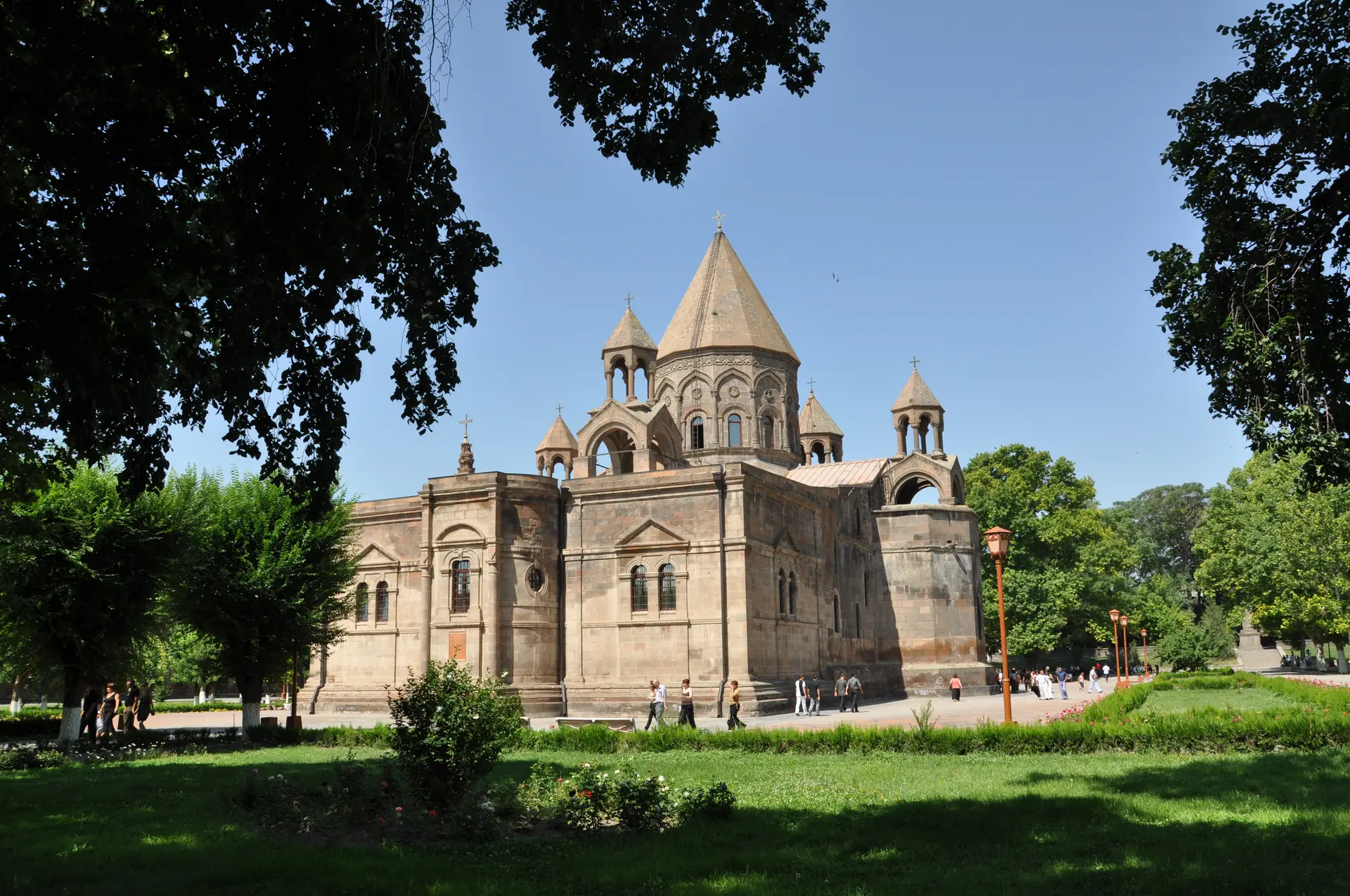
Image of Etchmiadzin Cathedral. Image source · CC-BY-SA-2.0
Visit essentials
A quick read before you go
- Duration
- Two to three hours to fully appreciate the cathedral, treasury museum, and grounds, and possibly…
- Etiquette
- Etchmiadzin is an active center of worship requiring modest dress, quiet respect, and awareness…
Overview
Twenty kilometres west of Yerevan, Etchmiadzin marks where Armenian tradition says Christ descended and struck the ground with a golden hammer, showing Gregory the Illuminator where to build. Traditionally around 301 CE, as Armenia became the first nation to adopt Christianity as its state religion, the cathedral became its Mother Church; today's cruciform, domed structure dates substantially to the 5th century.
Etchmiadzin remained an anchor through Persian invasions, Byzantine pressure, Arab conquest, Mongol devastation, Ottoman persecution, Soviet atheism, and the genocide and diaspora. It is still living headquarters of the Armenian Apostolic Church: the Divine Liturgy sounds in classical Armenian, the Catholicos of All Armenians presides, and the traditionally identified Holy Lance rests in the treasury. A six-year restoration completed in 2024 renewed its frescoes, while prayer connects the cathedral to Gregory's vision seventeen centuries ago.
Why this place is sacred
The ground beneath Etchmiadzin Cathedral was sacred before Christianity arrived. Archaeological excavations have uncovered a Urartian stele dating to the 8th through 6th century BCE, along with an amphora interpreted as part of a fire temple. The cathedral was deliberately built over a pagan temple dedicated to Aramazd, chief god of the ancient Armenian pantheon. This layering of sacred use across millennia suggests a place that different peoples, in different eras, recognized as thin.
According to the 5th-century historian Agathangelos, Gregory the Illuminator's vision of Christ descending here was not merely a dream but a revelation of cosmic architecture. Gregory saw the Lord as a heroic figure of light, surrounded by angels, striking the ground with a golden hammer.
He saw a circular base of gold, a column of fire rising with a capital of cloud and cross, and three similar visions at the sites where the martyrs Hripsime, Gayane, and their companions had been killed. A canopy of cloud in the shape of a dome covered everything, prefiguring the cathedral's form.
This founding vision gave the site its later name: Etchmiadzin, 'the descent of the Only-Begotten.' For Armenians, this is not metaphor. It is the place where heaven touched earth to establish their church.
Since then, seventeen centuries of continuous prayer have accumulated here. The Holy Muron, the sacred chrism used to anoint every ordained clergy member and newly baptized Christian in the Armenian Church, is blessed at this altar using relics of the True Cross, the Holy Lance, and the right hand of Gregory himself. Pilgrims come not to visit a monument but to drink from a living spring.
Gregory the Illuminator built the original cathedral immediately after Armenia's conversion to Christianity, following the vision in which Christ indicated the precise location. From the beginning, Etchmiadzin was intended as the mother church of the Armenian nation, the seat from which the faith would be shepherded. It was simultaneously a cathedral for worship, a headquarters for church administration, and a symbol of Armenian identity as the first Christian nation.
The original 4th-century structure was modest. The major reconstruction that shaped the current cruciform plan came in 483-484 CE under Vahan Mamikonian, after Persian invasions had damaged the earlier building. This reconstruction established the distinctive Armenian architectural innovation of a domed crossing supported by four pillars, a form that would influence Byzantine and European church design.
The cathedral has been renovated and restored repeatedly over the centuries, most recently during the six-year project completed in 2024. In 1441, after centuries when the catholicosate had moved elsewhere due to political turmoil, Etchmiadzin was restored as the permanent headquarters of the Armenian Church. The treasury museum was added in 1868 to house the remarkable collection of relics that had accumulated over the centuries.
Through Soviet persecution that closed churches and imprisoned clergy, Etchmiadzin survived as one of the few functioning religious centers. Through the diaspora created by genocide, it became even more precious as the symbolic homeland for Armenians scattered across the world. What began as the site of a vision has become something more: a anchor of identity for a people who have endured.
Experience and orientation
The transition from the bright Armenian plain to the cathedral's interior is abrupt and deliberate. Your eyes adjust slowly to the dimness, picking out gradually the gold and vibrant colors of the newly restored frescoes, the shafts of natural light falling from carefully placed windows, the altar where the Divine Liturgy has been celebrated for seventeen centuries.
Visitors use remarkably consistent language for what they encounter here: an overwhelming sense of peace, a quality of timelessness that makes the outside world feel distant, a recognition that they are standing where countless generations have stood in prayer. The atmosphere is contemplative rather than bustling, inviting stillness rather than demanding attention.
For Armenians, pilgrimage to Etchmiadzin carries dimensions beyond the spiritual. As one scholar observed, it is as much an ethnic as a religious experience, connecting visitors to seventeen centuries of identity forged through survival. The cathedral holds the memory of what the Armenian people have endured: the invasions, the genocides, the diaspora. To stand here is to stand with ancestors who kept the faith when keeping it meant death.
During the Divine Liturgy, the experience intensifies. The ancient chants in classical Armenian, sung by the cathedral choir, create what visitors describe as angelic voices filling the space. Incense rises. The liturgy unfolds in patterns that have not changed for centuries. Non-Armenians often find themselves moved despite not understanding the words, as though something below language is being addressed.
The treasury museum adds another dimension: the encounter with relics that tradition holds as direct connections to Christ and the apostles. The Holy Lance, believed to have pierced Christ's side, rests in its reliquary. A fragment of Noah's Ark, given according to tradition to Patriarch Jacob when he sought it on Mount Ararat, speaks to the even deeper antiquity of this region in biblical imagination. These are not merely artifacts.
For believers, they are points of contact with the sacred history that shaped the world.
Approach Etchmiadzin as a place of living worship rather than historical museum. If possible, attend a Divine Liturgy, even if you understand nothing of classical Armenian. The experience of the liturgy, with its chants and incense and ritual movements, communicates something beyond translation.
Take time in the cathedral proper before visiting the museum. Sit in the dimness. Let your eyes find the frescoes, the altar, the play of light. The treasures in the museum are impressive, but they are collections; the cathedral itself is the living thing.
If you come during a feast day or major celebration, expect crowds of Armenian pilgrims. You will be witnessing something you cannot fully participate in, the reunion of a scattered people with their spiritual home. Consider whether you want intimate quiet or the energy of communal celebration.
For those in life transitions, Etchmiadzin offers the particular solace of endurance. This church has survived what no church should survive. Whatever you are facing, there is something steadying about entering a place that has weathered so much and continues to pray.
Context and lineage
The story begins with persecution. Tiridates III, king of Armenia, had Gregory tortured and thrown into a pit called Khor Virap for fourteen years after Gregory refused to worship the goddess Anahit and was discovered to be the son of the man who had assassinated Tiridates' father. Left to die, Gregory somehow survived, sustained by a widow who secretly brought him food.
When Tiridates fell grievously ill with a mental affliction so severe that, according to tradition, he took on animal-like behavior, his sister Khosrovidukht had a vision: only Gregory could heal him. The prisoner was brought from his pit, emaciated but alive. Through his prayers, Tiridates was healed, and in his gratitude and conversion, declared Christianity the official religion of Armenia.
What happened next gave Etchmiadzin its meaning. Gregory, now called the Illuminator for bringing the light of faith to Armenia, had a vision of Christ descending from heaven surrounded by angels, appearing as a heroic figure of light. Christ struck the ground with a golden hammer, marking where the cathedral should be built. The vision included other sacred sites, but the place where Christ's hammer fell became the Mother Cathedral, the heart of Armenian Christianity.
The cathedral has served continuously as the headquarters of the Armenian Apostolic Church, though political upheavals sometimes forced the catholicosate to relocate temporarily. In 1441, Etchmiadzin was definitively restored as the permanent seat of the Catholicos of All Armenians.
The 130th Supreme Patriarch and Catholicos of All Armenians currently presides from Etchmiadzin, continuing a line of succession that traces back to Gregory the Illuminator himself. The cathedral is not merely a historic site but an active headquarters: ordinations happen here, church policy is determined here, and the Holy Muron that anoints every Armenian Christian is blessed here every five to seven years.
Through Soviet persecution, the catholicosate survived here when it was extinguished elsewhere. Through the diaspora, Armenians scattered across continents maintained their connection to this mother church. The lineage is not merely institutional but existential: the survival of Etchmiadzin is the survival of Armenian Christian identity.
Gregory the Illuminator
founder
The patron saint of Armenia who converted King Tiridates III and founded the Armenian Church. After fourteen years of imprisonment, he emerged to baptize the king and establish Christianity as Armenia's state religion. His vision of Christ's descent determined where Etchmiadzin would be built. His right hand remains in the treasury, used to bless the Holy Muron.
King Tiridates III
historical
The Armenian king whose conversion in 301 CE made Armenia the first Christian nation. Originally Gregory's persecutor, his healing and conversion set in motion the establishment of the Armenian Church. He commissioned the cathedral's construction after Gregory's vision.
Apostle Thaddeus
apostle
According to Armenian tradition, one of the seventy disciples of Christ who brought Christianity to Armenia in the 1st century CE, along with the Apostle Bartholomew. The Armenian Church claims apostolic foundation through these two missionaries. Thaddeus is said to have brought the Holy Lance to Armenia.
Vahan Mamikonian
historical
The Armenian noble who led the major reconstruction of the cathedral in 483-484 CE after Persian invasion damage. His reconstruction established the distinctive cruciform plan with central dome that defines the cathedral today.
Traditions and practice
The Blessing of the Holy Muron is the most sacred ceremony unique to Etchmiadzin, occurring every five to seven years. The Muron is made from olive oil, balsam, and more than forty varieties of incense, flowers, and spices. For forty days before the blessing, the cauldron is placed on the altar with daily special services. The Catholicos blesses it using three holy relics: pieces of the True Cross, the Holy Lance, and the right hand of Gregory the Illuminator.
This chrism is then distributed to Armenian churches worldwide to anoint ordained clergy, newly baptized Christians, churches, and khachkars (cross-stones).
The Divine Liturgy (Badarak) follows patterns established over centuries, conducted in classical Armenian with elaborate vestments, chanting, and incense. The liturgy's form connects contemporary worshippers to Gregory's time through continuous transmission.
Feast days throughout the year bring particular ceremonies: the Feast of St. Gregory the Illuminator with dove releases symbolizing the Holy Spirit, the Feast of Holy Etchmiadzin commemorating the founding vision, and the Blessing of Grapes and Pomegranates at the Open Altar of King Tiridates III.
Visitors can attend the Divine Liturgy, participating as observers or joining Armenian Christians in worship. The liturgy is usually celebrated in the morning, with Sunday and feast day services drawing larger congregations. Even without understanding classical Armenian, the experience of the ancient chants, incense, and ritual gestures conveys something of the tradition's depth.
Candle lighting is a traditional act of prayer and offering, available to all visitors. Votives are purchased and lit before icons as prayers for specific intentions.
The treasury museum allows visitors to view and venerate the relics, particularly the Holy Lance, which is brought out for public veneration on specific feast days. The guided tour explains the significance and history of each relic.
The grounds and gardens offer space for contemplation between more structured activities. The Open Altar of King Tiridates III, where outdoor celebrations including the blessing of grapes take place, provides another location for quiet reflection.
If you can attend only one thing, make it the Divine Liturgy. Arrive early, find a place where you can observe without obstructing worshippers, and let the service unfold around you. Understanding is not required; presence is.
In the cathedral between services, sit in the dim light and let the space speak. The frescoes tell stories if you look long enough. The play of light through windows is not accidental. Notice where your attention is drawn.
When viewing the Holy Lance in the treasury, consider what it would mean for this object to be what tradition claims: the weapon that wounded Christ, brought to Armenia by an apostle, preserved through seventeen centuries of upheaval. You need not believe this to recognize that millions have believed it, and that belief has weight.
Before leaving, light a candle if this form of prayer speaks to you. Name what you are seeking. The simplest acts of devotion often open what more elaborate practices cannot.
Armenian Apostolic Christianity
ActiveEtchmiadzin is the supreme spiritual and administrative center of the Armenian Apostolic Church, one of the oldest Christian churches in the world. As the seat of the Catholicos of All Armenians, it holds primacy over Armenian Christians worldwide. The cathedral represents Armenia's identity as the first nation to adopt Christianity as its state religion. For over seventeen centuries, it has been the symbolic heart of Armenian Christian identity and cultural continuity, surviving through invasion, persecution, genocide, and diaspora.
The Divine Liturgy (Badarak) is conducted in classical Armenian with ancient chants, elaborate vestments, and incense. The Blessing of the Holy Muron occurs every five to seven years, using relics of the True Cross, the Holy Lance, and Gregory's right hand to sanctify the chrism distributed to Armenian churches worldwide. The Holy Lance is venerated on its feast day. Ordinations and consecrations of clergy take place here. Feast days including the Feast of St. Gregory the Illuminator and the Feast of Holy Etchmiadzin are celebrated with special ceremonies, sometimes including dove releases and blessings of grapes and pomegranates.
Pre-Christian Armenian Religion
HistoricalThe cathedral was deliberately built over a pagan temple dedicated to Aramazd, the chief god of the ancient Armenian pantheon. Archaeological excavations have revealed a Urartian stele and fire temple artifacts beneath the altar, indicating sacred use dating to the 8th through 6th century BCE. This layering symbolizes Armenia's transformation from paganism to Christianity.
Perspectives and open questions
Etchmiadzin invites multiple modes of understanding. Historians and archaeologists can document its age, its layers of construction, its architectural innovations. The Armenian Church holds it as the site of divine revelation and unbroken apostolic tradition. Contemporary seekers encounter something that transcends both frameworks. Honest engagement holds these perspectives together without forcing resolution.
Scholarly perspective
Historians and archaeologists recognize Etchmiadzin Cathedral as one of the oldest continuously used Christian cathedrals in the world, though the precise founding date remains debated. The traditional date of 301 CE was calculated by the 18th-century historian Mikayel Chamchian; some contemporary scholars argue for 314 CE, after the Edict of Milan, based on archaeological and documentary evidence. The current cruciform structure dates substantially to the 483-484 CE reconstruction by Vahan Mamikonian, with modifications over subsequent centuries.
Archaeological excavations beneath the altar have confirmed pre-Christian sacred use, with Urartian artifacts dating to the 8th through 6th century BCE. The presence of a fire temple suggests the site's sacred significance predates the Armenian pantheon associated with the later temple to Aramazd.
The cathedral's architectural innovation, the cruciform plan with central dome supported by four pillars, is recognized as a significant contribution to Christian architecture. UNESCO's inscription notes that the religious buildings of Etchmiadzin graphically illustrate the evolution of the Armenian central-domed cross-hall type, which exerted profound influence on architectural development in the region and beyond.
Armenia's claim to be the first Christian nation is generally accepted by historians, though the dating question and the complexity of what 'official adoption' meant in practice continue to be discussed in scholarly literature.
Living and traditional perspectives
For the Armenian Apostolic Church and the Armenian people, Etchmiadzin is the holiest site in their tradition, sanctified by Christ's own descent in Gregory's vision. The vision is not treated as legend or metaphor but as historical revelation: Christ appeared, indicated where to build, and the cathedral stands on that spot.
The relics housed here, particularly the Holy Lance that pierced Christ's side and the fragment of Noah's Ark from Mount Ararat, connect Armenians to the passion of Christ and to the biblical narrative of human salvation. The Lance was brought by the Apostle Thaddeus himself in the first century; the Ark fragment was given to Patriarch Jacob by divine intervention when he sought to climb Ararat to find it.
Pilgrimage to Etchmiadzin is described as 'as much an ethnic as a religious experience.' The cathedral embodies the survival of Armenian identity through seventeen centuries of invasion, persecution, genocide, and diaspora. To stand here is to affirm that the faith endures, that the people endure, that what Gregory established cannot be destroyed by any earthly power.
The catholicosate's unbroken succession from Gregory to the present Catholicos represents apostolic continuity traced through specific human hands. This is living tradition, not archaeology.
Alternative interpretations
Some spiritual seekers note the significance of sacred layering at Etchmiadzin: Urartian sacred use, pre-Christian fire worship, the temple to Aramazd, and finally the Christian cathedral. From this perspective, the site's power predates any particular tradition's interpretation. The land itself was recognized as sacred by multiple cultures across millennia.
The proximity to Mount Ararat, legendary resting place of Noah's Ark and a powerful symbol in multiple religious and esoteric traditions, adds another dimension. Some view the cathedral's relics, particularly the Ark fragment, as connection points to antediluvian wisdom or primordial human heritage.
The cathedral's recent restoration and reopening in 2024, after six years of work, has been interpreted by some as symbolic of spiritual renewal aligned with larger patterns of transformation in our time.
Open questions
Genuine mysteries remain. What was the exact nature of the pre-Christian temple beneath the cathedral, and what was its relationship to fire worship? What artifacts or structures might remain undiscovered beneath the current building?
The authenticity and provenance of the major relics cannot be verified by scholarly methods. The Holy Lance, the Ark fragment, and the pieces of the True Cross are matters of faith rather than archaeology. Their power lies in what they have meant to generations of believers rather than in any proof that could satisfy a skeptic.
The precise date of Armenia's conversion remains debated. Whether 301 or 314 or some other date, the exact circumstances of Tiridates' transformation from persecutor to Christian king are filtered through hagiographic accounts that blend history with theological meaning.
What happens in this place, what visitors experience and pilgrims seek, exceeds any account we can give of it. The reports of peace, of timelessness, of connection to something vast, are consistent enough to take seriously without being explicable in conventional terms.
Plan your visit
Access and arrival
Most visitors stay in Yerevan, which offers the full range of accommodation from hostels to luxury hotels, and travel to Etchmiadzin as a half-day or day trip. For those seeking to stay closer to the cathedral, simple guesthouses are available in Vagharshapat. The cathedral complex has some pilgrim facilities, though these are primarily for Armenian pilgrims.
Respectful visit
Modest dress is required. Shoulders must be covered; knees must be covered; this applies to both men and women, and to children as well. Sleeveless shirts, shorts, and miniskirts are not appropriate. Head coverings are not required but are considered respectful for women, particularly during services.
Photography is generally permitted in the cathedral and grounds outside of services. During religious ceremonies, photography is not allowed. Flash photography should be avoided in sensitive areas. The treasury museum permits photography after the guided tour portion. Always ask before photographing individual clergy or worshippers.
Candles are the traditional offering and may be purchased on site. Light candles as prayers for specific intentions. Donations are welcome but not required; entry to the cathedral and grounds is free. The treasury museum charges a modest admission fee.
Some areas may be closed during religious ceremonies or for clergy use only. The treasury museum is closed on Mondays. Communion is reserved for members of the Armenian Apostolic Church. Large bags may need to be stored; check with site staff.
Do not attempt to participate in communion unless you are a baptized and chrismated member of the Armenian Apostolic Church. This is a closed communion, reserved for members of the tradition. Observers are welcome at all other parts of the liturgy.
Photography is not permitted during religious services. Even when permitted, exercise discretion. This is an active place of worship, not a museum exhibit.
If you visit during major feast days, be prepared for crowds and limited access to some areas. These are times of intense religious significance for Armenian pilgrims; your role as a visitor is to witness rather than to compete for space.
Current practical details
Address
1 Araratyan Street, Vagharshapat 1101, Armenia
Phone
Hours
Hours, fees, and access can change — verify on the official source before you travel. Practical details last checked Jun 2026.
Location
Map loads as you approach this section.
Pilgrim reflections
A portrait of encounter, not a score
Pilgrims describe what they felt, how present they could become, and whether the place would shape a journey. There are no stars and no ranking of traditions.
No reviewed reflections yet
The first pilgrims can help describe the character of being here.
Share a reflection
Available after an account-backed “Been there.” Every reflection is reviewed before publication.
Nearby sacred places
Explore other sacred places in the region. Proximity does not establish access or travel time; check each place’s guidance.


References
Sources consulted for this page. Source categories describe the publication, not a guarantee that every claim is verified. Traditional accounts and outside interpretations may differ.
- 01Etchmiadzin Cathedral - World History Encyclopedia — World History EncyclopediaacademicAcademic-quality source with archaeological details
- 02Cathedral and Churches of Echmiatsin and the Archaeological Site of Zvartnots — UNESCO World Heritage CentreofficialOfficial UNESCO World Heritage listing
- 03Mother See of Holy Etchmiadzin - Official Website — Armenian Apostolic ChurchspiritualOfficial website of the Armenian Apostolic Church
- 04Our Mother See - The Armenian Church — Armenian Church of AmericaspiritualOfficial Armenian Church source on Etchmiadzin
- 05St. Gregory the Illuminator | Biography, Legends, & Facts — BritannicaacademicAuthoritative encyclopedia entry on founder
- 06The Early Christianization of Armenia — World History EncyclopediaacademicScholarly article on Armenia's conversion to Christianity
- 07Etchmiadzin - Armenian Studies Program — California State University, FresnoacademicAcademic resource on Armenian architecture
- 08Etchmiadzin Cathedral - Wikipedia — Wikipedia contributorsacademicWell-sourced Wikipedia article with extensive references
- 09Blessing of the Holy Muron in Etchmiadzin — Armenian WeeklyspiritualCoverage of 2024 Muron blessing ceremony
- 10The oldest cathedral in the world is in Armenia — AleteiaspiritualCatholic publication discussing cathedral's age
- 11The Holy Etchmiadzin Museum: History of a Long Journey — AGBUofficialDetails on treasury museum and relics
- 12Etchmiadzin Monastery Reviews - TripAdvisor — Various visitorsguideVisitor experiences and practical information
Photo gallery
3 curated photos
Share a photo
Help visitors recognize Etchmiadzin Cathedral. Every submission is reviewed before publication.