Geghard Monastery
Where Armenian faith carved sanctuary from living rock, and voices still echo through seventeen centuries
Understand sacred places, explore living traditions, and learn how to engage respectfully with Pilgrim Map.
Access has not been verified. Check current local guidance before planning a visit.
Goght, Kotayk, Armenia
Read the sources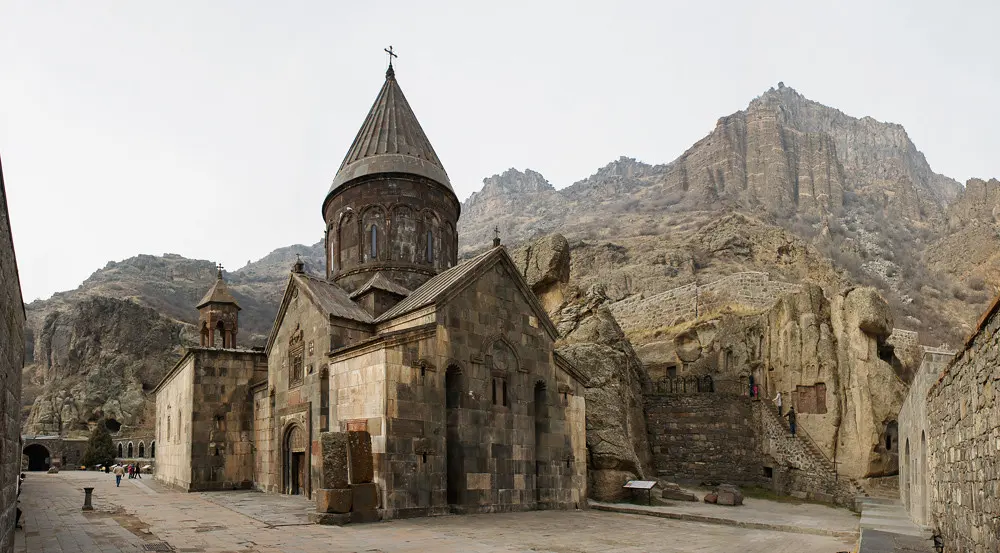
Image of Geghard Monastery. Image source
Visit essentials
A quick read before you go
- Duration
- 1-2 hours to explore all spaces, absorb the atmosphere, and sit in contemplation
- Etiquette
- Geghard is an active place of worship that welcomes visitors.
Overview
There is a quality of sound at Geghard that visitors do not expect. When a choir begins to sing Armenian sacred chants in the rock-cut chambers, the voices do not simply echo. They multiply, layer, transform into something that seems to come from everywhere and nowhere, from the stone itself. People who entered as tourists find themselves weeping.
The monastery rises from a cliff face in the Azat River gorge, thirty-six kilometers southeast of Yerevan. What appears from outside as a modest medieval complex reveals, upon entry, a series of chambers carved directly into the mountain. Some spaces are entirely excavated from rock, their domes and columns shaped from what was removed rather than what was added. Light falls through apertures cut in stone, moving across carved surfaces as the hours pass.
St. Gregory the Illuminator, who converted Armenia to Christianity in 301 CE and made it the first Christian nation, founded a monastery here at a spring already held sacred. For five centuries, Geghard housed the Holy Lance, the spear said to have pierced Christ at the crucifixion, brought to Armenia by the Apostle Thaddeus. The lance has since moved to Etchmiadzin, but the monastery's name remains: Geghardavank, Monastery of the Spear.
Seventeen centuries of prayer have accumulated in these chambers. The stone remembers. And something about the way sound behaves here, the way light enters, the way the mountain holds the space, creates conditions for encounter that visitors across traditions consistently describe.
Why this place is sacred
Long before Christianity reached these mountains, people came to the spring that emerges from the cave. The exact nature of their veneration is lost, but the pattern is familiar: water emerging from rock, life from stone, draws human recognition of the sacred. When St. Gregory chose this site for a monastery, he built upon something already present.
The conversion of Armenia in 301 CE was not a gradual affair. King Tiridates III, having imprisoned Gregory for thirteen years in a pit at Khor Virap, was healed by the very man he had tortured. Armenia became Christian in a single generation, the first nation in the world to do so. Gregory himself established Ayrivank, the Monastery of the Cave, at the sacred spring.
Centuries later, the Holy Lance arrived. According to Armenian tradition, the Apostle Thaddeus brought the relic to Armenia in 33 CE, but when it came to Geghard is less clear. For five hundred years the monastery housed this spear that had touched Christ's body, and pilgrims came from across the Christian world. The monastery took its current name: Geghardavank.
The rock-cut architecture creates something beyond shelter. When the 13th-century builders carved chambers from the mountain, they created acoustic spaces unlike anything found in freestanding structures. Whether they understood what they were doing, whether the remarkable acoustics were intended or discovered, remains unknown. But the effect is consistent: voices singing in these chambers take on qualities that seem impossible, layered and resonant in ways that bypass the rational mind and reach something deeper.
And underlying all of this, the spring still flows. Visitors drink from the pulpulak, the free-flowing fountain, as pilgrims have for seventeen centuries. The water is cold and clean. Something about drinking from a source that has sustained worship for this long carries its own kind of thinness.
Geghard began as a place of worship built over a sacred spring, following the pattern of early Christianity establishing itself at sites already recognized as holy. The original 4th-century monastery was destroyed by Arab invaders in the 9th century. The current structures date primarily to the 13th century, when the monastery became both a spiritual center and a seat of learning, housing a school, scriptorium, and library where scholars like Mkhitar Ayrivanetsi contributed to Armenian manuscript art.
It served simultaneously as a place of pilgrimage centered on the Holy Lance, a monastery supporting over 140 clergy in rock-cut cells, and a cultural institution preserving Armenian learning through centuries of foreign domination.
The monastery has survived what would have destroyed less rooted institutions. Arab invasion in the 9th century destroyed the first structures. Seljuk and Mongol incursions threatened the region. The Holy Lance was eventually moved to Etchmiadzin for safekeeping. Soviet rule brought suppression of religion throughout Armenia.
Yet worship never entirely ceased. The monastery remained a site of pilgrimage even when pilgrimage was discouraged. Today, it functions as both active religious site and UNESCO World Heritage Site, managing the tension between tourism and devotion that marks many living sacred places. Sunday morning Divine Liturgy continues. The December 4th Feast of St. Thaddeus and St. Bartholomew remains the designated Pilgrimage Day of the Holy Lance.
The relic returns, in a sense, each year when it is brought out for veneration at Etchmiadzin.
For Armenian Christians worldwide, Geghard represents something beyond its architectural significance. It embodies the survival of their faith through seventeen centuries, the continuity of a tradition that has outlasted empires.
Experience and orientation
The experience often begins before entering. The approach through the Azat River gorge, cliffs rising on either side, creates a sense of entering a threshold space. By the time the monastery's walls appear, carved into the cliff face, the ordinary world has already receded.
Inside, the temperature drops. The air is cool even in summer, carrying a mineral scent from the stone. Light enters through carved apertures, moving across relief carvings of lions, goats, and geometric patterns as the sun shifts. The space requires time to see fully. Eyes adjust. Details emerge.
Then someone begins to sing.
The acoustics of Geghard have been documented, studied, remarked upon for centuries. But no description prepares visitors for the actual experience. A single voice becomes a choir. The sound seems to emerge from the walls themselves. It layers, sustains, transforms in ways that bypass explanation and reach somewhere below thought. Visitors describe the experience as otherworldly, angelic, divine. Many find themselves weeping without understanding why.
Even without song, the chambers hold a quality of presence. The silence is not empty but full, as though the stone has absorbed centuries of prayer and releases it slowly. The carved khachkars, Armenian cross-stones with their intricate floral and geometric patterns, reward sustained attention. The craftsmanship speaks of devotion expressed through generations of labor.
The spring still flows. Drinking from the pulpulak, visitors participate in something pilgrims have done since before the current structures existed. The water is cold, surprisingly good. There is something grounding about it, a tangible connection to the physical source of this place's original sanctity.
Those who visit during services report a different experience again. The Divine Liturgy, sung in the Armenian Apostolic rite, fills the chambers with sound accumulated over seventeen centuries. To witness worship in a space carved for worship creates a sense of rightness, of seeing something function as intended. Non-Christians report being moved despite not sharing the tradition. Something about the sincerity of it, the continuity of it, transcends doctrinal boundaries.
Geghard rewards those who resist the temptation to photograph everything immediately. The space needs time to work. Consider entering the first chamber and simply standing still, allowing eyes and other senses to adjust. The carvings reveal themselves gradually. The quality of the air, the temperature of the stone, the particular silence of rock, these register if given space.
If you are fortunate enough to encounter singing, whether a scheduled choir, an impromptu performance, or the Sunday liturgy, stop whatever else you are doing. Find a place to sit or stand. Let the sound do what it does without trying to understand or capture it. This may be the most direct encounter with the site's sacred quality.
The spring offers a tangible practice. Drink from the pulpulak with attention. Consider what it means to participate in something pilgrims have done for seventeen centuries. The water is simply water, and also something more.
For those in life transition, carrying questions about direction or meaning, Geghard offers no answers. It offers conditions for something to shift. The combination of antiquity, beauty, accumulated devotion, and those extraordinary acoustics seems to loosen whatever usually keeps us defended. What arises in that loosening is personal, unpredictable, and often significant.
Context and lineage
The founding of Geghard belongs to the birth of Armenian Christianity itself. St. Gregory, born into nobility, raised in Cappadocia as a Christian, returned to Armenia to convert the nation. King Tiridates III, whose father had been killed by Gregory's father, imprisoned him for thirteen years in a pit at Khor Virap. When the king fell ill, a vision revealed that only Gregory could heal him.
Released and restored, Gregory healed the king, who then accepted Christianity and declared it the state religion in 301 CE.
Gregory traveled the land, establishing churches at sites already recognized as sacred. At a spring emerging from a cave in the Azat River gorge, where people had gathered to venerate the water since before memory, he founded Ayrivank, the Monastery of the Cave.
According to Armenian tradition, the Apostle Thaddeus had brought the Holy Lance to Armenia in 33 CE. At some point, this relic came to the monastery, which became known as Geghardavank. The first written record of this name appears in 1250, though the lance's presence likely preceded this by centuries.
The original monastery was destroyed by Arab invaders in the 9th century. What visitors see today dates primarily to the 13th century, when Armenian culture flourished under the protection of the Georgian crown. The Zakarid generals Zakare and Ivane, who recovered Armenia from Turkic control, oversaw construction of the main church in 1215. The spectacular rock-cut chambers came later, commissioned by Prince Prosh Khaghbakian after he purchased the monastery.
The monastery has maintained an unbroken lineage of Armenian Apostolic worship since its 4th-century founding, interrupted only by the 9th-century Arab destruction. The current structures preserve 13th-century construction, but the tradition they house is older. Clergy have prayed here continuously. Pilgrims have come seeking the Holy Lance and, after its removal to Etchmiadzin, seeking what the lance left behind.
In the medieval period, Geghard was a significant intellectual center. The school produced scholars and scribes whose illuminated manuscripts traveled throughout the Armenian world. When the monastery held over 140 clergy in its rock-cut cells, it functioned as a small city dedicated to prayer, learning, and the care of pilgrims.
Soviet suppression reduced active religious life, but worship continued. Independence in 1991 brought restoration of both buildings and tradition. Today the Armenian Apostolic Church maintains the site, balancing its role as active monastery with its status as UNESCO World Heritage Site. The tension is real, but the continuity is more remarkable: seventeen centuries of prayer at a spring that was sacred even before Gregory arrived.
St. Gregory the Illuminator
founder
The apostle who converted Armenia to Christianity in 301 CE and founded the original monastery at the sacred spring. After thirteen years imprisoned in a pit, he healed the very king who had tortured him and established Christianity as the world's first state religion.
Apostle Thaddeus
relic bearer
According to Armenian tradition, brought the Holy Lance to Armenia in 33 CE. Also known as St. Jude. One of the two apostles credited with bringing Christianity to Armenia.
Prince Prosh Khaghbakian
patron
13th-century prince who purchased the monastery and commissioned the famous rock-cut structures, including the family tombs with their elaborate carvings of lions, eagles, and the family's heraldic ram's head with chain.
Mkhitar Ayrivanetsi
scholar
Major 13th-century scholar-historian who lived and worked at Geghard, contributing to Armenian manuscript art and preserving knowledge through a period of foreign domination.
Traditions and practice
The Armenian Apostolic liturgy follows rites developed over seventeen centuries, distinct from both Eastern Orthodox and Roman Catholic traditions. The Divine Liturgy, sung rather than spoken, fills the rock-cut chambers with sacred chant that predates Gregorian plainchant. Clergy in elaborate vestments perform ceremonies that have continued, with variation, since the 4th century.
The December 4th Feast of St. Thaddeus and St. Bartholomew holds particular significance as the designated Pilgrimage Day of the Holy Lance. Though the lance now resides at Etchmiadzin, it is brought out for veneration on this day, connecting the relic to its former home.
The matagh, ritual animal sacrifice, continues to be practiced outside the monastery's east gate. This offering, made to ask God's forgiveness or healing, or as thanksgiving, involves the sacrifice of a lamb or rooster. The meat must be eaten before sunset and shared among seven relatives or neighbors. The practice has roots in pre-Christian tradition, adapted and continued within Armenian Christianity.
Sunday morning Divine Liturgy draws both local worshippers and pilgrims from the Armenian diaspora worldwide. The services are conducted in Classical Armenian, the liturgical language preserved since the 5th century. Choir singing during services demonstrates the extraordinary acoustics that make Geghard famous.
Christmas (January 6 in the Armenian calendar) and Easter feature elaborate ceremonies. Candlemas, feast days of major saints, and other liturgical occasions bring special observances. The monastery remains a site of weddings and baptisms for Armenian families seeking connection to their spiritual heritage.
Visitors who are not Armenian Christians may attend services as observers. The proper posture is one of respectful attention rather than participation. Standing at the back or sides of the chamber allows the ceremony to proceed without interference while offering full witness to the liturgy.
Even outside of services, meaningful engagement is possible. Drink from the sacred spring with attention, participating in something pilgrims have done for seventeen centuries. Light a candle at the designated areas, offering silent prayer or intention regardless of your tradition. Sit in one of the rock-cut chambers and allow the quality of silence to work without forcing interpretation.
If you can arrange to be present when singing occurs, whether the Sunday liturgy, a scheduled choir performance, or an impromptu vocal offering, this may be the most direct encounter with what makes Geghard sacred. Allow the sound to reach you without the mediation of photography or analysis.
For those seeking deeper engagement, attend the Divine Liturgy on Sunday morning. Arrive early to find a position with clear sightlines. Even without understanding Classical Armenian, the sung liturgy communicates something about the tradition's depth and the space's capacity to transform sound into prayer.
Armenian Apostolic Christianity
ActiveGeghard is one of the holiest sites in Armenian Christianity, founded by St. Gregory the Illuminator, who converted Armenia to Christianity in 301 CE. The monastery housed the Holy Lance that pierced Christ for five hundred years. It represents the unbroken continuity of the world's first Christian nation through seventeen centuries of challenge and survival. For the Armenian diaspora worldwide, it embodies the faith that has defined Armenian identity through genocide, exile, and dispersion.
Divine Liturgy is celebrated Sunday mornings with choir singing that demonstrates the extraordinary acoustics. Major Christian holidays feature special ceremonies. The December 4th Feast of St. Thaddeus and St. Bartholomew is the Pilgrimage Day of the Holy Lance. Pilgrims light candles, pray before icons, and drink from the sacred spring. The matagh, ritual animal sacrifice, continues outside the east gate. Baptisms and weddings connect families to seventeen centuries of tradition.
Medieval Armenian monasticism
HistoricalIn the 13th century, Geghard was not only a pilgrimage site but a major center of Armenian learning. The monastery housed a school, scriptorium, and library. Scholars like Mkhitar Ayrivanetsi and Simeon Ayrivanetsi contributed to Armenian manuscript art. Over 140 rock-cut cells housed clergy whose daily rhythms of prayer, study, and labor maintained the tradition through centuries of foreign rule.
The medieval monks followed daily prayer cycles, copied and illuminated manuscripts, taught students, and cared for the pilgrims who came to venerate the Holy Lance. The scriptorium produced works that traveled throughout the Armenian world, preserving and transmitting knowledge.
Pre-Christian spring veneration
HistoricalBefore Christianity reached Armenia, the spring emerging from the cave drew human recognition of the sacred. The Urartians inhabited the region between the 8th and 6th centuries BCE. When St. Gregory founded the monastery, he built upon existing sanctity, a pattern common in Christian conversion.
The specific practices of pre-Christian veneration are unknown. Water emerging from rock has drawn human recognition across cultures; whatever happened here likely followed patterns of offering, petition, and acknowledgment of power beyond human control.
Perspectives and open questions
Geghard Monastery invites multiple readings. Archaeological and art historical scholarship documents its extraordinary architecture. The Armenian Apostolic Church holds it as a site of continuous sacred tradition. Visitors from many backgrounds report experiences that transcend their explanatory frameworks. Holding these perspectives together without forcing resolution honors the complexity of a place this old and this alive.
Scholarly perspective
UNESCO inscription recognizes Geghard as an 'outstanding example of medieval Armenian architecture.' The complex demonstrates innovative rock-cut techniques that influenced regional development. The combination of freestanding and excavated structures, the integration of architecture with natural cliff face, and the sophisticated carving of interior spaces represent the pinnacle of medieval Armenian construction.
Archaeological consensus places the current structures in the 13th century, with the main church dating to 1215 and the rock-cut chambers to mid-century. The site builds upon a 4th-century foundation destroyed by Arab invasion in the 9th century. The Holy Lance housed here is one of several claimed relics; its authenticity, like all such relics, remains a matter of faith rather than historical certainty.
The extraordinary acoustics have attracted scientific study. Whether the builders intentionally designed for these effects or discovered them remains debated. The acoustic properties are measurable and consistent; their cause is less clear.
Scholars agree on Geghard's importance to Armenian Christianity and medieval Armenian culture. The monastery's role as scriptorium and school is documented through surviving manuscripts and historical references.
Living and traditional perspectives
In Armenian Christian understanding, Geghard stands in apostolic succession. The Apostle Thaddeus brought Christianity and the Holy Lance to Armenia in the 1st century. St. Gregory the Illuminator, founding father of Armenian Christianity, established the monastery at a spring he recognized as sacred. The Holy Lance is a genuine relic of Christ's Passion, its presence sanctifying this place for five centuries.
The monastery represents Armenia's identity as the first Christian nation and the faith's survival through seventeen centuries of foreign domination, invasion, genocide, and Soviet suppression. To worship here is to participate in an unbroken tradition that connects contemporary Armenians to their ancestors and to the apostles themselves.
The extraordinary acoustics are understood not as accidental but as divinely ordained, the space shaped by God's providence to enhance worship. When voices transform in these chambers, believers hear something more than sound.
Alternative interpretations
Some visitors perceive the rock-cut chambers as places of concentrated spiritual energy, the combination of sacred spring, ancient stone, and accumulated centuries of prayer creating a powerful vortex or energy node. The pre-Christian origins suggest layers of sacred power predating Christianity. The acoustics are sometimes interpreted as evidence of ancient builders' esoteric knowledge of sound and consciousness, techniques lost to modern construction.
These interpretations lack scholarly support but often emerge from genuine experiences visitors report. The language of energy and vibration may be attempts to describe something real that resists conventional vocabulary.
Open questions
Genuine mysteries remain at Geghard. The authentic provenance of the Holy Lance cannot be historically verified; multiple claimed lances exist worldwide. Details of the original 4th-century monastery before Arab destruction are lost. The nature of pre-Christian worship at the sacred spring is unknown. Whether the rock-cut chambers' remarkable acoustics were intentionally designed or accidentally discovered remains debated. The full extent of the medieval scriptorium's manuscript production is uncertain, with many works likely lost.
These unknowns are worth preserving. They keep the site open to questioning rather than pinned down by false certainty. Geghard has survived seventeen centuries; it can hold our uncertainty.
Plan your visit
Access and arrival
No accommodation at Geghard itself. Yerevan, 35 kilometers away, offers a full range from budget hostels to luxury hotels. Garni village has guesthouses for those wanting to stay closer. The site is typically visited as a day trip from Yerevan.
Respectful visit
Modest dress is required. Cover shoulders and knees. Avoid clothing with offensive images or text. Head covering for women is appreciated during services but not strictly required for general visiting. Practical footwear is advisable given the uneven stone surfaces.
Photography is generally permitted throughout the complex. Use discretion during services; flash is inappropriate. Do not photograph individuals at prayer without clear permission. Consider spending some time simply seeing before documenting. The space rewards direct attention in ways that photographs cannot capture.
Candles may be lit at designated areas. The candle lighting is a form of prayer, not a tourist activity, and should be approached with appropriate intention. Monetary donations are welcome and support the monastery's maintenance and religious functions.
The monastery is open daily from 8:00 AM to 8:00 PM. Entry is free. Some areas may be closed during services. Do not consume food or drink within the worship chambers (the spring water area is an exception). Smoking is not permitted. Large bags should be left outside worship spaces.
Visitors should not attempt to participate in the liturgy unless they are communicant members of the Armenian Apostolic Church. The matagh ceremony is a serious religious act, not a spectacle for tourists. If you encounter a sacrifice being prepared outside the east gate, respectful distance is appropriate unless you are invited to participate.
Do not treat the monastery as a concert venue. While the acoustics are remarkable, entering specifically to test them with your own singing may be inappropriate, particularly if services or private prayer are in progress. Observe and ask before assuming permission.
Current practical details
Address
4RR9+74, Mets Gilanlar, Armenia
Phone
Hours
Hours, fees, and access can change — verify on the official source before you travel. Practical details last checked Jun 2026.
Location
Map loads as you approach this section.
Pilgrim reflections
A portrait of encounter, not a score
Pilgrims describe what they felt, how present they could become, and whether the place would shape a journey. There are no stars and no ranking of traditions.
No reviewed reflections yet
The first pilgrims can help describe the character of being here.
Share a reflection
Available after an account-backed “Been there.” Every reflection is reviewed before publication.
Nearby sacred places
Explore other sacred places in the region. Proximity does not establish access or travel time; check each place’s guidance.


References
Sources consulted for this page. Source categories describe the publication, not a guarantee that every claim is verified. Traditional accounts and outside interpretations may differ.
- 01Monastery of Geghard and the Upper Azat Valley — UNESCO World Heritage CentreofficialOfficial UNESCO World Heritage listing and documentation
- 02Geghard — World History EncyclopediaencyclopediaScholarly historical overview
- 03Monastery of Geghard: In-Depth — CyArkofficialDigital preservation documentation with architectural details
- 04The Holy Lance in Armenian Tradition & Legend — Armenian ChurchofficialOfficial Armenian Apostolic Church perspective on the relic
- 05Geghard — WikipediaencyclopediaWell-referenced comprehensive article
- 06Geghard Monastery: A Complete Travel Guide — Absolute ArmeniaguidePractical visitor information
- 07The Armenian Holy Site Where Music 'Rings Like A Bell' — RFE/RLnewsCoverage of the monastery's remarkable acoustics
- 08Geghard Monastery — MockingbirdspiritualSpiritual and experiential perspective
- 09How to Visit Geghard Monastery: A Day Trip that turned into a Spiritual Odyssey — History FangirlguidePersonal visitor experience report
Photo gallery
3 curated photos
Share a photo
Help visitors recognize Geghard Monastery. Every submission is reviewed before publication.