Khor Virap
The deep pit where Armenian Christianity was born in darkness, with Mount Ararat rising behind
Understand sacred places, explore living traditions, and learn how to engage respectfully with Pilgrim Map.
Access has not been verified. Check current local guidance before planning a visit.
Ararat, Armenia
Read the sources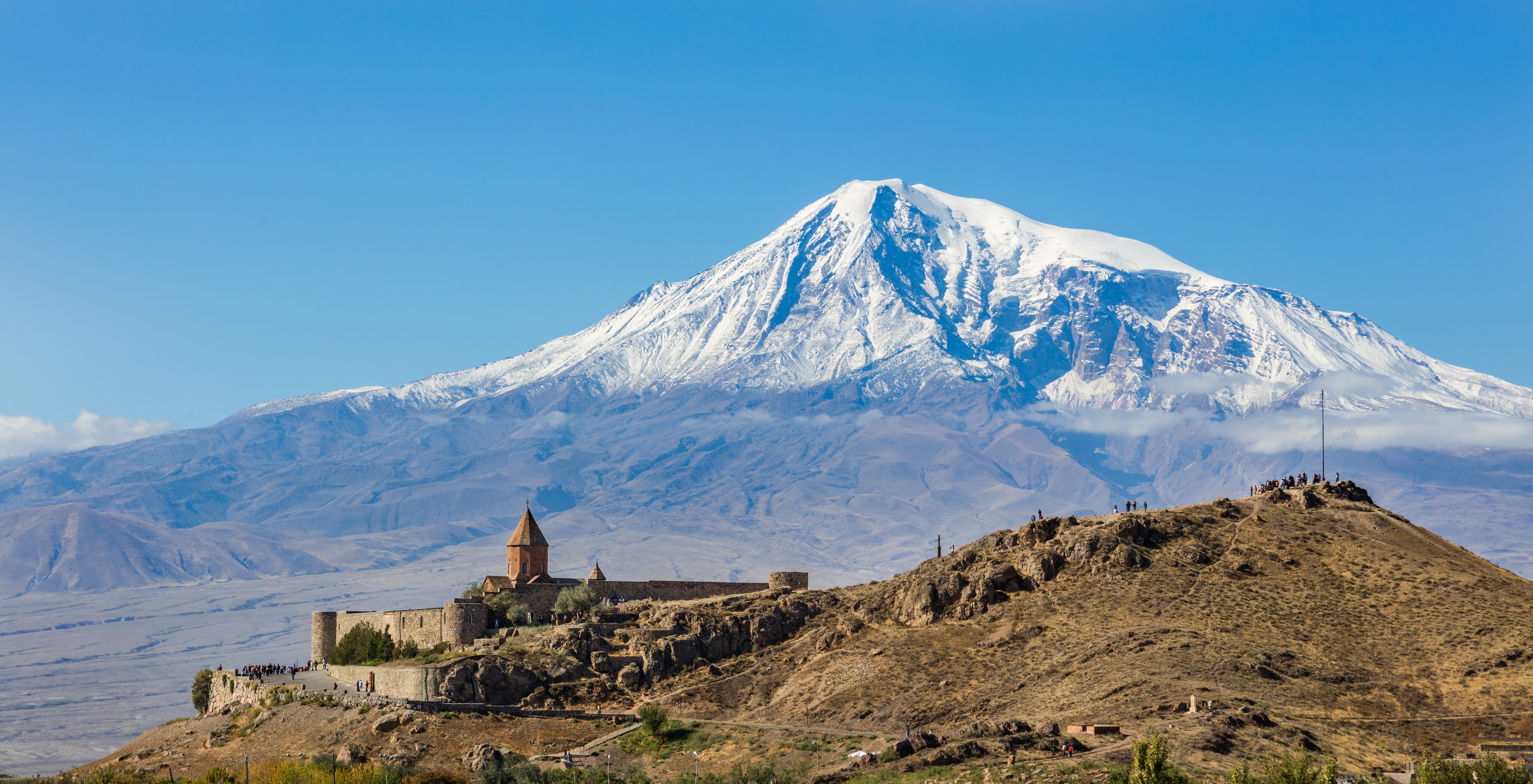
Image of Khor Virap. Image source · CC-BY-SA-4.0
Visit essentials
A quick read before you go
- Duration
- 1-2 hours for the monastery, pit descent, and Ararat views.
- Access
- Located near Lusarat village in Ararat Province, approximately 40 km south of Yerevan (30-40…
Overview
On southern Armenia's Ararat plain, Khor Virap's walled monastery rises from farmland below 5,137-metre, snowcapped dormant Mount Ararat. The mountain appears close but lies across the Turkish border, making proximity and inaccessibility central to the place.
Around 287 CE King Tiridates III condemned Gregory for Christianity to Artashat fortress's virap, or deep dungeon. Tradition says Christian women secretly lowered food, sustaining him for thirteen years. When sources say Tiridates suffered grave madness, his sister Khosrovidukht saw in a vision that Gregory alone could heal him. Freed, Gregory healed and converted the king, and Armenia became Christian in 301—or possibly 314; scholarship differs though tradition does not.
A narrow metal ladder descends into the preserved circular pit, roughly four metres across and six metres deep. Its dark, damp confinement makes Gregory's thirteen years bodily rather than abstract.
Why this place is sacred
The pit is the thing. Everything else at Khor Virap — the chapels, the walls, the khachkars, the souvenir stalls — exists in relation to a hole in the ground where a man was thrown to die and did not die. The vertical dimension of the experience is irreducible. You descend a metal ladder into a space that is dark, confined, and unmistakably a place of suffering.
You stand where Gregory stood, or at least where tradition says he stood, and the scale of what he endured — thirteen years in this darkness — becomes legible in the body rather than the mind.
Then you climb out. You emerge into light and air, and directly ahead, across the plain and across the border, Ararat rises. The mountain where, in another tradition, Noah's ark came to rest after the flood. The movement from pit to sky, from confinement to the largest visible landmark on Earth, replicates in compressed time the arc of the story this place tells: from darkness to illumination, from imprisonment to the founding of a faith.
The border adds an unexpected layer. Ararat is Armenia's national symbol, but it is in Turkey. The mountain is present and unreachable. This condition of visible inaccessibility mirrors something in the spiritual geography of the site — the sacred is close, enormous, undeniable, and yet not quite graspable.
The pit originally served as a dungeon beneath the royal fortress of Artashat, used for the imprisonment and expected death of political and religious prisoners. Its transformation into a site of pilgrimage inverted its purpose entirely — from a place designed to destroy life to one that commemorates life's persistence.
From prison pit to pilgrimage site to active monastery. The first chapel was built in 642 CE by Nerses III the Builder. The larger St. Astvatsatsin Chapel was added in 1662 during the Persian Safavid period. The monastery has been continuously active as a site of the Armenian Apostolic Church, and Pope Francis visited in 2016.
Experience and orientation
Arrive early, before the tour buses. The monastery compound is modest — stone walls enclosing chapels and courtyards. The St. Gevorg Chapel, built in 1662, holds the entrance to the pit. Inside, a metal ladder descends through a narrow shaft into darkness. The descent is steep and the space at the bottom is tight — a circular room roughly four metres across. The air is cool and damp.
A small altar and icon mark the space as sacred, but it is the confinement itself that communicates. Thirteen years in this room is not a number but a weight.
Climb out. The transition from the pit's darkness to the monastery courtyard is abrupt and clarifying. Walk to the monastery walls and face south. Mount Ararat rises from the plain in a proportion that photographs cannot convey — its base broad and agricultural, its peak white with permanent snow. The mountain is in Turkey, across a closed border and a river. On clear mornings, which are most mornings outside winter, every crevice is visible.
The monastery appears to lean toward the mountain, or the mountain toward the monastery.
In the courtyards, carved khachkars — Armenian cross-stones — line the walls. Families arrive for baptisms and post-wedding ceremonies. The matagh ritual, in which an animal is offered and shared, takes place in designated areas. The monastery is not a museum; it is a working institution of the Armenian Apostolic Church, and its rhythms are liturgical rather than touristic.
Begin with the pit descent — this is the foundational experience and everything else radiates from it. After emerging, spend time with the Ararat view. Then explore the chapels and khachkar collection. If a service or ceremony is underway, observe from the periphery. The sequence of descent, emergence, and vista mirrors the narrative the site embodies.
Context and lineage
Gregory, a Parthian nobleman raised as a Christian, entered the service of King Tiridates III. When the king discovered Gregory's faith and his refusal to worship at the pagan temple of the goddess Anahit in Artashat, he ordered Gregory thrown into the pit to die. For thirteen years, Christian women secretly brought Gregory food through the opening of the pit.
When Tiridates fell ill with a madness that his physicians could not treat, his sister Khosrovidukht dreamed that only the imprisoned Gregory could heal him. Gregory was brought from the pit, healed the king, and converted him to Christianity. The date traditionally given is 301 CE.
The site's lineage is continuous from Gregory's imprisonment to the present-day monastery. The Armenian Apostolic Church has maintained the site as one of its holiest pilgrimage destinations. The pit has been preserved as the physical anchor of the founding narrative.
Saint Gregory the Illuminator
Patron saint of Armenia. Survived 13 years in the pit and converted King Tiridates III, establishing the Armenian Apostolic Church
King Tiridates III
King of Armenia who imprisoned Gregory and later converted, making Armenia the first Christian nation
Princess Khosrovidukht
Sister of Tiridates III whose vision prompted Gregory's release from the pit
Nerses III the Builder
Constructed the first chapel over the pit in 642 CE
Traditions and practice
The central practice is pilgrimage to the pit itself — descending the ladder and standing where Gregory stood. The matagh ceremony, in which a family offers and shares an animal (typically sheep or chicken) after a wedding or baptism, continues as a distinctive Armenian Christian practice at the site.
Regular liturgical services of the Armenian Apostolic Church. Baptisms and post-wedding blessings are frequent. The monastery receives both Armenian pilgrims and international visitors. Pope Francis descended into the pit during his 2016 visit to Armenia.
Descend into the pit. The physical experience is the site's essence and no written description substitutes for it. If you visit during a baptism or matagh ceremony, observe the living tradition at work. The early morning, before tour groups arrive, offers the most contemplative conditions.
Armenian Apostolic Christianity
ActiveKhor Virap marks the foundational event of the Armenian Apostolic Church: the imprisonment, survival, and emergence of Saint Gregory the Illuminator, whose conversion of King Tiridates III made Armenia the first Christian nation. The site is among the holiest pilgrimage destinations in the Armenian tradition.
Regular liturgical services, baptisms, post-wedding matagh ceremonies, pilgrimage to Gregory's pit. The monastery functions as an active parish of the Armenian Apostolic Church.
Perspectives and open questions
Khor Virap sits at the intersection of personal faith, national identity, and geopolitical loss. It is at once a monastery, a national symbol, and a vantage point toward an unreachable mountain.
Scholarly perspective
Historians accept the site's identification with Gregory the Illuminator's imprisonment, though the exact dates remain debated (301 vs 314 CE for Armenia's conversion). The monastery's current structures are primarily 17th century. The site's proximity to the ancient capital of Artashat places it within a well-documented archaeological landscape. The pit's dimensions (4.4 m diameter, 6 m depth) are consistent with ancient dungeon architecture.
Living and traditional perspectives
For Armenian Christians, Khor Virap is among the holiest sites in the world — the birthplace of their nation's faith. Gregory's survival in the pit for thirteen years is understood not as a historical curiosity but as a miracle sustained by divine providence and the courage of Christian women who defied the king. The site's proximity to Ararat, the mountain of Noah, deepens its scriptural resonance.
Alternative interpretations
The convergence of pit, mountain, and founding narrative has drawn attention from those who read sacred geography as a language of its own. The vertical axis — descent into the earth, emergence to face the highest visible peak — has parallels in initiatory traditions worldwide. The border separating the monastery from Ararat has been read as a metaphor for exile, longing, and the gap between the sacred and the accessible.
Open questions
Whether Gregory was literally imprisoned in this specific pit, or whether the identification is traditional rather than archaeological, remains an open question. The mechanism of his survival for thirteen years strains historical credulity, though the tradition that sustains the site does not require historical verification to function.
Plan your visit
Access and arrival
Located near Lusarat village in Ararat Province, approximately 40 km south of Yerevan (30-40 minutes by car). Marshrutkas from Yerevan are infrequent; taxis and organised tours are more practical. Free admission.
Very limited near the monastery. Most visitors base in Yerevan and visit as a half-day trip, often combined with Noravank or Areni wine region.
Respectful visit
Modest clothing: shoulders and knees covered. Headscarves for women may be offered at the entrance and are expected during services.
Photography is permitted on the grounds and in the chapels. Avoid flash in the pit. Ask permission before photographing ceremonies or families.
Candle lighting is available in the chapel.
Maintain silence during services | Do not touch or remove khachkars or carved stonework | The pit descent requires navigating a steep, narrow ladder — assess your ability honestly | Give space to families performing matagh ceremonies
The pit descent requires basic physical ability — the ladder is steep and narrow, and the shaft is not suitable for those with claustrophobia or mobility limitations. Peak hours (10am-2pm) can create queues for the pit, diminishing the experience.
Current practical details
Address
near the village of, H11, Pokr Vedi 0612, Armenia
Phone
Hours
Hours, fees, and access can change — verify on the official source before you travel. Practical details last checked Jun 2026.
Location
Map loads as you approach this section.
Pilgrim reflections
A portrait of encounter, not a score
Pilgrims describe what they felt, how present they could become, and whether the place would shape a journey. There are no stars and no ranking of traditions.
No reviewed reflections yet
The first pilgrims can help describe the character of being here.
Share a reflection
Available after an account-backed “Been there.” Every reflection is reviewed before publication.
Nearby sacred places
Explore other sacred places in the region. Proximity does not establish access or travel time; check each place’s guidance.



References
Sources consulted for this page. Source categories describe the publication, not a guarantee that every claim is verified. Traditional accounts and outside interpretations may differ.
- 01Khor Virap - World History Encyclopedia — World History EncyclopediaacademicScholarly treatment of the monastery's history
- 02Khor Virap - Wikipedia — Wikipedia contributorsencyclopediaComprehensive overview of history and architecture
- 03Khor Virap Monastery | Historic Armenian Landmark — Armenia TravelofficialOfficial tourism portal
- 04Khor Virap: A Guide to Armenia's Most Sacred Monastery — The Common WandererguideDetailed visitor guide
- 05Khor Virap Monastery: A Complete Travel Guide — Absolute ArmeniaguidePractical visitor information
- 06Pope Francis visits pit where St. Gregory the Illuminator was imprisoned — AleteiaacademicDocumentation of Pope Francis's 2016 visit
Photo gallery
3 curated photos
Share a photo
Help visitors recognize Khor Virap. Every submission is reviewed before publication.