Sevanavank
Dark stone churches on a high-altitude lakeshore, where a widowed princess built to remember
Understand sacred places, explore living traditions, and learn how to engage respectfully with Pilgrim Map.
Access has not been verified. Check current local guidance before planning a visit.
Sevan, Gegharkunik, Armenia
Read the sources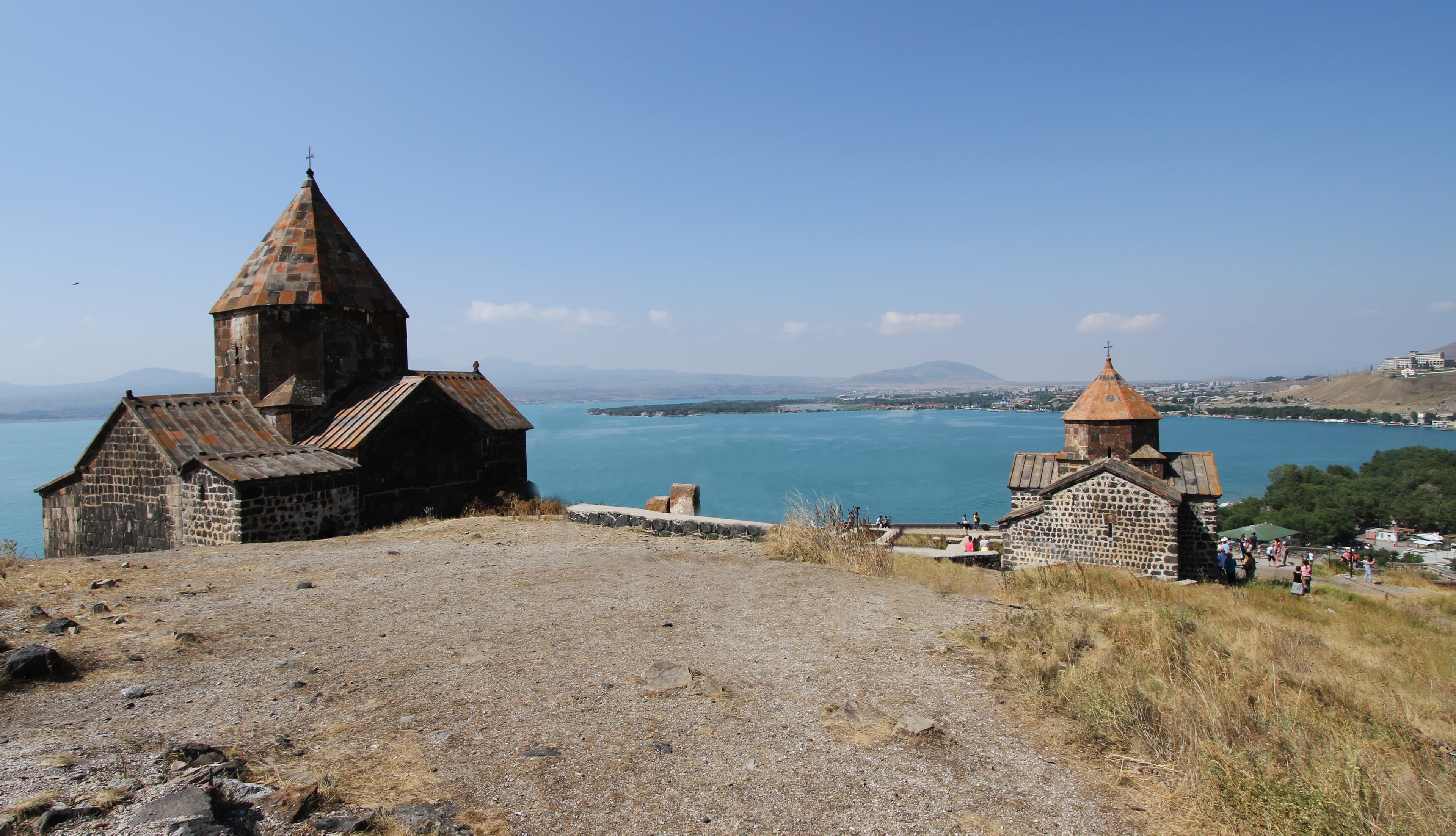
Image of Sevanavank. Image source · CC-BY-SA-4.0
Visit essentials
A quick read before you go
- Duration
- 1-2 hours including the climb, church exploration, and lake views.
- Access
- Located on the northwestern shore of Lake Sevan, approximately 65 km from Yerevan (1.5 hours by…
Overview
Sevanavank occupies the tip of a peninsula in Lake Sevan, Armenia's Gegharkunik Province. It was an island until Stalin-era water diversion projects lowered the lake by twenty metres and joined the monastery to the mainland, the site's most visible wound and a reminder that even a sacred landscape is not permanent.
Two of the three churches Princess Mariam built in 874 CE survive: Surp Arakelots (Holy Apostles) and Surp Astvatsatsin (Holy Mother of God). Their nearly black basalt and tuff earned the monastery its informal name, Sev Vank, the Black Monastery. Against the blue lake, the darkness of the stone creates a visual austerity difficult to photograph and impossible to forget.
Gregory the Illuminator is said to have founded a hermitage here in 305 CE on a pagan temple site whose deity and practices are unknown. A monastic brotherhood and theological school later accompanied the churches. In 921, King Ashot II the Iron fought Arab forces from this ground. Local tradition also values the physical ascent of 230 stone steps: climbing them three times, it is said, equals a pilgrimage to Jerusalem.
Why this place is sacred
The monastery's relationship to the lake is the source of its particular quality. When Sevanavank stood on an island, reaching it required crossing water — a passage from the ordinary to the set-apart that is one of the oldest structures of sacred geography. The Soviet-era lowering of the lake removed this passage. The island became a peninsula, and what was inaccessible became merely elevated.
The loss changes the site but does not diminish it. The 230-step climb now substitutes for the water crossing, creating a physical threshold that the body registers even if the mind knows the history. The steps are steep and the effort is real, and at the top, the dark churches appear against the lake with a severity that makes the effort meaningful.
The stone itself contributes. Basalt and tuff absorb light rather than reflecting it. The churches appear to hold darkness within their walls, and the liturgical chanting that fills them — amplified by acoustics designed for precisely this purpose — seems to emerge from the stone rather than from human throats.
In a tradition that built its churches from local stone, Sevanavank's material palette is an act of geological theology: the building is literally made of the mountain and the volcano, drawn from the earth and assembled into a form that reaches upward.
Gregory the Illuminator founded a hermitage here in 305 CE on the site of a pre-Christian pagan temple. The site's island isolation made it suitable for contemplative withdrawal — a quality that the peninsula transformation has altered but not eliminated.
From pagan temple to Christian hermitage (305 CE) to monastic complex with theological school (874 CE) to military stronghold (921 CE) to Soviet-era environmental casualty (island to peninsula) to revitalised spiritual centre (1990-present). Each transformation has added a layer without entirely erasing what came before.
Experience and orientation
The approach begins at the base of the peninsula, where a market of souvenirs and local crafts lines the path to the stairs. The 230 steps climb steeply, and the effort is part of the design, intended or not. By the time the churches come into view, the body has registered that this is not a casual visit.
Surp Arakelots, the Church of the Holy Apostles, is the first encounter. Its dark stone walls enclose a space that feels deeper than its dimensions suggest. The acoustics are immediately apparent — even quiet speech reverberates against the tuff and basalt. If a service or choir rehearsal is underway, the effect is extraordinary: voices seeming to emanate from the stone itself rather than from the singers.
In the courtyard, a collection of khachkars — carved cross-stones — includes a 12th-13th century crucifixion scene with distinctly Mongol-featured Christ, reflecting the artistic conventions of the period.
Surp Astvatsatsin, the Church of the Holy Mother of God, stands nearby. Between the two churches, the remains of the third — Surp Harutyun, the Church of the Resurrection, the original foundation attributed to Gregory the Illuminator — are visible as foundations.
Then there is the lake. Sevan stretches to horizons in every direction, its surface shifting between blue and grey depending on the weather and the hour. At this altitude — nearly 1,900 metres — the light has a clarity that flattens the distance between near and far. On clear days, the mountains surrounding the lake are visible in their entirety. The scale is not intimate; it is liturgical.
Climb the 230 steps without rushing — the ascent is the beginning of the experience. Enter Surp Arakelots first and sit quietly, listening to the acoustics. Examine the khachkars in the courtyard. Then visit Surp Astvatsatsin. Finally, walk the perimeter of the peninsula for the full lake panorama. If visiting at dawn or sunset, the light on the dark stone and the water surface creates conditions that the midday crowds do not permit.
Context and lineage
Princess Mariam, daughter of King Ashot I Bagratuni and widow of the Syunik prince Vasak Gabur, vowed to build thirty churches in her husband's memory. In 874 CE, together with Archimandrite Mashtots Yegivardetsi — who would later become Catholicos of All Armenians — she oversaw the construction of the churches that still stand at Sevanavank. Whether she completed all thirty churches is historically uncertain. What is certain is that the two on this peninsula endured.
The site traces a lineage from pre-Christian pagan worship through Gregory the Illuminator's hermitage to Princess Mariam's monastic foundation to the present-day Armenian Apostolic monastery and seminary. The environmental transformation — island to peninsula — adds an unusual chapter in which the landscape itself was altered around the sacred site.
Saint Gregory the Illuminator
Founded the original hermitage in 305 CE, over a pagan temple site
Princess Mariam
Daughter of King Ashot I Bagratuni; commissioned the surviving churches in 874 CE as part of a vow to build thirty churches in memory of her husband
Mashtots Yegivardetsi
Archimandrite who oversaw construction with Princess Mariam; later became Catholicos of All Armenians
King Ashot II the Iron
Fought a decisive battle against Arab forces at Sevanavank in 921 CE
Traditions and practice
The monastery served as a centre for theological education and manuscript production throughout the medieval period. The monastic brotherhood established alongside Surp Arakelots maintained a tradition of contemplative learning that connected Sevanavank to the broader network of Armenian intellectual monasticism.
Regular liturgical services of the Armenian Apostolic Church. A seminary operates on site. Wedding ceremonies are frequently held, with photoshoots along the rocky shore. Choir performances within the churches take advantage of the exceptional acoustics. Pilgrimage visits are common, with the 230-step climb treated by some as a devotional act.
Attend a service if timing permits — the acoustics transform liturgical chant into something spatially immersive. If no service is scheduled, sit quietly in Surp Arakelots and listen to the silence the stone holds. The climb itself, taken slowly, functions as preparation. Visit at dawn or sunset for the most affecting light conditions.
Armenian Apostolic Christianity
ActiveSevanavank is one of Armenia's most historically significant monasteries, with a foundation attributed to Gregory the Illuminator and surviving churches built by Princess Mariam. The monastery has served as a centre for worship, theological education, and cultural preservation across twelve centuries.
Regular liturgical services, seminary education, wedding ceremonies, choir performances. Pilgrimage visits and the devotional ascent of the 230 steps.
Perspectives and open questions
Sevanavank holds within its dark stone walls a convergence of grief and devotion, military history and contemplative scholarship, ecological transformation and spiritual persistence.
Scholarly perspective
Architectural historians study the churches as examples of 9th-century Armenian ecclesiastical design, notable for their use of local basalt and tuff. The khachkar collection, including the Mongol-featured crucifixion scene, provides evidence of artistic exchange during the medieval period. The Soviet-era lowering of Lake Sevan is studied as a case in environmental impact on cultural heritage, and recent efforts to restore the lake level reflect growing awareness of the ecological damage.
Living and traditional perspectives
In Armenian Apostolic tradition, Sevanavank's founding by Gregory the Illuminator places it among the earliest and holiest Christian sites in Armenia. Princess Mariam's act of building in memory and grief connects the site to themes of devotion expressed through architecture — the idea that stone can hold love as well as prayer. The local tradition that climbing the 230 steps three times equals a pilgrimage to Jerusalem speaks to the site's devotional weight.
Alternative interpretations
The monastery's island origins have drawn interest from those who see water-surrounded sacred sites as inherently thin places — thresholds between worlds that the crossing of water makes explicit. The environmental transformation from island to peninsula has been read as both a loss (the threshold removed) and a revelation (the sacred persisting even when its protective geography is altered).
Open questions
The pagan temple that preceded Gregory's hermitage is almost entirely unknown — which deity was worshipped, what rites were performed, and whether any physical traces survive beneath the Christian foundations are questions that archaeological investigation might answer but has not yet addressed.
Plan your visit
Access and arrival
Located on the northwestern shore of Lake Sevan, approximately 65 km from Yerevan (1.5 hours by car). Regular marshrutkas and buses run from Yerevan to Sevan town. Free admission. The 230-step staircase to the churches is steep but manageable.
Hotels and guesthouses in Sevan town. Seasonal lakeside resorts and camping options.
Respectful visit
Modest clothing: shoulders and knees covered. Headscarves for women expected during services.
Photography permitted on the grounds and exteriors. Avoid photography during services. Ask before photographing wedding parties.
Candle lighting available in the churches.
Maintain silence during services | Do not touch khachkars or carved surfaces | Give wedding parties and ceremonies respectful space | The seminary is not open to casual visitors
The 230 steps are steep and can be slippery when wet. Summer brings large crowds and inflated prices at lakeside restaurants. The lake water is cold even in summer.
Current practical details
Address
H276+GCV, Sevan, Armenia
Hours
Hours, fees, and access can change — verify on the official source before you travel. Practical details last checked Jun 2026.
Location
Map loads as you approach this section.
Pilgrim reflections
A portrait of encounter, not a score
Pilgrims describe what they felt, how present they could become, and whether the place would shape a journey. There are no stars and no ranking of traditions.
No reviewed reflections yet
The first pilgrims can help describe the character of being here.
Share a reflection
Available after an account-backed “Been there.” Every reflection is reviewed before publication.
Nearby sacred places
Explore other sacred places in the region. Proximity does not establish access or travel time; check each place’s guidance.


References
Sources consulted for this page. Source categories describe the publication, not a guarantee that every claim is verified. Traditional accounts and outside interpretations may differ.
- 01Sevanavank - Wikipedia — Wikipedia contributorsencyclopediaComprehensive overview of history, architecture, and water level changes
- 02Lake Sevan & Sevanavank Monastery - Armenian Geographic — Armenian GeographicguideGeographic and cultural context
- 03Sevanavank Monastery - A Majestic Sight on Lake Sevan — Georgia.toguideVisitor guide with historical context
- 04Sevanavank - Atlas Obscura — Atlas ObscuraofficialCultural significance and visitor perspective
- 05Sevanavank Monastery - Exotic Armenia Tours — Exotic Armenia ToursguideAdditional historical details
- 06Sevanavank Monastery - Eurasia Travel — Eurasia TravelguidePractical information and ceremony details
Photo gallery
3 curated photos
Share a photo
Help visitors recognize Sevanavank. Every submission is reviewed before publication.