Erdene Zuu Monastery
Mongolia's first monastery, where Mongol imperial legacy became Buddhist devotion
Understand sacred places, explore living traditions, and learn how to engage respectfully with Pilgrim Map.
Access has not been verified. Check current local guidance before planning a visit.
Kharkhorin, Övörkhangai, Mongolia
Read the sources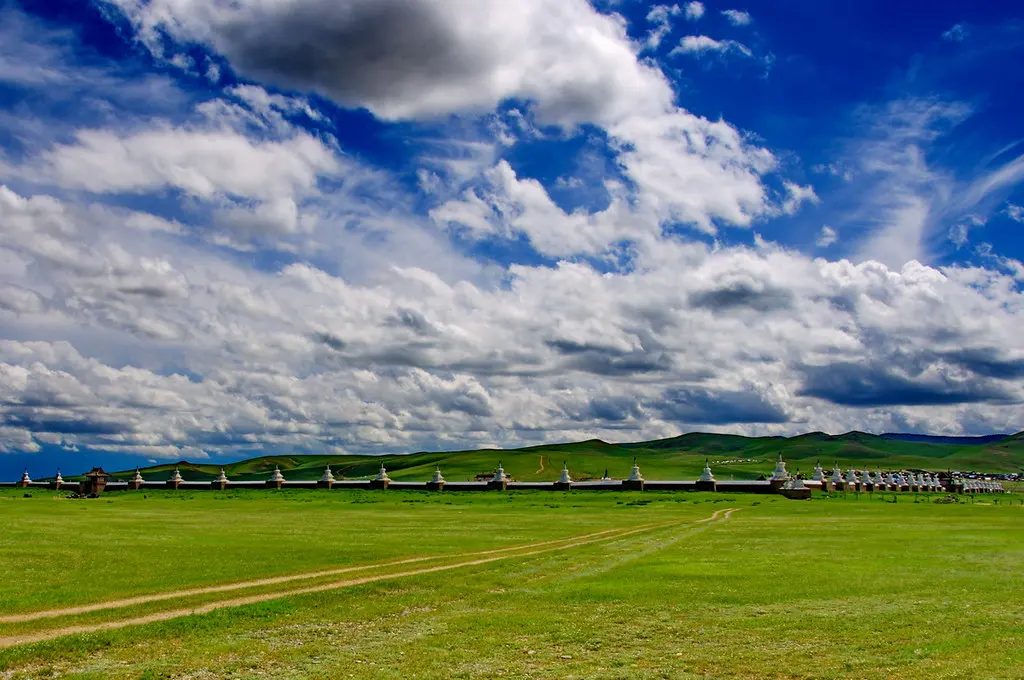
Image of Erdene Zuu Monastery. Image source
Visit essentials
A quick read before you go
- Duration
- One to two hours allows a basic tour of the surviving temples and museum exhibits.
- Access
- The monastery is located approximately 2 kilometers northeast of Kharkhorin town center,…
Overview
On grasslands once commanded by Mongol khans, a descendant of Genghis Khan built temples rather than fortresses. Erdene Zuu's 108 encircling stupas form an architectural rosary and a circumambulation path that has drawn pilgrims for over four centuries; its temples blend Mongolian, Tibetan, and Chinese forms. Communist authorities destroyed most buildings in the 1930s and killed thousands of monks across Mongolia in an attempt to erase Buddhism. Today approximately thirty monks again chant and tend incense.
The compound is simultaneously museum and active monastery, archaeological site and living tradition—not merely a relic, but a resurrection shaped from the stones and landscape of empire.
Why this place is sacred
The Orkhon Valley held significance long before Buddhism arrived. For millennia, nomadic peoples recognized this river valley as special ground. The Turkic Khaganate established capitals here. The Uyghurs built a city. When the Mongols rose to power, they chose this same valley for Karakorum, the center of an empire stretching from Korea to Hungary.
The founding of Erdene Zuu in 1585 was not a random act of piety. Abtai Sain Khan built the monastery on the precise location of Karakorum, using stones and bricks from the ruined imperial city. The two surviving stone turtle sculptures that once marked the boundaries of Genghis Khan's capital still stand outside the monastery walls, draped now with khadags, the blue silk scarves of Mongolian devotion.
The continuity is deliberate: spiritual authority replacing military power, the same ground serving a transformed purpose.
The number 108 appears throughout Buddhist cosmology as a complete number, representing the totality of existence. The 108 stupas forming Erdene Zuu's enclosure wall create a massive mala, a rosary in architecture. To walk their perimeter clockwise is to perform the circumambulation that Buddhists have practiced for centuries, connecting oneself to all who have walked this path before.
That the monastery survived the communist purges adds another dimension to its sacredness. Between 1937 and 1939, over 800 monasteries across Mongolia were destroyed, and an estimated 30,000 monks killed. Erdene Zuu lost most of its temples but three survived, protected as a museum. The buildings that remain are the same buildings where monks chanted for centuries before the destruction. When worship resumed in 1990, it was not a reconstruction but a return.
Abtai Sain Khan established Erdene Zuu following his meeting with the Third Dalai Lama and his declaration of Tibetan Buddhism as the state religion of Mongolia. The monastery was intended as the spiritual center of the Khalkha Mongol realm, a place where the religious power of Tibetan Buddhism would merge with the imperial prestige of the Mongol khans. Building on the ruins of Karakorum transformed political legitimacy into spiritual authority.
The khans who could no longer command armies could still preside over the dharma.
The monastery's first century saw it practice under the Sakya school of Tibetan Buddhism. In 1685, under the influence of Zanabazar, the First Jebtsundamba Khutuktu and most revered figure in Mongolian Buddhist history, Erdene Zuu converted to the Gelug (Yellow Hat) school. It survived raids in 1688 and 1732, rebuilt each time, reaching its peak around 1872 with over sixty temples and hundreds of resident monks.
The communist era nearly ended everything. Between 1937 and 1939, all but three temples were demolished. The Bodhi Stupa was destroyed. Monks were executed, imprisoned, or forced to abandon their robes. For over fifty years, the monastery existed only as a museum, its religious function legally prohibited.
The revival began in 1990 with the fall of communism. Monks returned to their vocations. The Labrin Temple became an active place of worship again. Today, the monastery navigates its dual identity as both cultural heritage site and living monastic community, hosting tourists and pilgrims, scholars and seekers, all beneath the gaze of the mountains and the silent presence of centuries.
Experience and orientation
Approaching Erdene Zuu across the Orkhon Valley, the first thing you notice is scale. The endless steppe stretches in every direction, grass rolling toward distant mountains under an enormous sky. Then the white stupas appear, 108 of them forming a wall against the green, marking a boundary between the open world and the enclosed sacred.
Inside, the atmosphere shifts. The grassland wind still moves through, but it passes now between temples rather than through unbounded space. Incense drifts from the active temples. The sound of monks chanting, when it occurs, seems both ancient and present, a continuity that defies the violence of the intervening decades.
Many visitors report a particular quality of attention here. The monastery asks something of those who enter it. Perhaps it is the knowledge of what nearly happened, the awareness of standing in a place that survived attempted annihilation. Perhaps it is the layering of histories: Mongol imperial capital, Buddhist monastery, communist museum, revived temple. All of these remain present in the stones.
The stone turtles outside the walls draw pilgrims who drape them with khadags and leave offerings. These guardians of ancient Karakorum have watched over this ground for eight centuries, through transformations they could not have anticipated. There is something moving about their persistence, their witness.
Those who arrive during ceremonies report the most striking experiences. Watching monks chant in temples that were forbidden for fifty years, in a tradition that was meant to be erased, produces a response that transcends tourism. This is not simply history preserved; it is faith resurrected.
Erdene Zuu rewards visitors who arrive with some understanding of what they are entering. The monastery is not simply old buildings on pretty grassland. It is a place where an empire became a religion, where destruction met persistence, where silence returned to singing.
Consider circumambulating the 108 stupas before entering the main compound. The walk takes perhaps an hour and connects you to centuries of pilgrims who have done the same. Move clockwise, as Buddhist practice requires. Let the repetition of white forms create its own effect. By the time you enter the gates, you will have earned your arrival.
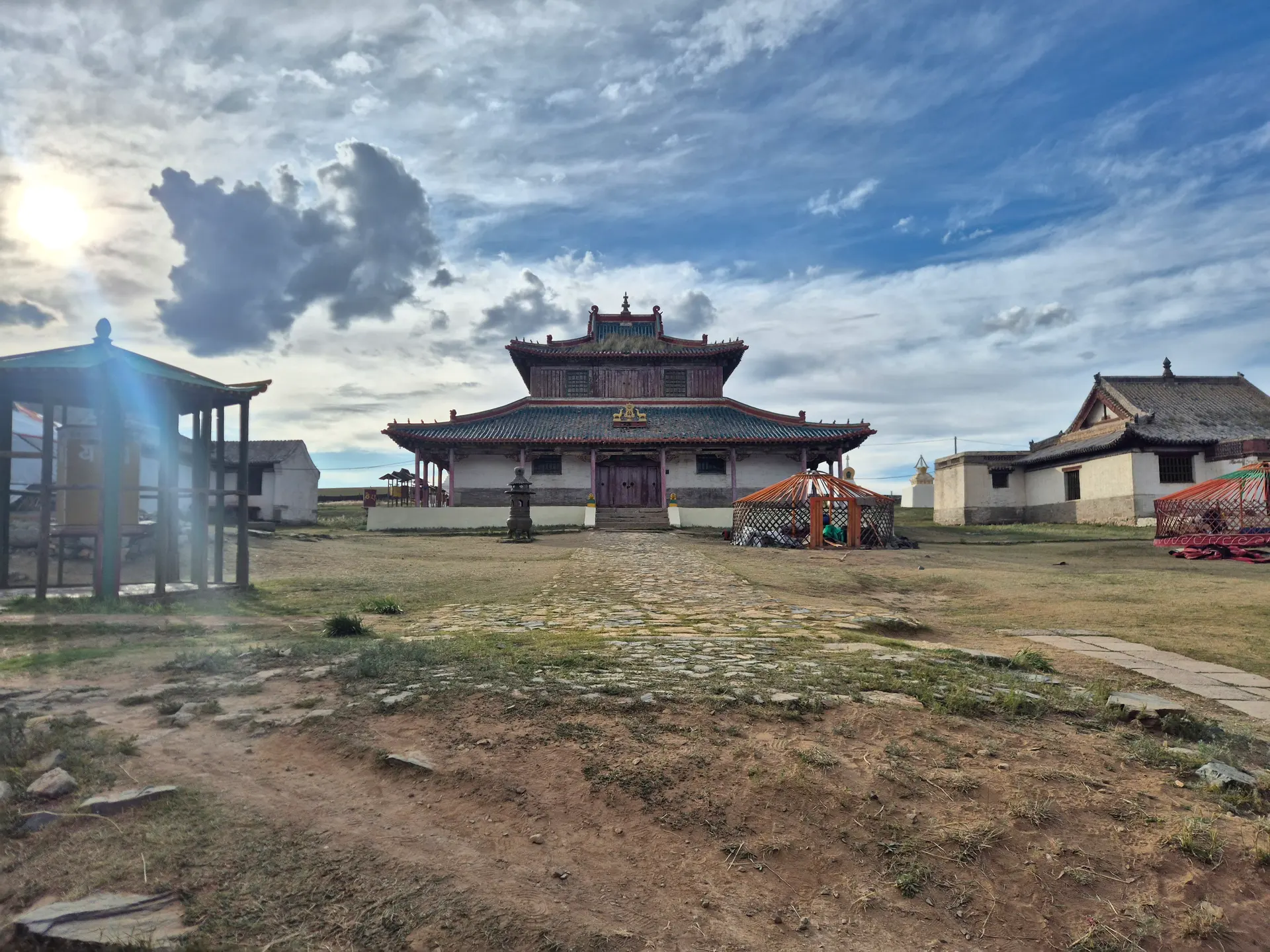
Inside, watch for the transition between museum and active worship. Some temples are exhibits; others hold living practice. The Labrin Temple, with its Tibetan architectural style, is the primary active temple. If monks are chanting, you may enter quietly and observe. Sit at the back. Let the sound work on you without needing to understand the words.
Before leaving, find the golden Bodhi Stupa near the center of the compound. A reconstruction of the original destroyed by communists, it contains sacred artifacts and represents the monastery's return to life. Circumambulate it three times. Consider what it took to rebuild after such loss.
Context and lineage
The story begins with a meeting between a Mongol khan and a Dalai Lama. In 1578, Abtai Sain Khan, ruler of the Khalkha Mongols and descendant of Genghis Khan, met with Sonam Gyatso, the Third Dalai Lama. From this meeting came the declaration that Tibetan Buddhism would be the state religion of Mongolia, a decision that would reshape the entire culture.
Seven years later, Abtai Sain Khan ordered the construction of a monastery on the site of Karakorum, the 13th-century capital that had been the heart of the Mongol Empire. By using stones and bricks from the ruined city, he created a direct material link between the old empire and the new spiritual order. The name Erdene Zuu, meaning Hundred Treasures, reflected the aspiration to create a center of sacred abundance.
The first small blue temple was completed by summer 1586. Over the following centuries, the monastery would grow to encompass over sixty temples, housing hundreds of monks at its peak. It would serve as the spiritual heart of Mongolian Buddhism, training generations of monks, hosting the famous Tsam dance festivals, and drawing pilgrims from across the steppes.
Erdene Zuu's lineage carries the weight of Mongolian history. From Abtai Sain Khan through generations of monks and teachers, the monastery transmitted Buddhist teachings across the steppes, adapted Tibetan practices to Mongolian culture, and maintained the Gelug tradition following Zanabazar's conversion.
The communist period nearly severed this lineage. Monks who survived did so by hiding their practice, preserving teachings in memory during decades when public observance meant imprisonment or death. Some fled to Mongolia's remote countryside; others maintained secret practice even in the cities.
When religious freedom returned in 1990, elderly monks who remembered the old ways emerged to train a new generation. The current community represents both continuity and renewal. Some monks are direct students of those who practiced before the destruction. Others are young men drawn to a tradition their grandparents could not openly observe. Together, they carry forward something that was meant to be erased.
Abtai Sain Khan
historical
The founder of Erdene Zuu, a Khalkha Mongol ruler and descendant of Genghis Khan. His decision to build the monastery on the ruins of Karakorum symbolically transformed Mongol imperial power into Buddhist spiritual authority.
Zanabazar (First Jebtsundamba Khutuktu)
historical/spiritual
The most revered figure in Mongolian Buddhist history, grandson of Abtai Sain Khan. A sculptor, architect, and creator of the Soyombo script, he converted Erdene Zuu from the Sakya to Gelug school in 1685. His influence shaped Mongolian Buddhism for centuries.
Third Dalai Lama (Sonam Gyatso)
historical/spiritual
The Tibetan Buddhist leader whose meeting with Abtai Sain Khan led to the declaration of Buddhism as Mongolia's state religion. This encounter set in motion the founding of Erdene Zuu and the transformation of Mongolian culture.
Fourth Bogd Gegeen
historical/spiritual
The Buddhist leader who commissioned the original golden Bodhi Stupa in 1799, a structure destroyed by communists and later rebuilt, symbolizing the monastery's resilience.
Traditions and practice
At its height, Erdene Zuu hosted elaborate ceremonies throughout the Buddhist calendar. The Tsam dance festival was particularly famous, featuring monks wearing elaborate masks and costumes representing deities and demons, performing dances intended to defeat the dark spirits causing suffering. These dances combined Tibetan Buddhist ritual with distinctively Mongolian elements, including references to pre-Buddhist shamanistic practices.
Daily monastic life followed Gelugpa discipline: morning and evening prayers, scriptural study, philosophical debate, and meditation. Monks progressed through stages of training, some specializing in ritual performance, others in scholarship, still others in tantric practice. The monastery maintained a printing house that produced Buddhist texts in Mongolian and Tibetan.
Historical practices also included pilgrimage circumambulation around the 108 stupas, offerings at temples and shrines, and ceremonies for life transitions such as birth, marriage, and death. The monastery served as spiritual center for Mongolian Buddhist life across the region.
Today, approximately thirty monks reside at Erdene Zuu, conducting daily prayers in the Labrin Temple and other active worship spaces. Morning chanting begins early; visitors who arrive at dawn may hear the deep resonance of prayers that have resumed after decades of silence. Ceremonies for Buddhist holy days continue, including observances of Tsagaan Sar, the Mongolian Lunar New Year, when pilgrims gather in significant numbers.
The Tsam dance festival has been partially revived, though on a smaller scale than historically. When performed, it draws both Mongolians reconnecting with suppressed heritage and international visitors witnessing a tradition returned from near extinction.
Pilgrims continue to circumambulate the 108 stupas, moving clockwise around the monastery walls. At the stone turtle guardians outside, offerings of khadags (blue silk scarves) and small coins accumulate, honoring both Buddhist and pre-Buddhist Mongolian sacred practice. The ger temple near the golden Bodhi Stupa offers an intimate space for prayer, combining the traditional Mongolian dwelling form with Buddhist worship.
Enter the experience as a visitor to a living tradition, not merely a tourist at a monument. The following practices are appropriate for visitors regardless of personal belief.
Circumambulate the 108 stupas before or after entering the main compound. Walk clockwise, maintaining the stupas on your right. This practice connects you to centuries of pilgrims while creating a meditative transition between the open steppe and the enclosed sacred space. One circumambulation takes roughly an hour; three is traditional for those with time.
If monks are chanting in the Labrin Temple, you may enter quietly and sit at the back. Remove your hat. Sit in silence and allow the sound to work without needing to understand. The chanting itself is practice, not performance.
At the golden Bodhi Stupa, circumambulate three times clockwise. Consider that this structure was destroyed in the 1930s and rebuilt after 1990. Your presence at this reconstruction is part of its continued life.
Before leaving, pause at one of the stone turtles. These guardians have watched over this ground since the time of Karakorum. You need not leave an offering to acknowledge their witness.
Gelug Tibetan Buddhism
ActiveErdene Zuu has practiced the Gelug (Yellow Hat) school of Tibetan Buddhism since its conversion in 1685 under Zanabazar. The monastery served as a major center for Gelugpa liturgy, meditation, scriptural study, and monastic discipline in Mongolia. It played a crucial role in establishing Tibetan Buddhism as Mongolia's dominant religious tradition and trained generations of monks in Buddhist philosophy. The current community continues Gelug practices, maintaining the liturgical and meditative traditions of this school.
Daily morning and evening prayers, chanting of Buddhist scriptures, meditation, and offerings follow Gelugpa forms. Ceremonies for Tsagaan Sar and other Buddhist holy days observe Gelug liturgy adapted to Mongolian custom. The Tsam dance festival, when performed, represents a Gelugpa ritual tradition brought to Mongolia from Tibet. Monks progress through stages of training including scriptural study, philosophical debate, and ritual performance.
Sakya Tibetan Buddhism (Historical)
HistoricalErdene Zuu was originally established as a Sakya school institution in 1585. The Sakya connection came through the early adoption of Tibetan Buddhism by Mongolian khans and the influence of the Third Dalai Lama's visit to Mongolia. The monastery practiced the Sakya tradition for approximately one hundred years before its conversion to Gelug under Zanabazar.
Historical Sakya rituals and teachings were practiced at the monastery from 1585 to 1685. The specific forms of Sakya practice at Erdene Zuu during this period are not extensively documented, though they would have included the liturgical and meditative traditions of that school.
Mongolian Pre-Buddhist Traditions
HistoricalThe Orkhon Valley and the site of Karakorum held significance in pre-Buddhist Mongolian culture. The establishment of Erdene Zuu represented the transformation of Mongolia from a primarily shamanistic culture to one shaped by Buddhist principles. Some pre-Buddhist elements were incorporated into Mongolian Buddhist practice, creating a distinctive syncretic tradition that persists in modified form today.
Historical practices included ovoo worship (cairns honoring local spirits), ancestor veneration, and rituals addressing the spirits of the land. Elements of these practices continue in modified form within Mongolian Buddhism. The offerings at the stone turtle guardians, blending Buddhist and pre-Buddhist elements, suggest ongoing integration of older Mongolian sacred traditions.
Perspectives and open questions
Erdene Zuu invites multiple readings: as archaeological site, as living monastery, as symbol of cultural transformation, as testament to survival. Each perspective illuminates something genuine about the place. Holding them together, without forcing reconciliation, allows the site to reveal its complexity.
Scholarly perspective
Historians and archaeologists recognize Erdene Zuu as the first Buddhist monastery in Mongolia and a crucial site for understanding the Mongolian adoption of Tibetan Buddhism. The deliberate construction using materials from Karakorum demonstrates the intentional connection between Buddhist spiritual authority and Mongol imperial heritage. The monastery's role in transforming Mongolian culture from shamanism to Buddhism marks one of the major religious shifts in Inner Asian history.
The destruction during the communist period and subsequent revival provide a case study in the relationship between political ideology and religious suppression. The survival of three temples, preserved as a museum while religious practice was forbidden, raises questions about the complex negotiation between heritage preservation and active faith.
UNESCO recognition as part of the Orkhon Valley Cultural Landscape emphasizes the site's position within a broader pattern of human occupation spanning millennia. Scholarly consensus views the valley as demonstrating continuous adaptation of nomadic pastoral culture to the grassland environment, with Erdene Zuu representing one chapter in that ongoing story.
Living and traditional perspectives
For Mongolian Buddhists, Erdene Zuu represents the spiritual heart of their tradition, the place where Buddhism took root in Mongolian soil. The monastery's connection to Zanabazar, the most revered figure in Mongolian Buddhism, adds to its sanctity. Pilgrims understand their circumambulation of the 108 stupas as accumulating merit, purifying karma, and connecting to the lineage of practitioners who have walked the same path.
The monastery's survival through communist persecution is understood in spiritual terms. That the three temples remained standing, that the tradition could be revived, that monks who hid their practice during decades of suppression could emerge to teach again, these facts carry religious significance. The revival is not merely historical recovery but something closer to resurrection.
The presence of monks chanting in temples where their predecessors were killed maintains a continuity that believers understand as testament to the dharma's persistence. Coming to Erdene Zuu is not simply visiting a monument; it is participating in a tradition that refused to die.
Alternative interpretations
Some visitors are drawn by the monastery's position on the site of Karakorum and the Orkhon Valley's ancient sacred significance. The convergence of nomadic pastoral culture, imperial Mongol history, and Buddhist devotion creates a unique sacred geography. The stone turtles from Karakorum, honored with offerings that blend Buddhist and pre-Buddhist Mongolian practice, suggest layers of sacredness predating any single tradition.
The 108 stupas, understood in Buddhist tradition as representing the complete number of existence, invite interpretation as a form of sacred architecture designed to affect consciousness. Some visitors describe the circumambulation as producing altered states or heightened awareness, though whether this reflects the architecture's design, the accumulated intention of centuries, or psychological response to the ritual remains open.
The site's survival through attempted destruction invites reflection on what persists when institutional religion is suppressed. Something maintained itself through fifty years of prohibition, in the memories of those who hid their practice, in the buildings preserved as museum rather than temple. What that something is, whether simply human determination or something more, visitors assess for themselves.
Open questions
Genuine mysteries surround Erdene Zuu. What pre-Buddhist sacred practices occurred on this ground before the monastery's founding? The Orkhon Valley held significance for nomadic peoples long before Buddhism arrived, but the specific nature of that significance remains largely unrecorded.
What happened to the religious artifacts that locals reportedly hid during the communist destruction? Some items have been returned to the monastery since 1990, but oral tradition suggests others remain hidden, their locations known only to aging families who have kept the secret for decades.
How did shamanistic elements integrate with Buddhist practice at the monastery? The khadags and offerings at the stone turtles suggest continuity with pre-Buddhist veneration, but the specific ways Mongolian shamanism and Tibetan Buddhism blended at Erdene Zuu are incompletely documented.
What was the full ceremonial calendar at the monastery's peak? Contemporary knowledge of historical practices derives partly from comparison with other Mongolian monasteries and partly from the memories of elderly practitioners. Much may have been lost with the monks who died in the purges.
Plan your visit
Access and arrival
The monastery is located approximately 2 kilometers northeast of Kharkhorin town center, accessible by foot, taxi, or as part of organized tours. From Ulaanbaatar, the journey takes 5-6 hours by paved road. Public buses run to Kharkhorin, though most international visitors arrive via organized tours or private drivers. Entry fees are approximately T5,000 for adults (roughly US $1.80), with additional fees for camera use. English-speaking guides are available.
Kharkhorin offers guesthouses and small hotels at various price points, allowing visitors to stay near the monastery and return for morning or evening visits. Tourist ger camps in the surrounding valley provide traditional Mongolian hospitality in nomadic-style accommodations. For those seeking a more immersive experience, the broader Orkhon Valley offers ger camps in more remote settings. Ulaanbaatar, five to six hours away, provides full tourist infrastructure.
Respectful visit
Dress modestly, covering shoulders and knees. This applies regardless of gender. The Mongolian steppe can be cool even in summer, and warmer clothing is practical as well as appropriate. Comfortable walking shoes are essential for circumambulating the stupas and exploring the grounds.
Photography is permitted in general areas with payment of a camera fee at the entrance. Photography is not permitted during religious ceremonies. Ask permission before photographing monks. Tripods and professional equipment may face additional restrictions or fees. Consider experiencing the monastery without a camera for at least part of your visit.
Incense may be offered at appropriate shrines within the active temples. Khadags (silk scarves, usually blue or white) are traditional Mongolian offerings seen at the stone turtles and other sacred spots. Small monetary offerings may be left at designated locations. If you wish to make offerings, do so with sincerity rather than performance.
Do not touch or climb on any structures, sculptures, or sacred objects. Do not remove anything from the site, including loose stones. Walk only in permitted areas. Large bags may need to be stored. Smoking is not permitted within the monastery grounds. Do not disturb monks during prayers or approach them intrusively for photographs.
Do not touch sacred objects, sculptures, or painted surfaces within the temples. Some damage at Erdene Zuu resulted from well-meaning tourists who did not understand the fragility of centuries-old artifacts. Observe all roped-off areas and signage.
During active ceremonies, maintain silence and remain at the back of worship spaces. Photography during ceremonies is not permitted. The monks are engaged in genuine religious practice, not performance.
Be aware that Erdene Zuu operates as both museum and monastery. Respect the distinction. In museum spaces, the rules of heritage preservation apply. In active worship spaces, the protocols of a living tradition take precedence.
Current practical details
Address
6R2R+F9Q, Kharkhorin, Ovorkhangai, Mongolia
Hours
Hours, fees, and access can change — verify on the official source before you travel. Practical details last checked Jun 2026.
Location
Map loads as you approach this section.
Pilgrim reflections
A portrait of encounter, not a score
Pilgrims describe what they felt, how present they could become, and whether the place would shape a journey. There are no stars and no ranking of traditions.
No reviewed reflections yet
The first pilgrims can help describe the character of being here.
Share a reflection
Available after an account-backed “Been there.” Every reflection is reviewed before publication.
Nearby sacred places
Explore other sacred places in the region. Proximity does not establish access or travel time; check each place’s guidance.

References
Sources consulted for this page. Source categories describe the publication, not a guarantee that every claim is verified. Traditional accounts and outside interpretations may differ.
- 01Orkhon Valley Cultural Landscape — UNESCO World Heritage CentreofficialOfficial UNESCO documentation for World Heritage Site
- 02Erdene Zuu — Treasury of LivesacademicBiographical encyclopedia of Tibet and Inner Asia
- 03Erdene Zuu Buddhist Monastery, Mongolia — World Monuments FundSource contextHeritage conservation perspective
- 04Erdene Zuu Monastery — Wikipedia contributorsencyclopediaComprehensive overview with historical details
- 05Erdene Zuu Khiid — Lonely PlanetguidePractical visitor information
- 06Erdene Zuu - The Oldest Monastery in Mongolia — Atlas ObscuraguideHistorical and cultural context
- 07History of Karakorum city continues with Erdene Zuu Monastery — Montsame News AgencynewsMongolian national news perspective on connection to Karakorum
- 08Erdene Zuu Monastery Travel Guide — Tours MongoliaguidePractical visitor information and cultural context
Photo gallery
3 curated photos
Pilgrim glossary
- Stupa
- A dome-shaped Buddhist monument that holds relics or marks a sacred place.
- Dharma
- The teachings of the Buddha; also the universal law underlying them.
Share a photo
Help visitors recognize Erdene Zuu Monastery. Every submission is reviewed before publication.