Mt. Wu Tai Shan
Dwelling place of Manjushri, where Chinese and Tibetan Buddhism worship the same wisdom on the same mountain
Understand sacred places, explore living traditions, and learn how to engage respectfully with Pilgrim Map.
Access has not been verified. Check current local guidance before planning a visit.
Taihuai, Shanxi, China

On this pilgrimage
Four Sacred Buddhist Mountains of ChinaVisit essentials
A quick read before you go
- Duration
- One full day for Taihuai area monasteries.
- Access
- Wutai County, Xinzhou, Shanxi Province, approximately 240 km southwest of Beijing.
Overview
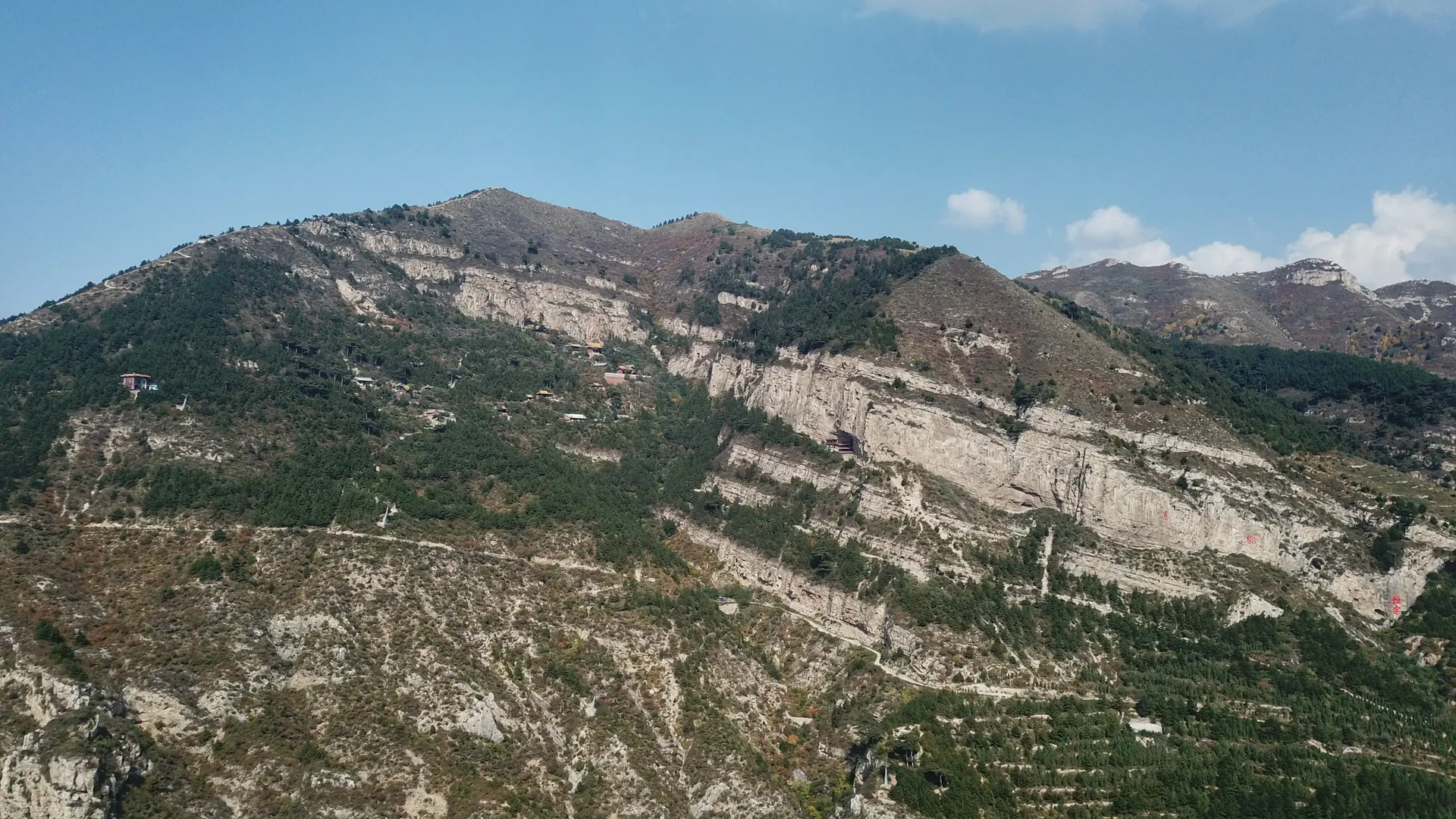
The Avatamsaka Sutra locates Manjushri, Bodhisattva of Wisdom, with ten thousand bodhisattvas on a northeastern Clear Cool Mountain. Chinese Buddhists identified it with Wutaishan's five flat-topped peaks, cool above the North China plain; pilgrims from Japan, Korea, India, and Tibet have come for more than 1,500 years.
Wutaishan uniquely joins Chinese monks in gray and Tibetan monks in maroon, worshipping Manjushri in different languages and forms within the same valley. Tibetan practice arrived under Yuan-dynasty Mongol patronage and has continued for more than seven centuries; no other major Chinese Buddhist site holds this dual tradition.
Its monuments include Foguang Temple's 857 CE East Main Hall, one of China's oldest timber structures and rediscovered by Liang Sicheng in 1937; Nanchan Temple's still older 782 CE structure; Tayuan Temple's fifty-metre Great White Pagoda; and Xiantong Temple, the largest monastery, with Eastern Han foundations. Some forty to fifty monasteries remain active, with services before dawn. The demanding Chaotai pilgrimage reaches all five peak temples over two to three days; some pilgrims travel the entire route on their knees.
Why this place is sacred
Wutaishan works on the mind. This is Manjushri's mountain, the mountain of wisdom, and its gift is clarity. The five peaks represent the five aspects of perfect understanding, and the Chaotai pilgrimage to all five is a journey through the dimensions of insight.
The identification with the Avatamsaka Sutra's Clear Cool Mountain gives the site scriptural authority. This is not a mountain that became sacred through human decision but one identified by scripture as the bodhisattva's chosen dwelling. The cool air at altitude, a tangible relief after the summer heat of the plains, was experienced as physical evidence of Manjushri's presence. The name Qingliang Shan, Clear Cool Mountain, is both description and theology.
Across centuries, pilgrims have reported seeing Manjushri manifest on the mountain: as a light on one of the five peaks, as a monk encountered on the path who vanishes, as a vision during meditation. These apparition accounts reinforced the belief that Manjushri truly dwells here, not as an abstract principle but as a presence that can be encountered.
The dual Chinese-Tibetan Buddhist ecology deepens the mountain's significance. Wisdom has more than one expression, and Wutaishan demonstrates this visibly. Chinese liturgy and Tibetan chanting, gray robes and maroon robes, philosophical debate and prayer wheel circumambulation: different traditions approaching the same bodhisattva through their own cultural forms. The coexistence is not contrived but organic, seven centuries old.
The Tang Dynasty buildings speak to impermanence and persistence simultaneously. These structures have survived 1,200 years, and still the mountain endures beyond them. Standing in the East Main Hall of Foguang Temple, under a roof that has sheltered prayer since 857 CE, the visitor encounters time itself as a form of sacred experience.
Wutaishan was identified as the dwelling of Manjushri during the Northern Wei Dynasty, based on the Avatamsaka Sutra's description of a Clear Cool Mountain in the northeast. Imperial patronage established the monastic infrastructure. The mountain has served as a pan-Asian Buddhist pilgrimage destination for over 1,500 years.
The mountain reached its peak development during the Tang Dynasty with over 300 monasteries. Mongol patronage in the Yuan Dynasty introduced Tibetan Buddhism. Ming and Qing dynasties contributed further construction. The Cultural Revolution caused significant damage, but the monastery complex has been substantially restored. UNESCO World Heritage inscription in 2009 recognized both the architectural heritage and the unique coexistence of Chinese and Tibetan traditions.
Experience and orientation
The first sight of Wutaishan, approaching the central valley of Taihuai, is the Great White Pagoda of Tayuan Temple. Fifty meters of whitewashed stone rising above a cluster of monastery roofs, visible from miles away. This pagoda is the mountain's spiritual landmark, the visual signal that one has entered Manjushri's domain.
Walk between monasteries in Taihuai and the dual character of the mountain becomes immediately apparent. At Xiantong Temple, Chinese monks chant in the main hall while incense smoke fills corridors that have been standing since the Northern Wei period. Walk a few hundred meters to Pusading Temple and the atmosphere shifts: Tibetan monks in maroon robes, prayer wheels spinning, butter lamps flickering. The transition is seamless. Both traditions are at home.
Morning chanting at Xiantong Temple, beginning at four or five in the morning, is among the most powerful communal devotional experiences available in China. Hundreds of monks' voices filling ancient halls, the sound overlapping and building until the individual voice disappears into the collective.
Foguang Temple, outside the central valley, requires a separate visit but justifies the effort. Standing inside the East Main Hall, built in 857 CE, is standing inside one of the oldest wooden buildings in China. The space is dark, the timbers massive, the Buddha images original Tang Dynasty work. The building was lost to scholarship until Liang Sicheng rediscovered it in 1937, following a clue from a Buddhist mural.
The Chaotai pilgrimage demands two to three days and approximately eighty kilometers of hiking across all five peaks. It is physically strenuous, especially the ascent of the North Peak, Yedou, at 3,058 meters the highest point in northern China. The reward is panoramic vision of the mountain's full extent and the experience of visiting all five aspects of Manjushri's wisdom.
Some pilgrims walk the route on their knees. Encountering them on the path, their devotion evident in every labored step, recalibrates whatever assumptions the visitor brought about the relationship between faith and effort.
Begin in Taihuai with Xiantong Temple, Tayuan Temple, and Pusading Temple. Attend morning chanting if possible. Visit Foguang Temple and Nanchan Temple in a separate trip. The Chaotai pilgrimage requires preparation and fitness. Two to three days covers the Taihuai monasteries; four to five days allows the full five-peaks pilgrimage.
Context and lineage
The Avatamsaka Sutra describes a Clear Cool Mountain in the northeast where Manjushri dwells with an assembly of ten thousand bodhisattvas. Chinese Buddhists identified this mountain as Wutaishan, its five flat-topped peaks matching the description, its cool climate contrasting with the surrounding lowlands.
Throughout the mountain's history, pilgrims have reported Manjushri apparitions: lights on the peaks, monks encountered on the path who vanish, visions during meditation. The Tang Dynasty master Amoghavajra received a vision of Manjushri that led him to establish esoteric Buddhist practice on the mountain.
Chinese Buddhist presence from the Northern Wei Dynasty. Tibetan Buddhist presence from the Yuan Dynasty. The mountain has been a pan-Asian pilgrimage destination for over 1,500 years, with documented visitors from Japan, Korea, India, and Tibet. The UNESCO inscription recognizes 1,600 years of continuous Buddhist architectural and spiritual development.
Manjushri (Wenshu Pusa)
deity
Bodhisattva of Wisdom who dwells on Mount Wutai with ten thousand bodhisattvas. Depicted wielding the sword of insight that cuts through delusion. Central figure of devotion for all traditions on the mountain.
Amoghavajra
tantric_master
Tang Dynasty tantric master who established esoteric Buddhist practice at Wutaishan following a vision of Manjushri.
Liang Sicheng
architectural_historian
Chinese architectural historian who rediscovered the Tang Dynasty East Main Hall of Foguang Temple in 1937, identifying one of the oldest surviving wooden buildings in China.
Traditions and practice
The Chaotai pilgrimage, visiting all five peak-top temples over two to three days on foot, is the mountain's most demanding devotional practice. Manjushri mantra recitation, Om A Ra Pa Ca Na Dhih, is the core devotional practice. Circumambulation of the Great White Pagoda is a daily practice for pilgrims. Sutra study focused on the Avatamsaka Sutra and Prajnaparamita literature sustains the scholarly dimension. The annual Bathing Festival in the sixth lunar month involves ritual bathing in mountain springs.
Daily services are maintained at approximately forty to fifty functioning monasteries. The Manjushri Birthday Festival on the fourth day of the fourth lunar month is the mountain's most important celebration. The Wutai Mountain Buddhist Culture Festival in August features concerts, lectures, and ceremonies. Summer retreat season runs from the fourth through seventh lunar months. Short-term monastic stays for lay practitioners are possible at select monasteries. Vegetarian meals are served at monastery dining halls.
Circumambulate the Great White Pagoda at Tayuan Temple. Walk clockwise, as Buddhist tradition prescribes. The pagoda's whitewashed surface and golden finial catch the light differently at each hour.
Attend morning chanting at Xiantong Temple. Arrive by 4:30 AM. The sound of hundreds of monks' voices in the darkness is not a performance but an act of collective devotion that the visitor is permitted to witness.
Recite the Manjushri mantra, even silently: Om A Ra Pa Ca Na Dhih. This is the mantra of wisdom, and on Manjushri's mountain it carries particular resonance.
If time and fitness allow, undertake the Chaotai pilgrimage. The physical effort transforms the journey from tourism to devotion. Each peak offers a different view, a different aspect of the mountain, a different dimension of understanding.
Visit a Tibetan monastery after visiting a Chinese one. The contrast and convergence are the mountain's particular teaching: wisdom speaks in many languages.
Chinese Buddhism (Manjushri Devotion)
ActiveMount Wutai is the earthly dwelling place of Manjushri, Bodhisattva of Wisdom. The identification, established by the Northern Wei Dynasty, is based on the Avatamsaka Sutra. The mountain is one of the Four Sacred Buddhist Mountains of China and the only one with UNESCO World Heritage status. At its peak it hosted over 300 monasteries; approximately forty to fifty survive today.
Chaotai pilgrimage to all five peaks. Manjushri mantra recitation. Circumambulation of the Great White Pagoda. Morning and evening chanting at major monasteries. Sutra study focused on the Avatamsaka and Prajnaparamita texts. Vegetarian meals at monastery dining halls.
Tibetan Buddhism (Gelug School)
ActiveMount Wutai is the only major Chinese Buddhist mountain with a significant Tibetan Buddhist presence. Tibetan monks settled during the Yuan Dynasty under Mongol patronage. The Gelug school maintains several active monasteries including Pusading Temple. The dual tradition makes Wutaishan unique in Chinese Buddhism.
Tibetan-style prayer wheel spinning. Tibetan chanting and ritual music. Full-body prostrations. Butter lamp offerings. Thangka painting and display. Tibetan Buddhist festival celebrations.
Perspectives and open questions
Wutaishan invites engagement from devotional, architectural, and philosophical perspectives. The mountain's five peaks are said to represent the five aspects of wisdom, and a thorough encounter with the mountain benefits from approaching it from multiple angles.
Scholarly perspective
Wutaishan's identification as the dwelling of Manjushri is one of the most significant examples of sacred geography in Chinese Buddhism. The coexistence of Chinese and Tibetan Buddhist traditions is recognized as unique among China's sacred mountains and is central to the UNESCO inscription. The Tang Dynasty architectural heritage at Foguang Temple and Nanchan Temple is of exceptional importance for understanding the development of Chinese wooden architecture.
Living and traditional perspectives
For Buddhist pilgrims, Wutaishan is where Manjushri actually dwells, not figuratively but literally. The cool air of the five peaks is his breath. The light on the mountains at dawn is his radiance. The apparitions reported across centuries confirm his continuing presence. Pilgrims come not to visit a historical site but to enter the bodhisattva's domain and receive the gift of wisdom.
Alternative interpretations
Some practitioners report unusual energy phenomena on the five peaks, particularly at dawn and dusk. The flat-topped peak formations have attracted geometric and feng shui interpretations. The mountain's dual Chinese-Tibetan character is sometimes understood as evidence of a universal sacred quality that transcends any single tradition.
Open questions
The full extent of pre-Buddhist sacred use of the mountain is unknown. How and when the identification with the Avatamsaka Sutra's Clear Cool Mountain was established remains debated. The complete history of Tibetan Buddhist settlement on the mountain has not been fully reconstructed. Whether the Manjushri apparition reports represent a genuine phenomenological tradition or literary convention is an open question. The contents of monastery libraries include many manuscripts that have never been catalogued or studied.
Plan your visit
Access and arrival
Wutai County, Xinzhou, Shanxi Province, approximately 240 km southwest of Beijing. Direct bus from Taiyuan takes four hours, from Beijing five to six hours. Train to Wutaishan Station, actually in Shahe fifty kilometers away, then bus to Taihuai. No commercial airport nearby. Shuttle buses within the scenic area connect Taihuai to outlying monasteries and peak trailheads. Entrance ticket is 135 CNY April through October, 118 CNY November through March. Mobile phone signal is available in Taihuai and along main routes.
Wide range in Taihuai: budget guesthouses from 50 to 150 CNY, mid-range hotels from 200 to 600 CNY, and a few higher-end options. Temple stays are possible at some monasteries, basic accommodation arranged through guest offices for 50 to 100 CNY. Book ahead for peak season in July and August and during festival periods.
Respectful visit
Modest clothing covering shoulders and knees. Layers for altitude and weather variability. No shorts or revealing attire in monastery areas.
Permitted outdoors and of monastery exteriors. Most monastery halls prohibit interior photography. Follow posted signs. Do not photograph monks without permission. Flash is never permitted near statues or paintings.
Incense available at monastery entrances, usually two to five CNY per bundle. Three sticks is standard. Monetary donations in designated boxes. Butter lamps available at Tibetan monasteries.
Do not step on thresholds. Do not touch statues, altar objects, or paintings. Do not sit on monks' meditation cushions. Walk clockwise around pagodas and temples. Do not point feet at Buddha images. No loud talking or phones in prayer halls.
The Chaotai pilgrimage is physically demanding, approximately eighty kilometers over two to three days with significant elevation change. The North Peak reaches 3,058 meters. Do not undertake it without adequate fitness and preparation. Some peaks may be inaccessible due to snow from November through March.
Current practical details
Address
2H5W+2GR, 205 Sheng Dao, Wu Tai Xian, Xin Zhou Shi, Shan Xi Sheng, China, 035515
Phone
Hours, fees, and access can change — verify on the official source before you travel. Practical details last checked Jun 2026.
Location
Map loads as you approach this section.
Pilgrim reflections
A portrait of encounter, not a score
Pilgrims describe what they felt, how present they could become, and whether the place would shape a journey. There are no stars and no ranking of traditions.
No reviewed reflections yet
The first pilgrims can help describe the character of being here.
Share a reflection
Available after an account-backed “Been there.” Every reflection is reviewed before publication.
Nearby sacred places
Explore other sacred places in the region. Proximity does not establish access or travel time; check each place’s guidance.


Pilgrim glossary
- Bodhisattva
- An enlightened being who postpones full nirvana to help others toward awakening.
- Sutra
- A canonical Buddhist scripture, often chanted as part of practice.
- Mantra
- A sound, word, or phrase repeated as part of meditation or ritual.
Share a photo
Help visitors recognize Mt. Wu Tai Shan. Every submission is reviewed before publication.