Daihonzan Eiheiji (Eihei Temple)
Where eight centuries of seated meditation have sanctified a mountain temple of eternal peace
Understand sacred places, explore living traditions, and learn how to engage respectfully with Pilgrim Map.
Access has not been verified. Check current local guidance before planning a visit.
Eiheiji Town, Fukui Prefecture, Japan
Read the sources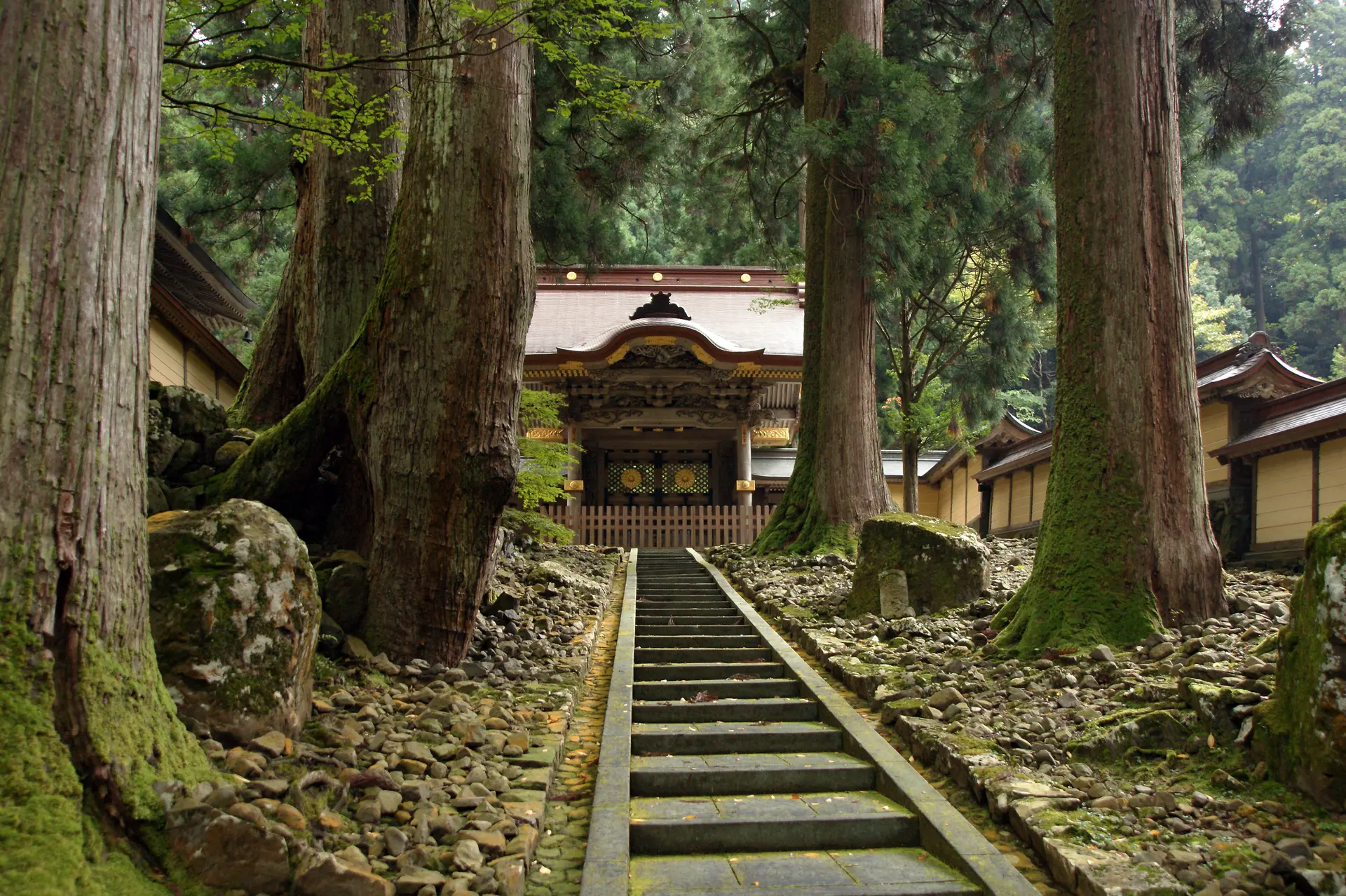
Visit essentials
A quick read before you go
- Duration
- Half day for basic tour of accessible buildings.
- Access
- Bus from Fukui Station (approximately 30 minutes).
Overview
The approach to Eiheiji climbs through cedars reaching a hundred feet, older than many temple buildings yet younger than the practice they shelter. In 1244, Zen Master Dōgen accepted land from a devoted samurai and founded the monastery; its monks still follow his essential pattern of predawn zazen, formal silent meals, and work that does not divide sacred from mundane.
Eiheiji means “Temple of Eternal Peace,” but its stillness exists within movement—the dropping away of body and mind. Dōgen brought this teaching from China after awakening under his master Rujing. His insight that zazen is itself enlightenment, not merely a route to it, became the foundation of Sōtō Zen in Japan.
Eiheiji remains the primary training centre for Sōtō priests, Japan's largest Buddhist denomination by number of temples. Seventy buildings cross a mountain slope through covered walkways built for heavy winter snow. Wooden clappers mark the hours as black-robed monks enact disciplines refined across generations. This is a living monastery rather than a Zen museum: its answer to enlightenment lies in continuous awakened practice.
Why this place is sacred
What makes Eiheiji a thin place differs from sites where thinness derives from spectacular natural features or ancient construction. Here, the thinness is created by practice itself. For 780 years, monks have risen before dawn to sit in zazen, have eaten in ceremonial mindfulness, have worked and walked and slept with continuous attention. This accumulated practice has saturated the grounds, the buildings, the very atmosphere with a quality that visitors consistently notice.
The architecture supports this effect. The seventy buildings are connected by covered walkways, creating a contained world where movement flows according to established patterns. Heavy snow in winter isolates the temple further, reinforcing the sense of separation from ordinary concerns. Ancient cedars surround the complex, their stillness reflecting the stillness cultivated within.
Most significant is the living presence of practice. Unlike temples that have become museums, Eiheiji remains an active training monastery. Over one hundred monks maintain rigorous daily schedules. Visitors encounter not artifacts of Buddhism but Buddhism in action, the dharma manifesting moment by moment in human bodies and minds. This creates a different kind of thinness: not the sense that divine presence permeates a place, but that ordinary human life, when lived with complete attention, reveals depths normally hidden.
Dogen's central teaching was that practice and realization are not separate, that sitting zazen is not a means to enlightenment but enlightenment itself expressed. At Eiheiji, this teaching finds spatial embodiment. Every corner of the temple is practice space. Eating is practice. Working is practice. Bathing is practice. The entire complex exists as a demonstration that any moment, any activity, can become the doorway to awakening.
Dogen founded Eiheiji as a place devoted to training practitioners in 'the perfection of Zen practice in every action of daily life.' His lofty ideal was to serve as a fundamental place of Buddhist discipline according to the correctly transmitted teachings of Shakyamuni Buddha. The temple was designed to support intensive monastic training in the style Dogen learned in China.
While Eiheiji has grown from its original modest buildings to the current complex of seventy structures, the essential purpose has remained constant: training practitioners in Soto Zen. The temple has survived fires and political changes, maintaining its role as one of two head temples of Soto Zen. Today it continues as an active training monastery while also welcoming visitors and offering overnight stays that allow laypeople to experience aspects of monastic life.
Experience and orientation
Entering Eiheiji, visitors immediately sense a shift from ordinary reality. The massive Sanmon Gate, rebuilt in 1749 and the oldest structure on the grounds, marks the threshold between mundane and sacred space. Beyond lies a world organized around practice, where every element serves the cultivation of awareness.
The temple complex reveals itself gradually as visitors walk the covered passageways connecting its buildings. The Buddha Hall at the center houses images of past, present, and future Buddhas. The Hatto, the spacious main lecture hall, sits at the highest point of the complex. The Joyoden, the Founder's Hall, contains Dogen's ashes and images of successive head monks. Each space carries its own quality while contributing to the whole.
What strikes most visitors is the atmosphere itself. Words commonly used include stillness, presence, depth. This is not merely the quiet of an empty building but something generated by continuous practice, as though the walls and walkways have absorbed the attention of centuries. Black-robed monks may pass silently on their way to zazen or sutra chanting, their presence reinforcing rather than disrupting the atmosphere.
For those who arrange overnight stays, the experience deepens considerably. Rising at 3:30 AM for zazen, eating formal meals in silence, following the monks' schedule even briefly, the temple reveals dimensions invisible to day visitors. Participants often describe the experience as transformative, a reset that continues to affect them long after leaving. Even without overnight stay, the temple's atmosphere tends to produce a slowing, a heightening of attention, that many find stays with them.
The temple's setting contributes to the experience. Ancient cedars filter light, create particular sounds of wind and rain, establish a sense of separation from ordinary life. Snow in winter transforms the complex into a landscape of deep silence. Whatever the season, the natural surroundings and the built environment combine to support the inner work the temple was designed to facilitate.
Approach Eiheiji as a place of active practice, not merely a historical site. Move quietly and slowly, allowing the atmosphere to affect you rather than rushing through. If possible, arrange an overnight stay to experience the full dimension of the temple's offering. When visiting during the day, arrive early to observe morning practice if permitted. Follow temple guidance on which areas are accessible.
Bring awareness to your own mind as you walk the grounds; this is, after all, a place devoted to the cultivation of such awareness.
Context and lineage
Dogen was born in 1200 to a wealthy Kyoto family but was drawn early to the religious life. After initial training in Japan, he traveled to China in 1223, seeking authentic Buddhist teaching. Under his master Tiantong Rujing, he experienced awakening when he heard Rujing scold a sleeping monk with the words 'Zazen is the dropping off of body and mind.' This profound realization became the core of his teaching.
Returning to Japan in 1227, Dogen eventually accepted land from his devoted lay follower Yoshishige Hatano, a samurai who had studied with him. In 1244, Dogen founded the temple, initially called Sanshoho Daibutsuji, which he later renamed Eiheiji, 'Temple of Eternal Peace.' Here he devoted himself to training followers in the perfection of Zen practice in every action of daily life.
Eiheiji maintains an unbroken transmission lineage from Dogen, who received transmission from Tiantong Rujing in China, connecting to the original Caodong (Soto) lineage tracing to Dongshan Liangjie (807-869). This lineage ultimately connects to Shakyamuni Buddha through the Chan masters of China. The temple preserves this transmission through its successive abbots and through the training of new priests who will carry the lineage forward.
Dogen Zenji
Founder of Eiheiji and Soto Zen in Japan. Born 1200, died 1253. Traveled to China to study Zen, returned to establish a distinct form of Zen emphasizing shikantaza ('just sitting') and the unity of practice and enlightenment. His ashes rest in the Joyoden.
Tiantong Rujing
Dogen's Chinese master under whom he experienced awakening. Transmitted the authentic Soto (Caodong) lineage to Dogen.
Yoshishige Hatano
Samurai and devoted lay follower who donated the land for Eiheiji. His support enabled Dogen to establish the temple.
Traditions and practice
The daily schedule at Eiheiji follows patterns established by Dogen. Monks rise at 3:30 AM for the first session of zazen. Morning sutra chanting follows. Meals are eaten formally using oryoki, a set of bowls and utensils manipulated in precise, mindful sequences. Work practice (samu) occupies portions of each day, the labor itself treated as meditation. Evening practice includes more zazen and study. Even sleep is practice, conducted in specific postures with specific awareness.
Central to all is shikantaza, 'just sitting.' Unlike Rinzai Zen with its emphasis on koan study, Soto Zen teaches that sitting itself, without seeking anything, is the direct expression of buddhahood. Dogen taught that practice and enlightenment are not separate: sitting zazen is not a method for achieving enlightenment but enlightenment itself manifesting. This teaching infuses every aspect of life at Eiheiji.
The training period for monks typically runs from three months to two years. During this time, practitioners submit completely to the temple's schedule and discipline, allowing the structure to work on them, breaking through habitual patterns through continuous, unreflective practice.
Modern Eiheiji maintains traditional practice while accommodating contemporary visitors. Day visitors can tour portions of the temple complex, observing the buildings and sometimes glimpsing monks at practice. For deeper experience, overnight stays (sanro) are available, allowing laypeople to follow a simplified version of the monks' schedule, experiencing zazen, formal meals, and the rhythm of temple life.
Zazen instruction sessions are sometimes offered for beginners. The temple also offers longer retreat programs for those seeking more intensive experience. While these programs do not replicate the full rigor of monastic training, they offer meaningful access to the temple's essential practice.
For first-time visitors, a day visit provides introduction to the temple's atmosphere and architecture. Those seeking deeper experience should strongly consider an overnight stay, which reveals dimensions of the temple invisible to day visitors. The early morning zazen, the formal meals, the silence and rhythm of temple schedule, these elements transform the visit from tourism to practice. For serious practitioners, inquiring about longer retreat programs or training options may be appropriate.
Soto Zen Buddhism
ActiveEiheiji is one of the two head temples (daihonzan) of Soto Zen, the largest Buddhist denomination in Japan by number of temples. It preserves and transmits the teaching brought from China by Dogen Zenji in the 13th century. The temple trains priests who will serve temples throughout Japan and increasingly worldwide.
Shikantaza ('just sitting') forms the core practice, understood not as a technique for achieving enlightenment but as enlightenment itself expressing. The temple maintains rigorous monastic schedule with zazen, sutra chanting, formal meals (oryoki), and work practice. Every activity is conducted with the attention that makes it practice.
Perspectives and open questions
Eiheiji can be understood as a training monastery perpetuating Dogen's teaching, as an architectural treasure of Japanese Zen, or as a place where the accumulated practice of centuries has created special conditions. Each perspective reveals different dimensions.
Scholarly perspective
Academic scholarship recognizes Dogen as one of Japan's greatest thinkers, his works studied in philosophy, religious studies, and literature departments worldwide. The Shobogenzo, his masterwork, is considered a major contribution to world philosophy. Eiheiji itself is valued as one of the most important Zen monasteries maintaining authentic traditional practice. Studies of Japanese Buddhism inevitably include significant treatment of Eiheiji and its role in Soto Zen.
Living and traditional perspectives
For Soto Zen practitioners, Eiheiji represents the authentic transmission of Buddha's enlightenment. The lineage passing from teacher to student, from Shakyamuni through Bodhidharma through the Chinese Chan masters through Dogen and his successors to the present day, constitutes an unbroken chain of awakening. Practice here is not preparation for enlightenment but enlightenment itself expressed in sitting, walking, eating, working. The temple is a living demonstration of Dogen's teaching that 'practice-realization is not defiled.'
Alternative interpretations
Some practitioners understand Eiheiji as a place where centuries of concentrated meditation have created distinctive spiritual conditions. The accumulated attention of countless practitioners is understood to have saturated the site, making it easier for newcomers to enter meditative states. The ancient cedars and mountain setting are seen as contributing their own subtle influences.
Open questions
While the historical facts of Eiheiji's founding and development are well documented, certain dimensions remain beyond ordinary understanding. What exactly occurs in deep zazen, how the accumulated practice of generations affects present practitioners, what Dogen meant by the dropping away of body and mind, these point toward mysteries that practice may reveal but words cannot capture.
Plan your visit
Access and arrival
Bus from Fukui Station (approximately 30 minutes). The temple is about 15 km east of Fukui city in the mountains. The complex is spread across a hillside; expect walking on stairs and covered walkways. The walkways protect from snow but buildings themselves may be cold.
Overnight stays within the temple (sanro) offer the most meaningful experience. Standard hotels available in Fukui city for those not doing overnight temple stay.
Respectful visit
Modest, comfortable clothing. For overnight stays, the temple provides robes. Remove shoes before entering all buildings. Bring warm layers in cooler seasons, as temple buildings may not be heated to modern standards.
Photography is permitted in most areas but should be done quietly and respectfully. Do not photograph monks without explicit permission. No flash in interior spaces. Consider whether photographing adds to or diminishes your experience.
Monetary donations are accepted and support the temple's maintenance and training programs. No specific offerings are required for visitors.
{"Maintain silence in meditation halls and during formal activities","Do not enter restricted areas including monks' quarters (Sodo), kitchen (Daikuin), and bath/toilet buildings","Remove shoes when entering buildings","Follow staff guidance at all times","Do not touch or disturb any temple objects","During overnight stays, follow all schedule requirements and rules"}
Overnight stays require adherence to temple schedule and rules. The early rising time (3:30 AM) and physical demands of sitting may be challenging. Those with physical limitations should inquire in advance about accommodations. The experience can be intense; some find the silence and structure uncomfortable. This discomfort may be part of the teaching.
Current practical details
Address
5-15 Shihi, Eiheiji, Yoshida District, Fukui 910-1228, Japan
Phone
Hours
Hours, fees, and access can change — verify on the official source before you travel. Practical details last checked Jun 2026.
Location
Map loads as you approach this section.
Pilgrim reflections
A portrait of encounter, not a score
Pilgrims describe what they felt, how present they could become, and whether the place would shape a journey. There are no stars and no ranking of traditions.
No reviewed reflections yet
The first pilgrims can help describe the character of being here.
Share a reflection
Available after an account-backed “Been there.” Every reflection is reviewed before publication.
Nearby sacred places
Explore other sacred places in the region. Proximity does not establish access or travel time; check each place’s guidance.



References
Sources consulted for this page. Source categories describe the publication, not a guarantee that every claim is verified. Traditional accounts and outside interpretations may differ.
- 01Daihonzan Eiheiji - Official Website — Eiheiji TempleofficialOfficial temple website with authoritative information
- 02Daihonzan Eiheiji - SOTOZEN.COM — Soto Zen BuddhismofficialOfficial Soto Zen organization information
- 03Eiheiji Temple - Travel Japan — Japan National Tourism OrganizationofficialGovernment tourism bureau information
- 04Eihei-ji - Wikipedia — WikipediaencyclopediaGeneral reference with cited sources
- 05Eiheiji Temple - Fukui Travel — Japan GuideguideTravel guide with practical information
Pilgrim glossary
- Sutra
- A canonical Buddhist scripture, often chanted as part of practice.
- Dharma
- The teachings of the Buddha; also the universal law underlying them.
- Zen
- A Japanese Buddhist school emphasizing seated meditation and direct insight.
- Koan
- A paradoxical question used in Zen training to break conceptual thinking.
Share a photo
Help visitors recognize Daihonzan Eiheiji (Eihei Temple). Every submission is reviewed before publication.