Mt. Haku
One of Japan's Three Holy Mountains, source of sacred waters for 1,300 years
Understand sacred places, explore living traditions, and learn how to engage respectfully with Pilgrim Map.
Access has not been verified. Check current local guidance before planning a visit.
Hakusan, Ishikawa Prefecture, Japan
Read the sources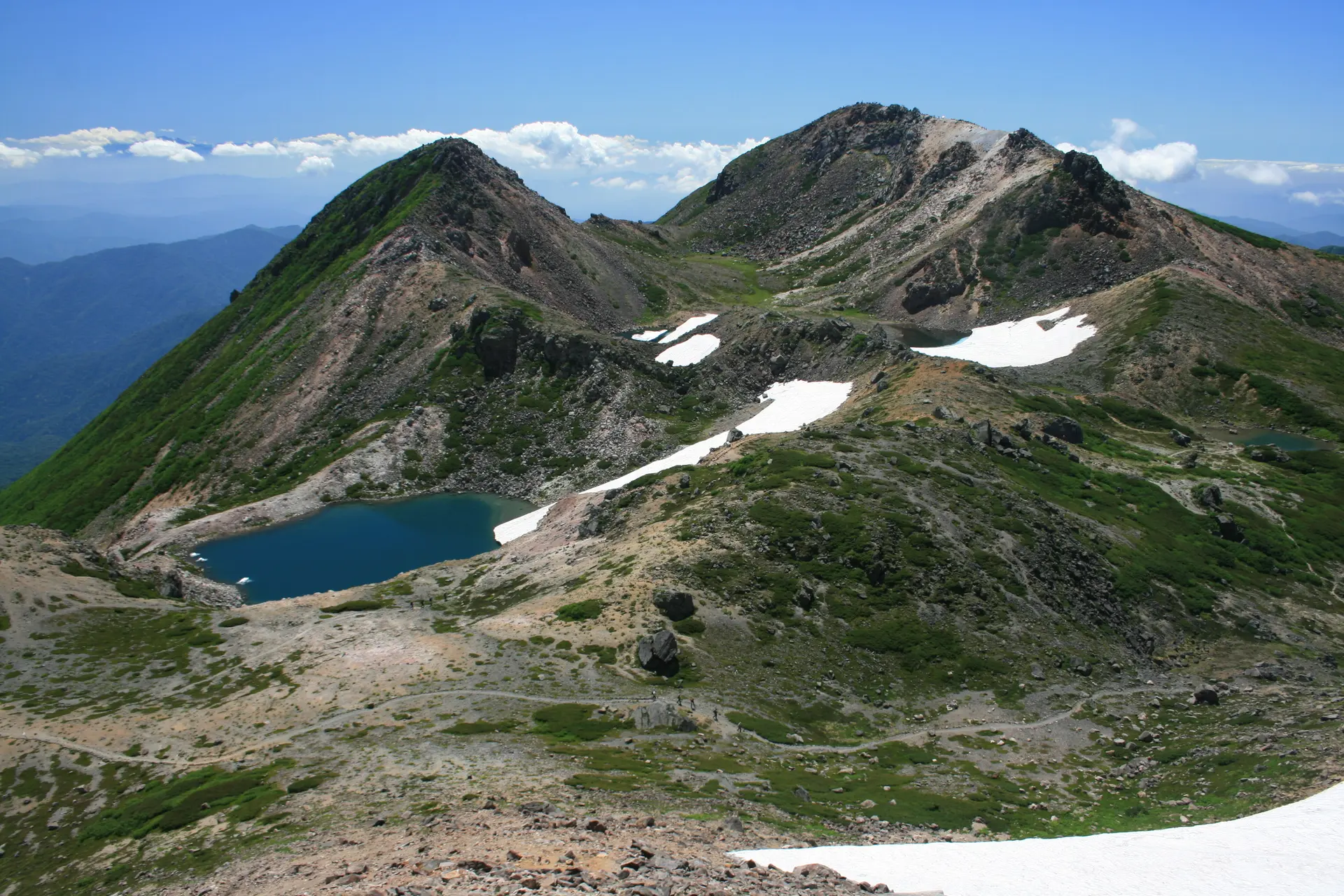
Visit essentials
A quick read before you go
- Duration
- Full day: 6-8 hours round trip from trailhead to summit and back.
- Etiquette
- Mountain climbing etiquette combined with shrine worship protocols apply.
Overview
In 717 CE, the priest Taicho became the first person to successfully climb Mount Haku. There the goddess Shirayamahime Okami revealed herself, and he founded Shirayama Hime Jinja, establishing a faith now over 1,300 years old.
Mount Haku rises 2,702 meters at the meeting of Ishikawa, Gifu, and Fukui prefectures. Summit snow lasting much of the year gives 'White Mountain' both its physical and spiritual-purity meanings, while snow-fed irrigation and drinking water make it essential to surrounding agricultural regions. Height, sacred presence, and life-giving water made Hakusan one of Japan's Three Holy Mountains (San-rei-zan), with Fuji and Tateyama.
Approximately 50,000 pilgrims still climb during the brief summer season on trails used since Taicho's ascent, and over 2,700 Hakusan-affiliated shrines extend the mountain's influence across Japan.
Why this place is sacred
The thinness at Mount Haku operates through the ancient Japanese understanding of mountains as dwelling places of the divine. High peaks were not obstacles but ladders, places where earth approached heaven. The White Mountain's snow-covered summit represented purity visible from miles away—a white crown against blue sky that seemed to belong to another realm.
Taicho's 717 CE ascent established formal worship, but the mountain was recognized as sacred before any recorded history. The goddess Shirayamahime Okami—associated with Eleven-Headed Kannon in the syncretic tradition—represents the mountain's spiritual identity made personal. She is not merely an idea but a presence believed to dwell on and as the mountain.
The waters flowing from Hakusan add practical dimension to spiritual significance. Snow becomes spring, spring becomes stream, stream becomes rice paddy irrigation and drinking water. The communities below have always depended on what flows from above. To worship the mountain was also to honor the source of life itself.
The Hakusan Shinji ceremony, conducted annually, maintains a tradition of mountain worship that predates Buddhism's arrival in Japan and has absorbed and survived every religious transformation since. When priests ascend to perform sunrise invocations at the summit shrine, they continue what Taicho began—human recognition of what the mountain offers.
The network of 2,700+ affiliated shrines extends this thinness across Japan. Each shrine connects worshippers far from the mountain to Shirayamahime Okami's presence, creating a web of devotion that makes the White Mountain accessible from Osaka to Tokyo.
Taicho founded the Hakusan faith in 717 CE as recognition of the mountain's inherent sacredness and the presence of Shirayamahime Okami. The mountain's role as water source for surrounding agricultural communities added practical significance to spiritual recognition.
From Taicho's founding, the Hakusan faith developed into one of Japan's most extensive shrine networks. Three distinct pilgrimage trails were established during the 9th century, approaching the mountain from Ishikawa, Gifu, and Fukui sides. The mountain received Hakusan National Park designation in 1962 and UNESCO Man and the Biosphere Reserve status in 1980. Today approximately 50,000 pilgrims climb annually during the summer season, continuing a tradition unbroken since 717 CE.
Experience and orientation
The experience of Mount Haku is inseparable from the climb. There are no easy routes; all approaches require sustained physical effort through terrain that changes from forest to alpine meadow to rocky summit. The trail takes six to eight hours round trip, demanding the same commitment that pilgrims have given for thirteen centuries.
The mountain's UNESCO Biosphere Reserve status reflects the ecological significance visitors encounter: alpine flowers in summer, pristine forests on lower slopes, and wildlife largely undisturbed by development. The climb passes through environments that feel increasingly removed from the modern world.
At the summit, Shirayama Hime Jinja's inner shrine awaits. The small structure seems almost improbable at this altitude—human devotion carried stone by stone to 2,702 meters. During special ceremonies, priests perform sunrise invocations as the sun breaks over the horizon, continuing practices established by Taicho.
The view from the summit on clear days extends to the Japan Sea and across multiple prefectures. Standing there, visitors understand why this was considered one of Japan's Three Holy Mountains—the elevation creates literal distance from ordinary life while providing perspective impossible at lower altitudes.
The summer climbing season is brief—typically July through early October—before snow closes the trails. This limitation makes Hakusan pilgrimage seasonal, concentrating devotion into the months when the mountain permits approach. Winter returns the peak to its white isolation.
Multiple trails approach Mount Haku from different prefectures, with the Ishikawa side routes being most popular. The climb typically begins from a trailhead reached by bus or car, takes 6-8 hours round trip, and requires proper hiking equipment and preparation. The summit shrine is the destination; the experience is the journey.
Context and lineage
In 717 CE, the Buddhist priest Taicho Shonin (682-767) became the first person to successfully climb Mount Haku. On the summit, he encountered Shirayamahime Okami, the goddess of the mountain, whom he recognized as a manifestation of Eleven-Headed Kannon. He founded Shirayama Hime Jinja to honor her presence and established the Hakusan faith that has continued for over 1,300 years.
Shirayama Hime Jinja at the mountain's summit serves as head shrine for over 2,700 affiliated Hakusan shrines throughout Japan. This network extends the mountain's spiritual influence far beyond the geographic reach of the peak itself.
Taicho Shonin
Buddhist priest (682-767) who made the first ascent in 717 and founded the Hakusan faith
Shirayamahime Okami
Goddess of Mount Haku; identified with Eleven-Headed Kannon; principal deity of the shrine network
Traditions and practice
Traditional practice involves climbing the mountain as pilgrimage, following one of the established trails to the summit shrine. The Hakusan Shinji ceremony, conducted annually, involves priests ascending for sunrise prayers and maintains ancient mountain worship traditions.
Approximately 50,000 pilgrims climb Mount Haku annually during the July-October season. The summit shrine receives worship from those who complete the climb. The network of affiliated shrines across Japan allows those unable to climb to connect with Shirayamahime Okami's presence at local Hakusan shrines.
Approach the climb as pilgrimage rather than hiking. The physical demands are real, but the tradition frames them as practice rather than mere exercise. At the summit, spend time at the shrine rather than rushing to descend. If climbing is not possible, visiting one of the 2,700+ affiliated Hakusan shrines offers connection to the same tradition.
Hakusan Faith / Shugendo
ActiveThe Hakusan faith, founded by Taicho in 717 CE, represents one of Japan's most extensive networks of mountain worship. Mount Haku's status as one of the Three Holy Mountains reflects its supreme importance in Japanese religious geography. The network of 2,700+ affiliated shrines extends the tradition across Japan.
Central practices include pilgrimage climbing during summer season, worship at the summit shrine, and the annual Hakusan Shinji ceremony with sunrise invocations. Affiliated shrines allow worship throughout Japan for those unable to climb.
Perspectives and open questions
Mount Haku invites interpretation as one of Japan's Three Holy Mountains, as an ecological treasure, and as a living example of mountain worship traditions predating recorded history.
Scholarly perspective
Historians recognize the Hakusan faith as among Japan's most extensive networks of mountain worship, with documented activity since 717 CE and likely pre-Buddhist sacred traditions before that. The mountain's designation as both National Park and UNESCO Biosphere Reserve reflects its ecological as well as cultural significance.
Living and traditional perspectives
In traditional understanding, Shirayamahime Okami is a living divine presence dwelling on Mount Haku, providing protection and blessing to those who honor her. The waters flowing from the mountain are her gift to the regions below, making agricultural life possible.
Open questions
Pre-Taicho sacred traditions at the mountain are not documented. The full extent of the original shrine networks before their formalization into the current system remains uncertain.
Plan your visit
Access and arrival
Mountain huts near the summit allow overnight stays during climbing season (advance booking required). Towns near trailheads offer standard accommodation.
Respectful visit
Proper hiking attire and equipment are essential, not optional. This includes sturdy boots, rain gear, warm layers, and sun protection. The mountain does not accommodate casual dress.
Permitted, but environmental and wildlife disturbance should be avoided.
Small coins at the summit shrine offering box.
{"Stay on designated trails","Carry out all waste","Respect wildlife and vegetation","Follow standard shrine protocols at summit","Be prepared for weather changes"}
Mount Haku is a serious mountain requiring proper preparation, equipment, and fitness. The climbing season is limited to July-October; snow closes trails at other times. Weather can change rapidly at altitude; be prepared for cold and rain even in summer.
Current practical details
Address
Mount Haku, Ozo, Hakusan, Ishikawa 920-2333, Japan
Hours, fees, and access can change — verify on the official source before you travel. Practical details last checked Jun 2026.
Location
Map loads as you approach this section.
Pilgrim reflections
A portrait of encounter, not a score
Pilgrims describe what they felt, how present they could become, and whether the place would shape a journey. There are no stars and no ranking of traditions.
No reviewed reflections yet
The first pilgrims can help describe the character of being here.
Share a reflection
Available after an account-backed “Been there.” Every reflection is reviewed before publication.
Nearby sacred places
Explore other sacred places in the region. Proximity does not establish access or travel time; check each place’s guidance.



References
Sources consulted for this page. Source categories describe the publication, not a guarantee that every claim is verified. Traditional accounts and outside interpretations may differ.
- 01Hakusan Mountains - Sacred Pilgrimage Sites in Japan — Onmark ProductionsacademicDetailed religious history
- 02Mt. Hakusan Hike - Hakusan City — Hakusan CityofficialOfficial city tourism information
- 03Mount Haku - Wikipedia — Wikipedia contributorsencyclopediaComprehensive overview
- 04Japan's Three Sacred Mountains — Japan Wonder TravelguideOverview of three sacred mountains
Pilgrim glossary
- Kannon
- The bodhisattva of compassion, central to many East Asian pilgrimage routes.
Share a photo
Help visitors recognize Mt. Haku. Every submission is reviewed before publication.