Eglise Notre-Dame de Pontoise
Where grieving medieval parents brought stillborn children to a miraculous Virgin
Understand sacred places, explore living traditions, and learn how to engage respectfully with Pilgrim Map.
Access has not been verified. Check current local guidance before planning a visit.
Pontoise, Val-d'Oise, France
Read the sources
Visit essentials
A quick read before you go
- Duration
- Thirty minutes to one hour for the church; longer if exploring Pontoise.
- Etiquette
- Standard church etiquette applies: modest dress, quiet behavior, respect for worshippers.
Overview
Northwest of Paris, where the Oise and Vienne rivers meet, stands a church built to honor a miraculous Virgin. Église Notre-Dame de Pontoise has been a pilgrimage destination for over eight hundred years, drawing seekers of intercession, healing, and the particular mercy that medieval theology demanded for unbaptized children.
The Miraculous Virgin of Pontoise was famous as a 'vierge à répit'—a Virgin who granted respite from death. Parents brought stillborn babies to her shrine, hoping for a moment of breath that would allow baptism before the infant died again. The belief addressed one of the deepest griefs of medieval Christianity: the fear that unbaptized children could not enter heaven.
On July 18, 1630, a documented miracle occurred when a stillborn child was reportedly restored to life before a great crowd, baptized, and then died peacefully. Word spread; pilgrimage increased. Three kings—Saint Louis, Charles V, and Louis XIV—placed themselves under the Virgin's protection. When plague threatened in 1580 and again in 1638, both Pontoise and Paris processed to seek her intercession.
The current church dates largely to 1598-1600, built after the medieval basilica's destruction in the Wars of Religion. The Virgin survived. The faith that brought parents here across centuries survives too, now expressed less in hope of physical miracle than in the ongoing human need for comfort, for intercession, for a place where grief has been honored and heard.
Sites inside
Why this place is sacred
The thin quality at Notre-Dame de Pontoise emerges from a specific human grief concentrated across centuries. Parents who lost children before birth faced not only loss but theological terror: without baptism, the infant could not be saved. The 'vierge à répit' tradition offered hope in desperation. Even a moment of breath would allow the sacrament; the child could die in grace.
Whether the miracles occurred as reported is less important than what the belief reveals: faith meeting unbearable loss, reaching for mercy beyond the rules. The Virgin of Pontoise became a focus for that reaching. Parents traveled from across France, carrying cold infants, hoping.
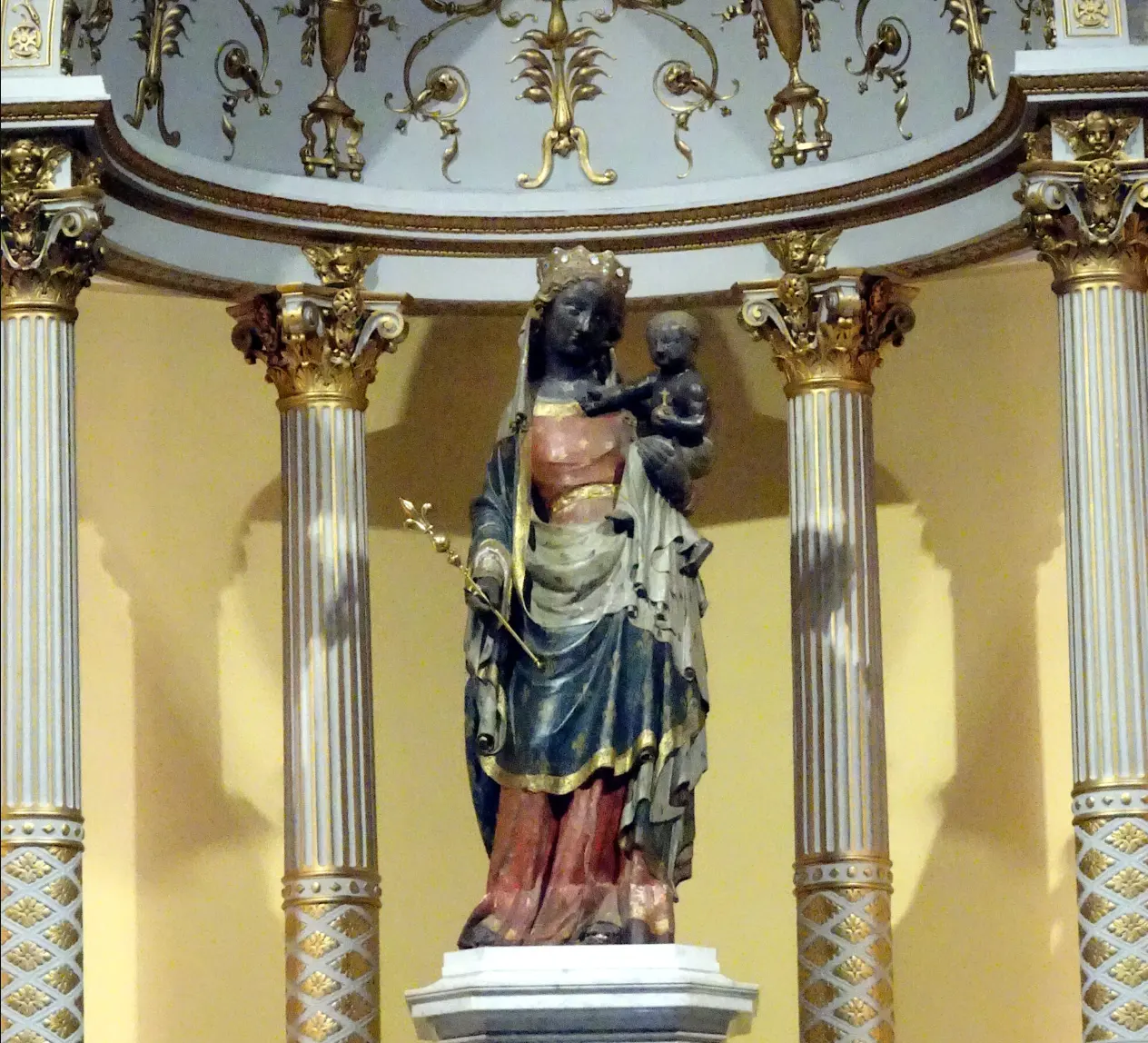
The church itself has been rebuilt, but the statue survives from the thirteenth century—over two meters tall, fine and slender, once standing on the portal of the destroyed medieval basilica. She has witnessed the faith of kings and commoners. She has received prayers for children who drew breath and children who did not.
The devotion continues, though its form has changed. Parents still pray for children at Notre-Dame de Pontoise. The September pilgrimage still draws the faithful. The Vow of Pontoise, first sworn during plague in 1638, has been renewed in 1726, 1838, and 1938. The belief that prayers here are heard persists.
The chapel was established around 1177 on land of the Count of Gisors. Devotion to the Virgin grew; the medieval basilica required enlargement to accommodate pilgrims. The 'vierge à répit' reputation made it a major destination for parents facing infant loss.
The medieval basilica was destroyed in 1589 during the Wars of Religion. The current church was built 1598-1600 by architect Nicolas Lemercier. The miraculous Virgin was preserved; devotion continued. The church was classified as a Historic Monument in 1926.
Experience and orientation
Pontoise lies thirty kilometers northwest of Paris, a historic town at the confluence of two rivers. The church of Notre-Dame stands in the old center, its Renaissance architecture rising where the medieval basilica once drew thousands.
Enter and let your eyes adjust. The chapel of the Miraculous Virgin is to the right, just inside the entrance. The statue is remarkable: over two meters tall, thirteenth-century limestone, slender and dignified. She survived the destruction of the basilica, the Revolution, the twentieth century's wars. What she witnessed—the parents, the wrapped bundles they carried, the desperate hope—has left no visible mark, but it is there.
The church holds other treasures: Renaissance stained glass, the sixteenth-century bell tower designed by Pierre or Nicolas Le Mercier. But the heart of pilgrimage is the Virgin. Sit before her. Consider what faith enabled parents to carry dead children to her shrine. Consider what mercy they believed she offered. The theological specifics may have shifted—the Church no longer teaches that unbaptized infants are damned—but the human need for comfort in loss remains.
If you visit in early September, you may witness the annual pilgrimage, continuing a medieval tradition. The Feast of the Holy Innocents on December 28 carries particular resonance here, honoring children taken too soon.
Enter the church through the main doors. The Miraculous Virgin is in the chapel immediately to the right. Pontoise itself is worth time—historic streets, river views, the feel of a town that has been a center of faith and commerce for a millennium.
Context and lineage
Around 1177, a chapel to the Virgin was built on land belonging to the Count of Gisors, near the confluence of the Oise and Vienne rivers. Devotion grew. By the thirteenth century, the statue that now stands in the church was installed—a fine, slender Virgin over two meters tall.
Word spread that this Virgin could grant 'répit'—respite, a moment of life for stillborn babies that allowed baptism. Parents traveled from far to bring their dead children to her. The documented miracle of July 18, 1630, when a stillborn infant reportedly revived before a great crowd, was baptized, and then died peacefully, increased the pilgrimage significantly.
Royal patronage added prestige. Saint Louis, Charles V, and Louis XIV all placed themselves under the Virgin's protection. During plague outbreaks in 1580 and 1638, both Pontoise and Paris sought her intercession. The city's formal vow to the Virgin, first sworn in 1638, has been periodically renewed.
The medieval basilica was destroyed in 1589 during the Wars of Religion. The current church was built 1598-1600. The Virgin survived; the pilgrimage continued.
The church remains an active Catholic parish within the Diocese of Pontoise. The annual pilgrimage continues the medieval tradition.
Saint Louis (Louis IX)
Royal patron
Nicolas Lemercier
Architect
Traditions and practice
The 'vierge à répit' practice drew parents from across France, carrying stillborn infants in hope of miraculous revival. Royal processions sought the Virgin's protection during plague and war. The Vow of Pontoise was renewed periodically across centuries.
The September pilgrimage maintains the tradition of collective devotion. Regular Masses serve the parish community. Individual pilgrims visit to pray before the Miraculous Virgin, continuing the pattern of seeking her intercession for children and mothers.
Visit when the church is open and quiet. Spend time before the Miraculous Virgin, reflecting on what faith enabled across centuries. If visiting in September, the pilgrimage offers witness to living tradition. The Feast of the Holy Innocents (December 28) carries particular resonance.
Roman Catholicism
ActiveNotre-Dame de Pontoise has been a major Marian pilgrimage destination since the thirteenth century, famous for the 'vierge à répit' tradition and royal patronage. The annual September pilgrimage continues medieval tradition.
Annual pilgrimage, veneration of the Miraculous Virgin, prayers for mothers and children, Mass and parish sacraments, periodic renewal of the Vow of Pontoise.
Perspectives and open questions
Notre-Dame de Pontoise can be understood as medieval pilgrimage center, example of popular Marian devotion, expression of parental grief across centuries, or living parish church. Each perspective illuminates the site's meaning.
Scholarly perspective
The 'vierge à répit' phenomenon is documented across medieval and early modern Catholic Europe. Pontoise represents one of France's most important examples, with documented miracles and royal patronage.
Living and traditional perspectives
Within Catholic tradition, the Miraculous Virgin of Pontoise is venerated as an image through which Mary's maternal intercession has been experienced. The continuation of pilgrimage demonstrates the devotion's ongoing vitality.
Open questions
The full extent of miracles attributed to the Virgin is not documented in accessible sources. The original appearance of the medieval basilica, destroyed in 1589, can only be partially reconstructed.
Plan your visit
Access and arrival
Pontoise has limited accommodations; Paris offers more options with easy train access.
Respectful visit
Modest dress appropriate for a church.
Generally permitted; be respectful and avoid flash during services.
Candles may be lit.
Do not disturb worshippers during Mass.
This is an active parish church; be mindful of services and worshippers.
Current practical details
Address
37 Place Notre Dame, 95300 Pontoise, France
Hours
Hours, fees, and access can change — verify on the official source before you travel. Practical details last checked Jun 2026.
Location
Map loads as you approach this section.
Pilgrim reflections
A portrait of encounter, not a score
Pilgrims describe what they felt, how present they could become, and whether the place would shape a journey. There are no stars and no ranking of traditions.
No reviewed reflections yet
The first pilgrims can help describe the character of being here.
Share a reflection
Available after an account-backed “Been there.” Every reflection is reviewed before publication.
Nearby sacred places
Explore other sacred places in the region. Proximity does not establish access or travel time; check each place’s guidance.

Black Madonna of Pontoise
Pontoise, Val-d'Oise, France
0.0 km away

Chapelle Notre-Dame de Bonne Délivrance
Neuilly-sur-Seine, Hauts-de-Seine, France
22.1 km away
Our Lady of Good Deliverance, Paris
Neuilly-sur-Seine, Hauts-de-Seine, France
22.1 km away

Basilica Cathedral of Saint-Denis
Saint-Denis, Saint-Denis, Seine-Saint-Denis / Île-de-France, France
23.3 km away
References
Sources consulted for this page. Source categories describe the publication, not a guarantee that every claim is verified. Traditional accounts and outside interpretations may differ.
- 01Eglise Notre-Dame - Pontoise — Eglises du ConfluentacademicDetailed local church history
- 02Découverte des vitraux de l'église Notre-Dame à Pontoise — Catholique 95officialDiocesan website
- 03Église Notre-Dame de Pontoise — Wikipédia — Wikipedia contributorsencyclopediaFrench Wikipedia article
- 04The Holy Innocents, Notre-Dame de Pontoise — AnaStpaulacademicDevotional article
Share a photo
Help visitors recognize Eglise Notre-Dame de Pontoise. Every submission is reviewed before publication.