Église Notre-Dame-de-la-Mer, Saintes-Maries-de-la-Mer
Where two peoples keep two saints in one fortress church
Understand sacred places, explore living traditions, and learn how to engage respectfully with Pilgrim Map.
Access has not been verified. Check current local guidance before planning a visit.
Saintes-Maries-de-la-Mer, Bouches-du-Rhône, France
Read the sources
Image of Église Notre-Dame-de-la-Mer, Saintes-Maries-de-la-Mer. Image source
On this pilgrimage
Chemin de Marie-MadeleineVisit essentials
A quick read before you go
- Duration
- A basic visit to the nave, crypt, and well takes 30-45 minutes; adding the rooftop terrace and…
- Access
- Located in the center of Saintes-Maries-de-la-Mer, Bouches-du-Rhône, easily reached on foot from…
Overview
The church stands on what was once an islet at the edge of the Camargue wetlands, its plain stone walls built to double as a refuge against pirates and raiders. Inside, two distinct and equally living devotions share the same building without merging into one.
Above, Catholic tradition venerates Mary Jacobe and Mary Salome, said to have crossed the Mediterranean in a rudderless boat after fleeing persecution in the Holy Land around 45 CE, their relics discovered in a 1448 excavation ordered by King René of Anjou and paraded to the sea each May and October.
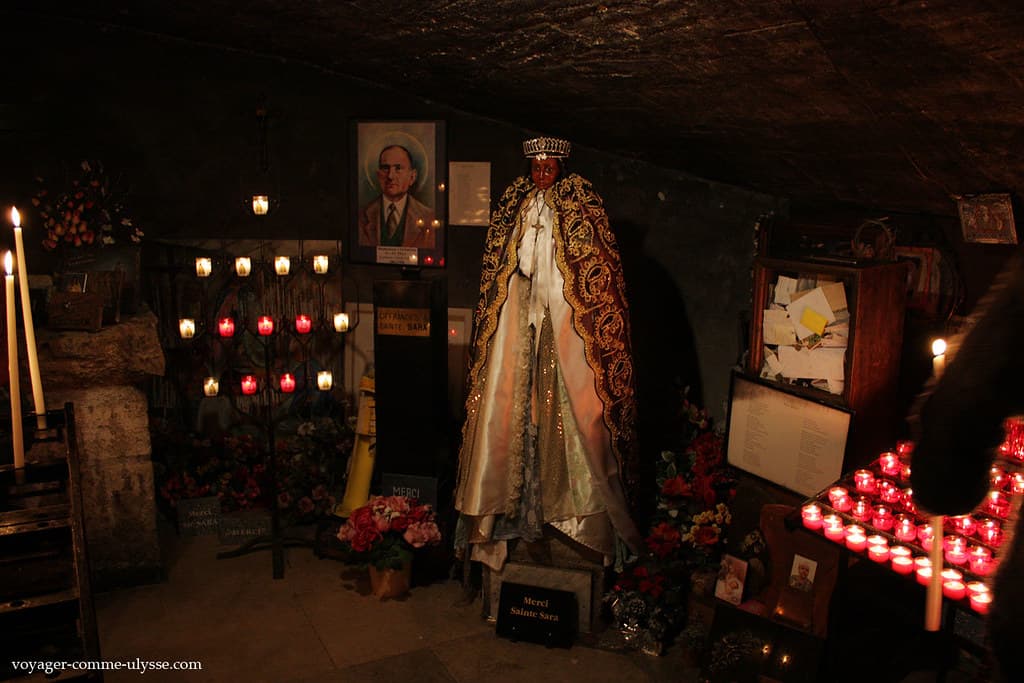
Below, in a crypt reached by stone steps, Roma and Gitan pilgrims from across Europe venerate Saint Sara — Sara-la-Kâli, Sara the Black — their own patron saint, whose statue stands year-round layered in the cloaks and jewelry left by generations of visitors. Neither tradition is a footnote to the other; both draw tens of thousands of pilgrims annually, and both call this building home.
Sites inside
Why this place is sacred
Historians generally treat the landing legend of the Three Marys as medieval hagiography rather than verified history, likely consolidating older regional cult traditions — including a pre-Christian, possibly Mithraic, sacred site on the same islet, evidenced by Mithraic altar stones found here — with the broader Provençal Mary Magdalene legend cycle that gained prominence from the 11th-13th centuries onward. The 1448 royal-sponsored 'discovery' of relics under King René of Anjou follows a common medieval pattern for legitimizing pilgrimage sites.
None of this diminishes what the site has become: a place where an unbroken chain of devotion — Catholic and Roma alike — has continued for centuries regardless of how the founding story is read historically. The identity of Saint Sara herself remains genuinely unresolved, debated even within devotional and academic literature, as to whether she is an indigenous Romani figure adopted into Christian veneration, a servant figure from the original legend, or a later devotional invention.
A fortified oratory and burial site marking the traditional landing point of Mary Jacobe and Mary Salome; independently, and just as centrally, the shrine of Saint Sara, venerated by Roma and Gitan communities as their patron.
Site tradition traces devotion to the mid-6th century, when a religious community was installed on the islet in 547 CE. The current fortified Romanesque church was built primarily between the 9th and 12th centuries, with major reconstruction of the choir and apse around 1165-1170 and a defensive fortification campaign in the early 14th century against piracy and raids. The crypt was created following the 1448 excavations ordered by King René of Anjou.
The Roma pilgrimage to Saint Sara was formally established in 1935/1936 and has since grown into one of the largest annual gatherings of Roma people in Europe.
Experience and orientation
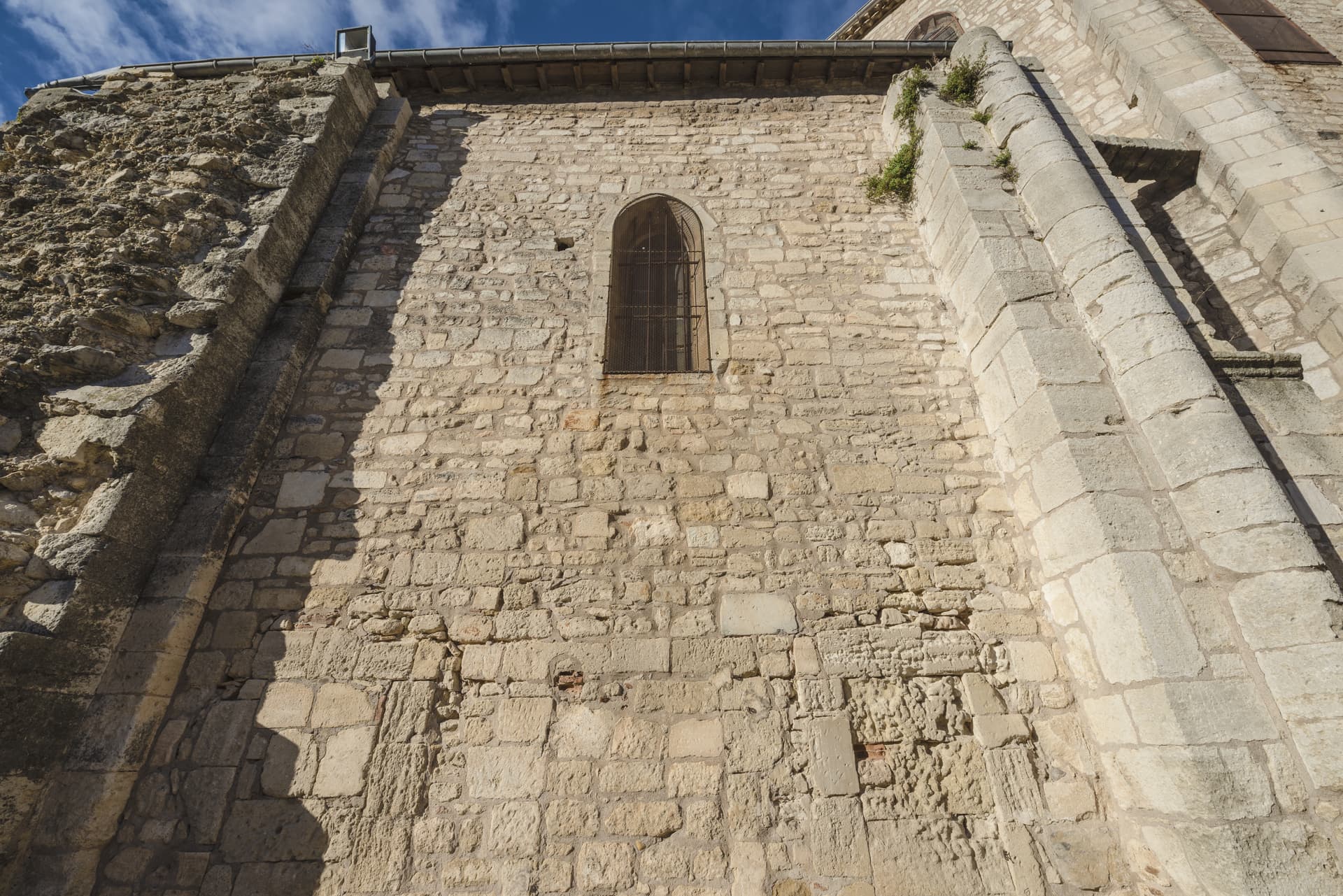
The exterior gives little away — a fortress first, windowless and grey against the flat Camargue horizon, once visible for some ten kilometers in every direction across the wetlands. Inside, the nave is plain and cool, built directly over a freshwater well still venerated by pilgrims.
Descending into the crypt changes the register entirely: a low, close, cave-like space, candlelit, where Saint Sara's statue stands dressed in the cloaks and jewelry pilgrims have layered onto her over generations — an accumulation of devotion made physically visible in a way the upper church, with its more formal reliquary chest, does not offer. Visitors consistently describe this contrast — plain fortress above, intimate shrine below — as the church's most striking quality.
A small fee grants access to the rooftop terrace and watchtower, from which the flat expanse of the Camargue wetlands and, for those visiting during the festival, the procession route to the sea, can both be seen.
The nave is free to enter; the crypt is included; the rooftop terrace requires a small fee (roughly 3-4 EUR). Outside festival weekends, the church is calm enough to visit at any pace; during 24-25 May and the October weekend, expect dense crowds and, at points, restricted access to non-participants.
Context and lineage
Legend holds that Mary Jacobe, Mary Salome, and their servant Sara — venerated separately as a saint by Roma communities — crossed the Mediterranean in an oarless, sailless boat after fleeing persecution in Palestine, making landfall on the Camargue coast around 45 CE. They founded a small oratory around a freshwater spring, were buried there upon their deaths, and their remains were rediscovered in excavations ordered by King René of Anjou in 1448.
Some retellings of the wider Provençal legend cycle include Mary Magdalene among the boat's passengers before she continued on to Marseille and La Sainte-Baume.
Founded by a monastic community from Arles installed on the islet in 547 CE; construction and fortification carried out by that community using stone quarried at Beaucaire and Carry-le-Rouet, with no individual architect recorded.
Traditions and practice
In the Catholic tradition, relics of Mary Jacobe and Mary Salome are kept in an upper reliquary chest, lowered by pulley during festivals, and processed in a boat to the shore escorted by Camargue gardians on horseback.
In the Roma tradition, the 'descent of the relics' — the statue of Sara carried from the crypt through the streets to the beach for ritual immersion in the sea — is a rite formally established in 1935/1936, distinct in origin and custodianship from the Catholic ceremony that follows it the next day.
Two major annual pilgrimages take place on 24-25 May — the Roma pilgrimage of Sara on the 24th, the Catholic pilgrimage of the Saintes Maries on the 25th — drawing an estimated 25,000-40,000 visitors combined, plus a smaller Provençal pilgrimage on the third weekend of October honoring Saint Mary Salome.
Visitors may attend Mass, view the crypt and relics, light a candle, or leave an ex-voto offering at any time of year; during the festival weekends, observing or peripherally joining the processions to the sea is welcomed with appropriate respect for the Roma custodianship of their own ritual.
Catholic Marian and Saints pilgrimage (Notre-Dame-de-la-Mer / the Saintes Maries)
ActiveThe church is dedicated to Notre-Dame-de-la-Mer and enshrines the legend that Mary Jacobe and Mary Salome landed here by boat after fleeing the Holy Land, founding an oratory and being buried near a freshwater well inside the nave. Their relics, discovered in the 1448 excavation, are kept in the church and paraded to the sea twice a year, making the site one of the most venerated Marian pilgrimage destinations in southern France, drawing roughly 200,000 visitors annually across three pilgrimage occasions.
Veneration of relics kept in an upper reliquary chest lowered by pulley during festivals; procession of statues in a boat to the shore escorted by Camargue gardians on horseback; devotion at the freshwater well in the nave; ex-voto offerings, many surviving from the 19th century.
Romani/Gitan (Roma) pilgrimage to Saint Sara
ActiveSaint Sara — venerated by Roma, Gitan, and Traveller communities as Sara-la-Kâli, Sara the Black — is honored as their patron saint. Tradition holds she welcomed and served the Three Marys upon their landing in the Camargue. Her statue and reliquary are kept in the church's dark crypt beneath the choir, layered year-round with cloaks, jewelry, and votive offerings left by pilgrims. Each 24 May, Roma pilgrims from across Europe carry her statue in procession to the sea for ritual immersion — a rite formally established in 1935/1936 that has grown into one of the largest annual gatherings of Roma people in Europe, drawing an estimated 25,000-40,000 visitors during the festival week. This stands as a distinct, self-directed devotional practice, not a subordinate footnote to the Catholic pilgrimage that follows on 25 May.
Ceremony of the descent of Sara's statue from the crypt; procession through town streets to the beach; ritual immersion of the statue in the sea as a gesture of purification and blessing; layering the statue with pilgrims' cloaks and jewelry in the crypt; communal gathering, music, and horse-riding gardians as ceremonial escort.
Provençal/Occitan October pilgrimage (feast of Saint Mary Salome)
ActiveA second, smaller annual pilgrimage held the third weekend of October, centered on the feast of Saint Mary Salome (traditionally 22 October), draws Provençal and Occitan pilgrims and reflects continuing regional identity woven around the church's foundation legend.
Procession of the reliquary boat to the sea, echoing the May ceremony but on a smaller, more local scale.
Perspectives and open questions
Scholarship reads the founding legend as medieval hagiography; both communities who venerate here hold their own devotion as living truth independent of that historical reading, and a further speculative layer exists at the margins that neither community endorses.
Scholarly perspective
Historians generally treat the landing legend of the Three Marys as medieval hagiography rather than verified historical event, likely consolidating older regional cult traditions — including a pre-Christian, possibly Mithraic, sacred site — with the broader Provençal Mary Magdalene legend cycle that gained prominence from the 11th-13th centuries onward, reinforced by the 1448 royal-sponsored 'discovery' of relics, a common medieval practice for legitimizing pilgrimage sites.
Living and traditional perspectives
For Catholic Provençal communities, the landing and burial of the Saintes Maries is accepted devotional history underpinning centuries of unbroken local veneration. For Roma and Gitan communities, Saint Sara's status as their patron saint and her presence at the landing is a foundational element of communal identity, treated with full devotional seriousness independent of Catholic Church doctrine on her status.
Alternative interpretations
Some alternative and esoteric traditions, particularly associated with 'Mary Magdalene bloodline' theories popularized in the late 20th and early 21st centuries, fold this landing legend into speculative narratives about a Magdalene lineage or hidden gnostic tradition in Provence. These claims are not supported by mainstream historical or theological scholarship and are presented here as a distinct interpretive layer, not fact.
Open questions
The precise identity, age, and origin of Saint Sara — whether an indigenous Romani figure adopted into Christian veneration, a servant figure from the original legend, or a later devotional invention — is genuinely unresolved and debated even within devotional and academic literature.
Plan your visit
Access and arrival
Located in the center of Saintes-Maries-de-la-Mer, Bouches-du-Rhône, easily reached on foot from the town's parking areas; nave entry is free, terrace access carries a small fee.
Respectful visit
Modest dress is expected, as in any active place of Catholic worship — covered shoulders recommended — though no specific dress code is mandated for casual visits outside of Mass times.
Generally permitted in the nave and crypt for personal, respectful use; avoid flash photography during services, and be especially considerate photographing Roma pilgrims and ritual moments during the festival, which are deeply personal and sacred to participants.
Ex-voto offerings, candles, and votive gifts are a long-established and welcomed tradition; visitors are free to light a candle or leave a small offering.
The rooftop terrace and watchtower require a small entry fee. During the festival weekends, access to the crypt and central nave may be tightly controlled by event stewards and closed at points to non-participants.
The Roma pilgrimage to Saint Sara is not a subordinate footnote to the Catholic pilgrimage that follows it — treat it as a distinct, self-directed devotional practice with its own history and meaning, and avoid exoticizing language when describing it.
Current practical details
Address
10 Pl. de l'Église, 13460 Saintes-Maries-de-la-Mer, France
Hours, fees, and access can change — verify on the official source before you travel. Practical details last checked Jun 2026.
Location
Map loads as you approach this section.
Pilgrim reflections
A portrait of encounter, not a score
Pilgrims describe what they felt, how present they could become, and whether the place would shape a journey. There are no stars and no ranking of traditions.
No reviewed reflections yet
The first pilgrims can help describe the character of being here.
Share a reflection
Available after an account-backed “Been there.” Every reflection is reviewed before publication.
Nearby sacred places
Explore other sacred places in the region. Proximity does not establish access or travel time; check each place’s guidance.
.JPG&w=1920&q=75)
References
Sources consulted for this page. Source categories describe the publication, not a guarantee that every claim is verified. Traditional accounts and outside interpretations may differ.
- 01Église Notre-Dame-de-la-Mer des Saintes-Maries-de-la-Mer — Wikipédia — Wikipedia contributorsacademicConstruction phases (9th-12th c.), 1448 excavation under King René, 1840 historic monument classification, Mithraic altar stones suggesting earlier pagan use, May/October processions, Roma Sara tradition since 1936.
- 02Church of the Saintes Maries de la Mer - Wikipedia — Wikipedia contributorsacademicEnglish-language overview of the fortified Romanesque church, legend of the three Marys, relics of Mary Jacobe and Mary Salome.
- 03Saintes-Maries-de-la-Mer - Wikipedia — Wikipedia contributorsacademicTown-level context, general history of the site and its pilgrimage traditions.
- 04Construction de l'église fortifiée — Sanctuaire des Saintes-Maries-de-la-Mer / Diocèse d'Aix-en-Provence et ArlesofficialOfficial diocesan sanctuary page on construction history of the fortified church.
- 05Le message du sanctuaire des Saintes-Maries-de-la-mer — Villes Sanctuaires en FranceofficialOfficial French Catholic sanctuary-towns network page describing the devotional meaning of the site, ex-voto tradition, and dedication to Notre-Dame-de-la-Mer.
- 06Pèlerinage aux Saintes-Maries-de-la-mer — Villes Sanctuaires en FranceofficialDetails on the three annual pilgrimages (Provençal pilgrimage in May, Roma pilgrimage in May, October pilgrimage of Saint Mary Salome), ~200,000 annual visitors.
- 07Feast brings Saintes Marie and Sainte Sara to the sea in France — Catholics & Cultures (College of the Holy Cross)academicAcademic ethnographic-religious-studies description of the descent of the relics, procession of Sara, and the May 24-25 rites; distinguishes Catholic and Roma devotional layers.
- 08Gypsy and Camarguaise Catholics in France honor women saints linking region to Jesus — Catholics & Cultures (College of the Holy Cross)academicDetailed description of Roma veneration of Saint Sara as distinct from, and alongside, Camarguais Catholic devotion to the Saintes Maries.
- 09Le chemin de Marie-Madeleine — Association Chemins des Saintes et Saints de ProvenceofficialOfficial pilgrimage-route organizing body; confirms Saintes-Maries-de-la-Mer as the starting point of the 224 km Chemin de Marie-Madeleine to Saint-Maximin-la-Sainte-Baume, opened May 2022.
- 10This unique Camargue pilgrimage is a fitting tribute to France's most singular region — National GeographicSource contextTravel-journalism account of the Romani pilgrimage, gardians (Camargue horsemen/cowboys), and the cultural texture of the festival.
- 11Église des Saintes-Maries-de-la-Mer : avis & conseils pratiques — AvygeoSource contextVisitor-practical information: free entry to the nave, small fee (3-4 EUR) for terrace/rooftop access, ex-voto collection description.
Share a photo
Help visitors recognize Église Notre-Dame-de-la-Mer, Saintes-Maries-de-la-Mer. Every submission is reviewed before publication.