Church of the Saintes Maries de la Mer
Where the Marys who knew Jesus landed, and where the Roma honor their saint
Saintes-Maries-de-la-Mer, Provence-Alpes-Côte d'Azur, France
Plan this visit
Practical context before you go
1-2 hours for church and crypt. Full day for pilgrimage.
Respect the deep significance of the Roma pilgrimage. Do not photograph Roma people without permission. Maintain reverence in the crypt.
At a glance
- Coordinates
- 43.4522, 4.4283
- Suggested duration
- 1-2 hours for church and crypt. Full day for pilgrimage.
Pilgrim tips
- Modest dress, especially in the church and crypt.
- Be very respectful. Always ask before photographing people, especially during the pilgrimage.
- During the pilgrimage, the town is extremely crowded; accommodations book far in advance. Be respectful of Roma devotees—do not treat them or their practices as spectacle.
Overview
According to medieval tradition, the Three Marys—Mary Magdalene, Mary Salome, and Mary of Clopas—escaped persecution after the Resurrection and landed on this shore. In the crypt, the Roma people's patron saint Sara awaits her annual procession to the sea. Each May, thousands of Roma from across Europe gather here for one of the continent's most powerful living pilgrimages.
The Church of the Saintes Maries de la Mer stands at the edge of the Camargue, a fortified church built where land meets sea. According to medieval tradition, this is where Christianity first touched French soil—the landing place of the Three Marys who had known Jesus personally and fled persecution after the Resurrection.
The church is built like a fortress because it needed to be. In the ninth century, when it was constructed, Viking and Saracen raids were constant threats. The Romanesque walls are thick, the windows small, the bell-gable a watchtower. This is a church that was also a refuge.
The Three Marys—Mary Magdalene, Mary Salome, and Mary of Clopas—came ashore here, according to tradition, accompanied by a servant named Sara. The relics of Mary Salome and Mary of Clopas were discovered in the fifteenth century and remain in the church. Mary Magdalene, tradition holds, eventually withdrew to a cave at Sainte-Baume.
But it is Sara who draws the most passionate devotion today. In the crypt, her dark statue stands covered in cloaks and surrounded by candles. Sara-la-Kali—Sara the Black—is the patron saint of the Roma people. Each year on May 24, thousands of Roma from across Europe gather to carry her statue to the sea, immersing her in the Mediterranean in a ritual that echoes Indian practices and affirms their identity as a displaced people under a patron who understands displacement.
The following day, the Two Marys receive their own procession. These two pilgrimages, Catholic and Roma, share this space where faith and sea and history converge.
Context and lineage
According to medieval tradition, the Three Marys—Mary Magdalene, Mary Salome, and Mary of Clopas—escaped persecution after the Resurrection by sailing from the Holy Land. They landed on this shore, accompanied by others including a servant named Sara. The Marys lived out their lives in Provence, bringing Christianity to France.
The fortified church was built in the ninth century when Viking and Saracen raids threatened the coast. The building served as both worship space and refuge. In the fifteenth century, relics identified as those of Mary Salome and Mary of Clopas were discovered.
Sara's cult developed alongside the Christian tradition but remained separate. In 1935, the Marquis Folco de Baroncelli-Javon—a local figure devoted to preserving Camargue traditions—won the Roma the right to hold their own public procession for Sara. Before this, Sara's veneration had been private; after 1935, it became the major pilgrimage it is today.
The origin of Sara herself is disputed. One tradition says she was the Egyptian servant of the Three Marys. Another says she was a local woman who had visions and went to the shore to meet the arriving boat. Some scholars see connections to the Hindu goddess Kali—her name 'Sara-la-Kali' can be read as 'Sara who is Kali,' and the Roma's Indian origins lend plausibility to this interpretation.
The church is part of the Diocese of Aix and Arles. It serves as both parish church and major pilgrimage destination, hosting both Catholic and Roma traditions.
The Three Marys
Arriving apostles
Sara-la-Kali
Patron of the Roma
Marquis Folco de Baroncelli-Javon
Pilgrimage advocate
Why this place is sacred
The Church of the Saintes Maries de la Mer is thin in multiple ways that do not perfectly overlap. For Catholic tradition, this is where Christianity arrived in France—where women who had known Jesus, who had stood at the cross, who had encountered the risen Lord, came ashore and began to teach. The relics in the church connect the present to that apostolic moment.
For the Roma people, the thin quality centers on Sara. Her origin is disputed—Egyptian servant? Local woman? Something older?—but her significance is clear. For a people scattered across Europe for centuries, marginalized and persecuted, Sara represents divine understanding of what it means to wander. Her annual procession to the sea is an affirmation of identity, a gathering of the dispersed, a ritual that echoes practices from the homeland they left in India centuries ago.
The church sits at a liminal location, where the Camargue marshes meet the Mediterranean. Land and sea blend here; fresh and salt water mix; the boundary is porous. Liminal spaces have always attracted sacred attention. Something about edges invites the divine.
The fortified architecture adds another layer. This church was built to protect as well as to pray. The thick walls have absorbed centuries of fear and faith, Viking raids and pilgrim devotion. The building itself embodies the human need for both spiritual and physical sanctuary.
To experience the annual Roma pilgrimage is to witness one of Europe's most powerful expressions of living faith—thousands of people who have traveled from across the continent to carry their saint to the sea, singing and praying in a tradition that has survived centuries of persecution. The thin quality here is the thin quality of defiant devotion.
The church was built in the ninth century as both place of worship and fortified refuge against Viking and Saracen raids.
The relics of Mary Salome and Mary of Clopas were discovered in the fifteenth century. The Roma pilgrimage was formalized in 1935 when the Marquis Folco de Baroncelli-Javon won the right for Roma to hold their own procession for Sara.
Traditions and practice
Processions of the Three Marys. Veneration of relics. Night vigils in the crypt before the Roma pilgrimage.
The Roma pilgrimage (May 24-25) draws thousands. A second pilgrimage occurs in October. Regular masses continue. The crypt receives devotees seeking Sara's intercession throughout the year.
If possible, time your visit for the Roma pilgrimage—participation in this living tradition is unforgettable. Otherwise, spend time in the crypt with Sara, light a candle, and consider what it means to honor a patron of displaced peoples. Climb to the roof for perspective across the Camargue.
Roman Catholicism
ActiveThe church is dedicated to the Three Marys who, according to tradition, brought Christianity to France. Relics of Mary Salome and Mary of Clopas are venerated.
Veneration of relics, pilgrimage, masses, procession of the Two Marys (May 25).
Roma Spirituality
ActiveSara-la-Kali is the patron saint of the Roma people. The annual pilgrimage (May 24) is one of Europe's most significant minority religious traditions, drawing thousands from across the continent.
Night vigil in crypt, procession of Sara to the sea, immersion in the Mediterranean, music and celebration.
Experience and perspectives
Saintes-Maries-de-la-Mer is a small town at the edge of the Camargue, accessible by road from Arles. The church dominates the town, its fortified bell-gable visible from distance across the flat marshland.
Enter the church and find a Romanesque space designed for survival—thick walls, small windows, the proportions of a fortress that happens to contain an altar. The interior is relatively plain, the atmosphere one of endurance rather than decoration.
Climb to the roof for panoramic views across the Camargue—the marshes, the Mediterranean, the white horses and black bulls that populate the regional imagination. The bell-gable that served as a watchtower against raiders now serves as a viewpoint for pilgrims.
Descend to the crypt to encounter Sara. Her statue stands in a small underground space, covered in cloaks left by devotees, surrounded by candles. The atmosphere is intimate, intense, charged with the accumulated prayers of those who have come seeking her intercession. This is the space where Roma devotees keep vigil before the annual procession.
If your visit coincides with the pilgrimage on May 24-25, you will witness something extraordinary. Thousands of Roma gather from across Europe. On May 24, Sara's statue is carried from the crypt to the sea and immersed in the Mediterranean. The following day, the Two Marys receive similar procession. Music, prayer, celebration, and deep communal devotion fill the town.
Even outside pilgrimage season, the church carries the weight of these traditions. The crypt in particular holds the intensity of the Roma devotion—a sacred space within a sacred space.
The church is at the center of Saintes-Maries-de-la-Mer. The crypt is accessible from inside the church. Roof access may require a small fee. The annual Roma pilgrimage occurs May 24-25.
The church can be understood as a landing place of early Christianity, as a fortified refuge that preserved faith through raider attacks, as the site of one of Europe's most powerful minority religious traditions, or as a place where multiple faiths share sacred geography.
Historians view the Three Marys legend as medieval tradition rather than historical fact. The Roma pilgrimage is recognized as an important anthropological phenomenon. The church's fortified architecture documents the insecurity of medieval coastal life.
Within Catholic tradition, the Three Marys are venerated as disciples who knew Jesus and brought Christianity to Provence. Within Roma tradition, Sara is a powerful patron whose intercession protects and blesses.
Some researchers see Sara as a continuation of the Hindu goddess Kali, brought by the Roma from India. The ritual immersion in the sea supports this interpretation. Mary Magdalene's presence connects to alternative traditions about her significance.
The historical identity of Sara. The origin of Roma devotion to her. The full extent of Mary Magdalene's legacy in Provence. What the Roma pilgrimage meant before its formalization in 1935.
Visit planning
Tourist town with accommodations. Extremely crowded during the May pilgrimage; book far in advance.
Respect the deep significance of the Roma pilgrimage. Do not photograph Roma people without permission. Maintain reverence in the crypt.
Modest dress, especially in the church and crypt.
Be very respectful. Always ask before photographing people, especially during the pilgrimage.
Candles available in the crypt.
Do not intrude on devotees in the crypt. Respect all-night vigils.
Plan your visit
Address
10 Pl. de l'Église, 13460 Saintes-Maries-de-la-Mer, France
Hours, fees, and access can change — verify on the official source before you travel. Practical details last checked Jun 2026.
Nearby sacred places
Sacred places within a half-day’s reach. Pilgrims often visit them together: walk one, stay for the other.
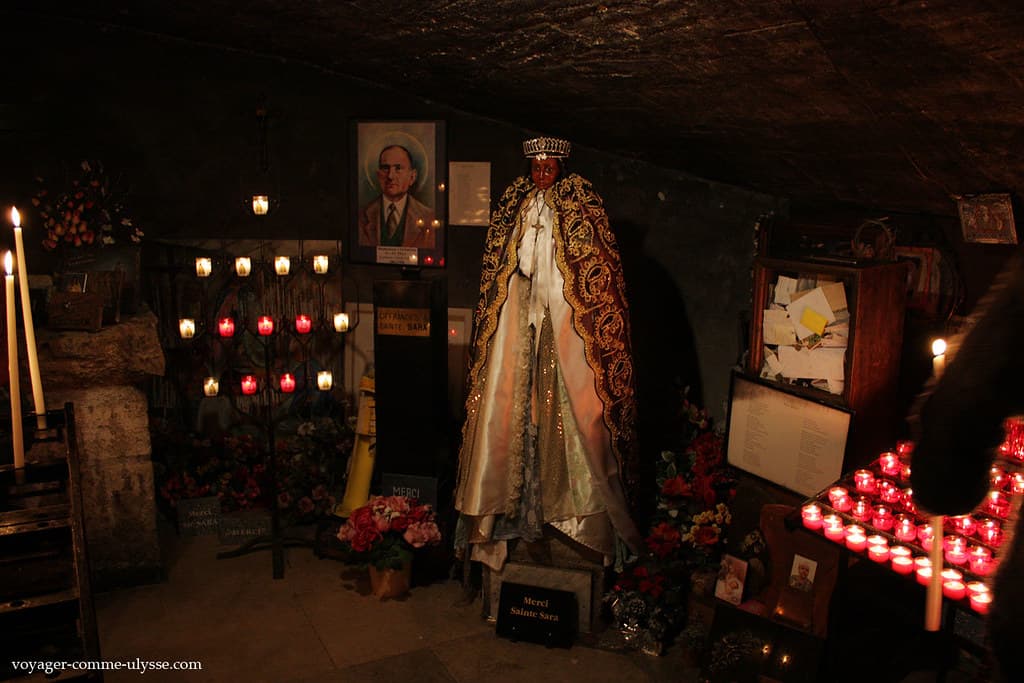
Saint Sarah
Saintes-Maries-de-la-Mer, Provence-Alpes-Côte d'Azur, France

Église Notre-Dame-de-la-Mer, Saintes-Maries-de-la-Mer
Saintes-Maries-de-la-Mer, Saintes-Maries-de-la-Mer, Provence, France
0.1 km away
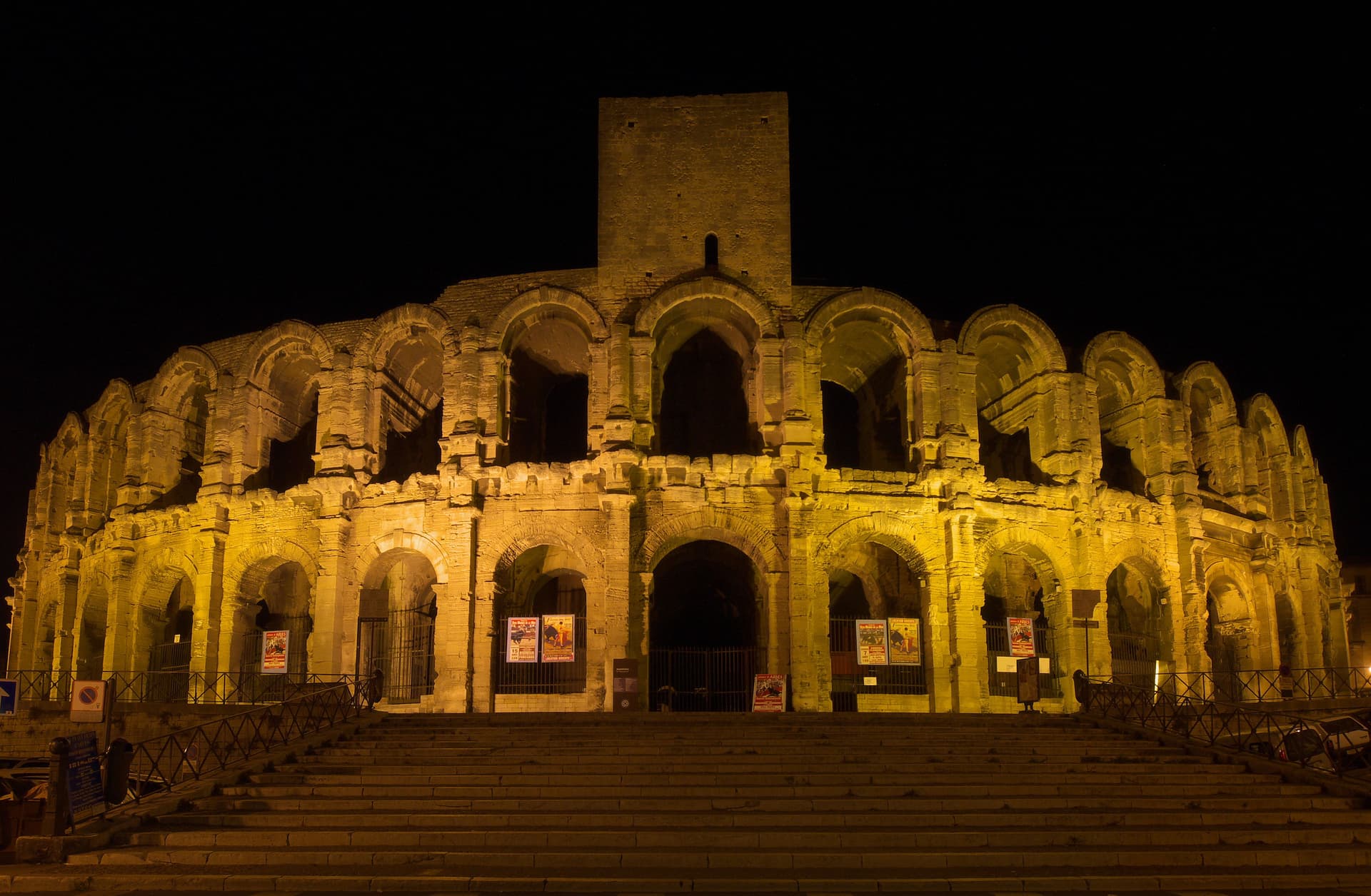
Arles
Arles, Provence-Alpes-Côte d'Azur, France
29.7 km away
.JPG&w=1920&q=75)
Église Sainte-Marie-Madeleine, Martigues
Martigues, Martigues, Provence, France
50.9 km away
References
Sources consulted when researching this page. Independent verification by readers is welcome.
- 01Meet Sara-la-Kali, the patron saint of displaced people — National Geographichigh-reliability
- 02Church of the Saintes Maries de la Mer - Wikipedia — Wikipedia contributors
- 03Saintes-Maries-de-la-Mer - Wikipedia — Wikipedia contributors
- 04Gypsy Pilgrimage in Les Saintes Maries de la Mer — Avignon et Provence
Key questions
What pilgrims usually ask
- Why is Church of the Saintes Maries de la Mer considered sacred?
- Where the Three Marys landed and where Sara draws thousands of Roma annually. Fortified church, crypt shrine, extraordinary May pilgrimage in the Camargue.
- What should I wear at Church of the Saintes Maries de la Mer?
- Modest dress, especially in the church and crypt.
- Can I take photos at Church of the Saintes Maries de la Mer?
- Be very respectful. Always ask before photographing people, especially during the pilgrimage.
- How long should I spend at Church of the Saintes Maries de la Mer?
- 1-2 hours for church and crypt. Full day for pilgrimage.
- What offerings are appropriate at Church of the Saintes Maries de la Mer?
- Candles available in the crypt.
- What etiquette should visitors follow at Church of the Saintes Maries de la Mer?
- Respect the deep significance of the Roma pilgrimage. Do not photograph Roma people without permission. Maintain reverence in the crypt.
- What is the history of Church of the Saintes Maries de la Mer?
- According to medieval tradition, the Three Marys—Mary Magdalene, Mary Salome, and Mary of Clopas—escaped persecution after the Resurrection by sailing from the Holy Land. They landed on this shore, accompanied by others including a servant named Sara. The Marys lived out their lives in Provence, bringing Christianity to France. The fortified church was built in the ninth century when Viking and Saracen raids threatened the coast. The building served as both worship space and refuge. In the fifteenth century, relics identified as those of Mary Salome and Mary of Clopas were discovered. Sara's cult developed alongside the Christian tradition but remained separate. In 1935, the Marquis Folco de Baroncelli-Javon—a local figure devoted to preserving Camargue traditions—won the Roma the right to hold their own public procession for Sara. Before this, Sara's veneration had been private; after 1935, it became the major pilgrimage it is today. The origin of Sara herself is disputed. One tradition says she was the Egyptian servant of the Three Marys. Another says she was a local woman who had visions and went to the shore to meet the arriving boat. Some scholars see connections to the Hindu goddess Kali—her name 'Sara-la-Kali' can be read as 'Sara who is Kali,' and the Roma's Indian origins lend plausibility to this interpretation.
- Who is associated with Church of the Saintes Maries de la Mer?
- The Three Marys (Arriving apostles), Sara-la-Kali (Patron of the Roma), Marquis Folco de Baroncelli-Javon (Pilgrimage advocate)