Easter Island
Where a thousand stone ancestors still watch from the edge of the world
Understand sacred places, explore living traditions, and learn how to engage respectfully with Pilgrim Map.
Access has not been verified. Check current local guidance before planning a visit.
Easter Island, Valparaíso, Chile
Read the sources
Visit essentials
A quick read before you go
- Duration
- Minimum 3-4 full days to see major sites without rushing.
- Access
- LATAM Airlines operates the only commercial flights, departing from Santiago, Chile…
Overview
More than three thousand kilometers from the nearest continent, in the southeastern Pacific where nothing else exists, a small island holds one of humanity's most extraordinary expressions of spiritual devotion. The Rapa Nui people, arriving by canoe from Polynesia perhaps a thousand years ago, created something unprecedented: a landscape populated by nearly a thousand stone figures, each carved to hold the sacred power of an ancestor.
The moai are not gravestones. They are not memorials. In the Rapa Nui understanding, they are aringa ora—living faces of deified ancestors, actual embodiments of the mana (sacred power) that flows from the divine through human lineages. When a chief died, their moai was completed with eyes and a pukao (topknot), activating its capacity to watch over the living. The statues face inland, toward their villages, backs to the sea. They were protectors.
Today, the Rapa Nui people maintain living traditions. The concepts of mana and tapu shape behavior. Fishing prohibitions protect marine species. The Ma'u Henua indigenous community manages the national park. Each February, the Tapati festival revives traditional competitions, music, and body painting, crowning a queen through cultural achievement. The ancestors carved in stone are not relics of a vanished people—they are watched over by their descendants.
Why this place is sacred
The isolation of Rapa Nui is difficult to comprehend. It is the most isolated inhabited island on Earth—3,500 kilometers from Chile, 2,000 kilometers from the nearest inhabited island, surrounded by nothing but ocean in every direction. To arrive here is to arrive at the end of the world.
And at the end of the world, you find stone faces watching.
There are roughly 887 of them scattered across the island, some still emerging from the volcanic quarry where they were born, others standing in rows on platforms at the island's edge, facing inland toward villages that have long disappeared. They range from two to twenty meters tall. They weigh tons. And for centuries, the Rapa Nui people carved, transported, and erected them as the central activity of their civilization.
The moai are not gravestones or memorials in any Western sense. They are aringa ora—living faces. When a chief or important person died, a moai was commissioned, quarried from Rano Raraku volcano, transported to the family's ahu (platform), and erected facing the village. At this point, coral and obsidian eyes were inserted, a red scoria pukao was placed atop the head, and the statue's mana was activated. It became an ancestor capable of watching over its descendants.
What creates thinness here is the existential question the moai pose. What did these people believe so completely that they devoted their island's resources—its trees for transport, its labor, its stone—to creating a thousand embodiments of ancestral power? The archaeological debates about how the moai were moved (rolled on logs? 'walked' with ropes?) miss the more profound question: why? What certainty about the relationship between the living and the dead could generate such devotion?
The Rapa Nui answer is mana—the sacred power that flows from the divine through human descendants, concentrating in certain people, places, and objects. The moai were not just representations of ancestors but actual vessels for their continuing presence. They watched. They protected. They participated in the ongoing life of the community.
This worldview persists. The Rapa Nui people still speak of mana and observe tapu—sacred prohibitions that protect people and places charged with this power. The moai are not museum pieces to them; they are relatives, requiring care and respect. When the Ma'u Henua community received authority over the national park in 2017, they assumed responsibility for caring for their ancestors.
The extreme isolation contributes to the experience. You cannot casually visit Easter Island—it requires commitment, a long flight over empty ocean, a decision to seek out what exists at the world's edge. The island offers no distractions from the questions the moai pose. Standing before Ahu Tongariki at sunrise, with fifteen silhouettes against the Pacific, or walking among the half-buried figures at Rano Raraku, there is space to sit with a mystery that will not resolve into explanation.
The moai were carved as embodiments of ancestral mana—not as memorial representations but as actual vessels capable of holding the sacred power of deified ancestors. Placed on ahu platforms at the boundary between land and sea, facing inland toward their communities, they were protectors watching over their descendants. The ahu themselves were sacred spaces for cremation and the transfer of the deceased to the spiritual realm.
When a moai received its eyes and pukao, its mana was activated; it became a living participant in community life.
Moai carving flourished from approximately 1000 to 1500 CE, with the culture producing nearly a thousand figures. Sometime around 1400 CE, construction appears to have declined—whether from resource depletion, cultural shift, or environmental pressure remains debated. A new sacred system emerged: the Tangata Manu (Birdman) cult, centered at Orongo village on the rim of Rano Kau crater.
Each year, representatives of Rapa Nui clans would compete to retrieve the first egg of the sooty tern from Motu Nui islet, requiring descent of 300-meter cliffs and a swim through shark-inhabited waters. The sponsor of the winning competitor became tangata manu for the year—sacred, secluded, and politically powerful. This practice continued until Christian missionaries ended it in 1867.
Today, the Tapati festival revives traditional competitions and practices, and the Rapa Nui community maintains living concepts of mana and tapu while managing their ancestral sites through the Ma'u Henua organization.
Experience and orientation
The first moai many visitors encounter is not among the island's famous sites but a single figure standing near the harbor in Hanga Roa. It is not particularly large or elaborately carved. But it establishes something immediately: these are not mere statues. There is something in the face—the heavy brow, the elongated nose, the downturned mouth, the ears stretched nearly to the jaw—that registers as presence. The moai looks at you.
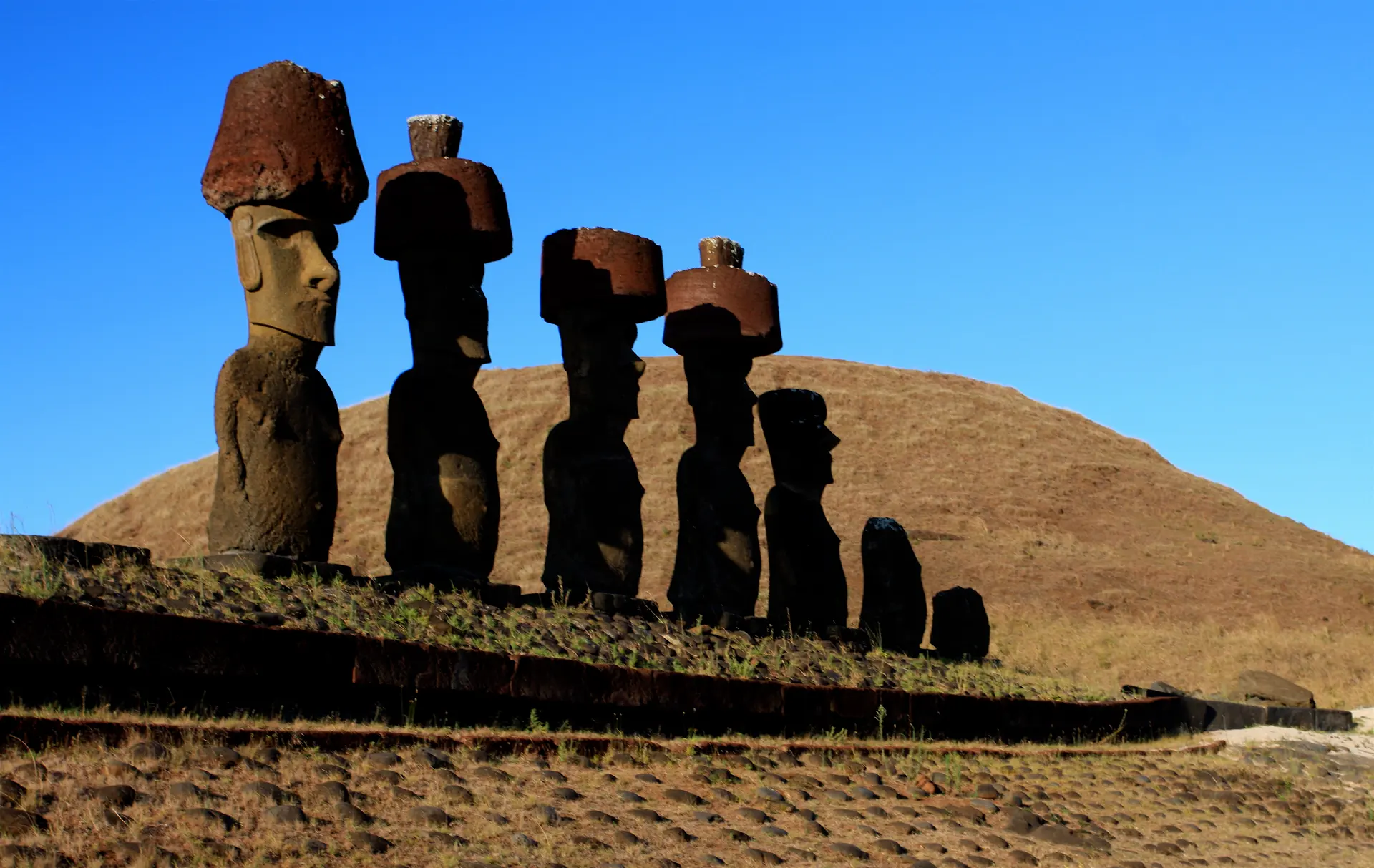
This quality intensifies at the major sites. Ahu Tongariki, with its fifteen moai restored after a 1960 tsunami scattered them across the landscape, is most often visited at sunrise. Arriving in darkness, visitors wait as the sky lightens behind the row of figures, their silhouettes becoming distinct against the Pacific. Photographers seek the image, but the experience is more than visual.
There is something about standing before ancestors carved nine centuries ago, at the edge of the world, as another day begins. People fall silent.
Rano Raraku, the volcanic quarry where 95% of all moai were carved, offers a different quality. Here, roughly 400 figures remain—some still attached to the rock from which they were emerging, others half-buried in the hillside, having apparently never been transported to their intended ahu. Walking among them, you see the moai in process: the moment of creation frozen. There is a giant—El Gigante—that would have stood twenty meters tall, apparently abandoned when a flaw appeared in the stone.
There is Tukuturi, a unique kneeling figure whose purpose remains unknown. The partially buried moai, with only their heads visible, created the misperception that the figures were merely heads; they all have bodies, buried by centuries of erosion.
Orongo, the ceremonial village of the Birdman cult, occupies one of the island's most dramatic locations: a narrow ridge between the Rano Kau crater and sheer 300-meter sea cliffs. Stone houses with corbeled roofs line the ridge. Petroglyphs of the birdman—human body with bird head holding an egg—and the deity Make-Make are carved into the rocks.
Looking down, you can see the islets of Motu Nui, Motu Iti, and Motu Kao Kao, where competitors once swam to retrieve the sacred egg. The setting makes the danger and devotion of the ceremony palpable.
Anakena beach, with its white sand unusual on this volcanic island, holds its own significance. According to tradition, this is where Hotu Matu'a landed his canoe, bringing the first settlers. Ahu Nau Nau stands at the beach's edge, its seven moai with restored pukao looking inland. It is possible to swim in the Pacific here, in the waters the ancestors crossed, then sit in the sand watching figures who have stood in that same spot for centuries.
Visitors who come during Tapati (the first two weeks of February) experience something beyond archaeology: a living culture in celebration. Families compete in traditional practices—takona (body painting with ancestral designs), kai kai (storytelling through string figures), haka pei (sliding down slopes on banana trunks at speeds up to 70 km/h). The festival culminates in the coronation of a queen at Ahu Tahai. The ancestors carved in stone are watching over their descendants, who are very much alive.
Most visitors base themselves in Hanga Roa, the island's only town, located on the west coast. A rental vehicle (car, scooter, or bicycle) is essential for reaching sites across the island, though certified local guides are mandatory for most archaeological areas. Begin with Tahai (accessible without a guide) near Hanga Roa to orient yourself to the moai. Sunrise at Ahu Tongariki is the most popular experience—arrive before dawn and expect other visitors.
Rano Raraku and Orongo can only be visited once per ticket, so plan these carefully. Allow at least half a day for each. The island is small (163 km²) but the sites require time to absorb. Build in afternoons for rest, the museum (Museo Antropológico Sebastián Englert), and time simply to be present. The rhythms of the island—sunrise, sunset, the persistent wind—become part of the experience.
Context and lineage
The royal adviser Hau-Maka had a prophetic dream in which his spirit traveled across the ocean to a distant land. He reported this vision to King Hotu Matu'a, who sent seven explorers toward the rising sun. After sailing for days, they found a small island suitable for growing yams—uninhabited, volcanic, but fertile. They returned to Hiva (their ancestral homeland, probably in the Marquesas), and the king led the colonizing expedition himself.
Hotu Matu'a's canoe landed at Anakena beach, the island's one stretch of white sand. From there, his people spread across the island, dividing it among clans that traced descent from his sons. Hotu Matu'a became the first ariki mau (paramount chief), embodying mana as both political and spiritual leader. All subsequent chiefs claimed lineage to him and, through him, to the gods Tangaroa and Rongo.
The seven explorers are memorialized by the seven moai of Ahu Akivi—unique among ahu for their inland location and moai that face the sea, looking toward the homeland their scouts once found.
Scholars note that this founding narrative bears similarities to Mangarevan mythology, and some question whether it was introduced or emphasized after missionary contact in the 1860s. The archaeological and genetic evidence confirms Polynesian settlement but leaves the precise date and circumstances uncertain—estimates range from 300 to 1200 CE. What is clear is that the Rapa Nui developed, in their isolation, something unprecedented.
The Rapa Nui traced lineage through the ariki mau (paramount chief) back to Hotu Matu'a and the gods. The island was divided among clans, each with its own ahu and moai, each claiming descent from one of Hotu Matu'a's sons. The concept of mana flowed through these lineages—concentrated in the ariki mau, present in varying degrees in nobles and specialists, embodied in the moai of departed ancestors.
The Birdman cult introduced a different system of sacred authority, with the tangata manu gaining ritual power through competition rather than inheritance. After missionary contact, Christianity became the primary religious framework, though traditional concepts of mana and tapu persist. Today, the Rapa Nui people maintain their cultural identity through organizations like Ma'u Henua, the Tapati festival, and ongoing relationship with their ancestral sites.
Hotu Matu'a
Legendary founder
The Seven Explorers
Legendary scouts
Rokunga
Last tangata manu
Traditions and practice
The central practice of classical Rapa Nui civilization was the creation, transport, and erection of moai. When an important person died, their family commissioned a moai from the carvers at Rano Raraku. The figure was quarried using stone picks (toki), refined at the quarry site, then transported—by methods still debated—to the family's ahu. There it was raised onto the platform, given eyes of coral and obsidian, and topped with a red scoria pukao (topknot).
At this moment, the moai's mana was activated; it became a living participant in community life, watching over descendants.
The Birdman ceremony (c. 1400-1867) established a different practice. Each spring, representatives of Rapa Nui clans gathered at Orongo village. Competitors called hopu manu descended the 300-meter sea cliffs, swam to Motu Nui islet, and waited in caves for the sooty terns to arrive. The first to secure an egg would swim back, climb the cliffs, and present it to their sponsor, who became tangata manu (birdman) for the year.
The tangata manu was considered tapu—sacred, secluded in a special house, allowed to let their nails grow, wearing a headdress of human hair. This sacred status conferred political power on their clan.
The Tapati Rapa Nui festival (first two weeks of February) is the primary living expression of traditional culture. Two families compete across a range of disciplines, accumulating points toward crowning a Queen of Tapati.
Competitions include takona (body painting with natural pigments and clay, with theatrical explanation of ancestral designs), kai kai (storytelling through string figures), koro haka opo (choral singing), haka pei (sliding down steep slopes on banana trunks at speeds reaching 70 km/h), tau'a rapa nui (traditional triathlon of swimming, paddling, and running), horse races, and craft competitions in carving, tapa cloth, and tattooing. The festival closes with the queen's coronation at Ahu Tahai and a ceremony at sunset.
Beyond the festival, traditional concepts persist. Fishing tapus continue to protect certain marine species from harvest. The concept of tapu governs behavior at sacred sites—the moai and ahu are not merely protected by law but by cultural understanding of their sacred status. The Ma'u Henua community, which manages the national park, approaches site conservation as care for ancestors rather than mere heritage preservation.
Visitors cannot participate in Tapati competitions, which are for Rapa Nui families, but can attend as spectators. Cultural performances are available through tour operators, offering traditional music, dance, and demonstrations of kai kai. The most meaningful form of participation is respectful engagement: hiring certified local guides who share traditional knowledge, asking questions, listening to what the Rapa Nui choose to share about their culture, and supporting Rapa Nui-owned businesses.
Some visitors bring their own contemplative practices—meditation, journaling, quiet sitting with the moai—which is appropriate as long as site restrictions are observed. There is no traditional offering practice for outsiders; the best 'offering' is respect.
Rapa Nui Traditional Beliefs
ActiveThe Rapa Nui worldview centers on interconnected concepts of mana (sacred spiritual power flowing from the divine through human lineages) and tapu (sacred prohibitions protecting people, places, and objects charged with mana). The moai embody ancestral mana—when erected with eyes and pukao, they become living presences protecting their descendants. The ariki mau (paramount chief) embodied mana as both political and spiritual leader. These concepts shape contemporary Rapa Nui identity and behavior.
The Tapati Rapa Nui festival (first two weeks of February) is the primary annual expression of traditional culture. Families compete in takona (body painting with ancestral designs), kai kai (string figure storytelling), koro haka opo (choral singing), haka pei (sliding down slopes on banana trunks), and tau'a rapa nui (traditional triathlon). Traditional crafts including carving, tapa cloth, and tattooing are practiced. Fishing tapus protect certain marine species. The Ma'u Henua community manages ancestral sites as a form of sacred care.
Roman Catholicism
ActiveChristianity arrived with missionaries in the 1860s, ending the Birdman cult and becoming the majority religion on the island. Today, most Rapa Nui identify as Catholic. The faith coexists with traditional beliefs—mana and tapu remain culturally important concepts even among Catholics. The Iglesia Santa Cruz in Hanga Roa incorporates Rapa Nui artistic elements, reflecting cultural synthesis.
Catholic masses are held at the church in Hanga Roa. Easter (Pascua) celebrations have particular resonance given the island's Spanish name (Isla de Pascua, Easter Island—named for Roggeveen's arrival on Easter Sunday 1722). Traditional festivals like Tapati coexist with the Catholic calendar.
Perspectives and open questions
The moai have inspired countless interpretations—from the scholarly to the speculative, from indigenous understanding to New Age projection. What remains consistent is their power to provoke questions that do not resolve into easy answers.
Scholarly perspective
Archaeologists understand the moai within the broader Polynesian pattern of ancestor veneration. The statues embodied ancestral mana (sacred power) and were placed on ahu platforms to watch over communities. The cultural florescence that produced nearly 1,000 moai between approximately 1000-1500 CE is remarkable for its isolation and originality—UNESCO recognizes it as a 'masterpiece of human creative genius' developed 'free from any external influence.'
Current research challenges earlier narratives, particularly the 'ecocide' theory that the Rapa Nui destroyed their environment through deforestation for moai transport. Newer evidence suggests more complex interactions involving climate change, rats (which ate palm seeds, preventing forest regeneration), and sustainable practices that persisted longer than previously thought. DNA analysis confirms pure Polynesian ancestry before European contact, contradicting once-popular theories of South American influence.
The transition from moai construction to the Birdman cult remains debated. Some scholars see it as a response to resource depletion; others view it as cultural evolution within a still-functional society. What is clear is that spiritual life on the island continued to develop—the Rapa Nui were not a 'collapsed' civilization but an adapting one, until European contact brought disease and, eventually, the Peruvian slave raids of the 1860s that devastated the population.
Living and traditional perspectives
For the Rapa Nui people, the moai are aringa ora—living faces of deified ancestors. They are not representations or memorials but actual embodiments of ancestral mana. The concept of mana remains central to Rapa Nui understanding: a sacred power that flows from the divine through human descendants, concentrating in certain people, places, and objects. When a moai received its eyes and pukao, its mana was activated; it became present, watching, participating in community life.
Tapu—sacred prohibition—continues to govern behavior around the moai and ahu. These are not merely protected sites but sacred ground, and violations carry cultural weight beyond legal penalty. The founding narrative of Hotu Matu'a establishes the island as a chosen land, discovered through prophetic vision. Contemporary Rapa Nui identity is inseparable from the moai and the responsibility to care for them.
The return of the national park to Ma'u Henua community management in 2017 represents a reclaiming of sacred stewardship. For the Rapa Nui, caring for the moai is not heritage preservation—it is caring for ancestors.
Alternative interpretations
Easter Island has attracted alternative interpretations ranging from the scientifically unfounded to the spiritually sincere. Claims of extraterrestrial builders persist in popular culture despite clear archaeological evidence of Polynesian creation. Theories connecting the island to Atlantis, Lemuria, or a global civilization of antiquity find no scholarly support but continue to circulate.
More nuanced alternative perspectives include New Age visitors who experience the island as an 'energy vortex' or place of 'high vibration.' Some visitors report profound spiritual experiences—a sense of connection, communication, or transformation—that they frame in terms of Earth energy, ley lines, or cosmic significance. While these interpretations are not shared by the Rapa Nui themselves and should not be confused with traditional understanding, they reflect the island's genuine capacity to provoke experiences that feel significant.
Visitors who bring contemplative practices—meditation, prayer, journaling—often find the island's isolation and the presence of the moai conducive to inner work. This is appropriate as long as site restrictions are respected and the visitor's interpretation is not projected onto the Rapa Nui culture.
Open questions
Despite extensive study, fundamental questions remain about Rapa Nui. The precise date of initial settlement is uncertain—estimates range from 300 CE to 1200 CE. How exactly were the moai transported from quarry to ahu? Experiments have demonstrated various possibilities (sledges, rollers, 'walking' with ropes), but the actual method used by the Rapa Nui remains debated.
Why did moai construction cease? Resource depletion, cultural shift, climate change, and other factors have been proposed, but no consensus exists. What triggered the transition to the Birdman cult? Some moai bear unique features—like the kneeling Tukuturi—whose significance is unknown.
Perhaps most intriguing, the rongorongo script—a system of glyphs carved on wooden tablets—remains undeciphered. Only 26 authentic tablets survive, most removed from the island before their significance was understood. What knowledge might they contain? What stories, genealogies, or sacred texts have been lost?
These mysteries are part of the island's power. The moai witness a civilization that left questions we cannot fully answer—and perhaps that is the point. They invite us to sit with not knowing, to recognize that some human achievements exceed our capacity for explanation.
Plan your visit
Access and arrival
LATAM Airlines operates the only commercial flights, departing from Santiago, Chile (approximately 5.5 hours). Flights typically run daily but schedules vary seasonally. Book well in advance, especially for Tapati season or summer holidays. The island is approximately 3,500 km from the Chilean mainland—the most isolated inhabited island on Earth. All visitors arrive at Mataveri International Airport in Hanga Roa. There is no ferry or other transport option.
Accommodations are centered in Hanga Roa, ranging from simple hostels to boutique hotels. Book well in advance, especially for Tapati season (February) and summer holidays (December-January). Most hotels are small and family-run. Camping is available at Camping Mihinoa and other sites. Consider accommodations with kitchen access, as restaurant options are limited and food prices are high due to the island's isolation.
Respectful visit
No formal requirements. Modest clothing appreciated at archaeological sites; beachwear appropriate only at beaches (Anakena, Ovahe). Bring layers as weather changes quickly. Strong sun protection essential—the island's location near the tropics and lack of pollution creates intense UV exposure. Comfortable walking shoes for uneven volcanic terrain.
Photography permitted at all outdoor sites. Drones require special permits and are rarely approved within the national park. Tripods may require permission at some sites. Do not use flash in enclosed spaces (cave paintings, museum). Never cross barriers to improve your angle. Photography should not take precedence over presence and respect. Ask permission before photographing Rapa Nui people.
No traditional offering practice exists for visitors. The most meaningful 'offering' is engaging certified local guides, supporting Rapa Nui-owned businesses, and contributing to conservation efforts. Some visitors light candles or leave flowers at sites; while not traditional, this is generally tolerated if done respectfully and items are not left to become litter.
Do not touch, climb on, or approach within roped barriers around moai. Do not sit on ahu platforms. Do not remove any materials from sites—stones, shells, artifacts, or plants. Certified local guides mandatory for most sites (exceptions: Tahai, Anakena). Rano Raraku and Orongo can only be visited once per ticket. Stay on marked paths. National park hours: 9:00 AM - 6:00 PM. Violation of regulations can result in substantial fines and criminal charges.
The moai and ahu are sacred sites, not photo opportunities. Do not touch the moai—this is both illegal and deeply offensive. Do not cross barriers or ropes. Do not sit on ahu platforms or climb on any structures. Do not remove stones, shells, or any materials from sites. The Rapa Nui have seen significant damage from tourists seeking souvenirs or 'better photos'—a Finnish tourist who broke off a moai ear in 2008 faced serious consequences.
Treat the sites as you would a church, temple, or graveyard of your own tradition. When uncertain, ask your guide.
Current practical details
Address
Easter Island, Valparaíso, Chile
Hours, fees, and access can change — verify on the official source before you travel. Practical details last checked Jun 2026.
Location
Map loads as you approach this section.
Pilgrim reflections
A portrait of encounter, not a score
Pilgrims describe what they felt, how present they could become, and whether the place would shape a journey. There are no stars and no ranking of traditions.
No reviewed reflections yet
The first pilgrims can help describe the character of being here.
Share a reflection
Available after an account-backed “Been there.” Every reflection is reviewed before publication.
Nearby sacred places
Explore other sacred places in the region. Proximity does not establish access or travel time; check each place’s guidance.
Ahu Nau Nau
Anakena, Rapa Nui, Valparaíso Region, Valparaíso, Chile
5.0 km away

Ahu Akivi
Hanga Roa interior, Rapa Nui, Valparaíso Region, Valparaíso, Chile
6.3 km away

Rano Raraku
Hanga Roa / Hanga Nui area, Rapa Nui, Valparaíso Region, Valparaíso, Chile
7.6 km away

Vinapu Ceremonial Complex
Hanga Roa, Rapa Nui, Valparaíso Region, Valparaíso, Chile
8.8 km away
References
Sources consulted for this page. Source categories describe the publication, not a guarantee that every claim is verified. Traditional accounts and outside interpretations may differ.
- 01Rapa Nui National Park - UNESCO World Heritage Centre — UNESCOofficialOfficial UNESCO listing with inscription criteria
- 02Rapa Nui (Easter Island) Moai — SmarthistoryacademicAcademic art history resource
- 03Moai - British Museum — British MuseumofficialMuseum documentation on moai significance
- 04Rapa Nui National Park Official Website — Ma'u Henua Indigenous CommunityofficialOfficial park management by indigenous community
- 05Easter Island - Wikipedia — Wikipedia contributorsencyclopediaComprehensive overview article
- 06Mana Rapa Nui - The supernatural power of Easter Island — Imagina Rapa NuispiritualLocal cultural tourism source with traditional knowledge
- 07Tapu Rapa Nui - The concept of the sacred and forbidden — Imagina Rapa NuispiritualLocal source on traditional sacred concepts
- 08Tangata Manu - The Easter Island Birdman Cult — Imagina Rapa NuispiritualDetailed account of Birdman ceremony
- 09Hotu Matu'a - Wikipedia — Wikipedia contributorsencyclopediaOverview of founding legend
- 10Easter Island Travel - Tapati Rapa Nui Festival — Easter Island TravelguideDetailed festival information
Photo gallery
3 curated photos
Share a photo
Help visitors recognize Easter Island. Every submission is reviewed before publication.