Dewa Shrine and Mt. Haguro
The pilgrimage of death and rebirth: 2,446 steps through ancient cedars to the mountain of the present
Understand sacred places, explore living traditions, and learn how to engage respectfully with Pilgrim Map.
Access has not been verified. Check current local guidance before planning a visit.
Tsuruoka, Yamagata Prefecture, Japan
Read the sources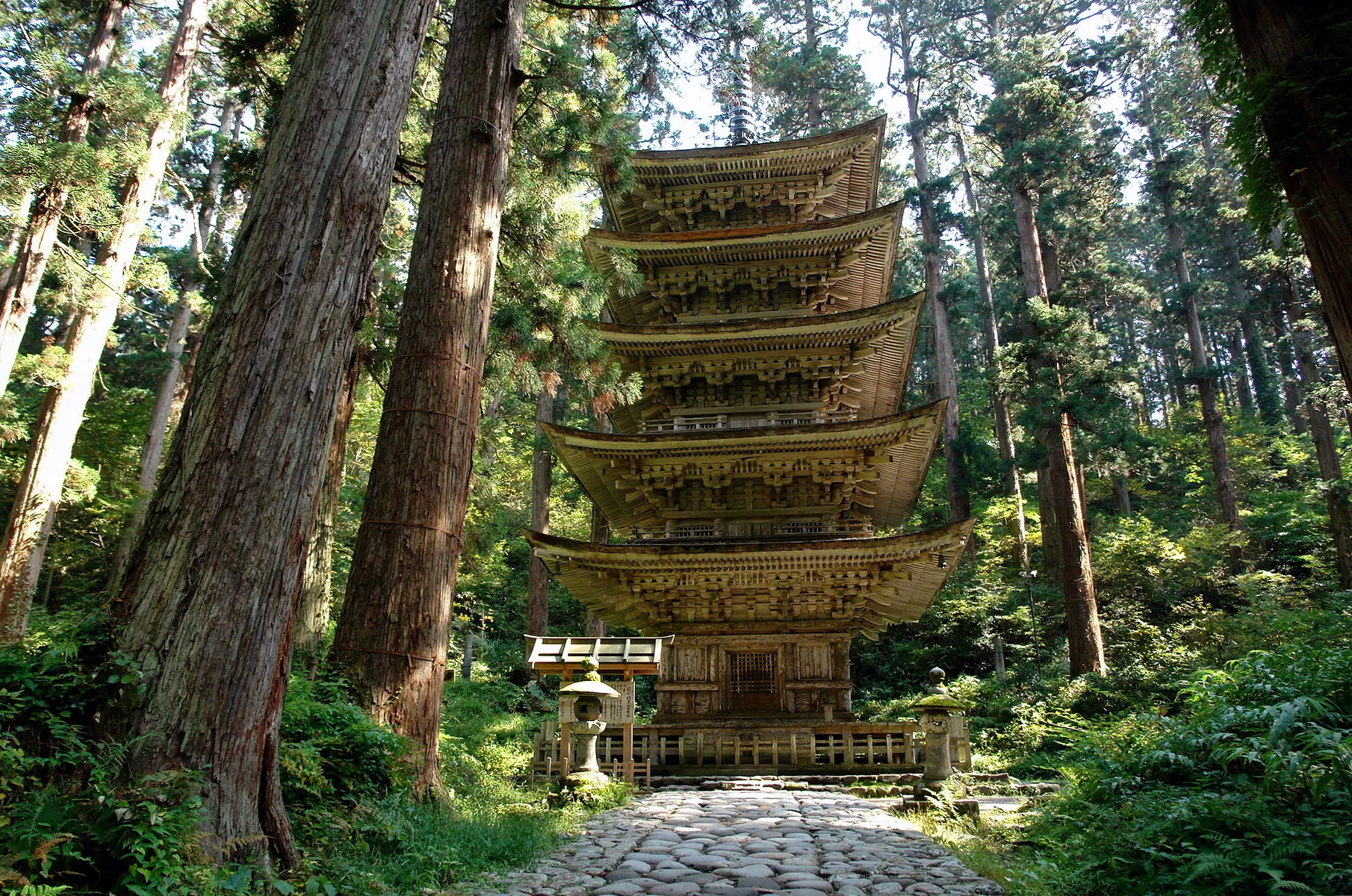
Image of Dewa Shrine and Mt. Haguro. Image source · CC-BY-3.0
Station 1 of 3
Dewa Sanzan PilgrimageVisit essentials
A quick read before you go
- Duration
- Half day for Mount Haguro climb; 2-3 days for complete three-mountain pilgrimage; longer for…
- Access
- Open during daylight hours.
Overview
In Yamagata Prefecture, three sacred mountains form a spiritual cosmology of complete human transformation. Mount Haguro represents the present, Mount Gassan the past and death, Mount Yudono the future and rebirth. Together, they are the Three Mountains of Dewa - and Mount Haguro, with its year-round accessibility and extraordinary stone stairway, is where most pilgrims begin.
The story starts in 593 CE, when Prince Hachiko fled to this remote region after the assassination of his father, Emperor Sushun. According to legend, a mystical three-legged crow guided him to these peaks. After rigorous ascetic training, he saw incarnations of Buddha appearing as Shinto deities. He spent his remaining life in religious pursuits, becoming known as Nojo Taishi and founding the mountain's sacred tradition.
From this beginning grew one of Japan's most important Shugendo centers. Shugendo - 'the Way of Harsh Training' - fuses esoteric Buddhism with Shinto and mountain worship. Its practitioners, the yamabushi, still roam these peaks, identifiable by their white robes and the conch shells they blow to announce their practice.
The approach to the summit shrine is one of Japan's great sacred journeys: 2,446 stone steps climbing through forests where cedars over 600 years old stand like silent witnesses. At the base, a five-story pagoda designated a National Treasure emerges from the forest. At the summit, the Sanjin Gosaiden shrine encompasses all three mountain deities.
To complete the full pilgrimage - all three mountains - is to experience symbolic death and rebirth. Most pilgrims return transformed, carrying something of the mountain's power back to their ordinary lives.
Why this place is sacred
The thinness of the Dewa Sanzan permeates every aspect of the experience. It begins with the approach - the ancient cedars create a cathedral-like space where light filters down as if from another realm. The 2,446 stone steps, worn smooth by centuries of pilgrims' feet, carry the accumulated spiritual intention of millions of journeys.
But the deepest thinness lies in the cosmology itself. The three mountains are not merely places but phases of existence: present, death, and rebirth. To walk among them is to walk through the structure of life itself. Mount Haguro represents the present - the embodied experience of climbing, breathing, being alive. From here, the pilgrim will descend into the death realm of Gassan before emerging reborn at Yudono.
This schema is not metaphor for practitioners. Yamabushi describe the pilgrimage as genuine spiritual death and rebirth. They emerge from the experience with new capacities for healing and protection. The tradition has continued for over 1,400 years, each generation's practice deepening the groove between worlds.
On Mount Haguro, the Five-Story Pagoda stands as a threshold marker. Appearing suddenly in the forest, surrounded by ancient cedars, it signals the transition from ordinary space into something else. Many pilgrims report this moment - when the pagoda comes into view - as the first point where the atmosphere shifts palpably.
Mount Haguro and the Dewa Sanzan were established as a complete system of spiritual death and rebirth. From the beginning, the three mountains formed a cosmology: present, past/death, and future/rebirth. The purpose was transformation - to die to old patterns and be reborn with spiritual power. This was not figurative but understood as actual passage through the realms of existence.
The tradition has survived remarkable challenges. During the Meiji period, the government banned Shugendo and forced the conversion of Buddhist-Shinto syncretic sites to purely Shinto shrines. Temples were converted or destroyed. Yet the Haguro tradition survived, preserved by practitioners who continued their practice despite official suppression. Today, Shugendo is experiencing revival. Visitors can join yamabushi training retreats, experiencing something of what ascetics have practiced for fourteen centuries.
Experience and orientation
The journey up Mount Haguro begins at the Zuishin Gate, where pilgrims traditionally change into white robes. Beyond the gate, the modern world falls away. The path descends briefly to the Harai River and its small shrine, then enters the forest.
The Five-Story Pagoda appears before the main climb begins. This National Treasure, standing among cedars over 600 years old, is an introduction to what is to come. Many pause here to simply absorb the atmosphere - the ancient wood, the silent trees, the sense of entering sacred space.
Then the stone steps begin: 2,446 of them, climbing steadily through the cedar forest. Each step is a small act of devotion. Pilgrims have marked this ascent for over a thousand years; their passage has worn the stones smooth and infused the path with accumulated intention.
Teahouses appear at intervals, offering rest and refreshment - a tradition maintained for centuries. The climb takes most visitors 1.5 to 2 hours. With each elevation gain, the world below grows more distant. The cedars eventually give way to broader views.
At the summit stands the Sanjin Gosaiden, the shrine that encompasses all three mountain deities. Here pilgrims who have completed the full circuit can pay respects to all three mountains in one place. For those who have climbed only Haguro, it is both an arrival and an invitation to return.
The descent can be made on foot (experiencing the journey differently in reverse) or by road. Either way, something of the mountain accompanies the pilgrim back to ordinary life.
Mount Haguro lies in Tsuruoka City, Yamagata Prefecture. The Dewa Shrine complex occupies the summit. The main climbing route begins at the Zuishin Gate (Ideha Bunka Kinenkan area), passing the Five-Story Pagoda before ascending the 2,446 stone steps. A toll road also reaches near the summit for those who cannot make the climb. The summit facilities include the Sanjin Gosaiden shrine and visitor services.
Context and lineage
In 593 CE, the young Prince Hachiko faced tragedy. His father, Emperor Sushun, was assassinated, and the prince was forced to flee for his life. He made his way to the remote Dewa region, where mountains rose wild and holy.
According to tradition, a mystical three-legged crow appeared to guide him through the wilderness. This yatagarasu - the same divine crow that appears throughout Japanese mythology - led the prince to the three peaks that would become sacred. On these mountains, Hachiko subjected himself to rigorous ascetic training.
After years of practice, he experienced a vision: incarnations of Buddha appearing in the form of Shinto deities. This vision integrated the Buddhist and Shinto traditions that would characterize Dewa Sanzan worship. Prince Hachiko spent the remainder of his life in religious pursuits, becoming known as Nojo Taishi and establishing the sacred tradition that continues today.
The three mountains came to represent a complete spiritual cosmology: Mount Haguro (the present), Mount Gassan (the past/death), and Mount Yudono (the future/rebirth). Pilgrimage through all three enacts the cycle of death and rebirth, allowing the pilgrim to return to ordinary life renewed.
The Dewa Sanzan tradition represents Shugendo at its most developed. Shugendo synthesizes esoteric Buddhism (particularly Shingon and Tendai), Shinto, Taoism, and indigenous mountain worship. The yamabushi lineages of Haguro have transmitted their practices for over 1,400 years, surviving even the Meiji-era ban on Shugendo. Today, the tradition continues with active yamabushi leading training retreats for both Japanese and international participants.
Prince Hachiko (Nojo Taishi)
Founder
Shozen Daitoku
Developer of Mount Gassan shrine
Traditions and practice
Traditional practice at Dewa Sanzan centers on the pilgrimage of rebirth through all three mountains. Yamabushi undertake rigorous ascetic training including mountain climbing, waterfall meditation (standing under cold waterfalls as purification), fire ceremonies (goma), conch shell blowing, and periods of isolation and fasting. The sokushinbutsu practice - self-mummification through extreme asceticism - was historically performed in this region, with preserved mummies still venerated at nearby temples.
Contemporary practice maintains the essential structure. The three-mountain pilgrimage is performed during summer when all peaks are accessible. Year-round pilgrimage to Mount Haguro continues. Temple lodging (shukubo) and vegetarian temple cuisine (shojin ryori) offer immersive experiences. Crucially, yamabushi training retreats are now available to visitors - offering a guided introduction to the practices that ascetics have performed for over a millennium.
For those seeking spiritual experience at Dewa Sanzan, the Mount Haguro climb offers the most accessible entry. Approach it as pilgrimage rather than hiking - white robes are available for rent, transforming the ascent into something more than exercise. For deeper engagement, consider temple lodging at a shukubo. For the most profound experience, join a yamabushi training retreat - even brief retreats offer genuine exposure to the tradition. If time permits, complete the full three-mountain pilgrimage during summer.
Shugendo
ActiveDewa Sanzan is one of Japan's most important Shugendo centers. Shugendo ('the Way of Harsh Training') blends esoteric Buddhist practices with Shinto and mountain worship. Practitioners called yamabushi perform rigorous ascetic exercises to transcend the physical world. The tradition has survived over 1,400 years, even through Meiji-era suppression.
Mountain pilgrimage, waterfall meditation, fire ceremonies, austerities, yamabushi training retreats, conch shell blowing
Pilgrimage of Rebirth
ActiveThe three mountains represent a journey through time and rebirth: Mount Haguro represents the present, Mount Gassan the past and death, Mount Yudono the future and rebirth. Completing the pilgrimage symbolizes spiritual death and rebirth. For millennia, both yamabushi and ordinary pilgrims have made this transformative journey.
Sequential pilgrimage through all three mountains, ritual death and rebirth, offerings at each mountain's shrine
Perspectives and open questions
The Dewa Sanzan represents one of Japan's most significant examples of syncretic mountain religion, understood through multiple lenses.
Scholarly perspective
Scholars recognize the Dewa Sanzan as invaluable evidence of how Japanese spirituality evolved through the blending of Buddhist, Shinto, and Taoist elements. The unbroken 1,400-year history provides documentation of practices that elsewhere disappeared. The sokushinbutsu mummies at nearby temples demonstrate the extreme asceticism once practiced in this tradition. Researchers study how the three-mountain cosmology creates a complete ritual geography of death and rebirth.
Living and traditional perspectives
In Shugendo understanding, the mountains are living sacred presences - not symbols of spiritual realities but the realities themselves. The pilgrimage is not merely symbolic death and rebirth but actual passage through these states of being. Yamabushi who complete the practices genuinely gain spiritual powers - abilities for healing, protection, and blessing that can be transmitted to others. The three-legged crow that guided Prince Hachiko is understood as a divine messenger, not a legend.
Alternative interpretations
Some view the Dewa Sanzan as a powerful energy center where the veil between worlds is naturally thin. The mountains are understood as forming a mandala or energy grid that concentrates spiritual force. The mummified ascetics are seen as maintaining spiritual presence, their practice continuing beyond physical death.
Open questions
The full nature of Prince Hachiko's founding vision remains mysterious. Secret practices preserved within yamabushi lineages are not fully documented for outsiders. The complete symbolism of the three-mountain cosmology - why these particular mountains, why this particular arrangement - retains depths that scholarship has not fully plumbed.
Plan your visit
Access and arrival
Open during daylight hours. Free access; fees for some buildings and experiences. Bus from Tsuruoka Station to Mount Haguro base. Bus service connects the mountains during summer.
Traditional temple lodging (shukubo) at the summit offers the most immersive experience, including vegetarian temple cuisine. Lodging also available in Tsuruoka city.
Respectful visit
Comfortable hiking attire suitable for the 2,446-step climb. Traditional white pilgrimage garb available for rent at the base. Proper footwear essential.
Permitted in most areas. Prohibited at Mount Yudono's inner sanctuary.
Coins at shrine offering boxes. Traditional offerings during ceremonies if participating.
{"Respect sacred areas and ongoing practices","No photography at Mount Yudono's holiest area","Follow instructions of yamabushi guides","Maintain reverent attitude throughout"}
Mount Gassan and Mount Yudono are closed from approximately November through June due to heavy snow. Only Mount Haguro is accessible year-round. Physical fitness is required for the 2,446-step climb. Temple lodging books up during peak periods. Yamabushi training involves genuine austerity and is not suitable for those with physical limitations.
Current practical details
Address
Mt. Haguro, Haguroyama Haguromachi Touge, Tsuruoka, Yamagata 997-0211, Japan
Hours, fees, and access can change — verify on the official source before you travel. Practical details last checked Jun 2026.
Location
Map loads as you approach this section.
Pilgrim reflections
A portrait of encounter, not a score
Pilgrims describe what they felt, how present they could become, and whether the place would shape a journey. There are no stars and no ranking of traditions.
No reviewed reflections yet
The first pilgrims can help describe the character of being here.
Share a reflection
Available after an account-backed “Been there.” Every reflection is reviewed before publication.
Nearby sacred places
Explore other sacred places in the region. Proximity does not establish access or travel time; check each place’s guidance.

References
Sources consulted for this page. Source categories describe the publication, not a guarantee that every claim is verified. Traditional accounts and outside interpretations may differ.
- 01About The Dewa Sanzan Mountains — The Dewa SanzanSource contextOfficial information
- 02Dewa Sanzan Guide: Experience the Journey of Rebirth — Japan National Tourism OrganizationSource contextOfficial tourism information
- 03Dewa Sanzan - Tsuruoka City Tourism — Tsuruoka CitySource contextLocal government tourism
- 04Three Mountains of Dewa - Wikipedia — Wikipedia contributorsencyclopediaComprehensive overview
- 05Shugendo that remains in Yamagata — NIHONMONOspiritualCultural context
Pilgrim glossary
- Shukubo
- A temple lodging where pilgrims and visitors can stay overnight, often with vegetarian meals and morning service.
- Mandala
- A symbolic diagram of the cosmos used in meditation and ritual.
- Torii
- The traditional Japanese gate marking the entrance to a Shinto sacred area.
- Shingon
- An esoteric Japanese Buddhist school emphasizing ritual, mantra, and mandala practice.
- Tendai
- A Japanese Buddhist school based on the Lotus Sutra, foundational to many later traditions.
Share a photo
Help visitors recognize Dewa Shrine and Mt. Haguro. Every submission is reviewed before publication.