Akita Seibo no Sono
A working Japanese convent where a wooden statue of Mary wept 101 times
Understand sacred places, explore living traditions, and learn how to engage respectfully with Pilgrim Map.
Access has not been verified. Check current local guidance before planning a visit.
Yuzawadai, Akita Prefecture, Japan
Read the sources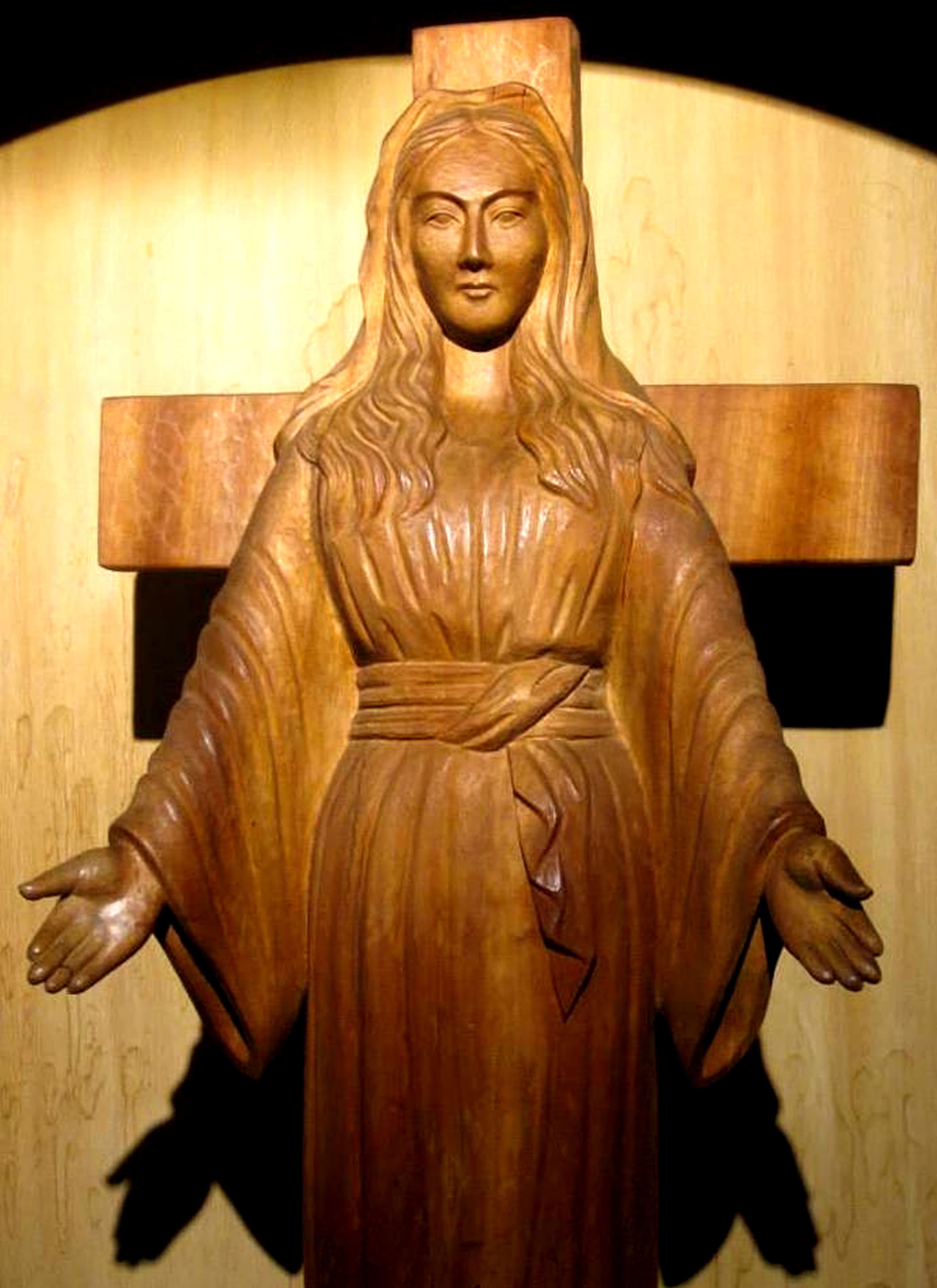
Image of Akita Seibo no Sono. Image source · CC-BY-SA-4.0
Visit essentials
A quick read before you go
- Duration
- Half a day for the chapel, statue veneration, and grounds.
- Access
- Yuzawadai (Soegawa), in the hills about 10 km east of central Akita City.
Overview
Akita Seibo no Sono, 'The Garden of the Holy Mother of Akita', houses the Institute of the Handmaids of the Sacred Heart of Jesus in the Holy Eucharist, a contemplative women's institute founded in 1970 by Bishop John Shojiro Ito of Niigata. On 12 June 1973, Sister Agnes Katsuko Sasagawa—a Japanese convert, survivor of multiple medical crises, and recently profoundly deaf—reported brilliant rays from the chapel tabernacle.
Two weeks later she received the stigmata of a cross-shaped wound on her left palm. From July through October 1973, she reported three messages from Mary calling for prayer, penance, and reparation.
On 4 January 1975, the convent's wooden Blessed Virgin statue began weeping human tears, later bleeding and exuding sweet-smelling liquid from its hands. Buddhist sculptor Saburo Wakasa had carved it from one piece of katsura wood and it was installed in 1965. The statue wept 101 times through 15 September 1981, the Feast of Our Lady of Sorrows. Akita University and Kyushu University laboratories identified its tears, blood, and perspiration as human, with blood types O, B, and AB.
After eleven years of investigation, Bishop Ito declared the events supernatural on 22 April 1984. In 1988 Cardinal Joseph Ratzinger, then Prefect of the Congregation for the Doctrine of the Faith, indicated no objection to Ito's pastoral letter. That was not formal Vatican approval, which has not been issued. Sister Agnes died on the Feast of the Assumption, 15 August 2024, aged 93.
Why this place is sacred
Akita's distinctiveness is its smallness. There is no basilica, no procession, no commercial corridor. The site is a working contemplative convent — the Handmaids of the Holy Eucharist live cloistered lives of prayer, daily Mass, and Eucharistic adoration — and pilgrims are accommodated within that structure rather than around it.
The wooden statue, carved by a Japanese Buddhist sculptor from native katsura wood, stands in the convent chapel; visitors venerate it during open hours, often in groups of only a handful. The events of 1973–1981 — three messages, stigmata, 101 weepings investigated by independent laboratories — are unusual in their forensic documentation, and the chapel preserves the locus of those events without elaboration. The October 13 anniversary of the final message draws a quiet pilgrimage rather than a crowd.
The convent was founded in 1970 by Bishop John Shojiro Ito of Niigata as a contemplative women's institute. The wooden statue was installed in 1965, five years before the institute's founding. The site became an apparition site after the 1973 events.
From a small contemplative foundation, the site has grown into Japan's principal Marian pilgrimage destination — though it remains, by deliberate choice, a working convent rather than a developed shrine. The 1984 episcopal decree on the supernatural origin of the events established its devotional status; the 1988 acknowledgment by Cardinal Ratzinger settled its standing with the Holy See without formal Vatican approval. International pilgrim numbers have grown steadily.
Experience and orientation
Most pilgrims reach Akita by Shinkansen from Tokyo, then taxi or bus to Yuzawadai in the hills about ten kilometers east of central Akita. The convent grounds are quiet and well-kept; the chapel is small, with the wooden statue at its center. Veneration is intimate — there is rarely a crowd, even on the October 13 feast — and the dominant atmosphere is the contemplative life of the resident sisters rather than the spectacle of an apparition shrine.
Visitors describe Akita as the 'opposite' of Lourdes: no processions, no commerce, no developed pilgrimage infrastructure. The seasonal closure (December through March for the snowy Akita winter, the entire month of August for the sisters' retreat, and Wednesdays year-round) reinforces the rhythm of monastic life. Cherry blossom season (late April) and the autumn colors of October align with the principal feast days.
The chapel housing the wooden statue is the focus of pilgrim visits. The cloistered areas of the convent are off-limits to visitors. Groups of 13 or more must reserve in advance; individuals may visit during open hours without reservation.
Context and lineage
Sister Agnes Katsuko Sasagawa (born 1931, died 2024) was a Japanese Catholic convert who had survived multiple severe medical crises and had recently become profoundly deaf when, on 12 June 1973, she reported seeing brilliant rays of light from the tabernacle in the convent chapel. Two weeks later, on 28 June 1973, she received the stigmata of a cross-shaped wound on her left palm.
Between 6 July and 13 October 1973 — the final date being the 56th anniversary of the Miracle of the Sun at Fatima — she received three messages from Mary calling for prayer, penance, and adherence to the rosary, and warning that 'the work of the devil will infiltrate even into the Church.' Beginning on 4 January 1975, the convent's wooden statue of the Blessed Virgin began to weep human tears.
Over the next six and a half years the statue wept 101 times, and subsequently bled and exuded a sweet-smelling liquid from the hands. The final weeping occurred on 15 September 1981, the Feast of Our Lady of Sorrows. Independent laboratory analysis at Akita University and Kyushu University typed the tears, blood, and perspiration as human (blood types O, B, AB).
Bishop John Shojiro Ito of Niigata investigated the events over eleven years and on 22 April 1984 declared them of supernatural origin, authorizing veneration of Our Lady of Akita within his diocese.
In 1988 Cardinal Joseph Ratzinger, then Prefect of the Congregation for the Doctrine of the Faith, stated that he had no objection to Bishop Ito's pastoral letter — a position commonly described in devotional sources as 'Vatican approval' but more accurately framed as the absence of formal objection from the CDF.
Roman Catholicism in the Latin Rite, in the form of a contemplative women's institute (Handmaids of the Sacred Heart of Jesus in the Holy Eucharist) within the Diocese of Niigata. The convent's spirituality centers on Eucharistic adoration and reparation.
Sister Agnes Katsuko Sasagawa (1931–2024)
Japanese Catholic convert and member of the Handmaids of the Holy Eucharist; received the messages, stigmata, and witnessed the weeping statue. Died on the Feast of the Assumption, 15 August 2024.
Bishop John Shojiro Ito (1909–1993)
Bishop of Niigata. Founded the Handmaids of the Holy Eucharist in 1970 and issued the decree of supernatural origin on 22 April 1984 after eleven years of investigation.
Cardinal Joseph Ratzinger
As Prefect of the Congregation for the Doctrine of the Faith in 1988, indicated he had no objection to Bishop Ito's pastoral letter. This is distinct from formal Vatican approval, which has not been issued.
Saburo Wakasa
Japanese Buddhist sculptor who carved the wooden statue from a single piece of katsura wood; the statue was installed at the convent in 1965.
Traditions and practice
The Feast of Our Lady of Akita on 13 October — the anniversary of the final 1973 message and a deliberate parallel with Fatima — is the principal annual feast. The anniversary of the first apparition (12 June) is observed with a commemorative Mass. The Feast of Our Lady of Sorrows (15 September), the date of the final weeping in 1981, is also marked.
The Prayer of the Handmaids of the Eucharist, taught in the 1973 apparitions, is recited as part of the convent's daily office.
The resident sisters live a contemplative monastic life of prayer, daily Mass, and Eucharistic adoration. Pilgrim Masses can be scheduled with the convent in advance. Veneration before the wooden statue during open hours is the principal devotional act for visitors. The sisters' contemplative office is largely not public.
Pilgrims should respect the convent's hours and the monastic quiet of the property. Most visitors come for half a day, combining the chapel and grounds with an overnight stay in Akita city. Feast-day visits should be planned well in advance; the principal feast on 13 October aligns with the autumn colors of northern Honshu.
Roman Catholicism (Handmaids of the Holy Eucharist)
ActiveThe principal Marian apparition site of East Asia. Three Marian messages received by Sister Agnes Katsuko Sasagawa in 1973 and the weeping of a wooden statue of the Blessed Virgin Mary 101 times between 4 January 1975 and 15 September 1981. Bishop John Shojiro Ito of Niigata declared the events of supernatural origin on 22 April 1984. Cardinal Joseph Ratzinger indicated in 1988 he had no objection to Bishop Ito's pastoral letter; this is distinct from formal Vatican approval.
Contemplative monastic life by the resident sisters (Seitai Hoshikai, founded 1970 by Bishop Ito), daily Mass and Eucharistic adoration, pilgrim Masses and veneration of the wooden statue, recitation of the Prayer of the Handmaids of the Eucharist taught in the 1973 apparitions.
Perspectives and open questions
Akita is held in different ways by different communities — as one of the most forensically investigated reported Marian apparitions of the late twentieth century, as a contemplative Japanese Catholic site of monastic quiet, and as an apparition whose precise canonical status remains widely misrepresented in popular sources.
Scholarly perspective
Akita is one of the most thoroughly investigated reported Marian apparition cases of the late twentieth century. Bishop Ito's 1984 decree followed eleven years of inquiry including independent laboratory analysis of the statue's tears, blood, and perspiration at Akita University and Kyushu University. Theological and scientific debate continues. The case is approved at the diocesan level and has been received without formal disapproval from the Holy See, though no positive Vatican decree exists.
Living and traditional perspectives
Within Japanese Catholic devotion, Akita centers on Mary's call to prayer, penance, and reparation, with the Eucharistic spirituality of the Handmaids as its institutional context. The wooden statue, carved by a Japanese Buddhist sculptor from native katsura wood, is read by some Japanese Catholic writers as theologically significant in its inculturated material origin.
Alternative interpretations
The 13 October 1973 message has been read by some commentators as eschatological — a warning of crisis in the Church and the world. This reading is contested within Catholic theology and was not part of Bishop Ito's formal approval. Popular sources frequently describe Akita as 'Vatican approved'; the accurate position is episcopal approval in 1984, with Cardinal Ratzinger indicating no objection to Bishop Ito's pastoral letter in 1988.
Open questions
The biological tests on the statue's emissions identified human blood and tears, but the mechanism by which a sealed wooden statue produced them remains unexplained. Bishop Ito's decree treats the events as a sign requiring religious interpretation rather than offering a physical explanation.
Plan your visit
Access and arrival
Yuzawadai (Soegawa), in the hills about 10 km east of central Akita City. From Akita Station (the terminus of the Akita Shinkansen from Tokyo) by taxi (~20 minutes) or bus plus a short walk. Akita Airport (AXT) is about 30 km south. Address: 1 Soegawa Yuzawadai, Akita City. Groups of 13 or more must reserve via the convent's online form; individuals may visit during open hours without reservation.
No on-site lodging for general pilgrims (the convent is a closed religious community). Akita City has a range of hotels and ryokan within easy travel distance.
Respectful visit
Modest dress with covered shoulders and knees. Pilgrims often dress more formally than at typical Japanese religious sites in deference to the monastic setting.
Generally permitted of the chapel and statue outside liturgies and prayer; never of the sisters. Always ask before photographing inside.
Candles and flowers are offered at the chapel. Donations support the convent's care of the shrine and the sisters' contemplative life.
Silence throughout the property. No food or drink in the chapel. Cloistered areas are off-limits. Wednesdays closed; August closure (typically the entire month) for the sisters' retreat. Winter closure December through March.
The convent is closed from December through March for the Akita winter, on Wednesdays year-round, and for the entire month of August for the sisters' retreat. Groups of 13 or more must register in advance via the convent's online form. The cloistered areas are off-limits; photographs of the sisters are not permitted.
Location
Map loads as you approach this section.
Pilgrim reflections
A portrait of encounter, not a score
Pilgrims describe what they felt, how present they could become, and whether the place would shape a journey. There are no stars and no ranking of traditions.
No reviewed reflections yet
The first pilgrims can help describe the character of being here.
Share a reflection
Available after an account-backed “Been there.” Every reflection is reviewed before publication.
Nearby sacred places
Explore other sacred places in the region. Proximity does not establish access or travel time; check each place’s guidance.



References
Sources consulted for this page. Source categories describe the publication, not a guarantee that every claim is verified. Traditional accounts and outside interpretations may differ.
- 01Our Lady of Akita — Wikipedia — Wikipedia contributorsencyclopediaCore history of 1973 apparitions, three messages, weeping statue, Bishop Ito's 1984 decree.
- 02Our Lady of Akita — Catholic Convent Seitai Hoshikai (Official) — Institute of the Handmaids of the Sacred Heart of Jesus in the Holy EucharistofficialOfficial convent website with history, messages, and visiting information.
- 03The Institute of the Handmaids of the Sacred Heart of Jesus in the Holy Eucharist (Seitai Hoshikai) — Akita City Tourism (Akitachi Plus)officialOfficial Akita tourism page on convent and pilgrim visit logistics.
- 04Seitai Hoshikai — Institute of the Handmaids of the Holy Eucharist at Tohoku — Japan National Tourism Organization (JNTO)officialNational tourism authority's description of the site and its religious context.
- 05Woman religious who was Our Lady of Akita visionary dies at 93 on feast of Assumption — Global Sisters ReportnewsDeath notice (15 August 2024) for Sister Agnes Sasagawa with full biographical context.
- 06Our Lady of Akita's 1973 message to Japanese nun still resonates, say experts — Global Sisters ReportnewsScholarly and theological discussion of the messages and their contemporary reception.
- 07Western pilgrims flock to Japan's 'Our Lady of Akita' — UCA NewsnewsReporting on increased international pilgrimage to the convent.
- 08A Message From Our Lady — Akita, Japan — EWTNspiritualFull text of the three messages received by Sr. Agnes Sasagawa.
Share a photo
Help visitors recognize Akita Seibo no Sono. Every submission is reviewed before publication.