Church of Santa Maria de Marvila
A Gothic frame quietly overtaken by a flood of painted tile
Understand sacred places, explore living traditions, and learn how to engage respectfully with Pilgrim Map.
Access has not been verified. Check current local guidance before planning a visit.
Santarém, Santarém, Portugal
Read the sources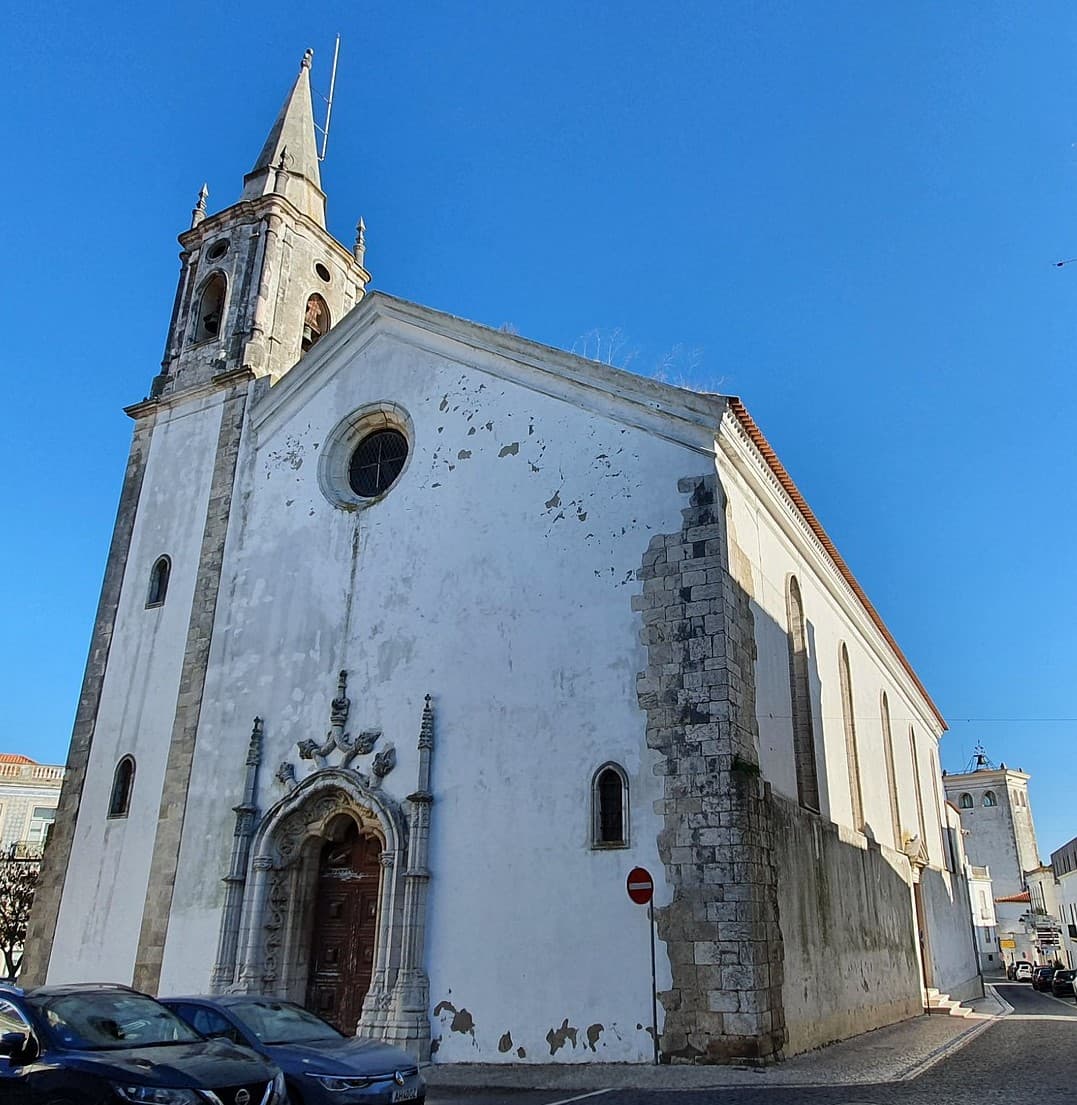
Image of Church of Santa Maria de Marvila. Image source
Visit essentials
A quick read before you go
- Access
- Located at Largo de Marvila, 2000-090 Santarém, in the historic Marvila parish of the old town;…
- Etiquette
- No site-specific dress code, photography policy, or offering practice is documented for Marvila;…
Overview
Beyond Santa Maria de Marvila's Manueline doorway, nearly every wall carries dense seventeenth-century blue-and-white azulejos, earning the popular name Cathedral of Tiles. The decoration wraps a Gothic-turned-Manueline structure whose ribbed chancel vault and triumphal arch belong to the early-sixteenth-century rebuilding.
Tradition places a Templar foundation here after Santarém's 1147 Christian reconquest, supported by a 1149 grant from the Bishop of Lisbon, while an even earlier Islamic structure is suggested but not archaeologically confirmed. Documented milestones are collegiate status in 1244 and the Manueline reconstruction sponsored by D. Francisco de Almeida, first Viceroy of Portuguese India, and completed in 1530.
Marvila remains a Diocese of Santarém parish, with its 1817 pipe organ still installed and periodically used, even as most visitors come for the tilework rather than the liturgy.
Why this place is sacred
Marvila's sacredness is layered rather than singular. The ground carries symbolic weight from the Christian Reconquest of Santarém in 1147 — the church stands as one of several parish foundations planted in the newly Christian city, some of which, according to tradition rather than confirmed archaeology, were raised over earlier Islamic structures. No excavation report among the sources reviewed settles whether Marvila itself occupies a former mosque site; heritage guides repeat the claim, but it remains tradition, not established fact.
A separate legend attaches to the church's popular name. According to folklore recorded in Portuguese sources, 'Marvila' descends from 'Nossa Senhora das Maravilhas' — Our Lady of Wonders — a Marian image said to have been offered to the church by Saint Bernard of Clairvaux and named by King Afonso Henriques himself.
The story appears in a collection of Portuguese legends rather than as documented history, and its particulars — the image's fate, its actual connection to Bernard — are unverified.
What is architecturally certain is the collision of eras inside the building: a Gothic shell rebuilt in Manueline style under royal and viceregal patronage in the early sixteenth century, then entirely resurfaced a century later in azulejo tile dated 1617, 1620, 1635, and 1639. That collision — stone bones wrapped in painted color — is what travel sources consistently single out as Marvila's defining feature, whatever visitors make of the older legends beneath it.
As a parish church founded, according to tradition, in the wake of the 1147 Reconquest, Marvila's original purpose was straightforward Christian worship for a newly resettled parish — a function it has never stopped performing. Its 1244 elevation to collegiate status marked it as a significant ecclesiastical foundation within the diocesan hierarchy, likely supporting a chapter of canons rather than a single parish priest.
The building was substantially remade in the early sixteenth century under King Manuel I, sponsored by D. Francisco de Almeida, and completed in 1530. A century later it acquired its defining feature: the extensive azulejo tilework installed in phases dated between 1617 and 1639. It was declared a Portuguese National Monument in 1917 and placed within a protected zone in 1946 — formal recognition of a status the building had likely held informally for generations.
Experience and orientation
There is no posted route through Marvila; visitors are free to move at their own pace. Those who linger tend to walk the nave slowly, letting their eyes adjust from the plain façade to the density of pattern inside, then look up toward the ribbed chancel vaulting where the older Manueline structure is still legible above the tile line.
Context and lineage
According to tradition, the Knights Templar established a church on this site shortly after Santarém's return to Christian rule in 1147, with construction funded by a 1149 rent grant from D. Gilberto, Bishop of Lisbon. Some sources propose an earlier structure already stood here, possibly Islamic in origin, though no archaeological excavation confirms this. The church was elevated to collegiate status in 1244 under Bishop D.
Aires Vasques, and its Manueline rebuilding — the structure visible today — was sponsored by D. Francisco de Almeida, first Viceroy of Portuguese India, and completed in 1530.
Marvila's continuity is that of an ordinary parish rather than a monastic order: canons of the collegiate chapter established in 1244, followed by centuries of secular parish clergy under the Diocese of Santarém, a line that continues today. The building's most visible transformation was not a change of custodianship but of decoration — the seventeenth-century tiling that gave the church its lasting popular identity as the Cathedral of Tiles.
D. Gilberto
historical
Bishop of Lisbon whose 1149 rent grant is traditionally credited with funding the church's foundation following the 1147 Reconquest of Santarém.
D. Francisco de Almeida
historical
First Viceroy of Portuguese India, who sponsored the church's Manueline reconstruction under King Manuel I, completed in 1530.
Afonso Henriques
historical
Portugal's first king, credited in local legend — though not documented history — with naming the Marian image said to have given the church its popular name, 'Marvila.'
Traditions and practice
As a former collegiate church, Marvila would historically have supported the liturgical offices of a canonical chapter — the daily round of prayer maintained by a body of canons rather than a single priest. Specific ceremonial detail from this period was not found in the sources reviewed.
The church continues as a working parish of the Diocese of Santarém. Its 1817 pipe organ, installed in its current form on 19 March 1903 and restored in 2008, remains in use for liturgical and cultural occasions.
Christianity (Roman Catholic)
ActiveOne of the oldest parish churches of Santarém, tied by tradition to the Christian Reconquest of the city in 1147 and elevated to collegiate status in 1244, reflecting its historical prominence within the diocesan hierarchy. Today dedicated to Nossa Senhora da Assunção (Our Lady of the Assumption) while retaining the popular name 'Marvila.'
Parish worship; the church also houses a historic 1817 pipe organ, installed in its current form in 1903, used in liturgical and cultural contexts.
Perspectives and open questions
Heritage authorities and encyclopedic sources largely agree on Marvila's documented history and architecture; the open questions concern what came before the documented record, and how much weight to give to folkloric tradition alongside it.
Scholarly perspective
Heritage authorities (DGPC/SIPA) and encyclopedic sources agree on the church's National Monument classification, its Manueline architectural significance — particularly the portal, triumphal arch, and chancel vaulting — and its seventeenth-century azulejo decoration. There is broad agreement that the visible structure results from an early sixteenth-century campaign completed in 1530, built over an earlier Gothic building.
Living and traditional perspectives
Within local Catholic memory, Marvila is understood through its dedication to Nossa Senhora da Assunção and, informally, through the popular legend of 'Nossa Senhora das Maravilhas' that gave the parish its name.
Open questions
The precise founding date and the historical accuracy of the claim that the church stands on the foundations of a former mosque remain unresolved in the sources consulted — presented as tradition rather than settled archaeological fact. The circumstances of the 'Nossa Senhora das Maravilhas' Marian-image legend — its historicity, the image's fate, its relation to Saint Bernard of Clairvaux — are similarly unverified beyond folkloric record.
Plan your visit
Access and arrival
Located at Largo de Marvila, 2000-090 Santarém, in the historic Marvila parish of the old town; visitable without a guide.
Respectful visit
Marvila functions simultaneously as a place of worship and a widely visited monument, and the appropriate register is quiet respect rather than either strict devotional protocol or unrestrained tourism.
Location
Map loads as you approach this section.
Pilgrim reflections
A portrait of encounter, not a score
Pilgrims describe what they felt, how present they could become, and whether the place would shape a journey. There are no stars and no ranking of traditions.
No reviewed reflections yet
The first pilgrims can help describe the character of being here.
Share a reflection
Available after an account-backed “Been there.” Every reflection is reviewed before publication.
Nearby sacred places
Explore other sacred places in the region. Proximity does not establish access or travel time; check each place’s guidance.


References
Sources consulted for this page. Source categories describe the publication, not a guarantee that every claim is verified. Traditional accounts and outside interpretations may differ.
- 01Igreja de Santa Maria de Marvila — Pesquisa Geral do Património — Direção-Geral do Património Cultural (DGPC)officialOfficial Portuguese heritage database entry; confirms National Monument classification (Decree No. 3318 of 27 August 1917) and protected zone (Z.E.P., 1946).
- 02Igreja Paroquial de Marvila / Igreja de Santa Maria / Igreja de Santa Maria de Marvila (SIPA) — Sistema de Informação para o Património Arquitectónico (SIPA/DGPC)officialOfficial architectural heritage inventory record; details Manueline reconstruction under D. Manuel I, azulejo dating (1617, 1620, 1635, 1639), and the organ history.
- 03Igreja de Nossa Senhora da Assunção de Marvila — Câmara Municipal de SantarémofficialMunicipal source confirming current patron is Nossa Senhora da Assunção, three-nave interior description, and organ restoration details.
- 04Igreja de Santa Maria de Marvila — Wikipedia — Wikipedia contributorsSource contextConfirms 1147 Templar founding tradition, 1149 rent grant from Bishop of Lisbon D. Gilberto, 1244 elevation to collegiate church, Manueline rebuilding under D. Manuel I (completed 1530) sponsored by Viceroy of India D. Francisco de Almeida, and National Monument status.
- 05Igreja de Santa Maria de Marvila (Santarém) — Wikipédia — Wikipédia (Portuguese-language contributors)Source contextPortuguese-language article; notes uncertain founding date, the possibility of an earlier pre-conquest structure, and the 1244 collegiate elevation under Bishop D. Aires Vasques.
- 06Igreja de Santa Maria de Marvila — Lendas Portuguesas / Infopédia — Infopédia (Porto Editora)Source contextRecords the popular legend that the name 'Marvila' derives from 'Nossa Senhora das Maravilhas,' an image reputedly offered to the temple by Saint Bernard of Clairvaux and named by King Afonso Henriques.
- 07Igreja de Santa Maria de Marvila - Santarém — Turismo de Portugal (visitportugal.com)Source contextOfficial national tourism board description; confirms Manueline doorway, triumphal arch, ribbed chancel vaulting, and 17th-century azulejo interior.
- 08Igreja de Nossa Senhora da Assunção de Marvila — Visite Santarém (municipal tourism portal)Source contextLocal tourism-office source; used for practical visiting details, address (Largo de Marvila, 2000-090 Santarém) and contact information.
- 09Igreja de Santa Maria de Marvila — e-culturaSource contextCultural-heritage aggregator confirming Manueline classification and 'Cathedral of Tiles' nickname.
- 10A Igreja de Marvila ou 'Catedral do Azulejo' — PortugallookSource contextTravel blog; used only with epistemic marker for the 'Cathedral of Tiles' popular nickname and general visitor impressions, corroborated by higher-reliability sources.
Share a photo
Help visitors recognize Church of Santa Maria de Marvila. Every submission is reviewed before publication.