Cathédrale Notre-Dame-du-Puy
A Romanesque cathedral rising from ancient healing stone, gateway to the Camino
Understand sacred places, explore living traditions, and learn how to engage respectfully with Pilgrim Map.
Access has not been verified. Check current local guidance before planning a visit.
Le Puy-en-Velay, Haute-Loire, France
Read the sources
Image of Cathédrale Notre-Dame-du-Puy. Image source · CC-BY-2.0
Visit essentials
A quick read before you go
- Duration
- 1-2 hours for cathedral and cloister.
- Access
- Located in Le Puy-en-Velay historic center, accessible by foot from the main square.
Overview
Le Puy Cathedral rests on sacred foundations older than Christianity in this volcanic basin. A dolmen on Mont Anis became the 'fever stone' after a sick woman, guided by vision, lay upon it and was healed. Recovered and returned inside in 1998, it preserves a layer of recognition beneath the cathedral.
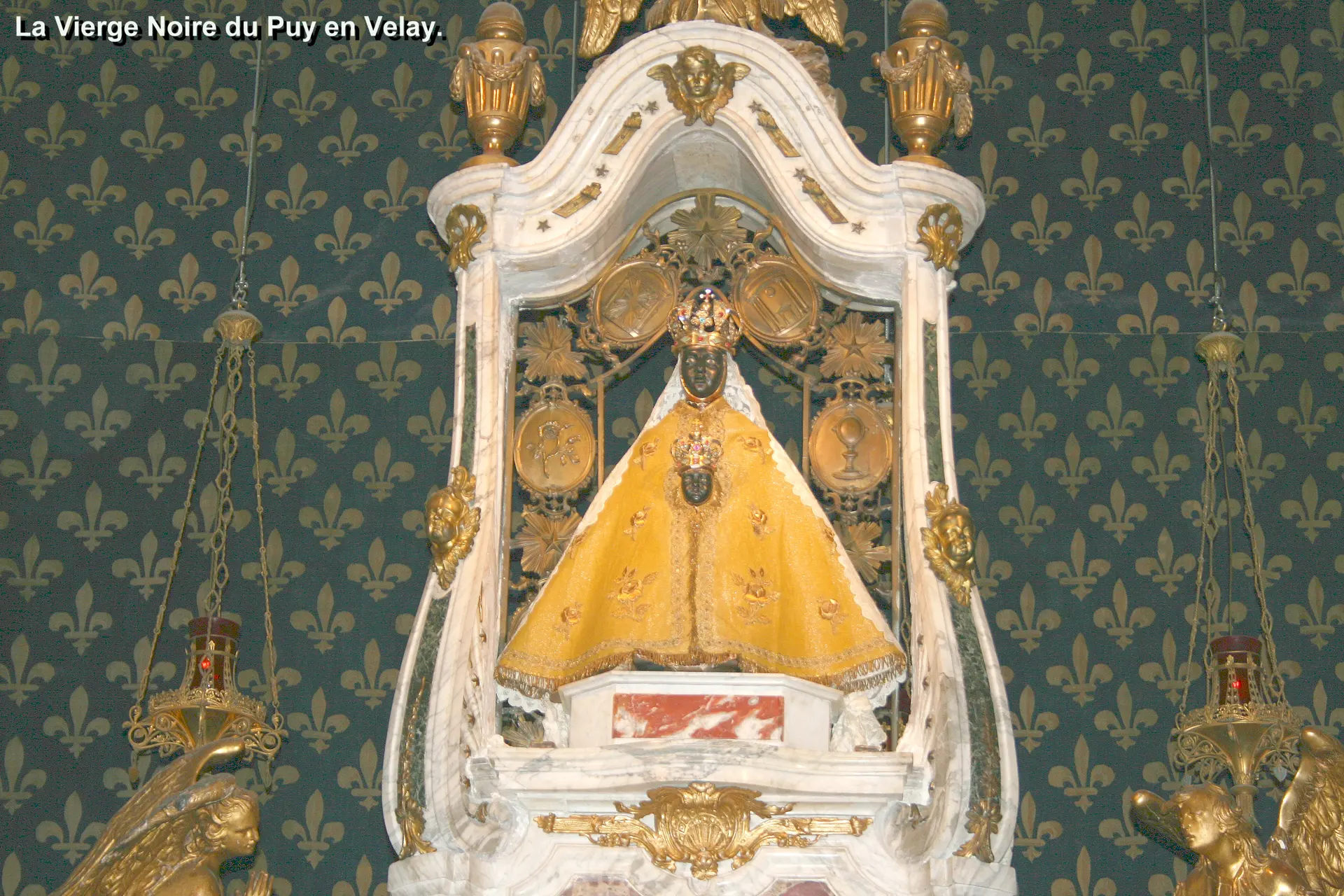
One of France's most venerated Black Virgins presides here. Louis IX gave the original after returning from Crusade; Revolution-era iconoclasm destroyed it, but its replacement draws pilgrims seeking the particular grace Black Madonnas are said to hold. Thirteen kings came before them, including Charlemagne and Saint Louis.
Le Puy is also a departure: the Via Podiensis, most popular of the French Camino routes to Santiago de Compostela, begins here. Pilgrims have set out since Bishop Godescalc made one of the first recorded pilgrimages in 951; the cathedral blesses their beginning and holds their return.
Sites inside
Why this place is sacred
The fever stone tells the story. Before the cathedral, before Christianity, something on Mont Anis was recognized as sacred. The dolmen that once stood here drew a sick woman to lie upon it, and whether the healing came through the Virgin's intercession or the stone's own power depends on the frame one brings. The result was the same: this hill became a place of pilgrimage.
Fifteen centuries of continuous veneration have deepened the thinness. The Black Virgin draws devotees seeking the particular grace associated with dark-skinned Madonnas—older, earthier, closer to the soil than their fairer counterparts. The Jubilee years, when Annunciation falls on Good Friday, bring plenary indulgence and extraordinary crowds. The annual Assumption procession fills the streets with ten thousand faithful.
For Camino pilgrims, Le Puy marks the threshold. The long walk to Santiago begins here, blessed in this cathedral, carrying the weight of a thousand years of pilgrims who set out on the same path. The thinness is not only vertical—reaching toward heaven—but horizontal, connecting to the distant cathedral in Spain and all the stopping places between.
Pre-Christian sacred site (dolmen). Christian sanctuary established in 5th century following healing miracle.
From prehistoric dolmen through early Christian oratory (5th century) to Romanesque cathedral (11th-12th century). Pilgrimage expanded from local healing site to major Marian shrine to Camino starting point. Destruction of original Black Virgin in Revolution (1794) and replacement. UNESCO World Heritage inscription (1998). Fever stone returned inside cathedral (1998).
Experience and orientation
The approach to Le Puy Cathedral winds through the volcanic old town, climbing toward Mont Anis where the sanctuary rises. The facade presents itself in stages—Romanesque, yes, but marked by Moorish pointed arches, a visual reminder that pilgrimage routes carried culture as well as faith. One third of the building stands on rock; two thirds are suspended above the void, engineering audacity in service of sacred space.
Inside, the eye adjusts to a forest of columns beneath Byzantine-influenced domes. The architecture does not feel entirely French—there is something of the mosque, something of Constantinople, something uniquely born of the cultural crossroads that pilgrimage creates. Chapels open from the nave; the Romanesque cloister waits beyond, one of the most beautiful in Europe.
The Black Virgin draws pilgrims to her altar. She is not tall—about twenty-five inches—but she holds presence. Made of black marble after the Revolution destroyed her predecessor, she continues the veneration that has flowed here since Louis IX placed the original ebony Madonna on this spot in 1254. Pilgrims kneel, light candles, whisper their needs.
The fever stone waits in its chapel, returned inside in 1998 after centuries as pavement. The basalt slab—all that remains of the dolmen that preceded everything—invites touch from those who know the story, who come seeking the healing that once flowed here.
For Camino pilgrims, the experience includes blessing. The long walk begins here—730 kilometers to Santiago through the Massif Central and across the Pyrenees. To receive blessing in this cathedral is to join a procession that stretches back over a thousand years.
Le Puy Cathedral rewards those who understand its layers—prehistoric, early Christian, Romanesque, Marian, Camino. Come with time to absorb rather than just observe.
Context and lineage
Legend tells that a woman suffering fever saw the Virgin Mary in a dream, who directed her to be carried to Mont Anis and lie upon the dolmen stone. She was healed and received a vision of Mary requesting that an oratory be built. Bishop Saint Scutarius constructed the first church between 415 and 430 CE. The site's reputation for healing and Marian intercession grew over centuries.
The cathedral belongs to the great tradition of European Marian pilgrimage, particularly the Black Madonna devotion found across France and Spain. Its Camino connection links it to Santiago de Compostela and the network of pilgrimage routes recognized by UNESCO.
Saint Scutarius
Bishop who built the first cathedral between 415-430 CE
Bishop Godescalc
Made one of the first recorded pilgrimages to Santiago in 951, establishing Le Puy as a Camino starting point
Louis IX (Saint Louis)
Gave the original ebony Black Virgin statue in 1254 upon return from the Holy Land
Traditions and practice
Mass, veneration of Black Virgin, pilgrimage blessing, Jubilee observance, healing prayers at fever stone
Daily Mass, pilgrimage blessing for Camino pilgrims, Black Virgin veneration, visiting fever stone, cloister contemplation, annual Assumption procession (August 15)
Visit in the morning when the light enters through the nave. Sit with the Black Virgin before exploring the architecture. Visit the fever stone if the healing tradition speaks to you. If beginning the Camino, receive blessing. Walk the cloister in contemplative silence.
Roman Catholicism / Black Madonna Veneration
ActiveOne of Europe's oldest Marian sanctuaries (5th century), home to a venerated Black Virgin statue. The Jubilee tradition (since 992 CE) grants plenary indulgence when Annunciation coincides with Good Friday. Thirteen kings made pilgrimage here.
Daily Mass, Black Virgin veneration, Jubilee observance, annual Assumption procession, healing prayers
Camino de Santiago / Via Podiensis
ActiveHistoric starting point of the most popular French Camino route. Bishop Godescalc established the tradition with his 951 pilgrimage. UNESCO World Heritage recognition.
Receiving pilgrimage blessing, beginning the 730 km walk to Santiago
Pre-Christian Sacred Stone
HistoricalThe dolmen on Mont Anis preceded and underlies the cathedral. The fever stone remains, preserved since the healing miracle that established the Christian sanctuary.
Healing pilgrimage (historical); touching the fever stone (contemporary personal practice)
Perspectives and open questions
Le Puy Cathedral can be approached as architectural masterpiece, Black Madonna shrine, Camino gateway, or continuation of prehistoric sacred tradition. Each perspective reveals different dimensions of this layered site.
Scholarly perspective
Art historians recognize the cathedral as an exceptional example of Romanesque architecture with unusual Byzantine and Moorish influences, reflecting cultural exchange along pilgrimage routes. The fever stone documents the transition from prehistoric to Christian sacred space. The Black Virgin belongs to a widespread medieval devotional pattern.
Living and traditional perspectives
For Catholic tradition, Le Puy represents one of Europe's oldest continuous Marian pilgrimage sites. The Jubilee privilege, granted in 992 CE, gives the cathedral unique spiritual significance. The Black Virgin draws devotees seeking Mary's particular intercession.
Alternative interpretations
Some earth-energy practitioners note the alignment of Le Puy's volcanic sacred sites (cathedral, Saint-Michel d'Aiguilhe, Notre-Dame de France statue) and interpret the fever stone as evidence of pre-Christian recognition of the site's telluric power.
Open questions
The original appearance and full history of the first Black Virgin remains partially mysterious. The specifics of pre-Christian worship on Mont Anis are lost. The meaning of the strong Moorish architectural influences invites continued inquiry.
Plan your visit
Access and arrival
Located in Le Puy-en-Velay historic center, accessible by foot from the main square. Coordinates: 45.0434° N, 3.8852° E. Parking available in town. Accessible via train to Le Puy-en-Velay station.
Le Puy-en-Velay offers pilgrim hostels (gîtes) as well as hotels. The town is geared toward Camino pilgrims with multiple accommodation options.
Respectful visit
Modest dress covering shoulders and knees
Generally permitted except during services. Flash may be restricted near artwork.
Candles available for lighting at the Black Virgin altar
Quiet voices throughout. Respectful distance from those at prayer. No entry during certain services.
This is an active cathedral with scheduled services. Check Mass times. During major feast days (especially Assumption), crowds may be significant.
Current practical details
Address
2 Rue de la Manecanterie, 43000 Le Puy-en-Velay, France
Phone
Hours
Hours, fees, and access can change — verify on the official source before you travel. Practical details last checked Jun 2026.
Location
Map loads as you approach this section.
Pilgrim reflections
A portrait of encounter, not a score
Pilgrims describe what they felt, how present they could become, and whether the place would shape a journey. There are no stars and no ranking of traditions.
No reviewed reflections yet
The first pilgrims can help describe the character of being here.
Share a reflection
Available after an account-backed “Been there.” Every reflection is reviewed before publication.
Nearby sacred places
Explore other sacred places in the region. Proximity does not establish access or travel time; check each place’s guidance.


References
Sources consulted for this page. Source categories describe the publication, not a guarantee that every claim is verified. Traditional accounts and outside interpretations may differ.
- 01Notre-Dame Cathedral of Puy-en-Velay — Le Puy-en-Velay TourismSource contextOfficial tourism information
- 02History of the Cathedral — Cathédrale Notre-Dame du Puy-en-VelayofficialOfficial cathedral website
- 03Le Puy Cathedral - Wikipedia — Wikipedia contributorsencyclopediaComprehensive overview
- 04Le Puy - World Pilgrimage Guide — Sacred SitesSource contextDetailed pilgrimage information
- 05Le Puy Cathedral - Sacred Destinations — Sacred DestinationsSource contextSacred site information
Share a photo
Help visitors recognize Cathédrale Notre-Dame-du-Puy. Every submission is reviewed before publication.