Caguana Ceremonial Indigenous Heritage Site
Where the gods dwell in mountain shadow, and stone courts hold the memory of sacred play
Understand sacred places, explore living traditions, and learn how to engage respectfully with Pilgrim Map.
Access has not been verified. Check current local guidance before planning a visit.
Utuado, Puerto Rico, United States
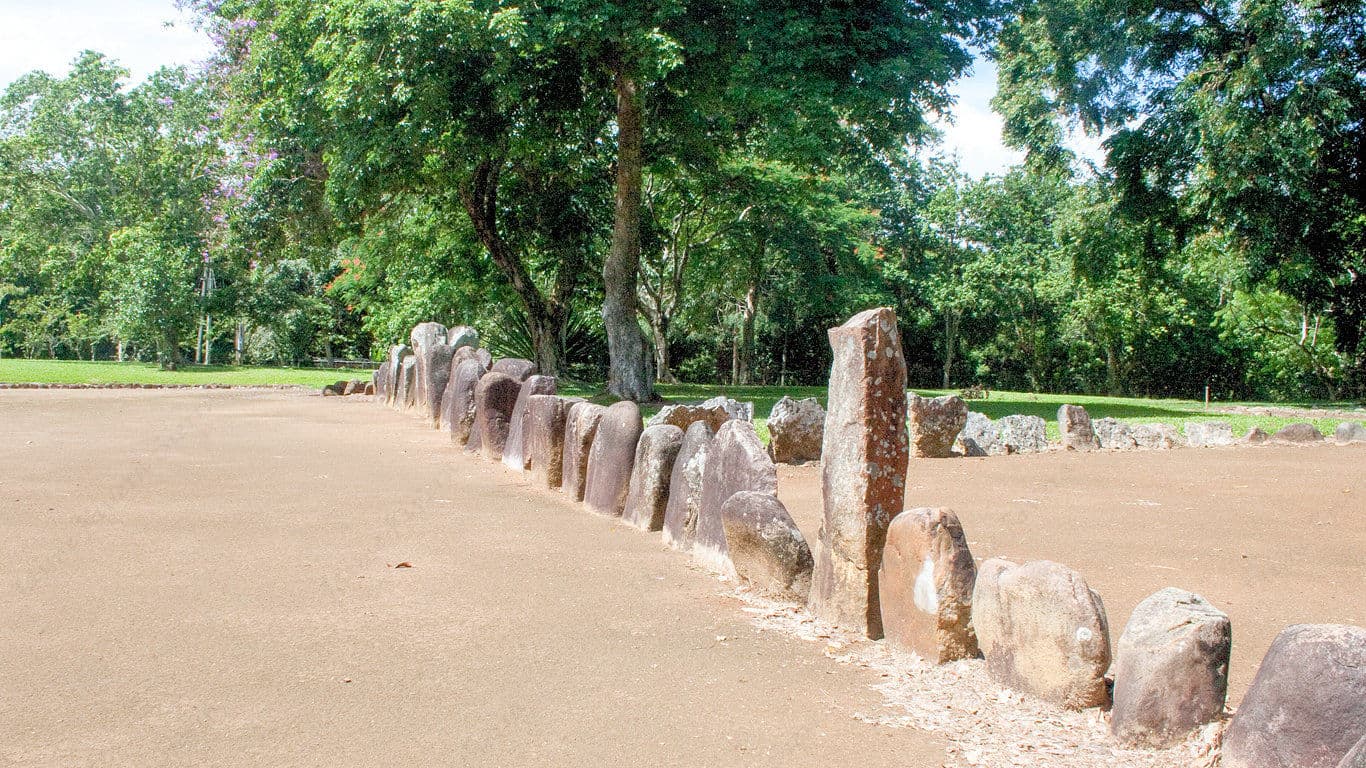
Image of Caguana Ceremonial Indigenous Heritage Site. Image source · CC0
Visit essentials
A quick read before you go
- Duration
- A minimum of 45 minutes allows for walking the ten open plazas and visiting the museum.
- Access
- Caguana is located at Carr.
Overview
The road to Caguana climbs Puerto Rico's central mountains toward Utuado, revealing stone-lined plazas beneath Cemi Mountain, where Taino tradition holds the gods reside. The ceremonial courts date to about 1270 AD and the site has been protected since 1955, but Caguana is not a frozen museum: Taino people still gather for ceremonies, the ball game batu has been revived, and court petroglyphs—including the famous image of fertility goddess Atabey—express a surviving cosmology.
Its thirteen bateyes were not merely sports grounds. They hosted political decisions, alliances, and conflicts resolved through ritual competition rather than bloodshed. Court monoliths weighing over a ton came from the nearby Tanama River, while astronomical alignments joined earthly ceremony to celestial rhythm. For the Taino, worlds could meet here.
Visitors now walk among stones carrying over seven centuries of continuous sacred significance. Caguana offers encounter with a sophisticated pre-contact Caribbean spiritual culture and a living tradition that refuses to become merely historical.
Why this place is sacred
To stand at Caguana is to stand at a threshold. The Taino built their most important ceremonial center here not by accident but by recognition—the landscape itself spoke to them of the sacred.
The Cemi Mountain rises behind the site, a presence impossible to ignore. In Taino cosmology, a cemi is not an idol or symbol but a living spirit that animates reality, connecting humans with forces of fertility, healing, and cosmic order. The mountain itself was understood as home to the gods. Within the ceremonial grounds, a large earth mound recreates the sacred mountain in miniature—a cauta that guards the ancient spaces.
The petroglyphs that line the ball courts intensify the site's charged quality. The largest concentration in all the Antilles, these carved images include representations of Atabey, the fertility goddess who gives life to all things. Her image, known as the Caguana woman, embodies the site's understanding of Caguana itself: not merely a location but the embodiment of a divine being who brings forth, renews, and sustains life.
The thirteen ball courts were designed with care that extended to the celestial. Archaeological studies have documented alignments with planetary transits and stellar events, suggesting that ceremonies here unfolded in relationship with cosmic rhythms. The UNESCO Astronomy and World Heritage Initiative has recognized these archaeoastronomical features.
Perhaps most significantly, the thinness of Caguana is not a quality that has faded. While many archaeological sites feel like empty vessels from which the sacred has drained, Caguana remains active. Taino people continue to carry out ceremonial responsibilities here. The ball game has been revived. The relationship between community and site persists. Whatever quality made this place feel close to the sacred in 1270 AD, visitors today consistently report that it remains present.
Caguana was constructed around 1270 AD as a major ceremonial center where Taino from neighboring settlements gathered for political, social, and religious activities. The thirteen bateyes served multiple interconnected purposes: spaces for the ceremonial ball game that could substitute for warfare, venues for diplomatic negotiation and political decision-making, sites for communication with cemi spirits, and locations for astronomical observation.
The center functioned as a place where the community could align itself with cosmic forces and resolve conflicts through ritual rather than violence.
The arrival of Spanish colonizers in 1493 disrupted but did not entirely sever the connection between the Taino and their sacred sites. While much traditional knowledge was lost in the colonial period, the site's significance was never entirely forgotten. In 1914-1915, anthropologist John Alden Mason conducted the first formal excavations, bringing archaeological attention to the ball courts and petroglyphs. In 1955, the Institute of Puerto Rican Culture placed Caguana under protection, transforming it into a heritage park.
The site gained recognition as a National Historic Landmark in 1993 and was listed on the National Register of Historic Places. More recently, Taino cultural revival has returned ceremony to Caguana. The ball game batu has been revived, and Taino people once again gather for traditional purposes. The museum, which closed for renovations in 2020, reopened in June 2024 with an expanded collection of over 200 archaeological pieces.
Caguana today exists in dual identity: protected archaeological heritage and living sacred site.
Experience and orientation
Arrival at Caguana marks a transition. The mountain road requires attention; the destination rewards it. As the ceremonial center comes into view, the first impression is often of peace—a quality distinct from mere quiet.
The ten bateyes open to visitors (of thirteen total) reveal themselves gradually. Walking among the stone-lined courts, the scale becomes apparent: these were not small gathering places but substantial arenas bounded by upright monoliths, some weighing over a ton. The effort required to transport these stones from the Tanama River speaks to the importance the Taino placed on this site.
The petroglyphs draw the eye and hold it. Carved into the standing stones, these images include the famous representation of Atabey, the fertility goddess. Other carvings remain more mysterious—their meanings debated by scholars and pondered by visitors. Standing before these carved faces, visitors often report a sense of being regarded in return.
The presence of Cemi Mountain cannot be overlooked. The sacred peak rises behind the ceremonial grounds, a constant reminder of the cosmology that shaped this place. For the Taino, this was the home of the gods. For contemporary visitors of any background, it provides a focal point that draws the eye upward.
The museum, reopened in 2024 after extensive renovations, houses over 200 archaeological artifacts that deepen understanding of Taino culture and cosmology. Taking time here enriches the subsequent experience of the outdoor spaces.
What visitors most commonly report is a sense of connection—to pre-Columbian Caribbean history, to a sophisticated spiritual tradition, to something in the landscape itself that seems to persist. Those of Taino descent describe Caguana as a place of homecoming, of ancestral connection made tangible. Others, arriving without knowledge of Taino cosmology, find themselves affected in ways they struggle to articulate. The pattern is consistent enough to take seriously.
Caguana invites a slower pace. Though forty-five minutes will allow you to walk the plazas and visit the museum, the site rewards lingering. Consider arriving in the morning, when light slants across the stones and crowds are thin. Walk deliberately. Pause at the petroglyphs. Allow Cemi Mountain to become a presence rather than a backdrop.
The ceremonial ball courts were spaces where important matters were settled through ritual competition rather than warfare—where young warriors demonstrated valor and communities aligned themselves with cosmic forces. Something of this purpose persists in the atmosphere. Visitors who approach with openness often find that Caguana offers more than expected.
Context and lineage
According to Taino tradition, Caguana was established beneath Cemi Mountain because the gods themselves resided there. A cemi is not an abstract concept but a living spirit that permeates and animates reality—connected to fertility, healing, and the ordering of existence. The site was chosen because the mountain's presence made the boundary between human and divine unusually thin.
Within the ceremonial grounds, a large earth mound replicates the sacred mountain in miniature. This cauta stands as guardian of the ancient spaces, a constructed mirror of the natural peak behind it. The petroglyphs, including the famous image of the Caguana woman (atabeyra), were not decorations but presences—images that made visible the divine forces operative at the site.
For contemporary Taino, Caguana is not merely a location where sacred things once happened. It is itself the embodiment of a divine being who brings forth, renews, and sustains life. The site is inseparable from Atabey, the fertility goddess whose image is carved into its stones. To enter Caguana is to enter her presence.
Caguana represents the flowering of Taino ceremonial culture in the Greater Antilles. Archaeological evidence shows activity at the site during the earlier Ostionoid period (600-1200 AD), but the construction of the ball courts dates to approximately 1270 AD, during the Classic Taino period that lasted until Spanish contact.
The Taino were not a single unified people but a collection of related groups sharing language, culture, and cosmology across the Greater Antilles. Caguana served as a major gathering place where people from neighboring settlements came together for ceremonial, political, and social purposes. The site's importance extended across regional boundaries.
Spanish colonization beginning in 1493 devastated Taino populations and disrupted traditional practice. Yet Taino culture never entirely disappeared. In recent decades, a cultural revival has gathered strength. Contemporary Taino people have reclaimed connection with ancestral sites including Caguana, reviving ceremonies and practices that were nearly lost. The site today serves both as memorial to what was disrupted and as living ground for what continues.
Atabey
Fertility goddess, mother of the supreme deity
John Alden Mason
Anthropologist, early excavator
Traditions and practice
The heart of Caguana's traditional practice was the ceremonial ball game, known as batu or batey. Far from simple sport, batu served multiple interconnected functions. Conflicts between communities could be resolved through ritual competition rather than warfare. Young warriors demonstrated skill and valor. Political alliances were negotiated. The games themselves held spiritual significance, connecting participants with cosmic forces.
The thirteen ball courts of varying sizes accommodated different gatherings. The largest plaza likely hosted the most important ceremonies and competitions, while smaller courts served more localized purposes. The stone monoliths marking the court boundaries were not mere dividers but presences—some carved with petroglyphs that made visible the spiritual forces witnessing the proceedings.
Beyond the ball game, Caguana hosted gatherings for political and social decisions, communication with cemi spirits, and ceremonies associated with Atabey and other deities. The astronomical alignments built into the site's layout suggest that ceremonies were timed to celestial events—planetary transits and stellar configurations that connected earthly ritual with cosmic rhythm.
Offerings were made. The specifics of pre-contact ceremonial practice remain matters of scholarly interpretation, but the accumulated evidence points to a rich ritual life centered on reciprocity between human community and spiritual forces.
Taino cultural revival has returned ceremony to Caguana. Contemporary Taino people continue to carry out what they describe as ceremonial responsibilities at the site. The ball game batu has been revived, providing young Taino with opportunity to demonstrate skill and valor as their ancestors did.
Specific ceremonies may occur on significant dates. While the details of contemporary practice are the community's own, the presence of living tradition at Caguana is not in doubt. This is not solely an archaeological site but an active sacred place where relationship between people and site persists.
The Institute of Puerto Rican Culture manages Caguana as a heritage park, but this management occurs in context of ongoing Taino sacred use. The dual identity of the site—protected archaeological heritage and living ceremonial ground—defines its contemporary reality.
Visitors cannot participate in Taino ceremonies, which remain within the community. However, meaningful engagement with Caguana is available to all who approach with respect.
Walk slowly through the ten bateyes open to visitors. Notice the variation in size and configuration. Consider what gatherings each might have hosted. Let the scale of the monoliths speak to the effort and intention invested in this place.
Spend time with the petroglyphs. Some images are recognizable; others remain mysterious. The famous Atabey petroglyph rewards contemplation. Allow the carved faces to become presences rather than curiosities.
Notice Cemi Mountain. The sacred peak is not simply background but the reason for Caguana's location. The Taino built here because the gods dwelt there.
Visit the museum, which houses over 200 archaeological artifacts. Context deepens experience. Understanding Taino cosmology enriches encounter with the sacred spaces.
Sit quietly. The ball courts were sites of resolution—places where conflict was transformed through ritual. Something of this quality may still be available to those who arrive with openness.
Taino
ActiveCaguana is one of the most sacred sites for the Taino people, the indigenous inhabitants of the Greater Antilles. Built around 1270 AD near Cemi Mountain—the believed home of the gods—the site served as a major ceremonial center where people from neighboring towns gathered for social, political, and religious activities. The thirteen ball courts were spaces for the ceremonial game batu, which could substitute for warfare and served diplomatic, political, and spiritual functions. For contemporary Taino, Caguana is the embodiment of a divine being who brings forth, renews, and sustains life, specifically associated with the fertility goddess Atabey. The site remains active: Taino people continue to gather here for ceremony, and the ball game has been revived.
Traditional practices at Caguana centered on the ceremonial ball game batu, gatherings for political and social decisions, communication with cemi spirits, astronomical observation aligned with celestial events, and offerings and rituals associated with Atabey and other deities. Contemporary practice includes revived ceremonies and the restored ball game, through which young Taino warriors demonstrate skill and valor. These practices are community matters, not performances for visitors.
Perspectives and open questions
Caguana is understood differently by archaeologists, by the Taino people for whom it remains a living sacred site, and by visitors seeking connection with Caribbean sacred heritage. Each perspective illuminates different aspects of the site's significance.
Scholarly perspective
Archaeological consensus recognizes Caguana as one of the largest and most important Pre-Columbian sites in the West Indies. The ball courts have been dated to approximately 1270 AD, during the Classic Taino period, though earlier Ostionoid activity (600-1200 AD) has also been documented at the site.
Scholars interpret the ceremonial center as a multi-functional space where sport, politics, religion, and diplomacy converged. The ball game served not merely as competition but as a mechanism for resolving conflicts without warfare—a sophisticated political and spiritual technology.
The UNESCO Astronomy and World Heritage Initiative has documented Caguana's archaeoastronomical features, confirming that the site's layout incorporates alignments with planetary transits and stellar events. This places Caguana within a broader pattern of Pre-Columbian sites designed to connect earthly ceremony with celestial rhythm.
The petroglyphs represent the largest concentration in the Antilles. Their iconography connects to broader patterns of Taino religious imagery, particularly representations of cemis and the fertility goddess Atabey.
Recent archaeological work and the museum's 2024 expansion have brought new attention to Caguana's material culture. The collection of over 200 artifacts provides context for understanding Taino society beyond the ceremonial center itself.
Living and traditional perspectives
For the Taino people, Caguana is not an archaeological site but a living sacred place. The distinction matters. To describe Caguana in purely historical terms is to miss what makes it significant.
In Taino understanding, Caguana is the embodiment of a divine being who brings forth, renews, and sustains life. The site is associated with Atabey, the fertility goddess whose image is carved into its stones. The Caguana woman petroglyph is not a representation of Atabey but a manifestation of her presence.
The Cemi Mountain that overlooks the site is not merely sacred but the home of the gods. The ceremonial center was built in this location because the boundary between human and divine was understood to be thin here. The cemis—living spirits that animate reality—were accessible at Caguana in ways not possible elsewhere.
Contemporary Taino people continue to carry out ceremonial responsibilities at Caguana. The ball game batu has been revived. The relationship between people and place persists. For those of Taino descent, Caguana offers connection with ancestors and with a spiritual tradition that survives despite centuries of colonization.
Alternative interpretations
Some visitors are drawn to Caguana's astronomical alignments and mysterious petroglyphs as evidence of sophisticated ancient spiritual knowledge. The site's position beneath Cemi Mountain and its careful orientation to celestial events suggest a cosmological awareness that resonates with contemporary seekers interested in earth-based spirituality and sacred geography.
These interpretations, while not identical to scholarly consensus or traditional Taino understanding, respond to genuine qualities of the site. The astronomical features are documented. The petroglyphs do encode spiritual meaning. The location was chosen with care. Visitors who approach Caguana as a place of earth-based sacred power are not wrong to sense that something here invites attention.
Open questions
Despite over a century of archaeological study, much about Caguana remains unclear. The specific rituals performed within the ball courts are matters of reconstruction rather than documentation. The complete meaning of all the petroglyphs eludes interpretation—some images remain mysterious even to scholars and contemporary Taino practitioners.
The extent of the ceremonial complex beyond what has been excavated is unknown. The relationship between Caguana and other Taino ceremonial centers across the Greater Antilles has not been fully mapped.
Perhaps most significantly, the inner experience of those who gathered here before European contact is irrecoverable. We can describe what they built and infer what they practiced, but the subjective dimension of their ceremonies—what it felt like to participate in batu beneath the sacred mountain, to stand before the petroglyphs, to communicate with cemis—belongs to a world we can approach but never fully enter.
This uncertainty is not a failure of scholarship but an honest acknowledgment of what separates the present from the pre-Columbian past. It also leaves space for what persists: the sense that Caguana remains, in some quality difficult to name, a place where something can be encountered.
Plan your visit
Access and arrival
Caguana is located at Carr. 111 Km. 48.6, Bo. Caguana, Utuado, PR 00641. The drive from San Juan takes approximately 90 minutes through mountain roads. A vehicle is necessary; public transportation does not serve the site. The museum building is wheelchair accessible. The ceremonial plazas, which involve walking on grass and uneven terrain, are not accessible to wheelchairs or those with significant mobility limitations.
Admission is cash only. Adults: $5. Children 6-13: $3. Seniors: $1.
Most visitors to Caguana stay in the San Juan area and make a day trip. Lodging is also available in Utuado and surrounding mountain towns for those wishing to explore the region more deeply. The mountain setting offers a different character from coastal Puerto Rico.
Respectful visit
Casual dress is appropriate for Caguana. The site is outdoors and may involve walking on uneven ground, so comfortable walking shoes are recommended. There is no dress code, but visitors may wish to dress in a manner that reflects respect for a sacred site.
Photography is generally permitted throughout the site. Be respectful when photographing the petroglyphs and sacred features—approach them as presences rather than objects. If Taino ceremonies are in progress, do not photograph without explicit permission.
Leaving offerings is not a traditional practice for visitors to Caguana. Do not leave items at the petroglyphs or within the ball courts. The most appropriate offering is respectful attention and care for the site's preservation.
Do not touch petroglyphs or climb on monoliths. Stay on designated paths. Do not remove anything from the site. Respect any areas marked as closed or restricted. Maintain appropriate distance from any ceremonies in progress. The museum and some areas may have specific photography restrictions—observe posted signs.
Caguana is an active sacred site for the Taino people. While it is open to visitors as a heritage park, approach with awareness that this is not merely an archaeological curiosity but a place where indigenous people continue to carry out ceremonial responsibilities.
Do not touch the petroglyphs or climb on the monoliths. These are both archaeological treasures and sacred presences requiring protection and respect.
If you encounter Taino ceremonies in progress, maintain appropriate distance. Your presence is extended as a privilege; respect is not optional.
Current practical details
Address
Carr.111 Km. 48.6, Bo Utuado, Utuado 00641, Puerto Rico
Phone
Hours
Hours, fees, and access can change — verify on the official source before you travel. Practical details last checked Jun 2026.
Location
Map loads as you approach this section.
Pilgrim reflections
A portrait of encounter, not a score
Pilgrims describe what they felt, how present they could become, and whether the place would shape a journey. There are no stars and no ranking of traditions.
No reviewed reflections yet
The first pilgrims can help describe the character of being here.
Share a reflection
Available after an account-backed “Been there.” Every reflection is reviewed before publication.
Nearby sacred places
Explore other sacred places in the region. Proximity does not establish access or travel time; check each place’s guidance.



Share a photo
Help visitors recognize Caguana Ceremonial Indigenous Heritage Site. Every submission is reviewed before publication.