Basilica of Our Lady of the Rosary of Chiquinquirá
Colombia's national shrine, where a ruined painting was restored by nothing but persistent prayer
Understand sacred places, explore living traditions, and learn how to engage respectfully with Pilgrim Map.
Access has not been verified. Check current local guidance before planning a visit.
Boyacá, Boyacá, Colombia
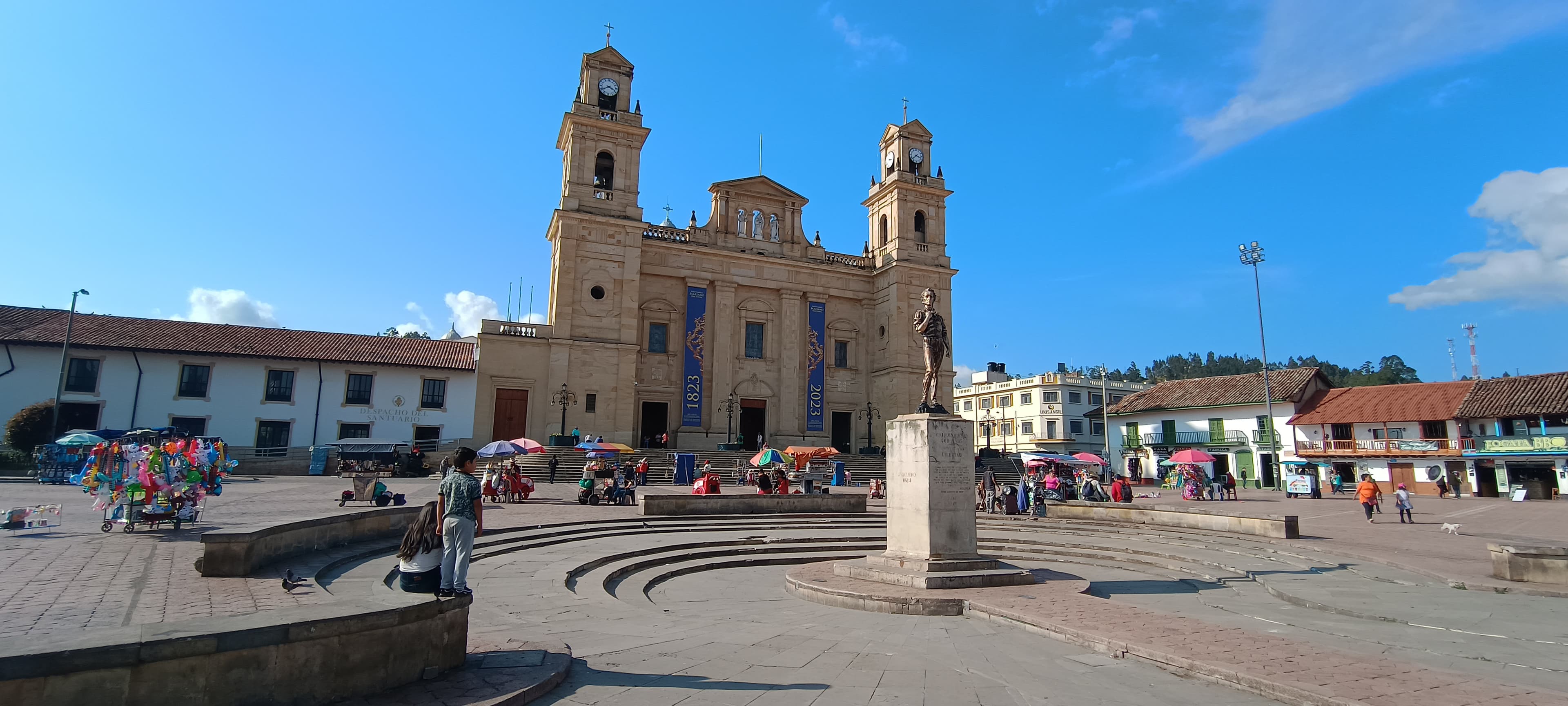
Image of Basilica of Our Lady of the Rosary of Chiquinquirá. Image source · CC-BY-SA-4.0
Visit essentials
A quick read before you go
- Duration
- 1-2 hours for the basilica and Church of the Renewal.
- Etiquette
- Standard Catholic basilica etiquette applies.
Overview
In 1562, Spanish painter Alonso de Narváez made a cotton-canvas Virgin of the Rosary for Chiquinquirá's chapel, showing the Virgin and Christ child between Saint Anthony of Padua and the Apostle Saint Andrew. Its cotton cloth, local pigments, and provincial colonial style were modest. After the chapel fell into disuse, moisture, mold, and more than twenty years of neglect left the canvas torn and mildewed and the image virtually unrecognizable.
Around 1586, the pious Spanish María Ramos cleaned the abandoned chapel and prayed daily before the ruin without commissioning a restoration or painter. On December 26, 1586, while she prayed with an indigenous woman named Isabel and Isabel's young son, the painting radiated light and was completely restored; townspeople gathered to see it.
The painting has not deteriorated since: over 440 years, a canvas that failed within its first twenty-four years has endured colonial upheaval, wars of independence, and political turmoil. Pope Benedict XV granted it canonical coronation in 1919, and the Virgin of Chiquinquirá became Colombia's patroness. The basilica, completed in 1823 and later expanded, now receives pilgrims from across the country.
Why this place is sacred
The miracle of Chiquinquirá is, at its core, a story about the relationship between faith and evidence. María Ramos prayed before a painting that gave her no reason to pray. The image was gone, consumed by mold and moisture. She prayed anyway, daily, before a canvas that offered nothing to the eye.
This persistence without evidence is the foundation of the devotion. What preceded the restoration does not change in quality whether the event is understood as divine intervention or as something whose cause remains unexplained: a woman's decision to honor something that appeared to be lost, to act as if the sacred was present when the visible evidence said otherwise.
The painting itself is the physical evidence of both the deterioration and the restoration. It hangs above the high altar in an ornate golden frame, visible to all who enter the basilica. The image is modest in artistic terms, a colonial devotional painting without the mastery of European masters. Its power lies not in its beauty but in its story: that it was destroyed and is whole, that it was abandoned and is the most venerated image in Colombia.
The basilica amplifies the painting's significance through scale. The grand plaza, the largest in Colombia, creates a monumental approach. The twin bell towers frame the sky. The interior rises to a dome that directs the eye toward the altar.
All of this grandeur exists to house a single painting on cotton cloth, and the disproportion between the building and the painting it protects is itself a commentary on the nature of the sacred: that it appears in humble materials, not in grand ones.
The national dimension adds another layer. The Virgin of Chiquinquirá is not merely a local devotion but the patroness of an entire country. For Colombian Catholics, the painting represents the mother who restored what was broken, a resonance that extends beyond the canvas to the life of the nation itself.
The painting was created in 1562 for the chapel of Chiquinquirá. After its miraculous restoration in 1586, the site became a pilgrimage destination, growing into Colombia's most important Catholic shrine.
The devotion grew from a local miracle to a national institution over four centuries. The current basilica was built 1801-1823 to replace earlier structures. Canonical coronation by Pope Benedict XV in 1919 elevated the devotion to its highest liturgical status. Pope John Paul II visited in 1986. The basilica continues to serve as the premier pilgrimage destination for Colombian Catholics.
Experience and orientation
The town of Chiquinquirá is shaped by the basilica's presence. The grand plaza opens before the facade like a stage, its expanse designed to accommodate the thousands who gather for feast days and major celebrations. The twin bell towers and central dome establish the basilica as the dominant feature of the town's skyline, visible from the surrounding Boyacá highlands.
Entering through the main doors, the interior's scale provides the context for the painting's smallness. The nave is long and high, the dome above the crossing admits natural light, and the eye is drawn inevitably to the high altar where the painting hangs in its golden frame. The approach from entrance to altar is a journey from grandeur to intimacy, the building narrowing the visitor's attention from the vast to the particular.
The painting itself is visible from a distance as a dark panel in its ornate setting; closer approach reveals its figures. The colors are those of colonial devotional painting, warm but not vivid. The cotton canvas, at over 460 years old, shows its age in ways that the restoration has not erased.
The atmosphere in the basilica varies with the time of day and season. Early mornings are quiet, the space available for personal prayer. The feast day of July 9 transforms the entire town into a pilgrimage destination, with processions, special liturgies, and crowds that fill the plaza and surrounding streets. Between these extremes, a steady stream of pilgrims maintains the devotional rhythm that has been continuous since 1586.
The Church of Our Lady of the Rosary of the Renewal, a short walk from the basilica, is the original site where the miracle occurred. Visiting both churches tells the complete story: the small, intimate space, and the monumental basilica that the devotion eventually required.
The basilica faces the grand plaza in the center of Chiquinquirá. The painting is above the high altar. The Church of the Renewal, site of the original miracle, is a short walk away. The town is compact and walkable.
Context and lineage
In 1562, Alonso de Narváez painted the Virgin of the Rosary on cotton canvas for Chiquinquirá's chapel. The chapel was abandoned and the painting deteriorated for over twenty years until the image was unrecognizable. María Ramos, a devout Spanish woman, cleaned the chapel and prayed daily before the ruined painting. On December 26, 1586, as she prayed with Isabel, an indigenous woman, and Isabel's young son, the painting radiated light and was completely restored.
The witnesses cried out, the townspeople gathered, and the devotion that would define Colombian Catholic identity was born.
The devotion belongs to the broader Dominican-influenced tradition of Marian devotion in Latin America. The Basilica of Chiquinquirá is the premier Marian shrine in Colombia, the counterpart to sites like the Basilica of Our Lady of Guadalupe in Mexico. The nearby Church of the Renewal preserves the original site of the miracle.
Alonso de Narváez
Spanish colonial painter who created the original painting in 1562
María Ramos
Pious woman whose persistent prayer before the ruined painting preceded its miraculous restoration
Isabel
Indigenous woman present with her son as witness to the miracle on December 26, 1586
Pope Benedict XV
Granted canonical coronation of the painting in 1919
Pope John Paul II
Visited the basilica and prayed before the painting in 1986
Traditions and practice
Pilgrimage to Chiquinquirá, often on foot from distant cities, has been practiced since the late 16th century. The rosary is central, reflecting the painting's association with Our Lady of the Rosary. Processions carrying replicas of the painting through the streets are an established tradition.
Daily Mass with multiple celebrations, rosary devotions, confessions, and prayer before the painting. The July 9 feast day draws massive crowds with special liturgies, processions, and cultural events. Marian festivals throughout the year. Organized pilgrimage groups from parishes across Colombia visit regularly.
Visit the Church of the Renewal first, to stand in the small space where María Ramos actually prayed and where the miracle occurred. Then walk to the basilica, allowing the shift in scale to register: from the intimate chapel where faith was tested to the monumental building that faith produced. At the basilica, spend time with the painting before engaging with the architectural grandeur. The painting is the point; the building is the frame.
Roman Catholicism — Marian Devotion
ActiveThe painting of Our Lady of the Rosary of Chiquinquirá is the most important sacred image in Colombia and the focus of the country's deepest Catholic devotion. The miraculous restoration of 1586 established a tradition that has defined Colombian Catholic identity for over four centuries.
Daily Mass and rosary devotions. Prayer before the miraculous painting. Annual feast day celebrations on July 9. Pilgrimage on foot from across Colombia. Processions with the painting's image. Canonical coronation ceremonies.
Perspectives and open questions
Chiquinquirá invites interpretation as the spiritual heart of Colombian Catholicism, as a case study in the power of persistent faith, and as a site where humble materials carry national significance.
Scholarly perspective
Art historians document the painting as a work by Alonso de Narváez in the local colonial devotional style. The miracle of 1586 is attested in contemporary accounts. Scholars study the devotion's role in shaping Colombian national identity and the significance of Marian devotion in Latin American Catholicism.
Living and traditional perspectives
For Colombian Catholics, the miracle is the foundational event of the national faith. The Virgin of Chiquinquirá is the patroness and mother of Colombia, her presence in the painting a living reality. The persistence of the devotion through centuries of political change is itself understood as miraculous.
Alternative interpretations
The painting's restoration during the colonial period's intense cultural transformation, the involvement of both Spanish and indigenous witnesses, and the cotton canvas (rather than imported European materials) have been interpreted as signs of a genuinely syncretic spirituality emerging from the colonial encounter.
Open questions
What caused the painting's physical restoration in 1586 remains unexplained. How a cotton canvas has endured for over 460 years after deteriorating rapidly in its first 24 is a material mystery. Whether the Chiquinquirá site held pre-Columbian spiritual significance is unknown.
Plan your visit
Access and arrival
Chiquinquirá offers a range of accommodations from simple hostels to mid-range hotels. The town is well-equipped for pilgrims. During feast days, book well in advance.
Respectful visit
Modest dress appropriate for a Catholic basilica. Shoulders and knees covered.
Generally permitted outside of Mass. Flash may be restricted near the painting. Be sensitive to pilgrims in devotional practice.
Candle lighting is customary. Donations support the basilica's maintenance and mission.
Quiet and reverent behavior in the basilica | No visiting during Mass unless attending worship | Modest dress required
Major feast days and Holy Week produce extreme crowds. The July 9 celebration fills the town well beyond its normal capacity. If seeking a contemplative visit, weekday mornings outside feast periods offer the quietest experience.
Current practical details
Address
Cl. 18 #11-80, Chiquinquirá, Boyacá, Colombia
Phone
Hours
Hours, fees, and access can change — verify on the official source before you travel. Practical details last checked Jun 2026.
Location
Map loads as you approach this section.
Pilgrim reflections
A portrait of encounter, not a score
Pilgrims describe what they felt, how present they could become, and whether the place would shape a journey. There are no stars and no ranking of traditions.
No reviewed reflections yet
The first pilgrims can help describe the character of being here.
Share a reflection
Available after an account-backed “Been there.” Every reflection is reviewed before publication.
Nearby sacred places
Explore other sacred places in the region. Proximity does not establish access or travel time; check each place’s guidance.


Share a photo
Help visitors recognize Basilica of Our Lady of the Rosary of Chiquinquirá. Every submission is reviewed before publication.