Broch of Clickimin
Where Bronze Age farmers, Iron Age warriors, and the carved footprints of forgotten kings converge on a Shetland loch
Understand sacred places, explore living traditions, and learn how to engage respectfully with Pilgrim Map.
Access has not been verified. Check current local guidance before planning a visit.
Lerwick, Scotland, United Kingdom
Read the sources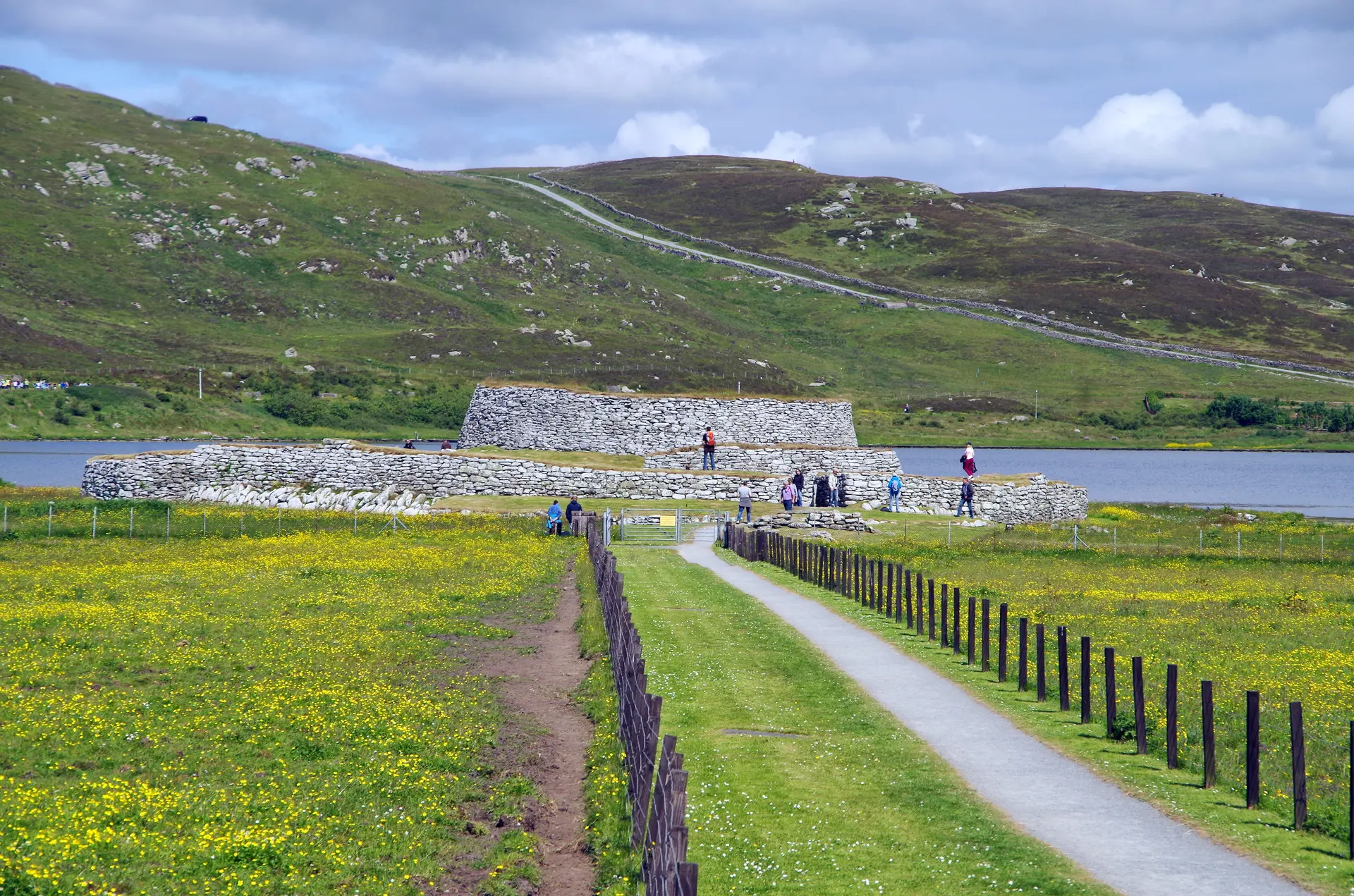
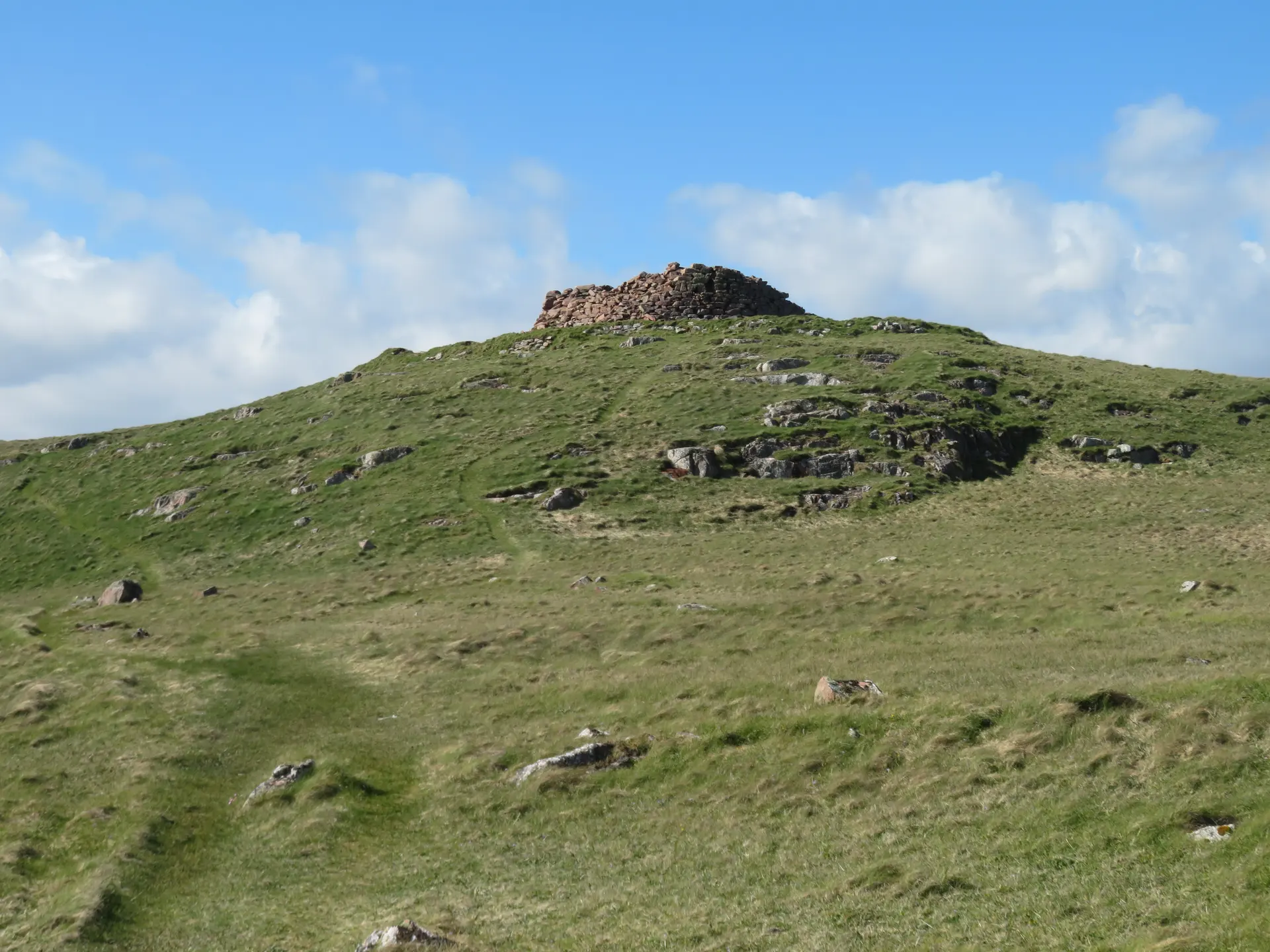
Image of Broch of Clickimin. Image source · CC-BY-SA-4.0
Visit essentials
A quick read before you go
- Duration
- 1 hour
- Etiquette
- Respect the scheduled monument status.
Overview
Within five minutes' walk of modern Lerwick—Shetland's capital, population 7,000—you reach a structure first occupied when iron was still a novelty in these islands. The Broch of Clickimin stands on a former islet, its stone causeway channelling the approach into a single processional line. On it, a flat stone bears two carved footprints: a coronation stone, scholars believe, where leaders claimed authority over the land visible from the broch's summit.
Five construction phases—from a 7th-century BC Bronze Age farmstead through a 5th-century BC Iron Age house, a fort built two centuries later, the 12-to-15-metre broch around the 1st century AD, and a wheelhouse within its reduced walls—make the place a record of persistent habitation and authority. Abandoned by approximately AD 500, it was already ancient when the Norse arrived three centuries later: stone walls against water that had outlived the cultures that built them.
Why this place is sacred
The thinness of Clickimin operates through compression. You do not need to travel far—the site is a few hundred metres from a supermarket—but you cross thresholds nonetheless. The path from the road. The causeway across the water. The entrance through the blockhouse. Each transition narrows the space between the present and the deep past.
The coronation stone intensifies this quality. Two footprints carved into flat stone, worn smooth by weather and time. To stand in them is to occupy the same physical space as someone who stood here to accept leadership over a community—an act of power and vulnerability simultaneously. The footprints are not metaphorical. They are the actual impressions where actual feet were placed in an actual ceremony. The gap between you and that moment is measured in millennia, but the stone remembers.
The loch setting creates its own liminality. The broch was built on an island—a place deliberately set apart from the mainland, accessed by a single controlled causeway. In many cultures, islands within lakes carry associations with the otherworld, with thresholds between the living and the dead, between the known and the numinous. Whether the builders of Clickimin held such beliefs cannot be proven. But they chose an island when they could have built on the shore. The choice speaks.
At 60 degrees north, the light itself becomes a thinning agent. In midsummer, darkness barely arrives—the simmer dim holds the land in extended twilight. In midwinter, daylight lasts fewer than six hours. The broch has stood through all of it, its stones absorbing the extremes of subarctic light.
The earliest settlement served as a Bronze Age farmstead. The site evolved through Iron Age defensive and domestic phases. The coronation stone suggests the complex also served ceremonial functions—specifically, the inauguration of tribal leaders. The broch tower itself combined defensive capability with statements of authority and status.
Following major vandalism and dilapidation, the Office of Works restored portions of the site in 1908-1910. J.R.C. Hamilton's excavation (1953-1957) established the site's phased chronology, though later archaeologists have challenged aspects of his interpretation—particularly the sequential dating of structures that may have been more contemporary. The site is now managed by Historic Environment Scotland as a scheduled ancient monument, freely accessible year-round.
Experience and orientation
From Lerwick town centre, the walk takes five minutes. You pass the leisure centre, turn toward the loch, and the path begins. Clickimin Loch stretches before you, and the broch complex appears on its promontory—stone walls dark against the water, a shape recognisably ancient despite the restoration work of a century ago.
The causeway funnels your approach. This is by design—the original builders intended a controlled entry, a single point of access that could be defended or ceremonially observed. Partway along, you encounter the coronation stone: a flat slab set into the causeway surface, bearing two carved footprints. Similar inauguration stones exist at Dunadd in Argyll, where the kings of Dal Riata were crowned.
Here in Shetland, the ceremony would have been different but the principle the same—a leader standing before the community, feet placed in the impressions of predecessors, accepting authority.
The blockhouse guards the entrance to the inner enclosure. Step through, and the temperature and light shift. The broch walls enclose you—roughly 20 metres across externally, 9 metres internally. Two chambers built into the wall thickness at ground level survive, dark and cool. Imagine this space rising 12 to 15 metres above you, with wooden floors, a central hearth, the sounds of daily life echoing off stone.
Then imagine it reduced, modified, a wheelhouse inserted within the diminished walls—a new domestic arrangement within the bones of the old.
The northwest corner preserves the outline of the original Bronze Age farmstead—the oldest structure on the site, predating the broch by over a millennium. This is where it began: a family, barley, livestock, the decision to settle on this particular islet in this particular loch. Everything that followed—the fort, the broch, the wheelhouse, the abandonment, the ruin, the excavation—grew from that first choice.
The Broch of Clickimin stands on a promontory extending into Clickimin Loch, southwest of Lerwick town centre. The causeway approaches from the south. The blockhouse entrance faces the causeway. The broch occupies the central area. The original Bronze Age farmstead ruins are to the northwest.
Context and lineage
Around the 7th century BC, a family chose a grassy islet in Clickimin Loch as the site for their farmstead. They built walls to enclose livestock, cultivated barley using stone troughs, and established what would become one of the longest-occupied sites in Shetland. By the 5th century BC, a larger circular house replaced the original, suggesting growing prosperity or population.
Two centuries later, the settlement was transformed: a defensive ditch was dug across the land bridge, walls were strengthened, and a blockhouse was constructed inside the gate—the community now felt the need for fortification.
Then came the broch. Around the 1st century AD, the circular tower rose from the islet—a monument visible across the loch and surrounding landscape, reaching 12 to 15 metres in height. Inside, rooms stacked vertically with stone staircases between floors. The broch was more than a dwelling; it was a statement of power, a visible assertion of control over the territory.
Eventually the tower was reduced in height and a single-family wheelhouse built within its walls. Settlement became less organised, with poorly constructed houses partly built into earlier ruins. By around AD 500, the site was abandoned entirely. When Norse settlers arrived around AD 800, Clickimin was already a ruin, its significance forgotten by those who passed it.
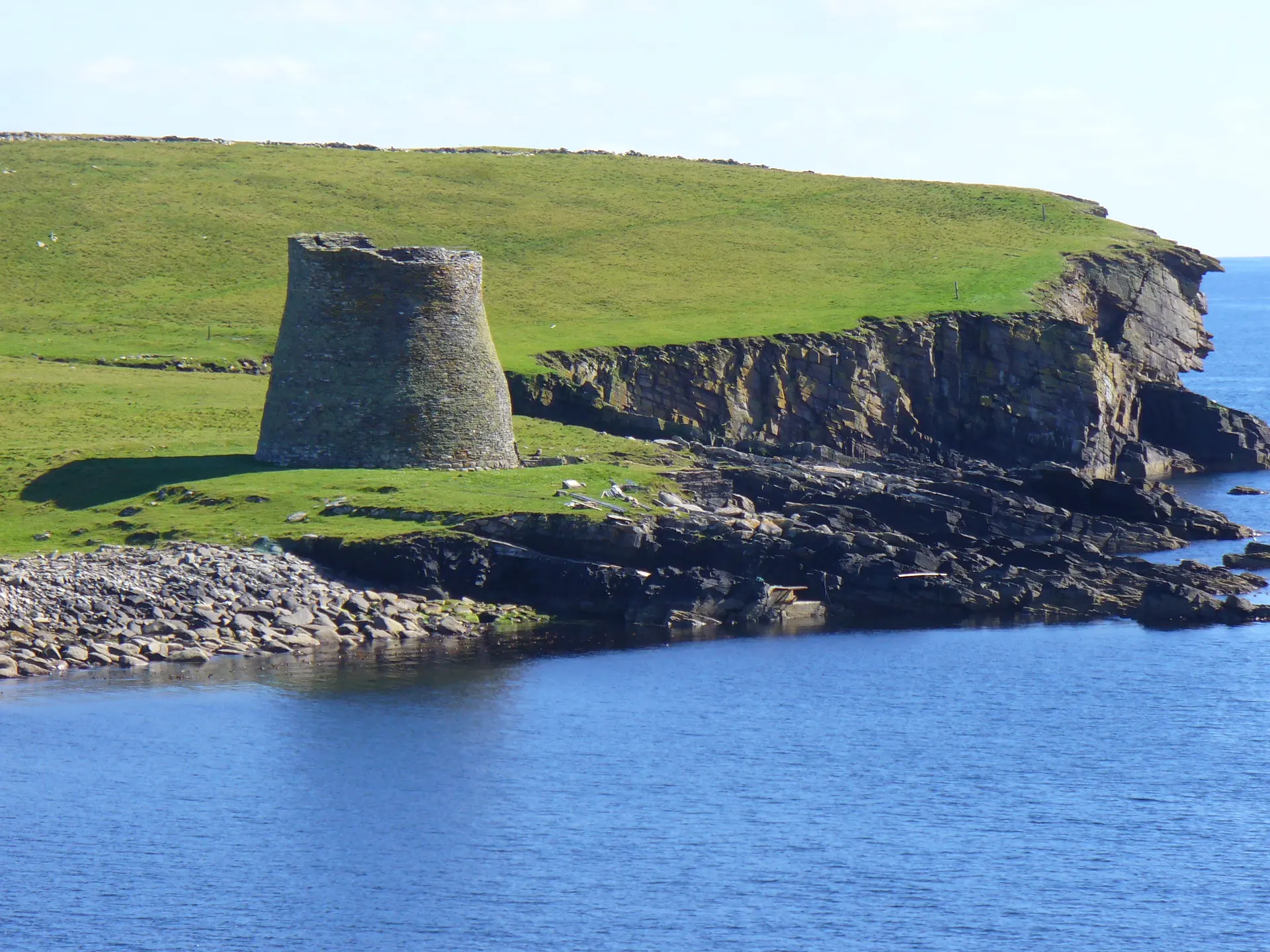
The Broch of Clickimin belongs to the distinctive broch-building tradition of Atlantic Scotland—massive circular drystone towers unique to Scotland and concentrated in the Northern and Western Isles, Caithness, and Sutherland. Shetland alone has over 100 broch sites. Clickimin's closest comparable site is Mousa Broch, 15 miles to the south and the best-preserved broch in Scotland, which retains its full height. The coronation stone connects Clickimin to a wider tradition of inauguration sites across Celtic Scotland, most notably Dunadd in Argyll.
J.R.C. Hamilton
Office of Works
Traditions and practice
The coronation stone suggests inauguration ceremonies for tribal leaders—a new chief or king standing in the carved footprints, symbolically stepping into the role of predecessors before the assembled community. The broch itself would have served as the focal point for daily domestic life, with cooking, craft-making, and communal gathering around a central hearth.
No active ceremonial practices take place at the site. It functions as an open-access archaeological monument managed by Historic Environment Scotland.
Approach along the causeway slowly, noting how the single path controls your movement—you are being channelled toward the broch just as the original inhabitants intended. When you reach the coronation stone, pause. Place your feet near the carved impressions and consider what it means to stand where authority was claimed and accepted.
Enter through the blockhouse passage. The transition from open sky to enclosed stone is immediate and physical. Inside the broch, find the two wall chambers at ground level. Step inside one. Notice how the temperature drops, how sound changes, how the quality of darkness shifts. These chambers held stores, perhaps people. The stones around you have not moved since they were placed.
If you visit in summer, return in the evening. The simmer dim—Shetland's midsummer near-perpetual twilight—transforms the loch setting. The broch against the water in that endless half-light is the site at its most atmospheric.
Bronze Age Agricultural Settlement
HistoricalThe earliest occupation represents one of the first permanent settlements in Shetland, with evidence of barley cultivation and livestock keeping dating to the 7th-6th century BC.
Subsistence farming, grain processing using stone troughs, livestock enclosure on the islet.
Iron Age Broch Culture
HistoricalThe broch represents the pinnacle of Iron Age architectural achievement in Atlantic Scotland. These circular drystone towers are unique to Scotland, with over 500 known examples. Clickimin's broch, though reduced, demonstrates the characteristic double-wall construction, internal chambers, and monumental scale of the tradition.
Communal living within the tower, defensive habitation, possible inauguration ceremonies at the coronation stone.
Archaeological and Conservation Stewardship
ActiveThe site has been subject to continuous scholarly and conservation attention since the 1908-1910 restoration. Historic Environment Scotland manages the monument, maintaining access while protecting its fabric.
Archaeological research, heritage management, public interpretation and education.
Perspectives and open questions
The Broch of Clickimin is understood primarily through its archaeology, which reveals a remarkably complete sequence of occupation spanning the Late Bronze Age through the post-Roman period.
Scholarly perspective
J.R.C. Hamilton's 1953-1957 excavation established a five-phase chronology: Late Bronze Age farmstead, Early Iron Age farmstead, Iron Age fort with blockhouse, broch tower, and wheelhouse settlement. This sequential interpretation has been partly challenged—later archaeologists suggest the ring wall, blockhouse, and broch may be more contemporary than Hamilton proposed. The coronation stone is widely interpreted as evidence of inauguration rituals, paralleling similar features at Dunadd in Argyll. Palaeoenvironmental research has confirmed barley cultivation at the site.
Open questions
The precise ceremony associated with the coronation stone remains unknown. Why the site was abandoned before the Norse period is unclear. The original appearance and full height of the broch can only be estimated. The relationship between the different construction phases—sequential or overlapping—continues to be debated.
Plan your visit
Access and arrival
Lerwick offers a full range of accommodation from hotels to B&Bs and self-catering. The site's town-centre location makes it accessible from any Lerwick base.
Respectful visit
Shetland weather demands warm, waterproof layers year-round. Sturdy footwear recommended for uneven stone surfaces within the broch.
Photography freely permitted. The loch setting provides excellent backgrounds. Evening and dawn light particularly striking.
Not traditionally associated with offerings. Presence and attentive observation are sufficient.
Do not climb on stonework. Do not remove any materials from the site. No fires or camping.
Uneven stone surfaces throughout. The kissing gate at the entrance is not wheelchair accessible. No facilities at the site itself.
Current practical details
Address
The Willows, 38 South Rd, Lerwick, Shetland ZE1 0RD, UK
Hours
Hours, fees, and access can change — verify on the official source before you travel. Practical details last checked Jun 2026.
Location
Map loads as you approach this section.
Pilgrim reflections
A portrait of encounter, not a score
Pilgrims describe what they felt, how present they could become, and whether the place would shape a journey. There are no stars and no ranking of traditions.
No reviewed reflections yet
The first pilgrims can help describe the character of being here.
Share a reflection
Available after an account-backed “Been there.” Every reflection is reviewed before publication.
Nearby sacred places
Explore other sacred places in the region. Proximity does not establish access or travel time; check each place’s guidance.
References
Sources consulted for this page. Source categories describe the publication, not a guarantee that every claim is verified. Traditional accounts and outside interpretations may differ.
- 01Clickimin Broch — Historic Environment ScotlandofficialOfficial heritage body managing the site
- 02Site in Focus - Broch of Clickimin — Archaeology ShetlandacademicLocal archaeological society with specialist knowledge
- 03Clickimin Broch, broch and settlement (SM90077) — Historic Environment Scotland PortalofficialOfficial scheduled monument listing
- 04Lerwick, South Road, Clickimin — Canmore (RCAHMS)officialNational record of the historic environment
- 05Palaeoenvironments, the archaeological record and cereal pollen detection at Clickimin, Shetland, Scotland — ScienceDirectacademicPeer-reviewed archaeological research
- 06Broch of Clickimin — WikipediaencyclopediaWell-referenced encyclopedia article with archaeological detail
- 07Clickimin Broch Feature Page — Undiscovered ScotlandguideDetailed historical and visitor information
- 08Clickimin Broch - a hidden treasure in Lerwick — NorthLink FerriesguideTravel guide with historical context
- 09Clickimin Broch — Shetland.orgguideOfficial Shetland tourism website
Share a photo
Help visitors recognize Broch of Clickimin. Every submission is reviewed before publication.