Basilica of the National Shrine of the Assumption of the Blessed Virgin Mary, Baltimore, Maryland
Where American Catholicism was born, in a cathedral designed by the architect of the Capitol
Understand sacred places, explore living traditions, and learn how to engage respectfully with Pilgrim Map.
Access has not been verified. Check current local guidance before planning a visit.
Baltimore, Maryland, United States
Read the sources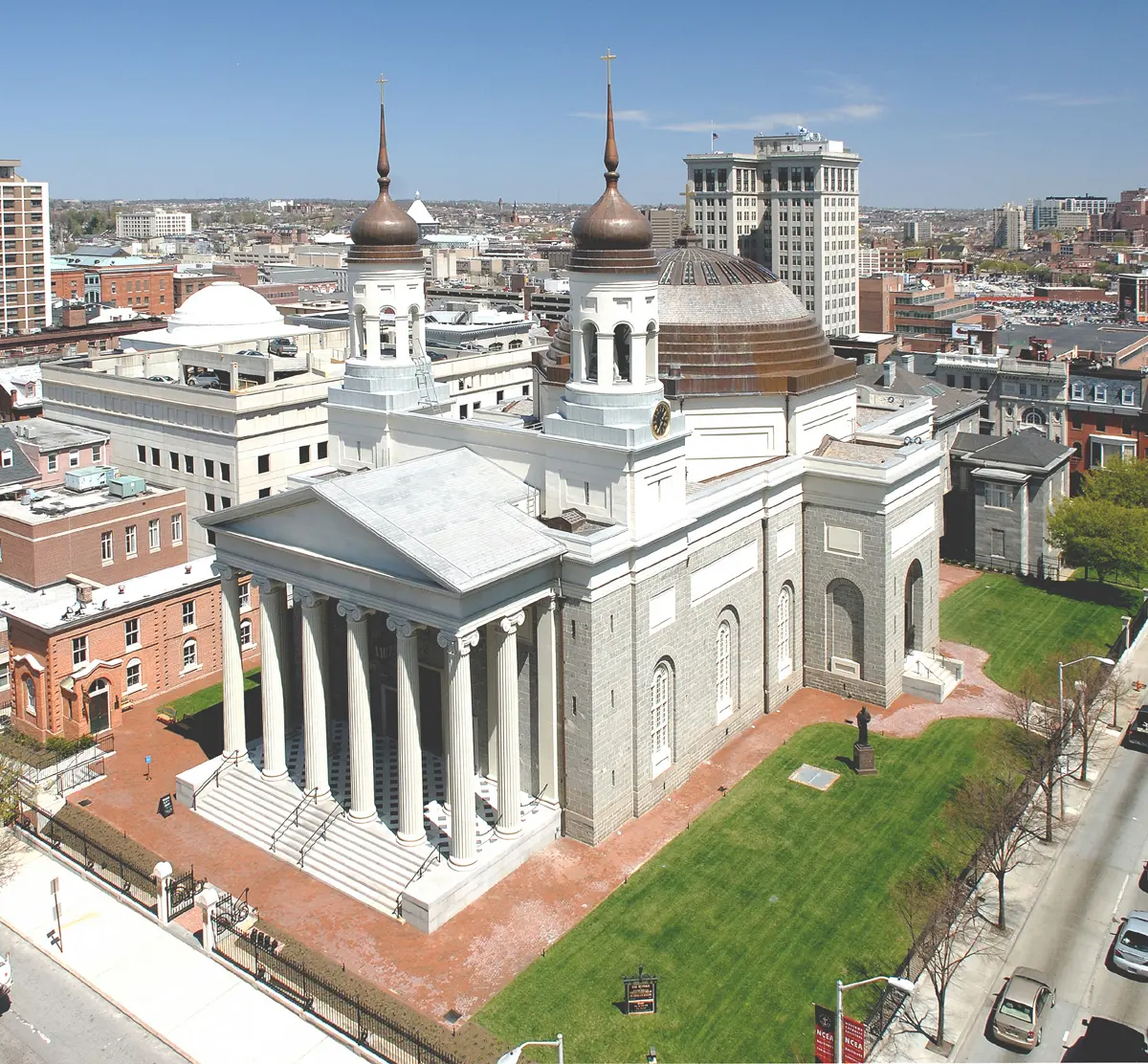
Visit essentials
A quick read before you go
- Duration
- A self-guided visit takes 30-45 minutes.
- Etiquette
- Standard Catholic church etiquette applies at the Baltimore Basilica.
Overview
The Basilica of the National Shrine of the Assumption of the Blessed Virgin Mary—also known as the Baltimore Basilica or America's First Cathedral—holds a singular place in American religious history. When Bishop John Carroll laid its cornerstone in 1806, Catholics were a small, suspect minority whose loyalty to Rome was often deemed incompatible with democracy. Carroll and Benjamin Henry Latrobe, architect of the U.S.
Capitol, answered with a sacred neoclassical building whose Roman- and French-influenced dome, portico, proportions, and luminous, open interior embodied both Catholic presence and American democratic ideals.
The first seven U.S. bishops were consecrated here; seven Provincial Councils and three Plenary Councils met here; and the Third Plenary Council of 1884 commissioned the Baltimore Catechism. For more than a century, more priests were ordained in this sanctuary than in any other American church. Blessed Michael J. McGivney, founder of the Knights of Columbus, was ordained here in 1877; St. John Neumann passed through its doors; Mother Teresa visited in 1996; and Pope John Paul II in 1995.
At least twenty saints or potential saints have been welcomed here.
Designated a national shrine by the U.S. Conference of Catholic Bishops in 1993 and extensively restored in the early 2000s, the basilica now receives over 100,000 visitors annually. Daily Mass continues in its never-closed parish, making it both a monument to the Catholic past and a living community of faith.
Why this place is sacred
Under the dome, Latrobe's luminous design feels intentionally theological. This is where American Catholicism took institutional form: Bishop Carroll presided, councils organized a church across the expanding nation, and the catechism that taught millions was commissioned. Blessed Michael McGivney was ordained here in 1877; St. John Neumann would have known the building; Mother Teresa and Pope John Paul II visited; and at least twenty saints, blesseds, or people under consideration for canonization have been hosted.
For Catholics, the basilica can be a pilgrimage to origins: dioceses trace through bishops consecrated here, parishes through priests often ordained here, and family formation through the Baltimore Catechism. For non-Catholics, it marks a chapter in American religious pluralism, where a suspect minority faith asserted full belonging. Its magnificence argued that Catholics could be American and American Catholicism magnificent—an obvious claim among seventy million American Catholics two centuries later, but not in 1806.
Bishop John Carroll established the cathedral as the seat of the first American diocese, later archdiocese. The building was designed to serve multiple purposes: worship for the local Catholic community, cathedral for the bishop's liturgical functions, and statement of Catholic presence and permanence in the new nation.
Carroll and Latrobe explicitly discussed how the building should embody American democratic ideals while remaining rooted in Catholic tradition. The result was a neoclassical design that drew on Roman and French models but adapted them to American context. The luminous interior, the democratic proportions, the balance of grandeur and accessibility: all serve the building's original purpose of establishing that Catholics belonged in America.
The building's physical evolution mirrors the evolution of American Catholicism itself. Construction began in 1806 but was not completed until 1863, interrupted by funding difficulties and the broader turmoil of the period. The original vision underwent modifications as American Catholic identity developed.
In the late twentieth century, the basilica faced the common challenges of urban churches: shifting demographics, aging infrastructure, questions about relevance. A major restoration in the early 2000s addressed physical deterioration and reconfigured some spaces.
The designation as a national shrine in 1993 marked institutional recognition of the building's significance beyond the Baltimore archdiocese. Today, the basilica functions simultaneously as a parish, an archdiocesan cathedral, and a national shrine, layers that reflect its accumulated history.
Experience and orientation
Enter through the grand portico and let your eyes adjust to the light descending from Latrobe's signature dome. Classical, Roman-inspired proportions adapted to an American scale make the interior grand yet accessible, magnificent yet democratic: a house of worship for a free people. In the nave, history is embodied in the sanctuary where the first American bishop presided, councils organized American Catholicism, bishops were consecrated, and priests ordained.
The undercroft museum displays vestments, documents, sacred vessels, and photographs, along with original features revealed by the restoration. Guided tours offered several days a week add stories of where bishops sat, what councils decided, and which future saints passed through.
Mass offers a different encounter: the worship begun here continues in the living tradition that sent bishops across the continent and formed priests and religious by the thousands. This is not simply a museum visit, but participation in what the building was made to do.
The Baltimore Basilica stands in downtown Baltimore, adjacent to the Inner Harbor area. The cathedral faces south, its portico welcoming visitors from Cathedral Street. The main entrance leads into the nave, with the altar at the far end and the dome rising above.
The building includes the main worship space, a side chapel dedicated to Our Lady, the undercroft museum beneath the sanctuary, and various support spaces. The gift shop offers religious items and books about the cathedral's history.
Public transportation serves the area well, with light rail and bus connections nearby. Baltimore Penn Station is within reasonable distance for those arriving by train.
Context and lineage
Pope Pius VI established the Diocese of Baltimore in 1789 and appointed John Carroll, from a prominent Maryland family, as the first American bishop. Believing American Catholicism needed a physical statement of presence and permanence, Carroll commissioned leading architect Benjamin Henry Latrobe, then engaged in designing the U.S. Capitol. Latrobe offered Gothic and neoclassical designs; Carroll chose the latter to align the cathedral with the young republic's architectural vocabulary and speak democracy as well as Catholicism.
Construction began with the cornerstone in 1806 and ended in 1863, delayed by funding difficulties, the deaths of Carroll and Latrobe, and the Civil War. Through those interruptions, the vision remained a cathedral proclaiming Catholic presence in the American experiment.
The Baltimore Basilica stands at the origin point of American Catholic institutional history. From this cathedral, bishops were sent to establish dioceses across the expanding nation. The councils held here created the organizational structure, liturgical practices, and educational systems that shaped American Catholicism.
The Baltimore Catechism, commissioned by the Third Plenary Council in 1884, served as the standard text for Catholic religious education until the Second Vatican Council. Generations of American Catholics learned their faith from this text, which originated in decisions made in this building.
The basilica's lineage extends through the bishops consecrated here to the entire American Catholic Church: every American diocese traces its institutional origins, through chains of episcopal succession, back to Baltimore.
Bishop John Carroll
First American Catholic bishop
Benjamin Henry Latrobe
Architect
Blessed Michael J. McGivney
Founder of Knights of Columbus
St. John Neumann
Bishop of Philadelphia, educator
Traditions and practice
Catholic liturgical practice has continued at the basilica without interruption since the building's dedication. Daily Mass, confession, baptisms, weddings, funerals, ordinations: the full range of Catholic sacramental life has been celebrated here for over two centuries.
The councils held here established practices that spread across American Catholicism. The Baltimore Catechism taught generations. The liturgical norms adopted here became standard. The educational structures pioneered here became the model for parochial schools nationwide.
Daily Mass continues in the basilica, typically with morning and noon options. The schedule is published on the basilica website. Sunday Mass is livestreamed for global access, extending the basilica's reach beyond those who can visit in person.
Guided tours operate several days a week, offering historical interpretation of the building and its significance. Self-guided visits are welcome during open hours.
Special liturgies mark significant feasts, particularly the Feast of the Assumption (August 15), to which the basilica is dedicated. These celebrations draw larger crowds and often feature more elaborate musical programs.
The undercroft museum, open during visiting hours, complements these living practices with displays on the cathedral's history.
For visitors seeking spiritual experience rather than historical tourism, consider attending Mass. The liturgy brings the building to life as what it was designed to be. Sitting in the nave during worship, hearing the prayers echo under the dome, connects you to two centuries of prayer in this space.
If attending Mass is not appropriate for you, consider a period of silent prayer or meditation. The basilica welcomes visitors of all faiths. The space itself, Latrobe's luminous design, invites contemplation. Sit quietly and let the building do its work.
Before your visit, read about the basilica's history. Understanding what happened here—the consecrations, the councils, the saints who passed through—deepens the experience and transforms beautiful architecture into meaningful encounter.
American Catholic Foundation
ActiveThe Baltimore Basilica is the Mother Church of Roman Catholicism in the United States, the first cathedral built in the nation after its founding. It served as the seat of the first American bishop, John Carroll, and hosted the councils that shaped American Catholicism. Most early American bishops were consecrated here.
Daily Mass. Confession. Devotions. Parish life. Pilgrimage visits. The tradition of visiting the basilica as a pilgrimage to American Catholic origins continues today.
Marian Devotion - Assumption of Mary
ActiveThe basilica is dedicated to the Assumption of the Blessed Virgin Mary, the Catholic belief that Mary was taken up body and soul into heaven at the end of her earthly life. This dedication reflects American Catholic devotion to Mary from the earliest days.
Feast of the Assumption celebrations (August 15). Marian devotions. Prayer to Our Lady. The side chapel dedicated to Mary offers a space for Marian devotion.
Perspectives and open questions
The Baltimore Basilica is understood primarily through the lens of American Catholic history. It is the origin point, the mother church, the place where American Catholicism took institutional form. Architectural historians also recognize it as Benjamin Latrobe's masterpiece and a significant example of American neoclassical design.
Scholarly perspective
Architectural historians recognize the Baltimore Basilica as Benjamin Latrobe's finest work, superior even to his contributions to the U.S. Capitol. The neoclassical design, with its dome, portico, and luminous interior, represents Latrobe's belief that architecture should serve democratic ideals. The building has been extensively studied as an example of early American architecture.
Church historians recognize the basilica's role in American Catholic institutional development. The councils held here organized the Church's expansion across the continent. The decisions made here shaped American Catholic identity for generations. The National Historic Landmark designation (1971) confirms the building's historical significance.
Living and traditional perspectives
For the Roman Catholic Church, the Baltimore Basilica is the Mother Church of American Catholicism. It is the cathedral where the first bishop presided, where the first councils met, where the institutional structure was established. The designation as a national shrine recognizes this significance.
The basilica's dedication to the Assumption of the Blessed Virgin Mary frames it within American Catholic Marian devotion, and the feast of the Assumption is celebrated with particular solemnity. Its association with numerous saints and blesseds, and the visits of Pope John Paul II and Mother Teresa, add to its sacred character in the Church's eyes.
Alternative interpretations
No significant alternative or esoteric interpretations attach to the Baltimore Basilica. It is understood straightforwardly as a significant Catholic church and architectural monument.
Open questions
The basilica's history is well documented. Questions remain about some of the building's construction details and about the fate of some early artifacts, but these are matters of historical research rather than mystery.
Plan your visit
Access and arrival
Hotels throughout downtown Baltimore serve visitors. The Inner Harbor area has numerous lodging options within walking distance of the basilica.
Respectful visit
Modest attire appropriate for a place of worship is expected. Business casual or nicer is appropriate. Avoid shorts, tank tops, revealing clothing, or anything with offensive imagery. Men should remove hats upon entering the church.
Photography is generally permitted but not during Mass. Check with staff about current policies. Flash photography may be restricted to protect artifacts. Tripods and professional equipment may require advance permission.
Candle lighting, prayer intentions, and donations are welcomed. Candles may be lit in the side chapel. The basilica, like all churches, depends on the generosity of visitors for its maintenance and ministry.
{"Do not photograph during Mass","Maintain quiet and reverent atmosphere","Dress modestly","Remove hats (men)","Silence phones","Do not disturb those at prayer"}
The basilica's primary purpose remains worship, with Mass celebrated daily. During Mass, participate respectfully or wait at the back until the liturgy concludes, without disturbing those at prayer. Photography is generally permitted but not during Mass; flash may be restricted, so confirm current policy with staff. Tours and visitors are welcome, but this active church is not a museum.
Current practical details
Address
409 Cathedral St, Baltimore, MD 21201, USA
Phone
Hours
Hours, fees, and access can change — verify on the official source before you travel. Practical details last checked Jun 2026.
Location
Map loads as you approach this section.
Pilgrim reflections
A portrait of encounter, not a score
Pilgrims describe what they felt, how present they could become, and whether the place would shape a journey. There are no stars and no ranking of traditions.
No reviewed reflections yet
The first pilgrims can help describe the character of being here.
Share a reflection
Available after an account-backed “Been there.” Every reflection is reviewed before publication.
Nearby sacred places
Explore other sacred places in the region. Proximity does not establish access or travel time; check each place’s guidance.

Basilica of the National Shrine of the Immaculate Conception
Washington, District of Columbia, United States
52.0 km away

Washington National Cathedral
Washington, District of Columbia, United States
56.3 km away
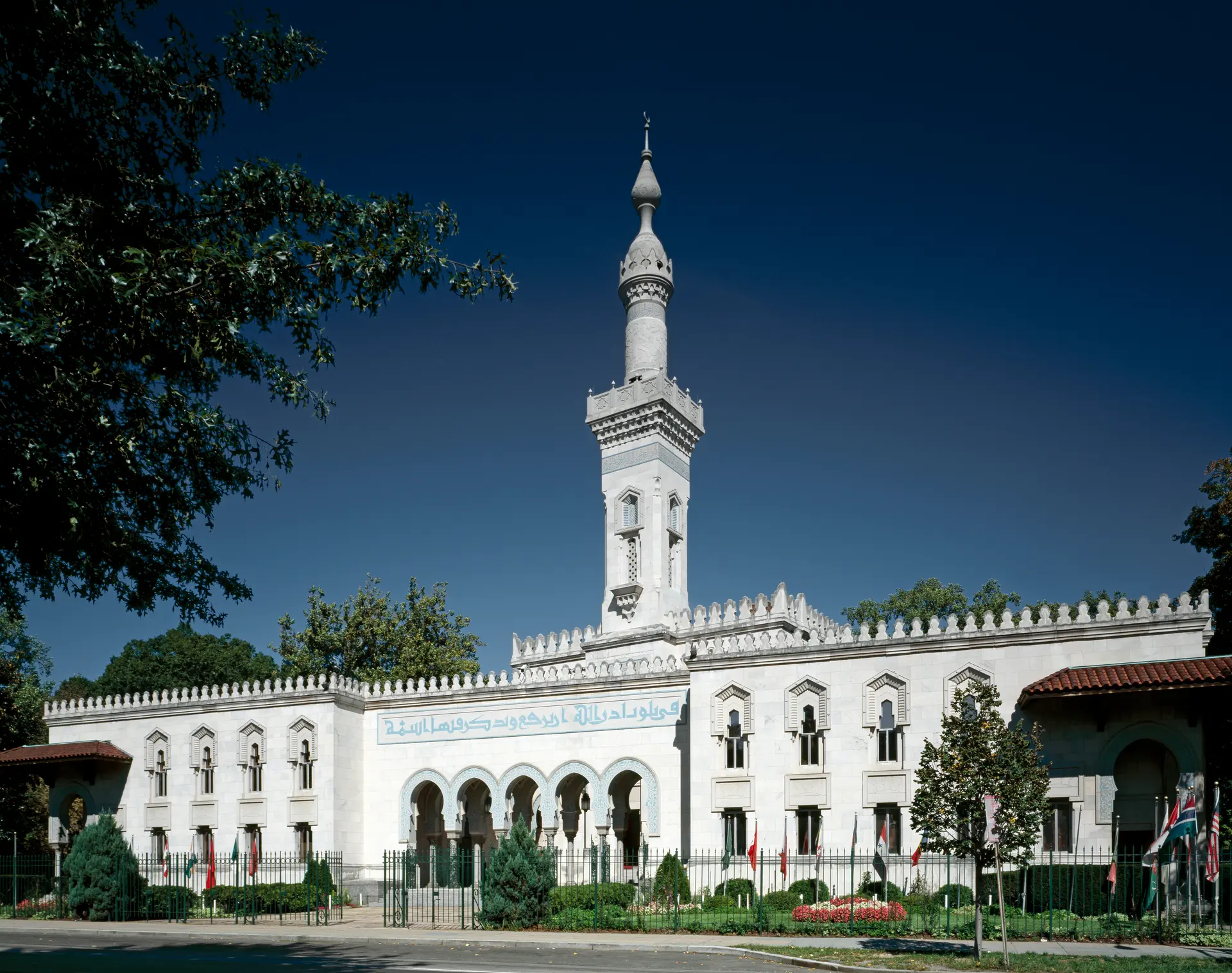
Islamic Center of Washington
Washington, District of Columbia, United States
56.5 km away

National Shrine of Saint Elizabeth Ann Seton
Emmitsburg, Maryland, United States
75.7 km away
References
Sources consulted for this page. Source categories describe the publication, not a guarantee that every claim is verified. Traditional accounts and outside interpretations may differ.
- 01Basilica of the Assumption - America's First Cathedral — Basilica of the AssumptionSource contextOfficial basilica website
- 02Basilica of the Assumption — Archdiocese of BaltimoreSource contextArchdiocesan documentation
- 03Basilica of the National Shrine of the Assumption of the Blessed Virgin Mary — WikipediaencyclopediaGeneral reference
Share a photo
Help visitors recognize Basilica of the National Shrine of the Assumption of the Blessed Virgin Mary, Baltimore, Maryland. Every submission is reviewed before publication.