Our Lady of Victory Basilica, Lackawanna, New York
A Civil War veteran's thanksgiving in marble and light, built for the poorest and the holiest
City of Lackawanna, New York, United States
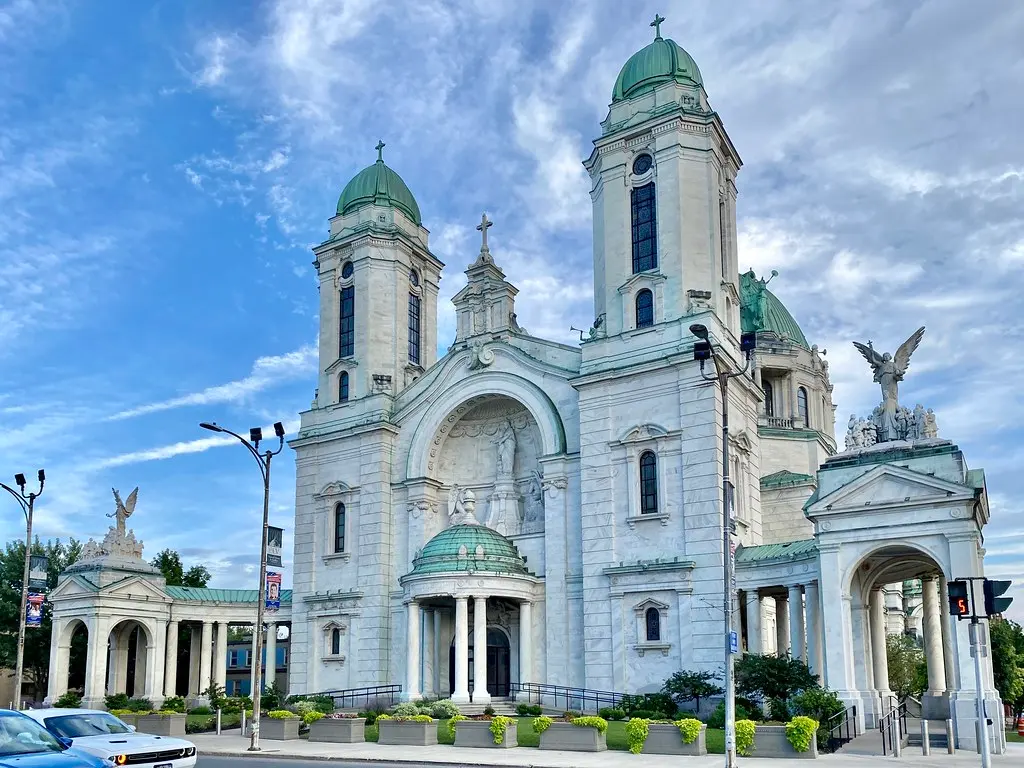
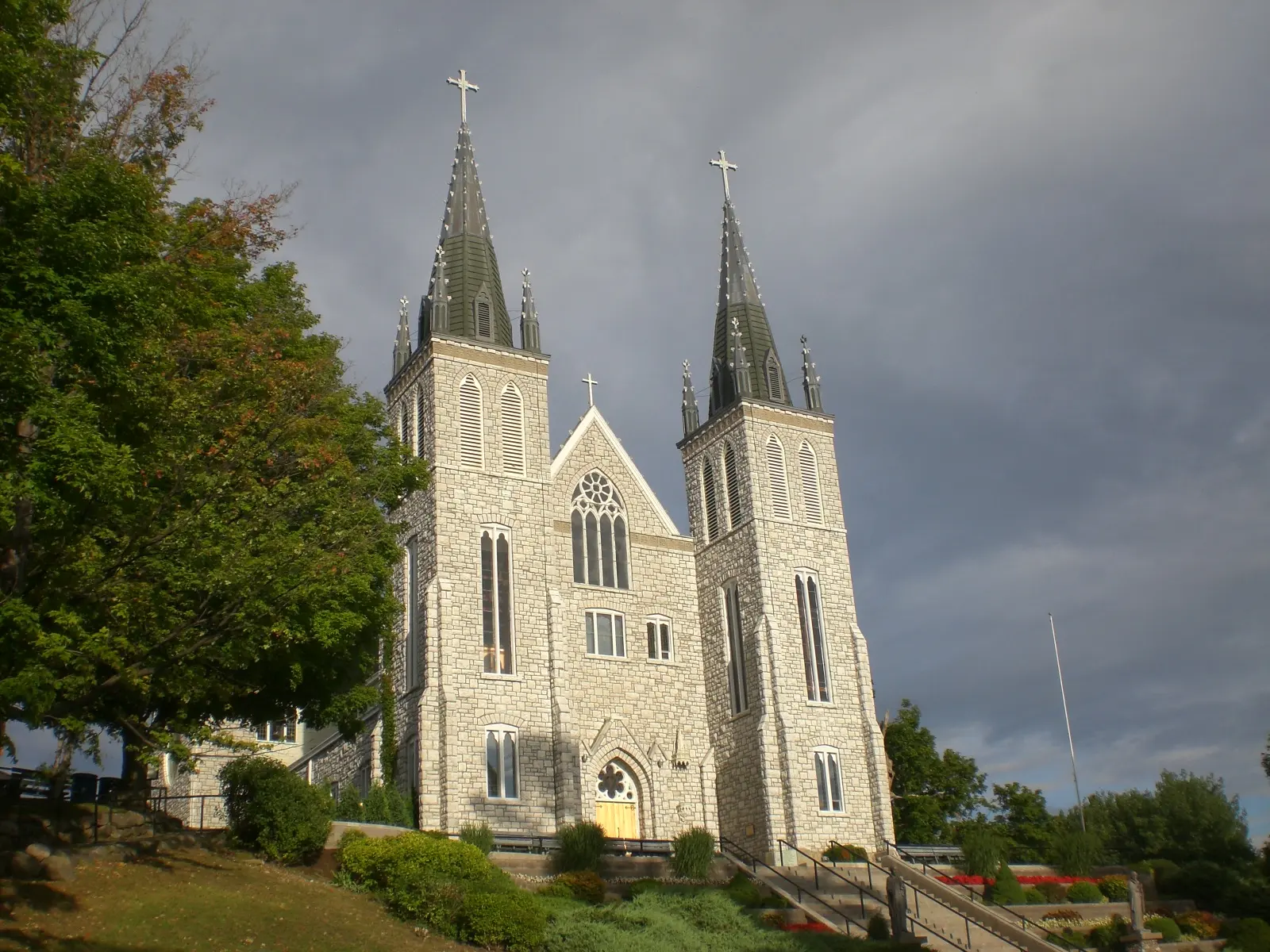
Image of Our Lady of Victory Basilica, Lackawanna, New York. Image source
Visit essentials
Before you go
- Access
- Located at 767 Ridge Road, Lackawanna, NY 14218, approximately 5 miles south of downtown Buffalo…
- Address
- 767 Ridge Rd, Lackawanna, NY 14218, USA
- Duration
- A self-guided visit takes thirty to sixty minutes.
- Etiquette
- Our Lady of Victory Basilica welcomes visitors of all faiths.
Overview
Eighteen-foot copper angels sound trumpets atop a dome visible for miles across the flat landscape south of Buffalo. Inside, forty varieties of Italian marble line the walls and columns, while 1,500 to 2,500 angels are carved, painted, and gilded across the basilica. The eighty-foot-diameter dome depicts Mary's Assumption and Coronation, drawing the eye upward like gravity reversed; windows filter light into gold and rose.
One parish priest built this grandeur in a steelworkers' neighborhood. Father Nelson Baker arrived in Lackawanna in 1882 and spent fifty-four years caring for orphans, sick people, unwed mothers, and the poor. He housed an estimated 100,000 children and ran orphanages, a hospital, maternity home, and infant home through devotional appeals to Our Lady of Victory, the Blessed Mother. After fire destroyed the parish church in 1916, he planned a basilica expressing his gratitude.
Its $3.2 million cost—roughly fifty-five million in current dollars—came entirely from donations to his Marian charity network; the parish carried no debt.
Baker died in 1936 at ninety-four, and his funeral drew an estimated 500,000 mourners. His remains lie beneath the basilica's Our Lady of Lourdes altar. Pope Benedict XVI declared him Venerable in 2011; his sainthood cause awaits a confirmed miracle.
The basilica remains a parish church with daily Mass and approximately 280,000 annual visitors. OLV Human Services continues his charity, serving 10,000 to 12,000 children and families each year.
Why this place is sacred
Sacred architecture often signals its significance through setting: hilltops, ancient cities, established pilgrimage routes. Our Lady of Victory does the opposite. It sits on Ridge Road in Lackawanna, New York, a city shaped by the steel industry and the immigrant labor that sustained it. The surrounding blocks are modest. The basilica is not modest.
This disjunction is itself a source of the site's power. The gap between context and content, between the humble exterior of the neighborhood and the radiant interior of the church, mirrors the spiritual principle at the heart of Father Baker's life: that grace appears where it is least expected, that the most beautiful offerings can arise from the most ordinary circumstances.
Inside, the thinness is architectural. The dome rises eighty feet in diameter, its interior surface covered with a painted Assumption scene that pulls the eye upward through a progression of figures and light. The forty varieties of Italian marble create surfaces that shift in color and texture as light moves through the space. The angels are everywhere: carved into capitals, painted on ceilings, sculpted on altars, gilded into niches. The exact count has never been settled.
Estimates range from 1,500 to 2,500, partly because some are woven into decorative patterns that blur the boundary between ornament and figure. The cumulative effect is saturation. You do not look at individual elements so much as submit to the whole.
Father Baker's tomb adds a different dimension. Located beneath the Our Lady of Lourdes altar on the left side of the basilica, the tomb draws pilgrims who kneel and pray, often with specific intentions.
The presence of the man himself, the Civil War veteran who became the Padre of the Poor, who personally oversaw the construction of every inch of this space, and whose cause for sainthood continues, gives the basilica a quality of personal encounter that pure architecture alone cannot provide.
The connection between the building and the charity it represents deepens the thinness further. This basilica was not built by wealth or institutional power. It was built by the accumulated generosity of modest donors responding to a priest's devotion to the Virgin Mary. Every marble column, every painted angel, every square foot of the dome represents someone's small gift magnified into something enormous. The building is, in this sense, a collective act of faith made visible.
The basilica was built by Father Nelson Baker as an act of thanksgiving to Our Lady of Victory for the resources that sustained his charitable works over decades. After a fire damaged St. Patrick's Parish Church in 1916, Baker chose to build not a replacement parish church but a monumental shrine expressing the depth of his devotion to the Blessed Virgin.
The basilica was designed to serve simultaneously as a functioning parish church, a pilgrimage destination, and a testament to the principle that sacred beauty and service to the poor are expressions of the same faith.
From its consecration in 1926, the basilica has served its dual role as parish church and pilgrimage destination without interruption. Pope Pius XI designated it a Minor Basilica just two months after consecration, one of the fastest such designations in Church history.
Father Baker's death in 1936 shifted the basilica's meaning. It became not only a shrine to Our Lady of Victory but a memorial to Baker himself. His remains were exhumed and reinterred beneath the Our Lady of Lourdes altar in 1999, creating a formal pilgrimage focal point. His designation as Servant of God (1987) and Venerable (2011) accelerated pilgrim interest.
The decline of the steel industry transformed Lackawanna from a prosperous working-class city into one facing economic hardship. The basilica endured, increasingly significant as an anchor for a community that had lost much of its industrial identity. In 2024, the Our Lady of Victory Basilica Complex, comprising thirteen buildings, was added to the National Register of Historic Places.
The current centennial celebration (2021-2026) and the Save the Dome restoration campaign, a three-million-dollar project to restore the copper dome, represent the basilica's ongoing efforts to preserve Baker's legacy for the next century.
Experience and orientation
Nothing on Ridge Road prepares you for what is inside.
The vestibule offers a transition: from the modest sidewalk of a Lackawanna neighborhood into a space that belongs to another order of ambition entirely. The first impression is of marble. Forty varieties of Italian stone line the walls and columns, each chosen for its color and veining, assembled with a precision that transforms geology into liturgy. The marble is not decoration. It is the structural language of the space, as fundamental as the prayers said within it.
Then the eye lifts. The dome opens above the sanctuary, eighty feet in diameter, its interior painted with a composition depicting the Assumption and Coronation of the Blessed Virgin Mary. The figures ascend through layers of cloud and light. The colors deepen toward the apex. The effect is vertiginous in the way that the best sacred architecture aims for: the body stays on the ground while something else rises.
The angels are inescapable. They fill every available surface: carved into the capitals of columns, painted into ceiling panels, sculpted onto altars and niches, gilded into frames. Some are monumental. Others are small enough to miss on a first visit and find on a third. The density of their presence creates a quality that the basilica's own literature describes simply: it feels like being surrounded by heaven.
Father Baker's tomb is on the left side of the nave, beneath the Our Lady of Lourdes altar. The space around it carries the quality of quiet concentration that marks a place where many people have brought their deepest needs. Pilgrims kneel. Some pray silently. Others touch the tomb or leave prayer cards.
The contrast between the soaring grandeur above and the intimate, personal nature of prayer at the tomb is the basilica's central experience: the public and the private, the monumental and the individual, held in the same space.
The Father Baker Museum in the lower level tells the human story. Photographs, documents, and artifacts trace Baker's life from Civil War service through seminary, ordination, and his decades of charitable work in Lackawanna. The museum is where the building's artistic excess becomes intelligible. Every piece of marble was chosen by a man who cared for orphans. Every angel was placed by a man who ran a maternity home for unwed mothers. The beauty is inseparable from the service.
Enter through the main doors and pause in the vestibule. Let the first impression register before moving forward. The shift from the street outside to the interior space is stark, and allowing it to land fully is part of the experience.
Walk slowly to the center of the nave. Look up. Let the dome work on you before examining the details at eye level. The composition moves from the earthly to the celestial, and following that progression with your eyes rehearses the architecture's intended effect.
Then explore the details. Move along the side aisles and examine the marble, the altars, the angels at close range. The craftsmanship rewards patient attention. Each altar has its own character. Each angel is individually rendered.
Visit Father Baker's tomb when you are ready for a more personal encounter. The tomb is not a performance. It is a place where people come with real needs. Whether you pray, sit quietly, or simply stand in witness, approach with the awareness that others around you may be in their most vulnerable moments.
For the fullest experience, take the free guided tour offered Sundays at 1:00 and 2:00 PM. The tour provides architectural and historical detail that enriches everything you see. Then visit the Father Baker Museum in the lower level to ground the artistic experience in the story of the man who made it possible.
Context and lineage
The basilica begins not with architecture but with charity.
Nelson Baker was born in Buffalo in 1842. He served in the Civil War, ran a grain and feed business, and at thirty-four entered seminary, an unusually late vocation. Ordained in 1876, he was assigned in 1882 to the struggling charitable institutions of Limestone Hill, the community that would become Lackawanna.
What followed was extraordinary. Over the next five decades, Baker built a network of care that included orphanages, a hospital, a maternity home for unwed mothers, an infant home, and a school, housing an estimated 100,000 children during his lifetime. His method was singular: he funded everything through devotional appeals to Our Lady of Victory, creating a mail-based charity network that invited people to join in Marian devotion while supporting his works. The response sustained his entire operation.
When fire damaged St. Patrick's Parish Church in 1916, Baker saw not a setback but an opportunity. He would build a basilica, a monument to the Blessed Mother who had provided for every need. He commissioned Emile Ulrich, a French-born architect based in Cleveland, who devoted himself entirely to the project.
The church rose over five years, its interior filled with forty types of Italian marble, thousands of angels, and a dome that would become the most recognizable feature of the Lackawanna skyline.
The $3.2 million cost was met entirely through donations. The parish carried no debt. On Christmas Day 1925, the first Mass was celebrated. On May 25, 1926, the church was consecrated. Two months later, Pope Pius XI designated it a Minor Basilica.
The basilica's lineage is inseparable from Father Baker's life and the charitable network he created. Baker arrived in Lackawanna in 1882 and spent over half a century building institutions of care funded by devotion to Our Lady of Victory. The basilica, completed in 1926, was the culmination of that devotion.
After Baker's death in 1936, the Franciscan Sisters and later OLV Human Services continued the charitable work. Today, OLV Human Services serves 10,000 to 12,000 children and families annually, maintaining the continuity of Baker's mission.
The spiritual lineage runs through the canonization process. Baker was declared Servant of God in 1987 and Venerable in 2011. His cause awaits the Vatican's confirmation of a miracle for beatification. The faithful who pray at his tomb are participating in a lineage of intercession that stretches from Baker's lifetime through the present, each prayer contributing to the ongoing story of a life that may yet be declared saintly.
Nelson Henry Baker
founder and pastor
Civil War veteran, businessman, and Catholic priest (1842-1936) who spent over fifty years serving the poor, orphaned, and sick in Lackawanna. Known as the Padre of the Poor, he housed an estimated 100,000 children and built the basilica as thanksgiving to Our Lady of Victory. Declared Venerable in 2011. His remains rest beneath the Our Lady of Lourdes altar.
Emile Ulrich
architect
French-born ecclesiastical architect based in Cleveland, Ohio, who designed the basilica. Ulrich halted all other projects to devote himself entirely to the building, personally inspecting artists' work in the United States and Europe. His design synthesized Renaissance Revival and Beaux-Arts traditions into a coherent expression of Marian devotion.
Pope Pius XI
religious leader
The pope who designated Our Lady of Victory as a Minor Basilica on July 20, 1926, just two months after its consecration, one of the fastest such designations in Church history.
Pope Benedict XVI
religious leader
The pope who in 2011 authorized the decree recognizing Father Baker's heroic virtue, advancing his cause for sainthood to the rank of Venerable.
Dianne Bosinski
tour coordinator and steward
Current group tour coordinator who helps visitors engage with the basilica's architectural and spiritual significance through guided interpretation.
Traditions and practice
Father Baker's spiritual practice centered on total confidence in divine providence through Mary's intercession. He attributed every success of his charitable work to Our Lady of Victory, creating a spirituality that fused Marian devotion with active service to the poor. His personal prayers, his fundraising appeals, and his construction of sacred spaces were all expressions of a single commitment: to honor the Blessed Mother by caring for those whom society had failed.
The basilica itself was Baker's most concentrated act of prayer. Every artistic choice, from the selection of marble to the placement of angels, was intended as an offering of thanksgiving. The building is, in Baker's understanding, not merely a container for worship but an act of worship in itself.
Daily Mass is celebrated on weekdays at 7:30 AM and 12:10 PM, with Saturday vigil at 4:30 PM and Sunday Masses at 8:00 AM, 10:00 AM, noon, and 4:30 PM. Confession is available. The basilica provides the full range of Catholic sacraments including baptisms, weddings, and funerals.
Pilgrims pray at Father Baker's tomb, often with specific healing or intercession intentions. The Father Baker Foundation promotes the Prayer for Canonization among the faithful. Candle lighting is available. The basilica enshrines first-class relics of various saints, which are venerated by Catholic visitors.
The Centennial Celebration (2021-2026) has included special Masses, events, and programs honoring the basilica's first century. The Save the Dome restoration campaign represents the community's commitment to preserving Baker's architectural legacy.
If you come seeking stillness, arrive for a weekday Mass at 7:30 AM or 12:10 PM. The weekday congregation is small, and the basilica's vastness holds a quality of quiet that weekend visits cannot match. Stay after Mass. Sit in the nave and let the space open around you.
If you come for Father Baker's story, begin with the museum in the lower level. Ground yourself in the biography before entering the basilica above. The building changes when you understand who built it and why. Every angel becomes an expression of gratitude. Every marble surface becomes an offering from a man who cared for orphans.
At the tomb, whether or not you pray in any formal sense, stand or sit in the awareness that you are near someone who spent ninety-four years on earth and devoted more than half of them to people who had no one else. That fact, whatever frame you put around it, carries weight.
Take the Sunday guided tour at 1:00 or 2:00 PM for the fullest understanding of the architecture. The guides know the building intimately: which marble came from which Italian quarry, how many months it took to paint the dome, which features Ulrich personally supervised in European workshops. The details accumulate into a portrait of devotion expressed through craftsmanship.
Roman Catholic
ActiveOur Lady of Victory Basilica is a Minor Basilica (designated 1926) and national shrine dedicated to the Blessed Virgin Mary under the title Our Lady of Victory. Built by Venerable Nelson Baker as an act of thanksgiving for the resources that sustained his lifetime of charitable work, the basilica serves as both a functioning parish church and a pilgrimage destination. Father Baker's remains, interred beneath the Our Lady of Lourdes altar, draw pilgrims seeking his intercession. His cause for canonization, advanced to Venerable in 2011, represents an active element of the basilica's spiritual life.
Daily Mass schedule with weekday and weekend liturgies. Pilgrimage to Father Baker's tomb for prayer and intercession. Candle lighting. Veneration of first-class relics of saints. The Prayer for Canonization of Venerable Nelson Baker. Centennial Celebration events (2021-2026). Sacramental life including baptisms, weddings, confessions, and funerals.
Architectural Heritage and Preservation
ActiveThe basilica is recognized as a significant example of Renaissance Revival and Beaux-Arts ecclesiastical architecture in North America. The 2024 listing of the thirteen-building complex on the National Register of Historic Places confirmed its architectural and historical importance. The Save the Dome restoration campaign (2024-2026) represents an active investment in preserving the building for future generations.
Ongoing restoration and conservation of the dome, marble surfaces, and artwork. Guided tours providing architectural and historical interpretation. The Father Baker Museum preserving documents, photographs, and artifacts related to the basilica's history. Partnership with preservation organizations including Partners for Sacred Places.
Perspectives and open questions
Our Lady of Victory Basilica is understood primarily through two lenses: as a work of sacred architecture and as a monument to one man's charity. Architectural historians examine its Renaissance Revival design and its place in the tradition of American Catholic church-building. Catholic faithful encounter it as a pilgrimage site centered on Marian devotion and Father Baker's ongoing cause for sainthood.
Both perspectives converge on the building's central proposition: that beauty and service are not separate pursuits but expressions of a single faith.
Scholarly perspective
Architectural historians place Our Lady of Victory within the tradition of American Catholic churches that draw on European Renaissance and Baroque models to create monumental sacred spaces. The Institute for Sacred Architecture has analyzed Emile Ulrich's design, noting its sophisticated use of Italian marble, its dome program, and its integration of sculpture and painting into a unified liturgical whole.
Historians of American Catholicism view Father Baker as a significant figure in the development of Catholic charitable institutions in the United States. His use of mail-based devotional appeals to fund a sprawling network of charitable works was innovative for his era and prefigured modern charitable fundraising methods. The fact that the $3.2 million basilica was completed without parish debt is studied as a remarkable organizational achievement.
The 2024 National Register listing confirms the architectural and historical significance of the thirteen-building basilica complex, recognizing it as a coherent campus of Catholic institutional life spanning a century.
Living and traditional perspectives
For Catholic faithful, Our Lady of Victory Basilica is a living shrine to the Blessed Virgin Mary and a place of encounter with the Venerable Nelson Baker. The building is understood as Baker's offering of thanksgiving to Our Lady of Victory, the Marian title under which he conducted his entire charitable ministry. Every element of the interior, from the marble to the angels to the dome, is read as an expression of devotion.
Father Baker's tomb draws pilgrims who seek his intercession for healing, guidance, and resolution of difficulties. The Prayer for Canonization is promoted among the faithful, and reports of answered prayers and favors received contribute to the body of evidence being compiled for his cause. The faithful understand Baker not as a historical figure but as a continuing spiritual presence whose prayers remain effective.
The basilica's message, as understood within the Catholic tradition, is that the most beautiful human achievement is possible when it is ordered to the glory of God and the service of the poor.
Open questions
The specific miracle currently under Vatican review for Father Baker's potential beatification has not been publicly disclosed. The canonization process requires one confirmed miracle for beatification and a second for canonization, and the investigation of claimed miracles involves rigorous medical and theological scrutiny.
How Father Baker consistently raised the funds needed for his extensive charitable operations, including the basilica, from a network of donors of modest means remains a subject of wonder among historians. His own explanation, that Our Lady of Victory provided, is consistent with his spirituality but does not satisfy secular analysis.
The exact number of angels in the basilica has never been definitively established. Estimates range from 1,500 to 2,500, partly because some figures are incorporated into decorative elements that make it unclear where ornament ends and angel begins. This ambiguity may be intentional: Baker's vision of heaven was not a place of countable beings but of pervasive presence.
Plan your visit
Access and arrival
Located at 767 Ridge Road, Lackawanna, NY 14218, approximately 5 miles south of downtown Buffalo via Ridge Road or Route 5. The basilica is easily reached from the New York State Thruway (I-90). Free admission. Open daily from 6:30 AM to 7:00 PM. Free guided tours on Sundays at 1:00 PM and 2:00 PM; meet at the 'Tour Begins Here' sign in the vestibule. Group tours available weekdays 1:00-5:00 PM by appointment through Dianne Bosinski at (716) 828-9424.
General contact: (716) 828-9444. Website: olvbasilica.org. Wheelchair accessible via ramps and elevator. Ample free parking is available on the basilica grounds. Mobile phone signal is reliable throughout the site, as the basilica is located in a suburban area with standard cellular coverage.
Lackawanna and the greater Buffalo area offer a full range of lodging options. Downtown Buffalo, five miles north, provides hotels, restaurants, and cultural attractions. The basilica is easily combined with other Buffalo-area visits, including Niagara Falls (approximately 25 miles north). For pilgrims seeking extended engagement, contacting the basilica office about group programs and retreats is recommended.
Respectful visit
Modest dress appropriate for a Catholic church. No formal requirements are enforced, but clothing that covers shoulders and knees is respectful. Comfortable shoes are recommended if you plan to walk the grounds or take a tour.
Photography is generally permitted for personal use throughout the basilica. Be discreet during Mass and other services. No flash photography during liturgy. If the basilica is empty or quiet, take your time with photographs. The interior rewards careful composition, and the light changes quality throughout the day.
Candles may be lit in the basilica. Donations are accepted and support the ongoing restoration and maintenance of the building. The OLV Gift Shop in the lower level offers religious items, books, and souvenirs related to Father Baker and the basilica.
Do not touch artwork, sculptures, altars, or architectural surfaces. Do not climb on pews or furniture. Follow tour guide instructions during guided tours. Standard church behavior is expected: quiet voices, respectful conduct, silence during services.
The basilica is an active parish church. If you visit during Mass or other services, your presence should not disturb the worshippers. Quiet observation or respectful participation is appropriate.
Be aware that the dome restoration project (2024-2026) may affect the exterior appearance with scaffolding but does not restrict interior access. Check the basilica website for current conditions.
Skeptical analyses of claimed miracles associated with Father Baker have been published by organizations including the Skeptical Inquirer. Visitors should be aware that the devotional claims made about Baker's intercession are matters of faith, not empirical evidence.
Current practical details
Address
767 Ridge Rd, Lackawanna, NY 14218, USA
Phone
Hours
Hours, fees, and access can change — verify on the official source before you travel. Practical details last checked Jun 2026.
Location
Map loads as you approach this section.
Pilgrim reflections
A portrait of encounter, not a score
Pilgrims describe what they felt, how present they could become, and whether the place would shape a journey. There are no stars and no ranking of traditions.
No reviewed reflections yet
The first pilgrims can help describe the character of being here.
Share a reflection
Available after an account-backed “Been there.” Every reflection is reviewed before publication.
Nearby sacred places
Explore other sacred places in the region. Proximity does not establish access or travel time; check each place’s guidance.
Share a photo
Help visitors recognize Our Lady of Victory Basilica, Lackawanna, New York. Every submission is reviewed before publication.