Basilica of Notre-Dame du Port
A Romanesque masterpiece of volcanic stone, where pilgrims have sought the Black Madonna since 1614
Understand sacred places, explore living traditions, and learn how to engage respectfully with Pilgrim Map.
Access has not been verified. Check current local guidance before planning a visit.
Clermont-Ferrand, Puy-de-Dôme, France
Read the sources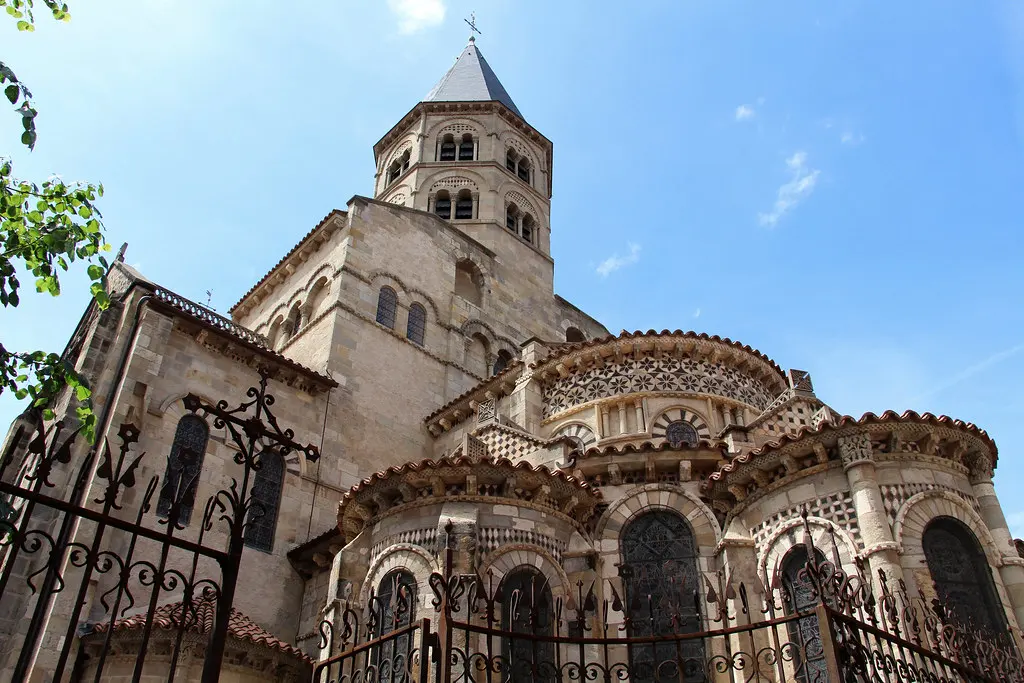
Image of Basilica of Notre-Dame du Port. Image source
Visit essentials
A quick read before you go
- Duration
- 45-90 minutes to appreciate architecture and crypt
- Access
- Port quarter of Clermont-Ferrand, between Place Delille and cathedral.
Overview
Auvergne's volcanic landscape gave birth to Notre-Dame du Port. Stone from the Chaîne des Puys, the dormant volcanoes defining the horizon, gave 12th-century builders a distinctly Auvergnat sacred architecture of harmonious proportions and intricate carvings.
Within thirty kilometers of Clermont-Ferrand, nine other major Romanesque churches—including Issoire, Saint-Nectaire, Saint-Saturnin, and Orcival—express this regional family. Notre-Dame du Port is distinguished by its place on a great Santiago de Compostela pilgrimage route, where medieval travellers prayed before continuing toward Spain.
In the crypt, a Black Madonna has focused documented devotion since at least 1614 and traditions understood to be older. Each year the faithful carry her through the streets, linking modern Clermont-Ferrand to its medieval past. Volcanic stone, capitals carved with biblical scenes, and the underground Madonna layer centuries of devotion into one space.
Why this place is sacred
Some places become thin through age; others through accumulation of purpose. Notre-Dame du Port is both. The stone itself carries geological time—volcanic eruptions that shaped Auvergne now shape sacred space. Upon that foundation, 12th-century craftsmen carved capitals that rank among Auvergne's finest, depicting scenes from Scripture and allegory.
But the thinness intensifies in the crypt, where the Black Madonna waits. Her darkness—whether from walnut wood, candle smoke, or intention—speaks of something older than the Romanesque architecture above. The procession documented since 1614 likely continues traditions that extend further back, though records do not reach their origin.
Pilgrims walking to Santiago de Compostela have stopped here for centuries, adding their prayers to the accumulated devotion. The UNESCO recognition in 1998 simply acknowledged what pilgrims already knew: this is a place where journeys pause, where travelers gather strength for what lies ahead.
Church founded by Bishop Avitus in 6th century; rebuilt in 12th century as pilgrimage church on Santiago route
From 6th-century foundation through Norman destruction to 12th-century Romanesque rebuild. Black Madonna procession documented since 1614. Declared basilica minor 1886. UNESCO World Heritage 1998. Major restoration 2007-2008.
Experience and orientation
Enter through the Port quarter of Clermont-Ferrand, an old neighborhood that preserves something of the medieval city. The basilica rises in dark volcanic stone, its exterior promising the Romanesque harmony within. Cross the threshold and let eyes adjust.
The nave extends in six bays, flanked by low side aisles. Above, the vaulting demonstrates the structural solutions that made Romanesque architecture possible. But look down—to the capitals. Notre-Dame du Port's carved capitals rank among Auvergne's finest, depicting biblical scenes and allegorical figures from the Psychomachia of Prudentius. Each tells a story; together they create a sermon in stone.
Descend to the crypt. Here the Black Madonna has received pilgrims for centuries. The space is darker, closer, more intimate than the church above. Light a candle. Join the line of those who have come before, documented since 1614, likely stretching back further.
The chevet—the eastern end with its radiating chapels—is architectural poetry. From outside, the arrangement of masses and the fine mosaics demonstrate why this church anchors Auvergne's Romanesque legacy.
Come as pilgrims have come for centuries—whether en route to Santiago or simply seeking the Black Madonna's presence.
Context and lineage
Bishop Avitus of Clermont founded a church here in the 6th century. Normans destroyed it; the current structure dates to the 12th century, built in the distinctive Auvergnat Romanesque style using volcanic stone from the nearby Chaîne des Puys.
One of ten major Auvergne Romanesque churches within 30km radius. Part of UNESCO-listed Routes of Santiago de Compostela (1998). Black Madonna veneration documented since 1614.
Bishop Avitus of Clermont
6th-century founder
Pope Leo XIII
Declared it basilica minor (1886)
Traditions and practice
Black Madonna procession (annually since 1614), pilgrimage devotions, candle lighting in crypt
Daily mass, veneration of Black Madonna, Santiago pilgrimage stop
Visit the crypt to encounter the Black Madonna. Study the carved capitals—they reward attention. If timing permits, attend mass to experience the Romanesque acoustic.
Roman Catholicism / Marian Devotion / Santiago Pilgrimage
ActiveOne of ten major Auvergne Romanesque churches. Black Madonna venerated since at least 1614. UNESCO World Heritage as part of Santiago routes.
Daily mass, Black Madonna veneration, annual procession, pilgrimage stop
Perspectives and open questions
Notre-Dame du Port can be approached as Romanesque architectural masterpiece, Black Madonna shrine, or Santiago pilgrimage stop.
Scholarly perspective
Recognized as one of the finest Auvergnat Romanesque churches. Capitals among the most significant in the region. UNESCO listing confirms international importance.
Living and traditional perspectives
Catholic tradition emphasizes the Black Madonna's centuries of veneration and the basilica's role on the great pilgrimage routes.
Alternative interpretations
Some connect Black Madonna traditions to pre-Christian goddess veneration. The volcanic landscape adds elemental dimension.
Open questions
Origins of Black Madonna devotion before 1614 documentation. Original 6th-century church layout.
Plan your visit
Access and arrival
Port quarter of Clermont-Ferrand, between Place Delille and cathedral. Open daily. Free admission. Accessible. Crypt accessible via stairs.
Clermont-Ferrand offers full range
Respectful visit
Modest church attire
Permitted outside services
Candles available in crypt
Quiet during services; reverence in crypt
Active basilica; services throughout the day.
Current practical details
Address
4 Rue Notre Dame du Port, 63000 Clermont-Ferrand, France
Phone
Hours
Hours, fees, and access can change — verify on the official source before you travel. Practical details last checked Jun 2026.
Location
Map loads as you approach this section.
Pilgrim reflections
A portrait of encounter, not a score
Pilgrims describe what they felt, how present they could become, and whether the place would shape a journey. There are no stars and no ranking of traditions.
No reviewed reflections yet
The first pilgrims can help describe the character of being here.
Share a reflection
Available after an account-backed “Been there.” Every reflection is reviewed before publication.
Nearby sacred places
Explore other sacred places in the region. Proximity does not establish access or travel time; check each place’s guidance.


References
Sources consulted for this page. Source categories describe the publication, not a guarantee that every claim is verified. Traditional accounts and outside interpretations may differ.
- 01Basilica of Notre-Dame du Port — WikipediaSource contextComprehensive historical overview
- 02Routes of Santiago de Compostela in France — UNESCOSource contextUNESCO listing
- 03Notre-Dame-du-Port Basilica — Clermont Auvergne VolcansSource contextOfficial tourism information
- 04Notre-Dame du Port Basilica — NavawaySource contextVisitor guide
Photo gallery
3 curated photos
Share a photo
Help visitors recognize Basilica of Notre-Dame du Port. Every submission is reviewed before publication.