Notre-Dame des Malades
Where Art Deco splendor houses a Black Virgin saved from revolutionary flames
Vichy, Allier, France
Visit essentials
Before you go
- Access
- Old Vichy center, walkable from thermal spa district.
- Address
- 8 Rue du Dr Charles, 03200 Vichy, France
- Duration
- 30-60 minutes to appreciate Art Deco interior and Black Virgin
- Etiquette
- Standard church etiquette in exceptionally ornate setting.
Overview
Romans knew Vichy's waters, and for centuries sick people came to bathe and drink in hope of healing. Notre-Dame des Malades—Our Lady of the Sick—joins that culture of therapeutic hope to spiritual healing.
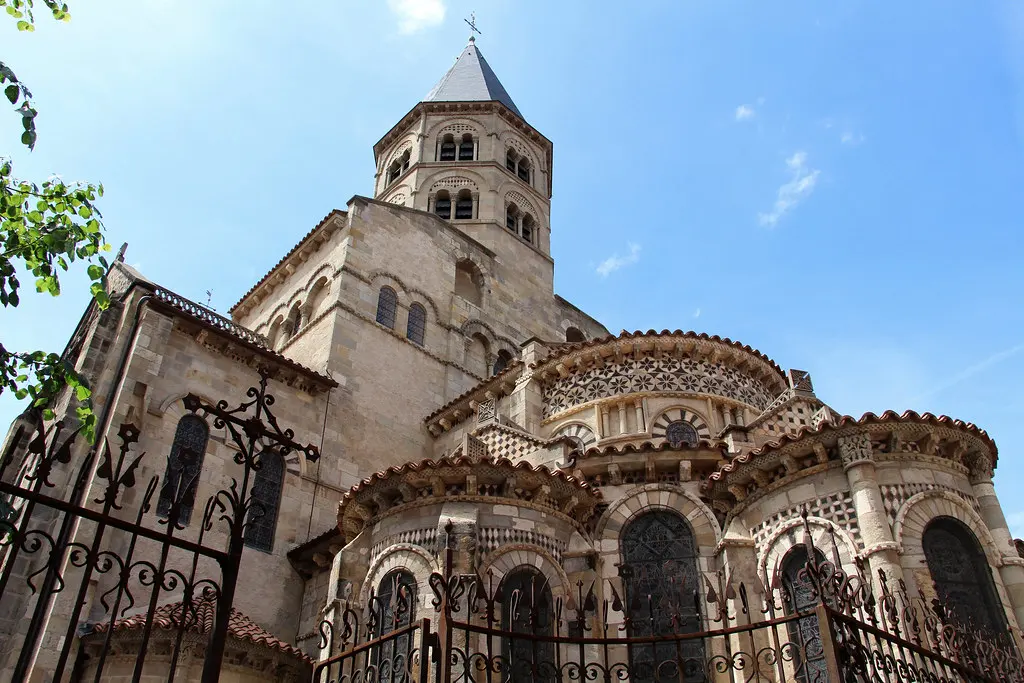
The church combines a 1714 chapel, built after Vichy's healing-spa reputation was established, with a 1931 addition. Its restrained concrete exterior opens onto Art Deco abundance: onyx pulpits, Carrara marble, blue Mauméjean stained glass, and mosaics rendering biblical narrative in modernist geometry. A 67-meter bell tower completed in 1956 carries an illuminated glass cross visible for miles.
At the center is a dark walnut Black Virgin perhaps seven centuries old. In November 1793, revolutionaries tried the statue like a criminal, sentenced it, and burned it, but eleven-year-old Claude Baffier rescued its head. The head alone was venerated for 138 years, until sculptor Emma Thiollier gave it a new body in 1931, when the Art Deco church was completed—physical and spiritual restorations joined.
Sites inside
Why this place is sacred
What makes this space thin is its layering of healings. Vichy's waters promise physical restoration; the Black Virgin promises spiritual restoration; the church itself required restoration after Revolutionary destruction. Every seeker who enters carries their own need for healing into a space that understands damage and repair.
The Art Deco interior, far from being mere decoration, creates an immersive environment that surrounds the visitor in sacred narrative. The Mauméjean stained glass, predominantly blue as befits a Marian church, filters light into something otherworldly. The mosaics and paintings tell the Bible's story in modernist form—ancient truths in contemporary language. This is not a museum of past devotion but an active translation of it.
The Black Virgin sits within this splendor as its reason for being. She was old when the church around her was new. Her darkness and stillness anchor the exuberance of Art Deco ornament, reminding visitors that beneath the aesthetic achievement lies a simpler truth: people came here—still come here—to ask for help.
Medieval chapel to Our Lady of the Sick, connecting Vichy's healing waters with Marian intercession
From medieval chapel through 1714 reconstruction, Revolutionary destruction, 1925-1931 Art Deco expansion (architects Chanet and Liogier), to 1956 bell tower completion. Listed as French Historical Monument 1991. Part of UNESCO Great Spa Towns 2021.
Experience and orientation
Nothing prepares you. The concrete exterior suggests utilitarian worship, perhaps a 20th-century church of modest means. Then you enter, and the interior detonates in color and light. Blue dominates—the color of Mary—streaming through Mauméjean stained glass, reflecting off Byzantine-influenced mosaics, illuminating walls of marble and onyx. The pulpit gleams like something from a luxury ocean liner. The Stations of the Cross march in stained glass panels around the nave.
Take time to read the space. The iconographic program moves along two axes: vertical lines draw the eye upward toward divine aspiration, while horizontal bands around the walls tell the biblical narrative centered on Christ. This is sacred art as total environment, designed to surround the worshipper in meaning.
Then find the Black Virgin. After the architectural abundance, her small dark presence comes as relief—something still and ancient amid the 20th-century splendor. Light a candle if you carry a burden. The faithful have done so for centuries, trusting their needs to her maternal darkness.
Come as the sick have always come to Vichy—carrying whatever needs healing, whether body, mind, or spirit.
Context and lineage
Vichy's thermal springs attracted Roman settlers and have drawn the sick ever since. By the 17th century, the waters had 'quasi-miraculous' reputation. A chapel to Our Lady of the Sick arose to connect physical and spiritual healing. The 1714 church replaced earlier structures; the 1931 Art Deco expansion responded to Vichy's growth as a fashionable spa destination.
Continues medieval Marian devotion. Part of Auvergne's significant Black Madonna tradition. Connected to European Black Madonna phenomenon (400-500 documented). Now part of UNESCO Great Spa Towns of Europe.
Antoine Chanet
Architect of Art Deco church
Jean Liogier
Co-architect
Ateliers Mauméjean
Master glassmakers and mosaicists
Claude Baffier
11-year-old who saved Black Virgin's head in 1793
Emma Thiollier
Sculptor who restored Black Virgin's body in 1931
Traditions and practice
Prayer before Black Virgin, candle lighting, healing petitions, August 15 procession
Daily mass in both old and new churches, regular devotions before Black Virgin, annual Assumption torchlight procession (since 1802)
Enter with time to absorb. Let eyes adjust to the interior's richness. Find the Black Virgin and sit with her presence. Light a candle if carrying a burden. If visiting August 15, join the procession.
Roman Catholicism / Marian Devotion
ActiveParish church of old Vichy housing 14th-century Black Virgin venerated for healing miracles. Exceptional Art Deco sacred art by Mauméjean studio. Part of UNESCO World Heritage site.
Daily mass, Black Virgin devotions, candle lighting, annual August 15 torchlight procession
Perspectives and open questions
Notre-Dame des Malades can be approached as Art Deco masterpiece, as Black Madonna shrine, or as expression of Vichy's healing identity.
Scholarly perspective
Listed as French Historical Monument since 1991. Mauméjean studio work recognized as significant Art Deco sacred art. Church part of Vichy's UNESCO Great Spa Towns of Europe designation (2021).
Living and traditional perspectives
For Catholic tradition, the church represents continuity of Marian devotion through destruction and rebuilding. The Black Virgin's survival testifies to faith's persistence.
Alternative interpretations
Some connect Black Madonnas to pre-Christian goddess traditions, seeing Vichy's Virgin as carrying older healing-goddess energies that predate Christianity.
Open questions
Exact age of Black Virgin (12th or 14th century). Original appearance before Revolutionary destruction. Full documentation of attributed miracles.
Plan your visit
Access and arrival
Old Vichy center, walkable from thermal spa district. Church open daily. Free admission. Bell tower (67m) visible throughout city.
Vichy offers full range as historic spa destination
Respectful visit
Modest church attire
Permitted outside services
Candles available for lighting
Quiet during services; reverence near Black Virgin
Active parish church; services continue throughout day.
Current practical details
Address
8 Rue du Dr Charles, 03200 Vichy, France
Hours, fees, and access can change — verify on the official source before you travel. Practical details last checked Jun 2026.
Location
Map loads as you approach this section.
Pilgrim reflections
A portrait of encounter, not a score
Pilgrims describe what they felt, how present they could become, and whether the place would shape a journey. There are no stars and no ranking of traditions.
No reviewed reflections yet
The first pilgrims can help describe the character of being here.
Share a reflection
Available after an account-backed “Been there.” Every reflection is reviewed before publication.
Nearby sacred places
Explore other sacred places in the region. Proximity does not establish access or travel time; check each place’s guidance.


References
Sources consulted for this page. Source categories describe the publication, not a guarantee that every claim is verified. Traditional accounts and outside interpretations may differ.
- 01Notre-Dame des Malades — Vichy Patrimoine MondialSource contextOfficial heritage documentation
- 02Church of Saint Blaise, Vichy — ReligianaSource contextReligious heritage site
- 03Vichy - Great Spa Towns of Europe — UNESCOSource contextUNESCO designation documentation
- 04Church of Our Lady of the Sick — Vichy Mon AmourSource contextLocal tourism site
- 05The church of Notre-Dame-des-Malades, Vichy — MalathronasblogTravel writer account
Share a photo
Help visitors recognize Notre-Dame des Malades. Every submission is reviewed before publication.