Baidyanath Shiva Temple, Deoghar, Jharkhand
Where Shiva healed Ravana and Sati's heart fell — a Jyotirlinga and Shakti Peeth in one
Understand sacred places, explore living traditions, and learn how to engage respectfully with Pilgrim Map.
Access has not been verified. Check current local guidance before planning a visit.
Deoghar, Jharkhand, India
Read the sources
Visit essentials
A quick read before you go
- Duration
- A few hours for darshan in normal times; a full day or more during the Mela.
- Access
- In Deoghar town, Santal Pargana, Jharkhand.
Overview
Baidyanath Dham stands in Deoghar, 'abode of the gods,' and is venerated both as a Jyotirlinga—one of Shiva's twelve self-luminous forms—and a Shakti Peeth, where Sati's heart fell during her dismemberment. Few sites unite both currents. Masculine and feminine principles meet across twenty-two shrines as devotees tie threads between Shiva's temple and the goddess Jaya Durga's.
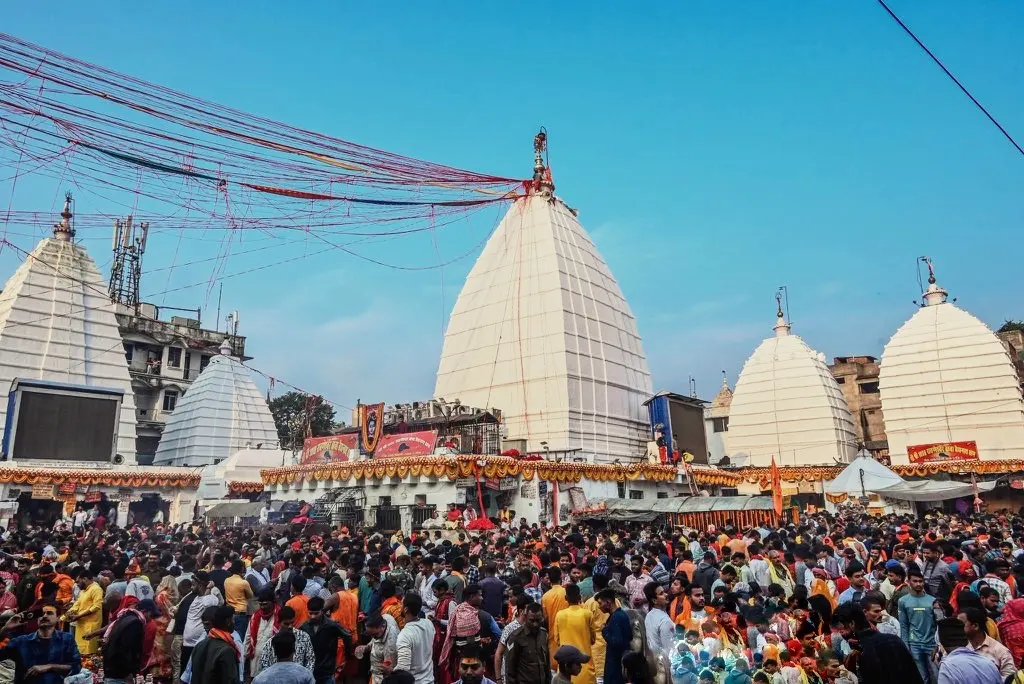
Baidyanath or Vaidyanath means 'divine physician,' recalling demon king Ravana's penance of offering his heads until Shiva restored them as healer. The legend grounds a centuries-old belief that worship here mends body and soul. A seventy-two-foot lotus-form tower bears gold finials and a five-pointed trident emblem found at few other temples.
During the lunar month of Shravan, an unbroken stream of saffron-clad Kanwariyas carries Ganga water roughly one hundred kilometres on foot from Sultanganj to pour over the lingam. The temple's precise age is unknown, and which site is the 'true' Baidyanath Jyotirlinga remains contested. Deoghar is the most widely venerated; on the ground, debate yields to dense devotion.
Why this place is sacred
What gives Baidyanath its particular charge is the meeting of two streams that usually run apart. As a Jyotirlinga it belongs to the great Shaiva map of twelve self-manifest lights of Shiva; as a Shakti Peeth, the Hriday or heart-peeth, it belongs to the Shakta map of places where the goddess's body fell.
To stand here is to stand where both the destroyer-ascetic and the mother-goddess are held to be present, and devotees deliberately bind the two shrines together with thread. The 'divine physician' name layers a third intensity over this: the conviction, sustained for centuries, that the sick and the vowing find healing at the lingam.
During Shravan the place becomes a moving thing — a hundred-kilometre column of barefoot pilgrims who will not set their water-pots on the ground until they reach the sanctum.
A shrine to Shiva as Jyotirlinga, held in legend to be the lingam Ravana carried from Kailash and was tricked into fixing at Deoghar; simultaneously honoured as the place where Sati's heart fell.
From a site of uncertain medieval or early-modern foundation, the complex grew through the patronage of successive rulers and devotees — the gold finials donated by the Maharaja of Gidhaur — into one of India's most heavily visited pilgrimage centres, with the Shravani Mela now among the world's largest religious gatherings.
Healing traditions
Shiva as divine physician
Baidyanath's tradition associates Shiva with the role of divine physician. One telling describes Ravana's severe acts of devotion and Shiva restoring him, explaining the name Vaidyanath. Other local narratives explain the establishment and naming of the linga differently. These are sacred accounts of divine response, and should not be merged into one proven history or understood as instructions to harm oneself.
Ways to participate
Offer a prayer to Shiva and ask the temple's authorized staff about water offerings or ordinary puja. A short, accessible visit can hold the same intention as a longer pilgrimage. Do not imitate Ravana's bodily sacrifice or undertake fasting, barefoot travel, or water carrying beyond your capacity.
These accounts describe religious traditions and reported experiences. They do not promise a cure or replace medical care.
Experience and orientation
Most who come describe being swept into something larger than themselves. The queues are long, the crowds dense, and the air carries the repeated cry of 'Bol Bam' from the saffron-clad Kanwariyas. The central act is simple and physical: water carried a great distance is poured over the Jyotirlinga, bel leaves and flowers are offered, and many tie a sacred thread joining the temple of Shiva to that of Jaya Durga, enacting the union the site embodies.
The arduous walk that precedes it for many — the Kanwar Yatra from Sultanganj — leaves pilgrims describing a deep surrender, a sense of vow fulfilled and grace received. Outside the Shravani Mela the same shrine offers a quieter darshan, and the cooler months allow time to take in the twenty-two shrines and the goddess temple without the press of the great fair.
The lotus-form tower with its gold finials and five-pointed Panchsula trident marks the main Jyotirlinga shrine; the Jaya Durga (Shakti Peeth) temple stands within the same twenty-two-shrine complex, the two joined by devotees' threads. The east-facing sanctum holds the lingam where water is offered.
Context and lineage
Tradition tells that the demon king Ravana performed severe penance, offering his heads to Shiva, who restored them as a divine physician — hence Baidyanath, 'the divine physician.' Granted the Jyotirlinga to carry to Lanka on the condition he never set it down, Ravana was tricked by Vishnu and Ganesha, disguised as a boy, into placing it at Deoghar, where it fixed forever.
In the Shakta telling, Deoghar is where Sati's heart fell when her body was dismembered, and the goddess is worshipped there as Jaya Durga.
Twin streams of Hindu tradition: Shaivism, through the worship of the twelve Jyotirlingas, and Shaktism, through the network of Shakti Peethas. Deoghar is counted in both.
Ravana
Legendary devotee
Shiva (Vaidyanath)
Enshrined deity
Sati / Jaya Durga
Enshrined goddess
Maharaja of Gidhaur
Patron
Traditions and practice
Jalarpan and abhishekam of the Jyotirlinga with Ganga water, offering of bel (bilva) leaves, flowers and sweets, worship of the goddess Jaya Durga at the Shakti Peeth, and the tying of sacred threads joining the Shiva and Shakti temples.
Daily darshan and multiple aartis continue year-round. The month-long Shravani Mela in the lunar month of Shravan (roughly July–August) brings the Kanwar Yatra from Sultanganj; Mahashivratri and Basant Panchami are also major observances.
If you come outside the great fair, the quieter darshan allows time to walk the twenty-two shrines and to sit with the joined Shiva and goddess temples. Offering water and bel leaves to the lingam is a simple way to enter the rhythm of the place without elaborate ritual.
Hinduism (Shaivism — Jyotirlinga)
ActiveBaidyanath at Deoghar is venerated as one of the twelve Jyotirlingas, the self-manifest abodes of Shiva. The seventy-two-foot lotus-form tower is crowned by gold finials and the distinctive five-pointed Panchsula emblem, and the lingam stands among twenty-two shrines.
Daily abhishekam with Ganga water, jalarpan by Kanwariya pilgrims during Shravan, offering of bel leaves and flowers, and the great Shravani Mela.
Hinduism (Shaktism — Shakti Peetha)
ActiveDeoghar is also revered as the Hriday (heart) Shakti Peeth, where Sati's heart is said to have fallen, the goddess worshipped as Jaya Durga. The combination of Jyotirlinga and Shakti Peeth at one site is rare.
Worship of Jaya Durga alongside the Shiva lingam, and the tying of sacred threads joining the Shiva and Shakti temples.
Perspectives and open questions
Baidyanath is read through its devotional power, its scholarly uncertainties, and the unresolved question of its identity among rival claimants.
Scholarly perspective
Scholars recognise Deoghar's Baidyanath as the most widely venerated claimant to the Baidyanath Jyotirlinga and a major Shaiva-Shakta centre, while noting that its precise founding date is unknown and that the Jyotirlinga's location is contested among several sites in different states.
Living and traditional perspectives
Devotees hold Deoghar to be the authentic Baidyanath Jyotirlinga and at once the Hriday Shakti Peeth of Jaya Durga — the place where Shiva healed Ravana and Sati's heart fell — making worship here uniquely powerful for healing and the fulfilment of vows.
Alternative interpretations
The union of Jyotirlinga and Shakti Peeth at one site is read as the meeting of the two cosmic principles, Shiva and Shakti, and the 'divine physician' name as the power of the divine to heal the whole person.
Open questions
The temple's true age and origins, and the resolution of the dispute over the 'real' Baidyanath Jyotirlinga, remain unsettled and largely matters of tradition.
Plan your visit
Access and arrival
In Deoghar town, Santal Pargana, Jharkhand. Reached by road, by rail (Baidyanath Dham / Jasidih stations) and by air (Deoghar Airport). The Kanwar route begins at Sultanganj on the Ganga in Bihar.
Respectful visit
Modest dress; footwear removed before entering. Saffron or traditional attire is common among Kanwariya pilgrims.
Typically restricted in and around the sanctum; follow temple and security directions, especially during the Mela.
Ganga water, bel (bilva) leaves, flowers, milk and sweets.
Follow official queue, route and timing arrangements, vital during the Shravani Mela; maintain order and respect crowd-control directions.
During the Shravani Mela the crowds are vast and tightly managed; follow the official queue, route and timing arrangements, which exist for safety as much as order.
Current practical details
Address
Baba Baidyanath Temple Administrative Building, Baba Mandir Campus, Shivganga Muhalla, Deoghar, Jharkhand 814112, India
Hours
Hours, fees, and access can change — verify on the official source before you travel. Practical details last checked Jun 2026.
Location
Map loads as you approach this section.
Pilgrim reflections
A portrait of encounter, not a score
Pilgrims describe what they felt, how present they could become, and whether the place would shape a journey. There are no stars and no ranking of traditions.
No reviewed reflections yet
The first pilgrims can help describe the character of being here.
Share a reflection
Available after an account-backed “Been there.” Every reflection is reviewed before publication.
Nearby sacred places
Explore other sacred places in the region. Proximity does not establish access or travel time; check each place’s guidance.
Vaidyanath Jyotir Linga and Jai Durga Shakti Pitha, Deoghar, Jharkhand
Deoghar, Jharkhand, India
0.0 km away

Basukinath Temple, Jarmundi, Jharkhand
Jarmundi, Jharkhand, India
40.6 km away

Ajgaivinath Dham Shiva Temple, Sultanganj, Bihar
Sultanganj, Bihar, India
84.6 km away

Brahmakund, Rajgir
Rajgir, Bihar, India
141.8 km away
References
Sources consulted for this page. Source categories describe the publication, not a guarantee that every claim is verified. Traditional accounts and outside interpretations may differ.
- 01Baba Baidyanath Dham — Incredible India — Ministry of Tourism, Government of IndiaofficialOfficial tourism profile of Baba Baidyanath Dham at Deoghar as a major Jyotirlinga pilgrimage centre, its significance and the Shravani Mela.
- 02Shrawani Mela — Deoghar District Administration — Deoghar District Administration, Govt. of JharkhandofficialOfficial documentation of the month-long Shravani Mela, the ~105–108 km Kanwar Yatra from Sultanganj, and crowd-management arrangements for millions of pilgrims.
- 03Official Website of Baba Baidyanath Temple — Baba Baidyanath Temple, DeogharofficialOfficial temple site: darshan and puja arrangements, Shravani Mela, the Panchsula emblem, the 22-temple complex and Jaya Durga Shakti Peeth.
- 04Baidyanath Temple — Wikipedia — Wikipedia contributorsacademicBaidyanath/Vaidyanath at Deoghar, Jharkhand, one of the twelve Jyotirlingas of Shiva; Ravana legend (Shiva as divine physician, 'Vaidya'); also a Shakti Peetha; temple complex of 22 shrines; Shravani Mela / Kanwar Yatra from Sultanganj.
- 05Baidyanath Jyotirlinga Temple — Behind Every TemplespiritualDevotional account of the Ravana legend, the Jyotirlinga's significance, the temple's architecture (Panchsula, gold finials) and worship traditions.
- 06Baidyanath's divine-physician tradition — Babadham pilgrimage sitespiritualSupports the attributed account or visitor practice in the healing section; not evidence of clinical efficacy.
- 07Deoghar district handbook — recorded local traditionsofficialSupports the attributed account or visitor practice in the healing section; not evidence of clinical efficacy.
- 08Baidyanath Jayadurga Shakti Peeth, Deoghar — Info, Timings, History — TemplePurohitSource contextDetails the Shakti Peeth dimension (Sati's heart, Jaya Durga), the combined Jyotirlinga-and-Shakti-Peeth status, timings and visitor practicalities.
Share a photo
Help visitors recognize Baidyanath Shiva Temple, Deoghar, Jharkhand. Every submission is reviewed before publication.