Ajgaivinath Dham Shiva Temple, Sultanganj, Bihar
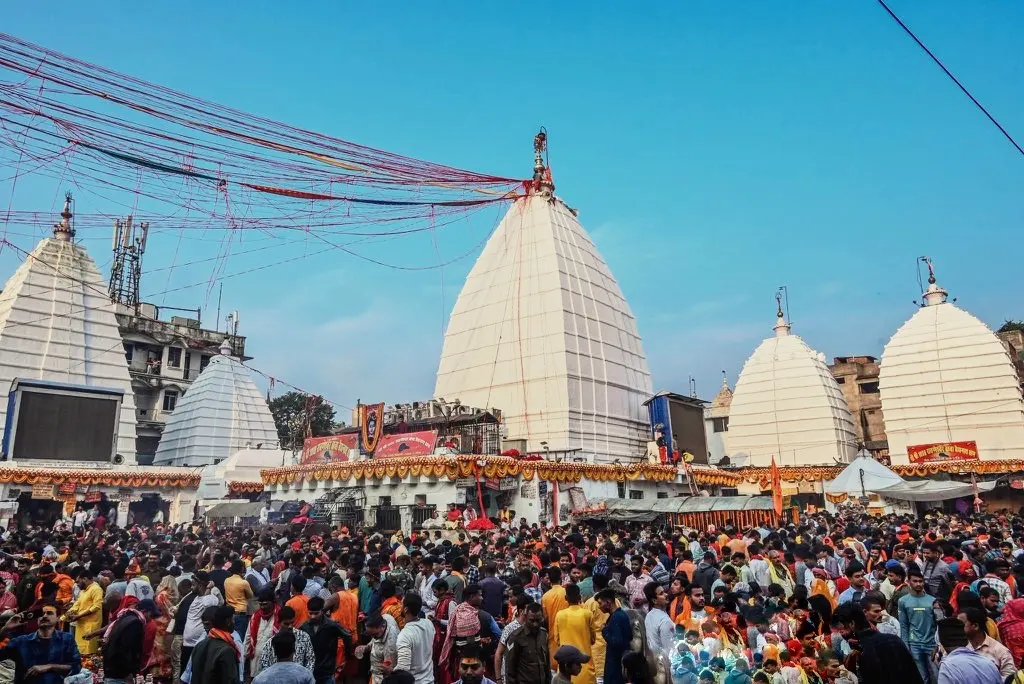
A Shiva temple rising from a rock midstream where the Ganga turns north
Understand sacred places, explore living traditions, and learn how to engage respectfully with Pilgrim Map.
Access has not been verified. Check current local guidance before planning a visit.
Sultanganj, Bihar, India
Read the sources
Visit essentials
A quick read before you go
- Duration
- 1–2 hours for darshan and the rock setting; far longer if observing or joining the Shravan…
- Access
- At Sultanganj, about 25 km west of Bhagalpur, Bihar; the temple sits on a rock in the Ganga…
Overview
Reached by boat or footbridge, Ajgaivinath stands on a granite outcrop in the Ganga at Sultanganj, Bihar. Its Shiva linga is carved in living rock and washed by the river, joining stone and current. The normally eastward Ganga turns north here as Uttarvahini, a reversal traditionally held to carry special charge.
Pilgrims fill pots, take a vow, and begin the foot journey to Baidyanath Jyotirlinga at Deoghar, some hundred kilometres away; this departure formally opens the Shravani Mela, often described as the world's longest religious fair. Layered carvings and inscription make the rock a record. The island is a threshold between banks, still and moving water, arrival and the long walk ahead.
Why this place is sacred
The thinness of Ajgaivinath comes from its position. A temple set on a rock in the middle of a flowing river is already a place apart — neither bank, surrounded on all sides by current. Add to that the rare north-flowing reach of the Ganga, considered spiritually charged, and the layered carvings of three traditions worked into the same stone, and the site gathers a density of meaning that visitors feel as soon as they cross the water.
It is also a place of beginning: the point from which a million-strong devotional current sets out on foot. The felt quality is one of departure as much as arrival.
A living Shiva shrine on a sacred rock-island, venerated as the place where the Ganga turns north and, by the founding tradition, where Shiva received his bow, the Ajgav.
From an ancient foundation of uncertain date — traditionally the rock-ashram of the sage Jahnu, later known as Jahangira (see the founding legend) — the site accrued Pala-era rock sculpture and became the canonical starting point of the Kanwar Yatra to Baidyanath. Today it functions year-round as a Shiva temple and, through the month of Shravan, as the launch point of a vast seasonal pilgrimage.
Experience and orientation
Most visitors first take in the temple from the bank: a tower of masonry rising from a rock midstream, reached over the water. The crossing itself slows you down. Once on the island, the rock-carved Shiva linga sits where the river reaches it, and worshippers perform abhishekam over the stone. In quieter months the setting is contemplative — the sound of the current, the carved surfaces, the open river light.
During Shravan the scene transforms: vast crowds of saffron-clad Kanwariyas fill the town and the ghats, and the air is one of departure as much as worship. Pilgrims often describe a strong sense of starting something — of joining a current of devotion that has flowed on foot for centuries.
Reached by boat or footbridge from the town, the island sets you across the water; orient yourself to the linga washed by the river. The rock's ancient carvings are best observed without touching.
Context and lineage
Tradition holds that Shiva received his bow, the Ajgav, here, giving the temple its name Ajgaivinath. The rock is also remembered as the abode of the sage Jahnu — the old name Jahangira is traced, traditionally though not securely, to Jahnu — a centre of learning beside the Ganga. Another strand links the site to Rama, who is said to have worshipped Shiva here in the Treta Yuga before facing Ravana.
Local memory recounts that the iconoclast Kala Pahar tried but failed to destroy the temple, though he damaged a nearby Parvati shrine. The earliest temple fabric is of uncertain date; the rock sculpture is attributed broadly to the later Pala period.
Shaivism within the broader Hindu tradition, with the site serving as the source-point of Gangajal for the Baidyanath Kanwar Yatra. The rock's earlier imagery reflects Pala-era Hindu and Buddhist contact.
Jahnu (Jahnu Muni)
Sage of tradition
Pala-period sculptors
Rock carvers
Kala Pahar
Iconoclast of local legend
Traditions and practice
Bathing in the Ganga, darshan and abhishekam of Ajgaivinath with water, bilva leaves, flowers and milk, and the taking of a vow before filling the kanwar with north-flowing Ganga water to carry to Baidyanath.
Year-round darshan, roughly 6 AM to 8 PM. Through the lunar month of Shravan the Shravani Mela turns the town into a continuous fair, with millions of pilgrims bathing, collecting water and departing on foot to Deoghar.
If you visit outside Shravan, let the crossing set the pace: take in the temple from the water, then sit a while with the sound of the river before approaching the linga. During Shravan, observe the purity customs and dress of the Kanwariyas with respect, whether or not you join the walk.
Shaivism (Hinduism)
ActiveDedicated to Shiva as Ajgaivinath / Gaibinath Mahadev, worshipped at a rock-carved linga continuously washed by the Ganga, on a rock-island where the river flows north (Uttarvahini). It is the source-point of Gangajal for the Baidyanath Kanwar Yatra.
Daily darshan and abhishekam of the linga; collection of Ganga water and vows by Kanwariyas; intensive Shravan-month worship.
Kanwar Yatra / Shravani Mela
ActiveSultanganj is the canonical starting point of the Kanwar Yatra: pilgrims bathe, worship Baba Ajgaivinath, take a vow, and carry north-flowing Ganga water roughly 105–109 km on foot to offer at the Baidyanath Jyotirlinga in Deoghar through the month of Shravan.
Bathing, vow-taking, filling kanwars with Ganga water, and barefoot pilgrimage to Deoghar; the fair runs the full month of Shravan.
Perspectives and open questions
Ajgaivinath holds a settled devotional meaning alongside an understudied archaeological record and a striking interpretation of the north-flowing river.
Scholarly perspective
The rock bears sculpture and inscriptions attributed largely to the later Pala period, with Hindu, Buddhist and Gupta-era imagery; scholars regard the site as archaeologically significant but comparatively understudied.
Living and traditional perspectives
Devotees hold the temple to be ancient and self-manifest, sanctified by the Ajgav bow, the sage Jahnu and Rama's worship, and revered as the source of holy water for Baidyanath.
Alternative interpretations
The north-flowing (Uttarvahini) Ganga at this spot is read as a reversal of the river's natural course, charged with special auspiciousness.
Open questions
The full meaning and dating of the rock inscriptions, and the deep history of the Jahnu/Jahangira tradition, remain incompletely documented. The distance of the yatra to Deoghar is itself variously cited as roughly 105, 108 or 109 km.
Plan your visit
Access and arrival
At Sultanganj, about 25 km west of Bhagalpur, Bihar; the temple sits on a rock in the Ganga reached by boat or footbridge. Sultanganj is on the rail and road network.
Lodging is available in Sultanganj and more widely in nearby Bhagalpur; expect heavy demand during Shravan.
Respectful visit
Men in dhoti, pyjama or trousers with an upper cloth; women in saree, half-saree or salwar. Shorts, mini-skirts, sleeveless tops and short T-shirts are discouraged.
Generally tolerated of the exterior and setting; respect worshippers and any signage, especially in the sanctum and during rituals.
Ganga water, bilva leaves, flowers and milk for the abhishekam of the linga. There is no entry fee.
Remove footwear on the temple grounds; do not touch the rock carvings; respect fellow pilgrims in crowded periods.
Shravan crowds are intense; move with care and patience. Do not touch or deface the ancient rock sculptures and inscriptions.
Current practical details
Address
New, sidhi, Ghat Rd, Sultanganj, Bihar 813213, India
Hours
Hours, fees, and access can change — verify on the official source before you travel. Practical details last checked Jun 2026.
Location
Map loads as you approach this section.
Pilgrim reflections
A portrait of encounter, not a score
Pilgrims describe what they felt, how present they could become, and whether the place would shape a journey. There are no stars and no ranking of traditions.
No reviewed reflections yet
The first pilgrims can help describe the character of being here.
Share a reflection
Available after an account-backed “Been there.” Every reflection is reviewed before publication.
Nearby sacred places
Explore other sacred places in the region. Proximity does not establish access or travel time; check each place’s guidance.
Vaidyanath Jyotir Linga and Jai Durga Shakti Pitha, Deoghar, Jharkhand
Deoghar, Jharkhand, India
84.6 km away

Baidyanath Shiva Temple, Deoghar, Jharkhand
Deoghar, Jharkhand, India
84.6 km away

Basukinath Temple, Jarmundi, Jharkhand
Jarmundi, Jharkhand, India
101.8 km away

Dargaah Makhdoom Husain Balkhi, Maner Sharif, Patna, India
Bihar Sharif, Bihar, India
122.7 km away
References
Sources consulted for this page. Source categories describe the publication, not a guarantee that every claim is verified. Traditional accounts and outside interpretations may differ.
- 01Shrawani Mela — District Deoghar, Government of Jharkhand — Government of Jharkhand (Deoghar District)officialOfficial account: devotees take Gangajal from north-flowing (Uttarvahini) Ganga at Sultanganj after worshipping Baba Ajgaivinath, then walk to Baidyanath; longest religious fair, millions of pilgrims.
- 02Ajgaibinath Dham — Wikipedia — Wikipedia contributorsacademicRock-island Shiva temple in the Ganga at Sultanganj; Ajgav-bow legend; former name Jahangira after sage Jahnu; later-Pala rock sculptures; starting point of Shravani Mela Kanwar Yatra to Baidyanath.
- 03Shravani Mela — Wikipedia — Wikipedia contributorsacademicMonth-long Shravan fair; pilgrims collect Ganga water at Sultanganj (Ajgaivinath) and carry it ~105 km to Baidyanath Jyotirlinga at Deoghar.
- 04Ajgaivinath Temple — Sultanganj (municipal/tourism site) — Sultanganj.inofficialLocal civic/tourism description of the rock-island temple and its role as the source of Gangajal for the Deoghar yatra.
- 05Ajgaivinath Temple, Sultanganj, Bhagalpur, Bihar — ApniSanskriti — ApniSanskritiSource contextHistory and legends: Ajgav bow, Jahnu Muni's ashram, Treta Yuga/Rama tradition, Kala Pahar's failed attack; rock sculptures of Pala period.
- 06Ajgaivinath Temple, Bihar — Info, Timings, Photos, History (TemplePurohit) — TemplePurohitSource contextUttarvahini (north-flowing) auspicious Ganga; rock-carved Shiva linga bathed by the river; pilgrimage and visitor information.
- 07Ajgaivinath Temple Tourism (Bhagalpur) — Travel Guide — TravelSetuSource contextVisitor guide: ~25 km west of Bhagalpur, darshan ~6 AM–8 PM, no entry fee, dress code, winter best season, Shravani Mela.
Photo gallery
3 curated photos
Share a photo
Help visitors recognize Ajgaivinath Dham Shiva Temple, Sultanganj, Bihar. Every submission is reviewed before publication.