Vaidyanath Jyotir Linga and Jai Durga Shakti Pitha, Deoghar, Jharkhand
The healing jyotirlinga and Shakti Pitha at Deoghar — destination of the world's largest walking pilgrimage
Understand sacred places, explore living traditions, and learn how to engage respectfully with Pilgrim Map.
Access has not been verified. Check current local guidance before planning a visit.
Deoghar, Jharkhand, India
Read the sources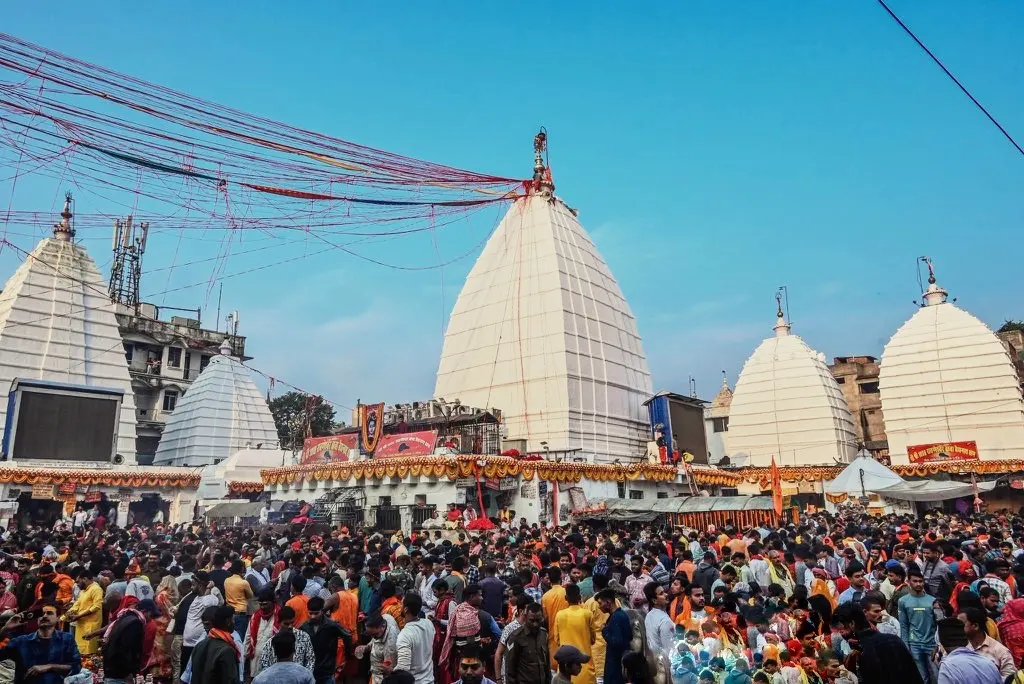
Image of Vaidyanath Jyotir Linga and Jai Durga Shakti Pitha, Deoghar, Jharkhand. Image source · CC0
Station vaidyanath of 12
Twelve JyotirlingasVisit essentials
A quick read before you go
- Duration
- Half day for general darshan; full day with the Shakti sanctum, satellite shrines, and…
- Access
- Deoghar Airport (DGH) opened in 2022 and is 10 km from the temple, about 25 minutes by road,…
Overview
Baidyanath Dham at Deoghar in Jharkhand is among the most distinctive sites in Indian sacred geography. It is the ninth jyotirlinga in the canonical sequence and is uniquely understood as Vaidyanath — Shiva in his form as Vaidya, the physician, the lord of healing. The same complex is also one of the 51 Shakti Pithas, marking the spot where Sati's heart fell after Vishnu's Sudarshana Chakra divided her body.
The convergence of jyotirlinga and Shakti Pitha in a single set of grounds is rare in India and theologically dense — Shiva and Shakti eternally together, in his healing form and her heart form. The temple is the destination of the Shravani Mela, the world's largest sustained pedestrian pilgrimage.
During Shravan (July–August), an estimated 8–10 million devotees walk 105 km barefoot from Sultanganj on the Ganga in Bihar to Deoghar, carrying decorated bamboo poles (kanwar) hung with two pots of Ganga water collected at the Ajgaibinath Ghat. They wear saffron, chant 'Bol Bam', and on reaching Deoghar offer the Ganga water as abhishekam on the lingam.
The lingam itself is small and dark, believed by tradition to be permanently embedded in the earth by Ravana, who tried to carry it to Lanka and failed. Unusually among major jyotirlingas, women may enter the inner sanctum and perform their own abhishekam — Baidyanath's accessibility is part of its character.
Why this place is sacred
Baidyanath concentrates several rare claims. The jyotirlinga itself is unique in interpretation — Shiva as Vaidya, the doctor, the healer of disease and chronic affliction. Devotees come specifically for relief from illness, infertility, and ongoing karmic afflictions. The lingam is small and worn smooth by centuries of abhishekam, and tradition holds it descends indefinitely into the earth — Ravana, having tried to lift it after a Brahmin boy (Ganesha in disguise) placed it down, only managed to push it deeper.
The Shakti Pitha overlay is the second rare claim: Sati's heart (hridya) fell at Deoghar, making the same complex the Hridya Pitha. The Shakti is worshipped here as Jaya Durga in an adjacent sanctum, and the gathbandhan ritual — tying a sacred thread between the Shiva and Parvati sanctums — enacts the marriage of Shiva and Shakti for marital harmony.
The third claim is the Shravani Mela: roughly 10 million walkers in 30 days, the saffron current visible from satellite imagery. Together — healing Shiva, heart Shakti, and the ocean of walking devotees — Baidyanath holds a distinctive place even within the jyotirlinga circuit.
Worship of Shiva as Vaidyanath — the lord of healing — and of Shakti as Jaya Durga at the spot where Sati's heart fell, joined through the gathbandhan ritual.
From mythological Ravana origin through Pala-era foundations (8th–12th century), late-16th-century reconstruction under Raja Pooran Mal of Giddhaur, 18th- and 19th-century shrine additions by the Maharajas of Birbhum and Burdwan, and the contemporary infrastructure that now supports Shravani Mela attendance approaching 10 million pilgrims annually.
Experience and orientation
Baidyanath is approached on foot through Deoghar's old town. The temple complex covers roughly three hectares and holds twenty-two small shrines around the central jyotirlinga sanctum. Phones, cameras, leather, and bags are deposited at the entrance. Inside the sanctum, the lingam is small, dark, and continuously bathed — and this is the defining difference from many other major jyotirlingas: devotees, including women, may enter the inner sanctum and perform their own abhishekam by pouring Ganga water directly on the lingam.
During Shravan this becomes a continuous current, with kanwariyas moving through in shifts day and night, each carrying the water they walked 105 km to offer. The act of pouring — after days of walking barefoot in the monsoon, sometimes for the relief of a sick relative — is the emotional centre of the pilgrimage.
After the Shiva darshan, most pilgrims walk to the adjacent Jaya Durga shrine — the Shakti Pitha — and tie a gathbandhan thread between the two sanctums. The ritual is small and quiet, but pilgrims describe it as one of the most tender experiences in Hindu practice: marriages renewed, family disputes laid at the threshold, healing requested across the Shiva-Shakti axis.
Outside Shravan, plan a half day for the core temple plus the Shakti Pitha, the satellite shrines, and the gathbandhan ritual. During Shravan, plan for the full kanwar walk if your body and time allow — three to five days from Sultanganj — or expect the entire town of Deoghar to be transformed and queues to flow continuously through the temple.
Context and lineage
Ravana, the demon-king of Lanka and a devoted Shaiva, performed severe penance to Shiva, asking that the jyotirlinga itself be given to him to install in Lanka. Shiva agreed but warned: do not place it on the ground during the journey. Vishnu, alarmed that Ravana with the jyotirlinga would become invincible, caused Ravana to feel an urgent need to relieve himself. Ravana asked a passing Brahmin boy (Ganesha in disguise) to hold the lingam.
The boy placed it on the ground. When Ravana returned, he could not lift it. Furious, he tried to push it back into the earth — and only a small portion remained visible. This is the Vaidyanath lingam at Deoghar. A second layer: Sati, daughter of Daksha, immolated herself when her father insulted Shiva. Shiva, in grief, carried her body across the universe in the Tandava.
Vishnu's Sudarshana Chakra divided her body into 51 parts to release Shiva from his grief. Her heart (hridya) fell at Deoghar — making it the Hridya Pitha. The presence of Shiva (Vaidyanath) and Shakti (Jaya Durga) in the same complex is therefore mythological inevitability. A third tradition: Vaidyanath as physician — Shiva took this form to heal the devas after their battles with the asuras, restoring them as the supreme physician.
The temple is administered by the Baidyanath Temple Management Board under Jharkhand state oversight. Ritual lineage runs through Eastern Indian Pashupata Shaivism, Pala-era Shaiva-Shakta yugala worship, and the tantric Bhairava-Shakti tradition. The kanwariya practice as a mass phenomenon emerged in its current form during the 20th century, drawing on older Shravan pilgrimage customs.
Ravana
Mythological figure whose attempt to carry the jyotirlinga to Lanka left it permanently embedded at Deoghar
Sati
Whose heart fell at Deoghar, making the site the Hridya Pitha among the 51 Shakti Pithas
Raja Pooran Mal of Giddhaur
Late-16th-century reconstructor of the principal temple structures
Maharaja of Burdwan
1810 patron of additional shrines including the Jaya Durga Shakti Pitha sanctum
Surinder M. Bhardwaj
Geographer whose academic work on Indian pilgrimage documents the Sultanganj–Deoghar kanwar route in the modern era
Traditions and practice
Mangala Aarti at 04:00, Shringar Aarti at 18:00, and Shayan Aarti at 21:00 mark the day. Ganga-jal abhishekam — pouring Ganga water on the lingam — is the defining ritual, and unusually for a major jyotirlinga the abhishekam is performed by lay devotees themselves, including women. Pancha-amrit abhishekam, Mahamrityunjaya Jaap for healing, and the gathbandhan ritual between the Shiva and Parvati sanctums are central. Mahashivaratri brings a night-long jagran with bhasma-lepan on the lingam.
Shravani Mela (the month of Shravan, July–August) is the defining contemporary practice. Roughly 8 to 10 million devotees collect Ganga water at Sultanganj's Ajgaibinath Ghat and walk 105 km barefoot to Deoghar over three to five days, wearing saffron and chanting 'Bol Bam'. The kanwar must not touch the ground until the water is offered at the lingam. During Shravan the temple operates continuously, with shifted queues moving through day and night.
Marriage and family-renewal rituals are performed at the gathbandhan courtyard year-round. The Bhadra (August–September) fortnight brings a secondary Bol Bam pilgrimage at smaller scale.
For a contemplative visit, choose a non-Shravan period — winter is the most comfortable. Plan a half day for the temple and Shakti sanctum, an evening at the Naulakha Mandir, and a morning for Trikuta Parvat or Tapovan caves. For the full kanwar experience, prepare physically over weeks beforehand and plan three to five days of barefoot walking in monsoon weather with a return-day buffer for darshan.
If unable to walk the full route, many pilgrims complete shorter symbolic walks from intermediate points.
Shaivism — Vaidyanath Jyotirlinga (Lord of Healing)
ActiveVaidyanath is the ninth jyotirlinga in the canonical sequence and is uniquely understood as Shiva in the form of Vaidya — the physician, the lord of healing. Devotees come specifically for relief from disease, illness, and chronic affliction. The lingam is small, dark, and worn smooth by centuries of abhishekam. Tradition holds that all eleven other jyotirlingas have their power amplified when paired with a Vaidyanath visit.
Abhishekam with Ganga water carried from Sultanganj (the defining ritual); pancha-amrit abhishekam; bilva-patra offering; Mahamrityunjaya Jaap for healing; three daily aartis.
Shaktism — Hridya-Pitha (Heart of Sati)
ActiveDeoghar is also one of the 51 Shakti Pithas, marking the spot where Sati's heart fell. The Shakti is worshipped here as Jaya Durga. The Vaidyanath complex is therefore a rare site where a jyotirlinga and a Shakti Pitha coincide in the same temple grounds — Shiva and Shakti together. This is considered one of the most karmically charged combinations in Hindu sacred geography.
Tying a sacred thread (gathbandhan) between the Shiva sanctum and the Parvati sanctum — the ritual marriage of Shiva and Shakti; darshan at the adjacent Jaya Durga shrine; Navratri celebrations; Mangala Gauri puja for marital harmony.
Kanwariya — Shravani Mela Pilgrimage
ActiveEvery year during Shravan (July–August, roughly 30 days), an estimated 8 to 10 million devotees walk the 105 km from Sultanganj on the Ganga in Bihar to Deoghar, carrying decorated bamboo poles (kanwar) hung with two pots of Ganga water collected at Sultanganj's Ajgaibinath Ghat. They walk barefoot, traditionally dressed in saffron, chanting 'Bol Bam'. This is the largest sustained pedestrian pilgrimage in the world by volume during its peak weeks.
Ganga water collection at Sultanganj Ajgaibinath Ghat; walking barefoot ~105 km in three to five days; wearing saffron and not putting the kanwar on the ground until the temple; chanting 'Bol Bam' and 'Har Har Mahadev' continuously; final abhishekam at Baidyanath Dham.
Perspectives and open questions
Vaidyanath is held simultaneously as Shiva-the-physician, a Shakti Pitha, a Ravana-origin lingam, and the destination of the largest sustained walking pilgrimage in the world. The site's identity as the canonical Vaidyanath jyotirlinga is debated against Parli Vaijnath (Maharashtra) and Baijnath (Himachal Pradesh), but Deoghar holds the strongest pilgrim consensus.
Scholarly perspective
Vaidyanath Dham at Deoghar is the most widely accepted candidate for the canonical Vaidyanath jyotirlinga, supported by the Shiva Purana, the Padma Purana, and the majority of pilgrim tradition — though Parli Vaijnath (Maharashtra) and Baijnath (Himachal Pradesh) maintain claims. The dual identity as both jyotirlinga and Shakti Pitha is well-attested. The Shravani Mela's scale — among the largest sustained pedestrian pilgrimages in the world — is documented in modern academic studies (Bhardwaj, others) and government records.
Living and traditional perspectives
For devotees, the Ravana origin story is foundational and uncontested: the lingam is in the ground because Ravana left it there. Shiva is here in his most accessible form — Vaidya, the doctor, who can be approached for any physical or mental ailment. The presence of Sati's heart in the same complex means Shakti is here in her most loving aspect, willing to bless marital and family healing.
Walking the 105 km is itself the prescription; the abhishekam is the medicine.
Alternative interpretations
Tantric tradition interprets the gathbandhan thread between the Shiva and Shakti sanctums as the literal joining of ida and pingala — the lunar and solar nadis — at the moment of darshan. The kanwariya's barefoot walk is read as a moving kundalini sadhana, with each step grounding the Ganga water carried on the shoulders, until the moment of offering enacts the union of crown (water poured) and root (lingam in earth).
Open questions
Why this particular stretch of eastern India — far from the classical Sanskritic heartland — became the singular destination of the largest Shaiva walking pilgrimage in the world is not fully explained either by geography or by political history. The depth to which the lingam extends into the earth has never been excavated; tradition holds it descends indefinitely. The exact identity of the canonical Vaidyanath jyotirlinga (Deoghar vs. Parli vs.
Baijnath) is a debate Hindu tradition has settled by pilgrim consensus rather than textual proof.
Plan your visit
Access and arrival
Deoghar Airport (DGH) opened in 2022 and is 10 km from the temple, about 25 minutes by road, with direct flights from Delhi and Kolkata. Jasidih Junction railway station is 8 km / 20 minutes — a major junction on the Delhi-Howrah line. Bhagalpur is 75 km / 2 hours, Patna 285 km / 6 hours, Kolkata 380 km / 7 hours by road. Sultanganj (kanwar route start) is reached via Bhagalpur.
Temple opens for Mangala Aarti at 04:00, general darshan 04:30 to 15:30 and 18:00 to 21:30; Shayan Aarti at 21:00. During Shravan the temple operates effectively continuously.
Deoghar has a wide range of pilgrim accommodation — from basic dharamshalas to mid-range hotels and ashram-style guesthouses. The Baidyanath Temple Management Board coordinates some pilgrim lodging through its official portal (babadham.org). Booking ahead is essential during Shravan, when accommodation across Deoghar and the kanwar route fills to capacity.
Respectful visit
Saffron for kanwariyas (mandatory during Shravan); otherwise modest traditional attire. Kanwariyas walking the 105 km route do not wear footwear and avoid placing the kanwar on the ground.
Strictly prohibited inside the temple. Permitted at the temple gates, on the kanwar route, and in the surrounding mela grounds.
Ganga water (from Sultanganj is most meritorious), bilva leaves, dhatura, white flowers, milk, honey, ghee, and bhang (cannabis preparation, traditional on Shivaratri). The kanwar itself, after offering its water, is often left at the temple as votive.
Cameras and phones inside the sanctum are prohibited. No leather. Kanwariyas during Shravan are bound by particular taboos: no meat, no alcohol, no slippers, no negative speech. The kanwar must not touch the ground until water is offered.
Crowds during Shravani Mela are extraordinary; visitors uncomfortable in dense crowds should avoid the month entirely. The 2007 stampede led to significant crowd-management overhauls, but the scale remains immense. The kanwar walk in monsoon weather is physically demanding; heatstroke, blisters, and foot injuries are common among unprepared walkers.
Current practical details
Address
Baba Baidyanath Temple Administrative Building, Baba Mandir Campus, Shankar Rd, Shivganga Muhalla, Deoghar, Jharkhand 814112, India
Hours
Hours, fees, and access can change — verify on the official source before you travel. Practical details last checked Jun 2026.
Location
Map loads as you approach this section.
Pilgrim reflections
A portrait of encounter, not a score
Pilgrims describe what they felt, how present they could become, and whether the place would shape a journey. There are no stars and no ranking of traditions.
No reviewed reflections yet
The first pilgrims can help describe the character of being here.
Share a reflection
Available after an account-backed “Been there.” Every reflection is reviewed before publication.
Nearby sacred places
Explore other sacred places in the region. Proximity does not establish access or travel time; check each place’s guidance.


References
Sources consulted for this page. Source categories describe the publication, not a guarantee that every claim is verified. Traditional accounts and outside interpretations may differ.
- 01Baidyanath Temple, Deoghar — Wikipedia — Wikipedia contributorsencyclopediaComprehensive coverage including history, jyotirlinga–Shakti Pitha dual identity, and Shravani Mela
- 02Jyotirlinga — Wikipedia — Wikipedia contributorsencyclopediaCanonical sequence including the Vaidyanath identification debate
- 03Shakti Pitha — Wikipedia — Wikipedia contributorsencyclopediaDeoghar listed among the 51 Shakti Pithas as the spot where Sati's heart fell
- 04Shri Baidyanath Jyotirlinga Temple Trust — Official — Baidyanath Temple Management BoardofficialOfficial trust site with darshan, aarti, and Shravani Mela information
- 05Shravani Mela — Government of Jharkhand — Government of JharkhandofficialOfficial state coverage of the Shravani Mela, kanwariyas, and the Sultanganj–Deoghar route
- 06Shravani Mela — Wikipedia — Wikipedia contributorsencyclopediaDetailed coverage of the month-long mela and kanwar yatra
- 07Sultanganj to Deoghar Kanwar Yatra Guide — Bihar Tourism / Jharkhand TourismguideOfficial guidance on the 105-km barefoot pilgrimage route
- 08Inside India's largest religious gathering: Shravani Mela — Hindustan TimesnewsReporting on annual ~10 million pilgrim attendance
- 09Hindu Pilgrimage: A Study of Tradition, Society and Polity — Surinder M. BhardwajacademicClassic academic treatment of Indian pilgrimage including the Sultanganj-Deoghar route
Share a photo
Help visitors recognize Vaidyanath Jyotir Linga and Jai Durga Shakti Pitha, Deoghar, Jharkhand. Every submission is reviewed before publication.