Arulmigu Thiruparankundram Murugan Temple, Tamil Nadu
The first of Murugan's six abodes—a temple hewn from living granite, the wedding ground of a god
Understand sacred places, explore living traditions, and learn how to engage respectfully with Pilgrim Map.
Access has not been verified. Check current local guidance before planning a visit.
Madurai, Tamil Nadu, India
Read the sources
Visit essentials
A quick read before you go
- Duration
- Two to three hours for the temple; longer to ascend the hill to the Kasi Viswanathar shrine.
- Access
- About 8 km southwest of Madurai, Tamil Nadu, at the foot of a 1,050-foot granite hill; well…
Overview
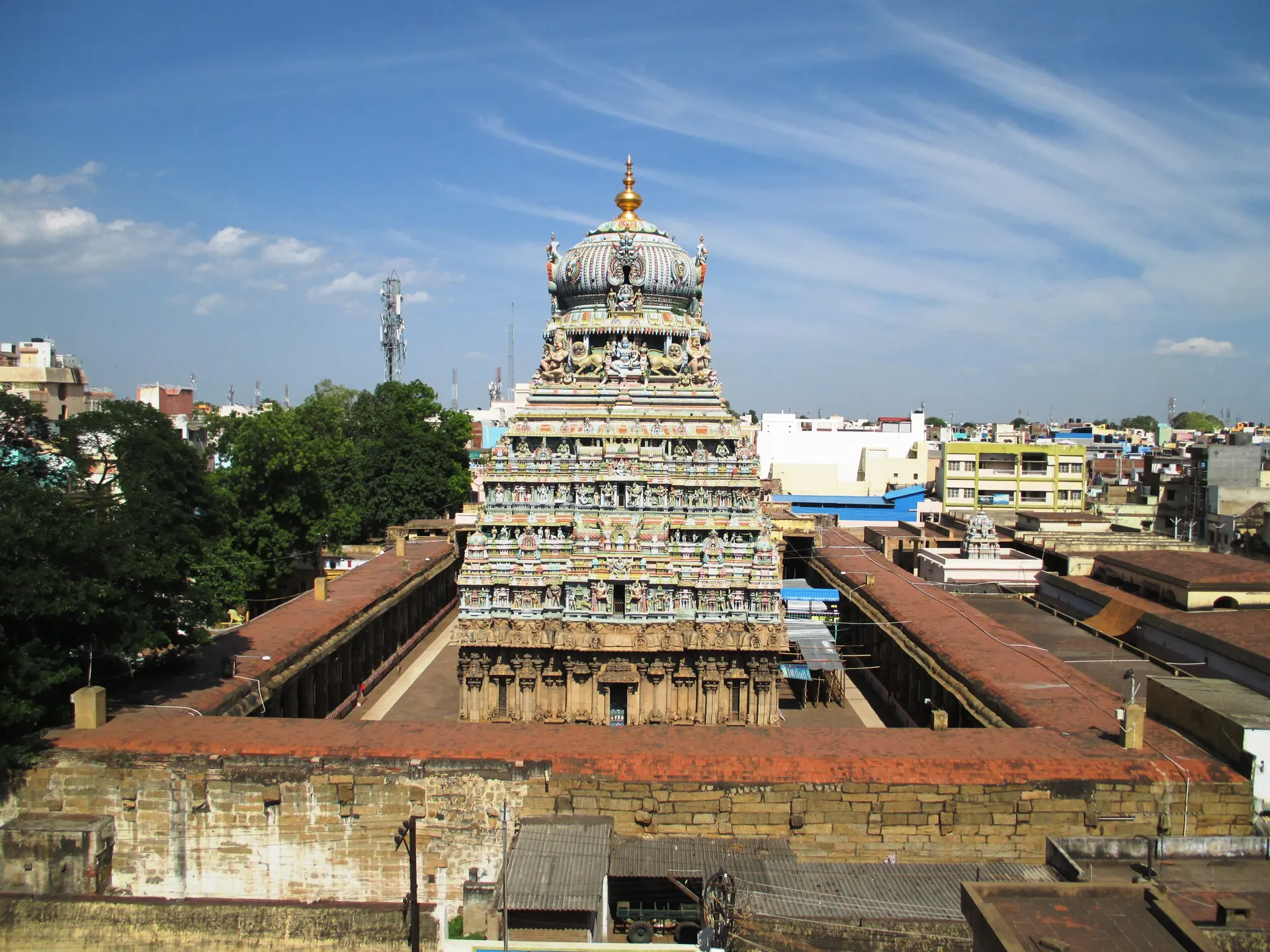
Some temples are built; this one is excavated. At Thiruparankundram, eight kilometers southwest of Madurai, an early Pandya shrine was cut directly into the face of a 1,050-foot granite hill in the sixth century, and the rock itself became the sanctuary. It is the first of the Arupadai Veedu, the six sacred abodes of Murugan, and tradition gives it a particular distinction: this is the wedding ground.
After Murugan defeated the asura Surapadman at Tiruchendur, the devas assembled here to honor him, and Indra gave his daughter Deivanai in marriage. The temple has been auspicious for weddings ever since, and couples still come seeking marital harmony.
The rock-cut sanctum is unusual in another way: it does not enshrine Murugan alone but houses him together with Durga, Vinayaka, Shiva, and Vishnu—the major deities gathered in a single hewn chamber, so that the visitor encounters something closer to the divine whole than a single god.
The hill carries a deep stratigraphy. Tamil-Brahmi rock beds in its natural caverns, dated to around the first century BCE, point to far older ascetic use, possibly by Jain renunciants, beneath the Pandya cave shrine and the later Nayak additions—the seven-tiered rajagopuram and the great pillared mandapams. The hill is also a shared sacred landscape: a dargah honoring the medieval ascetic Sikandar stands upon it, and a Kasi Viswanathar shrine near the summit.
Since late 2024, a dispute between Hindu and Muslim communities over the hill's name, ritual access, and observances has drawn court rulings and heavy police deployment; the matter remains socially unresolved even where courts have ruled on specific practices.
Why this place is sacred
Thiruparankundram concentrates several distinct kinds of sacred intensity. The first is material: the temple is not placed upon the hill but carved into it, so that worship happens inside the living rock. The second is theological: a single sanctum unites Murugan with Shiva, Vishnu, Durga, and Vinayaka, an unusual gathering that some devotional schemes read as the foundational, earth-energy abode at the root of the chakra system.
The third is temporal—the hill descends through deep time, from ancient Tamil-Brahmi cavern beds through the sixth-century Pandya cave shrine to the Nayak-era gopuram. And the fourth is communal: the same hill is sacred to Hindu and Muslim worshippers alike, a layered shared landscape that, in recent years, has also become contested. These strata do not resolve into a single story; they sit together, which is part of what makes the place feel charged.
Experience and orientation
Visitors note the dramatic rock-cut interior, the towering rajagopuram, and the pillared mandapams set at varying elevations up the hill. The integrated sanctum—Murugan flanked by the other great deities—invites a sense of the divine whole rather than a single figure. The marriage-blessing atmosphere is strong; many couples visit seeking marital harmony, drawing on the Deivanai-marriage association. Those who wish can ascend the hill further toward the Kasi Viswanathar shrine.
Because the hill is a shared and currently contested sacred landscape, visitors may encounter heightened security or temporary access changes. The respectful posture is to honor the temple's significance, observe the dargah's separate character, take no side in the dispute, and follow any court-ordered or police-managed conditions on site.
Enter through the seven-tiered rajagopuram to the rock-cut sanctum; remove footwear first. Allow time for the pillared mandapams and, if conditions permit, the climb toward the summit shrine. Be aware that the ongoing hill dispute can mean extra security or temporary access changes; check locally before visiting.
Context and lineage
After defeating the asura Surapadman at Tiruchendur, Murugan came to Thiruparankundram, where the devas assembled to honor him and Indra gave his daughter Deivanai in marriage—making the temple especially auspicious for weddings. The Skanda Purana frames the hill as the divine wedding ground, and the Kanda Puranam recounts Surapadman's boon-won near-immortality, broken only by Shiva's son. Beneath these accounts, the hill's natural caverns with Tamil-Brahmi rock beds point to far older ascetic use, likely Jain, layering the site's sanctity.
Tamil Murugan (Kaumaram) devotion within Hinduism, expressed in early Pandya rock-cut architecture and developed under later Pandya and Nayak patronage, on a hill also bearing Islamic and possibly early Jain devotional layers.
Murugan (Subramanya / Kartikeya)
Presiding deity
Deivanai (Devasena)
Consort
Early Pandya rulers
Builders of the rock-cut core (6th c.)
Nayak rulers (1559–1736)
Later patrons
Sikandar (Sikkandar Badusha)
Medieval ascetic
Traditions and practice
Daily pujas and abhishekam; the Skanda Sashti with its Surasamharam re-enactment; Panguni Uthiram celebrating Murugan's marriage; the fourteen-day annual Brahmotsavam with vahana processions; and Thaipusam.
Wedding ceremonies and marriage-blessing visits are prominent, given the Deivanai-marriage association, with festival processions on multiple mounts. Court-imposed limits apply to certain hill rituals, and the dargah maintains its separate observances.
Given the temple's character as a place of union, a fitting approach is to sit quietly before the integrated sanctum and take in the gathering of deities together rather than seeking one alone—letting the rock-cut chamber's sense of the whole settle before moving on.
Murugan (Kaumaram) worship
ActiveThe first of Murugan's six Arupadai Veedu abodes, where the god is venerated as the bridegroom of Deivanai, Indra's daughter, after his victory over Surapadman. An early Pandya rock-cut temple, expanded by later Pandyas and Nayaks, with a single sanctum uniting Murugan, Durga, Vinayaka, Shiva, and Vishnu.
Daily pujas and abhishekam; weddings and marriage-blessing visits; the Skanda Sashti Surasamharam re-enactment; Panguni Uthiram; and the fourteen-day Brahmotsavam.
Islam (Sikandar Dargah)
ActiveA dargah honoring Sikandar (Sikkandar Badusha), a medieval ascetic, stands on the same hill, making Thiruparankundram a multi-community sacred site.
Muslim prayer, now court-permitted in the Nellithope area; historically associated ritual observances, with animal sacrifice now barred by court order.
Perspectives and open questions
Thiruparankundram is read as a foundational monument of Murugan architecture, as the auspicious first abode and wedding ground, and as a contested shared landscape whose deeper history remains debated.
Scholarly perspective
An early Pandya rock-cut temple (6th c.) on a hill with even older Tamil-Brahmi cavern beds, expanded by later Pandyas and Nayaks; one of the foundational Murugan pilgrimage sites of Tamil Nadu. The exact dating of the earliest cave shrine is debated.
Living and traditional perspectives
Tamil Murugan tradition reveres it as the first Arupadai Veedu abode and the place of the god's marriage to Deivanai, making it deeply auspicious for marriages.
Alternative interpretations
Some devotional schemes associate the six abodes with the chakras, placing Thiruparankundram at the Muladhara (root)—the foundational earth-energy abode.
Open questions
The earliest religious use of the hill (Jain ascetics versus early Murugan worship) and the origins of its multi-community sanctity remain debated; the present dispute over the hill's identity is unresolved socially even where courts have ruled on specific rituals.
Plan your visit
Access and arrival
About 8 km southwest of Madurai, Tamil Nadu, at the foot of a 1,050-foot granite hill; well connected by road from Madurai. Note that the ongoing hill dispute can mean heightened security or temporary access changes—check current conditions before visiting.
Respectful visit
Modest, traditional attire is encouraged (dhoti, saree, salwar kameez); avoid shorts, sleeveless, and revealing clothing.
Customary restrictions apply inside the sanctums; follow posted rules and staff guidance.
Archana and abhishekam; weddings and marriage-related rituals are common.
Footwear removed before entering. Respect the shared, contested nature of the hill and any court-ordered or police-managed access conditions; avoid taking sides in the communal dispute on site.
Footwear is removed before entering. Respect the shared, contested nature of the hill and any court-ordered or police-managed access conditions, and avoid taking sides in the communal dispute on site.
Current practical details
Address
146a, Periya Ratha Veethi, Thiruparankundram, Tamil Nadu 625005, India
Phone
Hours
Hours, fees, and access can change — verify on the official source before you travel. Practical details last checked Jun 2026.
Location
Map loads as you approach this section.
Pilgrim reflections
A portrait of encounter, not a score
Pilgrims describe what they felt, how present they could become, and whether the place would shape a journey. There are no stars and no ranking of traditions.
No reviewed reflections yet
The first pilgrims can help describe the character of being here.
Share a reflection
Available after an account-backed “Been there.” Every reflection is reviewed before publication.
Nearby sacred places
Explore other sacred places in the region. Proximity does not establish access or travel time; check each place’s guidance.
Arulmigu Koodal Azhagar Vishnu temple, Periyar, Madurai, Tamil Nadu
Madurai, Tamil Nadu, India
6.1 km away

Andal Vishnu Temple, Srivilliputhur, Tamil Nadu
Thiruvilliputtur state assembly constituency, Tamil Nadu, India
63.5 km away

Palani Dhandayuthapani Swamy Temple
Palani, Tamil Nadu, India
86.6 km away
Suruli Falls
Theni, Tamil Nadu, India
87.4 km away
References
Sources consulted for this page. Source categories describe the publication, not a guarantee that every claim is verified. Traditional accounts and outside interpretations may differ.
- 01Subramaniya Swamy Temple, Thiruparankundram — Wikipedia — Wikipedia contributorsacademicConfirms first of the six Arupadai Veedu abodes, 6th-c. rock-cut architecture, 150 ft seven-tiered rajagopuram, multi-cell sanctum (Murugan, Durga, Vinayaka, Shiva, Vishnu), 1,050 ft granite hill, location 8 km from Madurai.
- 02Tirupparamkundram Murugan Temple — Arupadai Veedu — Arupadai.orgspiritualDevotional Murugan-tradition source; first-abode status, Deivanai marriage after Surapadman's defeat.
- 03Thiruparankundram Murugan Temple: The Sacred First Abode of Lord Murugan — Karungali MalaiSource contextPandya 6th-c. rock-cut origin, Nayak additions (1559–1736) including rajagopuram and 48-pillar mandapam, 2,200-year-old Tamil-Brahmi inscription on the hill.
- 04Thirupparankundram Temple, Madurai — Timings, Festivals, History — Trawell.inSource contextFestival calendar (Skanda Sashti, Panguni Uthiram, 14-day Brahmotsavam), darshan timings, dress code.
- 05Thiruparankundram temple row explained: The making of an 'Ayodhya of the south'? — The WeekSource contextNews explainer of the 2024–2025 temple–dargah dispute, naming controversy (Sikkandar Malai), and communal tension on the hill.
- 06Thiruparankundram hill verdict: What the court ruled on the Temple vs Dargah dispute — News9 LiveSource contextMadras High Court (Madurai bench) verdict upholding ban on animal sacrifice while allowing Muslim prayer in the Nellithope area.
- 07Thiruparankundram Murugan Temple — Dress Code, Architecture, History — Temple KnowledgeSource contextDress code and architecture details; corroborates timings and festival framing.
Photo gallery
3 curated photos
Share a photo
Help visitors recognize Arulmigu Thiruparankundram Murugan Temple, Tamil Nadu. Every submission is reviewed before publication.