Arulmigu Koodal Azhagar Vishnu temple, Periyar, Madurai, Tamil Nadu
A Madurai Divya Desam where Vishnu is seen seated, standing and reclining all at once
Understand sacred places, explore living traditions, and learn how to engage respectfully with Pilgrim Map.
Access has not been verified. Check current local guidance before planning a visit.
Madurai, Tamil Nadu, India
Read the sources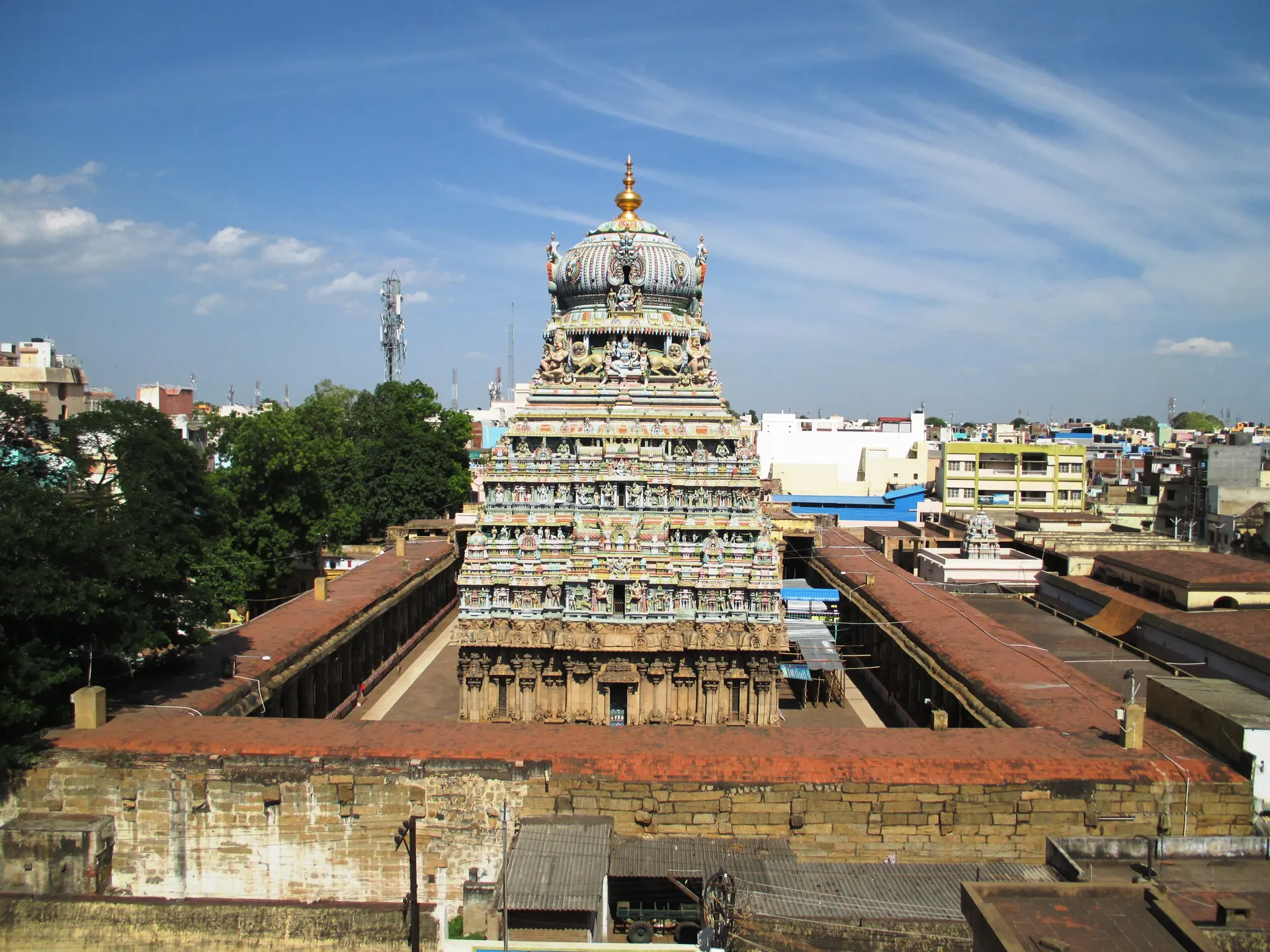
Image of Arulmigu Koodal Azhagar Vishnu temple, Periyar, Madurai, Tamil Nadu. Image source · CC-BY-SA-4.0
Visit essentials
A quick read before you go
- Duration
- 45–90 minutes.
- Access
- Central Madurai, within about a kilometre of the Meenakshi Amman Temple; easily reached on foot…
Overview
Near Meenakshi Amman Temple in central Madurai, Koodal Azhagar takes an old city name, Koodal, and the title 'beautiful one.' One of the 108 Divya Desams praised in the Nalayira Divya Prabandham, it reaches into Sangam-era Tamil literature, though firm construction evidence begins with later inscriptions. Its octagonal Ashtanga Vimana, traditionally attributed to divine architect Vishvakarma, presents Vishnu as Koodal Azhagar or Viyooga Sundararajan seated, standing, and reclining—the waking, dreaming, and deep-sleep states.
Devotees also recount that the vimana's shadow never touches the ground. Tradition says Vishnu slew Somuka here, recovering the four stolen Vedas, and appeared on Garuda to bless Vishnuchitha, or Periyalvar. Praised by three Alvars, this living festival temple remains markedly more contemplative than one of India's busiest shrines nearby.
Why this place is sacred
The thinness of Koodal Azhagar gathers around its rare triple darshan. To behold Vishnu seated, standing and reclining together invites reflection on the three states of consciousness — waking, dreaming and deep sleep — and on the soul's relationship to the divine. The octagonal Ashtanga Vimana, whose shadow is said never to touch the ground, deepens the sense of a place set apart, and the temple's Sangam-era literary roots give it an antiquity felt rather than seen.
Close to the thronged Meenakshi Temple yet markedly quieter, it offers a contemplative stillness in the heart of a busy city.
A Vaishnava temple enshrining Vishnu as Koodal Azhagar in all three postures beneath the octagonal Ashtanga Vimana, sung as one of the 108 Divya Desams.
With origins traced in Sangam literature and firm epigraphy from the 8th century, the temple was largely built by the Pandyas, with later pillared halls and shrines added by the Vijayanagara rulers and the Madurai Nayakas. It remains a living Divya Desam with a full festival calendar.
Experience and orientation
Visitors note the towering five-tiered gopuram, and then the rare darshan within: Vishnu shown seated, standing and reclining together beneath the octagonal Ashtanga Vimana. The atmosphere is markedly quieter and more contemplative than the nearby Meenakshi Temple, only about a kilometre away. Beholding the three forms at once invites reflection on the waking, dreaming and deep-sleep states of consciousness and on the soul's relationship to the divine.
Festival days — Brahmotsavam, the Float Festival and Vaikunta Ekadasi — bring processions and larger crowds, but on ordinary days the temple rewards an unhurried visit.
The temple is in central Madurai, within about a kilometre of the Meenakshi Amman Temple, easily reached on foot or by auto-rickshaw. Observe the dress code and remove footwear; sanctum access may be limited for non-Hindus. Photography requires a camera fee and is not permitted in the main sanctum. Visit 5:30 AM–12 PM or 4–9 PM.
Context and lineage
Vishnu is believed to have appeared as Koodal Azhagar to slay the demon Somuka, who had stolen the four Vedas, restoring them to creation. The Alvar saint Vishnuchitha (Periyalvar) was summoned to Madurai to expound the supremacy of Narayana, and Koodal Azhagar himself is said to have appeared in procession on Garuda to bless him. The temple's origins are traced in Sangam literature (c.
300 BCE–300 CE), but firm construction evidence begins only with later inscriptions, the earliest cited from the 8th century CE.
Sri Vaishnava Hinduism, rooted in the Alvar bhakti tradition and the Nalayira Divya Prabandham, with Pandya, Vijayanagara and Madurai Nayaka patronage.
Koodal Azhagar (Viyooga Sundararajan)
Enshrined deity
Periyalvar (Vishnuchitha)
Alvar saint
Vishvakarma
Divine architect of tradition
Pandya, Vijayanagara and Nayaka kings
Builders and patrons
Traditions and practice
Daily poojas and abhishekam; Brahmotsavam (February–March), the Float Festival (January–February) and Vaikunta Ekadasi (December–January) as the principal festivals.
Free and special (paid) darshan lines, festival processions, and ongoing daily worship.
Take the time to dwell on the triple darshan rather than passing through quickly — the three postures are an invitation to reflect on the states of consciousness. Pairing the visit with the nearby Meenakshi Temple lets the contrast in atmosphere become part of the experience.
Sri Vaishnava Hinduism
ActiveOne of the 108 Divya Desams, uniquely presenting Vishnu (Koodal Azhagar / Viyooga Sundararajan) in all three postures — seated, standing and reclining — within the octagonal Ashtanga Vimana, and revered in the Nalayira Divya Prabandham by Periyalvar, Thirumalisai Alvar and Thirumangai Alvar.
Daily darshan and poojas; Brahmotsavam, Float Festival and Vaikunta Ekadasi celebrations.
Perspectives and open questions
Koodal Azhagar is read both as a documented Dravidian temple with deep literary roots and as a sacred abode where Vishnu shows all three postures.
Scholarly perspective
A Dravidian Vaishnava Divya Desam with deep literary roots in Sangam poetry and epigraphy from at least the 8th century, expanded by the Pandyas, Vijayanagara rulers and Madurai Nayakas; the octagonal Ashtanga Vimana is a notable and comparatively rare architectural type.
Living and traditional perspectives
For Sri Vaishnavas it is a sacred Madurai abode of Vishnu praised by three Alvars, where the Lord appears in all three postures and once vanquished the demon Somuka to recover the Vedas.
Alternative interpretations
The three postures of the deity are interpreted as the three states of consciousness — waking, dreaming and deep sleep; the vimana's shadow 'never touching the ground' is held as a marvel.
Open questions
The precise founding date remains unknown, with tradition reaching back to the Sangam age but hard evidence beginning only centuries later.
Plan your visit
Access and arrival
Central Madurai, within about a kilometre of the Meenakshi Amman Temple; easily reached on foot or by auto-rickshaw from the city centre.
Madurai offers a wide range of hotels and lodges, many within walking distance of the temple precinct.
Respectful visit
Traditional attire: dhoti with upper cloth for men, saree or salwar-kameez for women; western or revealing clothing is not permitted.
Camera fee required (still around INR 50, video higher); not permitted in the main sanctum.
Flowers, fruits and devotional items.
Footwear removed; sanctum access may be limited for non-Hindus.
Photography requires a camera fee and is restricted in the sanctum; sanctum access may be limited for non-Hindus.
Current practical details
Address
Koodal Alagar Perumal Koil Street, Pallivasal Ln, near Periyar Bus Stand Road, Periyar, Madurai Main, Madurai, Tamil Nadu 625001, India
Phone
Hours
Hours, fees, and access can change — verify on the official source before you travel. Practical details last checked Jun 2026.
Location
Map loads as you approach this section.
Pilgrim reflections
A portrait of encounter, not a score
Pilgrims describe what they felt, how present they could become, and whether the place would shape a journey. There are no stars and no ranking of traditions.
No reviewed reflections yet
The first pilgrims can help describe the character of being here.
Share a reflection
Available after an account-backed “Been there.” Every reflection is reviewed before publication.
Nearby sacred places
Explore other sacred places in the region. Proximity does not establish access or travel time; check each place’s guidance.

Arulmigu Thiruparankundram Murugan Temple, Tamil Nadu
Madurai, Tamil Nadu, India
6.1 km away

Andal Vishnu Temple, Srivilliputhur, Tamil Nadu
Thiruvilliputtur state assembly constituency, Tamil Nadu, India
69.6 km away

Palani Dhandayuthapani Swamy Temple
Palani, Tamil Nadu, India
87.3 km away
Suruli Falls
Theni, Tamil Nadu, India
93.0 km away
References
Sources consulted for this page. Source categories describe the publication, not a guarantee that every claim is verified. Traditional accounts and outside interpretations may differ.
- 01Koodal Azhagar Temple — Wikipedia — Wikipedia contributorsSource contextDivya Desam status, deity Viyooga Sundararajan / Mathuravalli, three postures, Ashtanga Vimana, Sangam references, Pandya/Vijayanagara/Nayaka building phases, 8th-c. inscription, 125 ft gopuram.
- 02Koodal Azhagar Temple — Madurai — Tamil Nadu Tourism — Tamil Nadu Tourism DepartmentofficialState tourism listing; Vishnu temple in central Madurai, Sangam-era roots.
- 03Koodal Azhagar, Madurai — TN Temples Project — TN Temples ProjectacademicDocumentation project with epigraphic/architectural detail.
- 04Koodal Azhagar Temple in Madurai (Entry Fee, Timings, Entry Ticket Cost) — Madurai TourismSource contextTimings 5:30 AM-12 PM and 4-9 PM, festivals (Brahmotsavam, Float Festival, Vaikunta Ekadasi), dress code, camera fees.
- 05Koodal Azhagar Temple in Madurai — History, Architecture, Legend & Benefits — AstroVedSource contextSomuka demon legend, Vishnuchitha (Periyalvar) episode, three-posture significance.
- 06Koodal Azhagar Temple Madurai — A Divine Exploration Guide — Poojn.inSource contextAshtanga Vimana, three states of consciousness symbolism, visitor notes (epistemic markers).
Photo gallery
3 curated photos
Share a photo
Help visitors recognize Arulmigu Koodal Azhagar Vishnu temple, Periyar, Madurai, Tamil Nadu. Every submission is reviewed before publication.