Andal Vishnu Temple, Srivilliputhur, Tamil Nadu
Birthplace of Andal, the only woman among the Alvar saints, and source of the Tiruppavai
Understand sacred places, explore living traditions, and learn how to engage respectfully with Pilgrim Map.
Access has not been verified. Check current local guidance before planning a visit.
Thiruvilliputtur state assembly constituency, Tamil Nadu, India
Read the sources
Visit essentials
A quick read before you go
- Duration
- 1–2 hours; longer during festivals.
- Access
- Srivilliputhur town, Virudhunagar district, about 80 km from Madurai; reachable by road and…
Overview
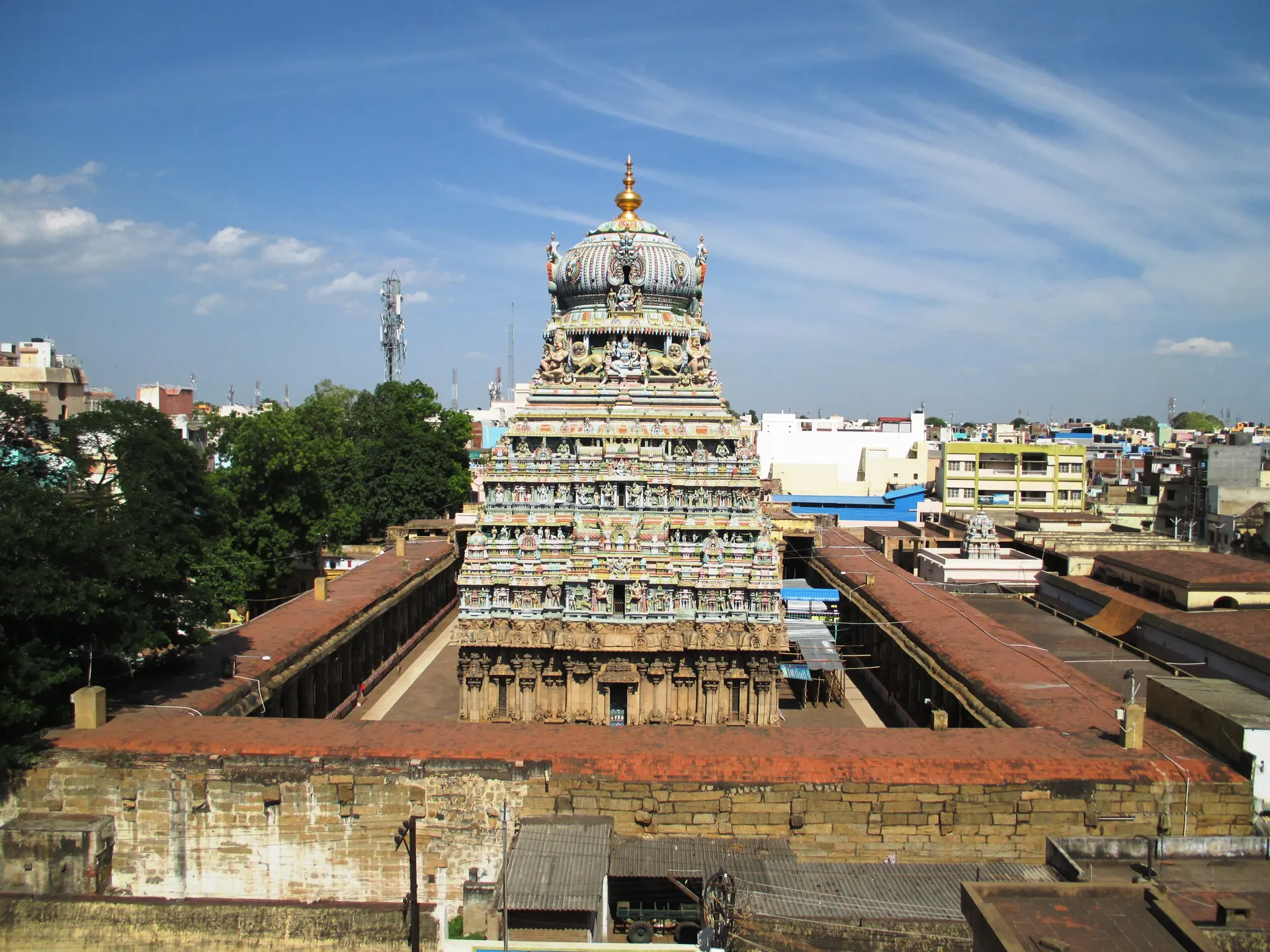
Srivilliputhur rises around one of the great gateways of southern India: a 192-foot Rajagopuram so iconic that it serves as the official emblem of Tamil Nadu. Beneath it lies one of the 108 Divya Desams, the sacred abodes of Vishnu sung in the Tamil canon — but its deepest claim is a human one. This is the birthplace of two of the twelve Alvar saints, and uniquely the home of the only woman among them, Andal.
The story is woven into the temple's life. Periyalvar, a garland-maker for Vishnu, is said to have found an infant girl beneath a tulasi plant in the temple garden and raised her as his daughter.
That girl, Andal, grew into a poet-saint whose longing for Vishnu was so complete that, as a girl, she would secretly wear the flower garlands meant for the deity before they were offered — and whose devotion culminated, by tradition, in her merging with Ranganatha at Srirangam. Here she composed the Tiruppavai, a cycle of thirty verses that remains one of the foundational poems of Tamil Vaishnava bhakti.
The temple holds twin shrines — Andal alongside Vatapatrasayi, the reclining form of Vishnu. Its devotional rhythm peaks in the Tamil month of Margazhi, when the Tiruppavai is recited daily and pilgrims pass through the Paramapada Vaasal, the gateway to heaven, and again at Aadi Pooram, Andal's birthday. Each year a garland is dispatched from here to Tirumala and to Madurai's Chitra festival — a thread of flowers linking the saint's town to the wider sacred geography of the south.
Why this place is sacred
The thinness of Srivilliputhur is bound to a single life. As the only birthplace shared by two Alvars — Periyalvar and Andal — and the place where Andal composed the Tiruppavai, it is a foundational site of Tamil Vaishnava bhakti. Andal's bridal-mysticism, her longing for and ultimate union with Vishnu, gives the town a charge that visitors feel most intensely during Margazhi, when her verses are recited daily and the Paramapada Vaasal is opened.
The towering Rajagopuram, the twin shrines, and the living recitation of poetry written here turn the place into something closer to a presence than a monument.
A Vaishnava temple enshrining Vishnu as Vatapatrasayi and the goddess-saint Andal, sung as one of the 108 Divya Desams and venerated as the birthplace of Andal and Periyalvar.
The Vatapatrasayi shrine is traditionally dated to the 8th century, with secure epigraphic evidence from the 10th; the monumental Rajagopuram is variously placed in the 14th century or later under the Vijayanagara and Nayaka rulers. Major renovation came under Thirumalai Nayak and Rani Mangammal. It remains a major living Divya Desam with a full festival calendar.
Experience and orientation
Most arrivals are struck first by the Rajagopuram — at 192 feet, it dominates the sacred town and is the emblem of the state. Within, the twin shrines of Andal and Vatapatrasayi anchor the worship, and the atmosphere intensifies during Margazhi and Aadi Pooram, when the town fills with pilgrims.
To recite or simply hear the Tiruppavai at the very place Andal composed it, and to pass through the Paramapada Vaasal — the gateway to heaven opened in Margazhi — gives many a powerful sense of bhakti and surrender. The garland, central to Andal's own story, remains the characteristic offering, and processions in decorated palanquins and the temple car mark the festival days.
The temple stands in Srivilliputhur town in Virudhunagar district. Observe the strict dress code, remove footwear, and follow temple staff regarding sanctum access — non-Hindus may view the complex but may be restricted from the inner sanctum. Early morning (5–8 AM) offers the most peaceful darshan; Margazhi and Aadi Pooram are the most charged times.
Context and lineage
Periyalvar (Vishnuchittar), a garland-maker for Vishnu, is said to have found the infant Andal beneath a tulasi plant in the temple garden and raised her as his daughter. As a girl, Andal would wear the flower garlands meant for the deity before they were offered, and her longing for union with Vishnu culminated, by tradition, in her merging with Ranganatha at Srirangam. Here she composed the Tiruppavai and the Nachiar Tirumoli.
The early Vatapatrasayi shrine is claimed from the 8th century, though secure epigraphic evidence dates only from the 10th century CE.
Sri Vaishnava Hinduism, rooted in the Alvar bhakti tradition (6th–9th c.) and the Nalayira Divya Prabandham, with later Nayaka and Madurai royal patronage.
Andal
Poet-saint, the only female Alvar
Periyalvar (Vishnuchittar)
Alvar saint, Andal's foster father
Thirumalai Nayak
Madurai Nayaka king (1623–1659)
Rani Mangammal
Nayaka regent (1689–1706)
Traditions and practice
Vishwaroopa Seva at dawn; Thirumanjanam (sacred bath) and silk-and-jewel decoration of Andal and Rangamannar; daily Tiruppavai recitation through Margazhi culminating on the 30th day; and the annual dispatch of Andal's garland to Tirumala (Garuda Utsavam) and to Madurai's Chitra festival.
Daily darshan, festival processions in decorated palanquins and the temple car, and garland and silk offerings continue.
If you can, come during Margazhi to hear the Tiruppavai recited where it was written, and to pass through the Paramapada Vaasal. Offering a flower garland — the gesture at the heart of Andal's own story — is a fitting way to participate. Early morning gives the quietest darshan.
Sri Vaishnava Hinduism
ActiveOne of the 108 Divya Desams, uniquely the birthplace of two of the twelve Alvars — Periyalvar and the only female Alvar, Andal — and the source of the Tiruppavai and Nachiar Tirumoli devotional poems.
Daily darshan, Vishwaroopa Seva, Margazhi-month daily Tiruppavai recitation, Aadi Pooram festival, and garland offerings.
Perspectives and open questions
Srivilliputhur is read both as a well-documented Dravidian temple and as the living sacred birthplace of Andal and the Tiruppavai.
Scholarly perspective
A Dravidian-style Vaishnava Divya Desam with secure 10th-century epigraphy and major later (Vijayanagara/Nayaka) expansion; the twin Andal and Vatapatrasayi shrines and the monumental Rajagopuram are well documented in Tamil temple architecture studies.
Living and traditional perspectives
For Sri Vaishnavas the site is the sacred birthplace of Andal and Periyalvar, the home of the Tiruppavai, and the source of the garlands that ritually bind Srivilliputhur to Tirumala and Madurai.
Alternative interpretations
Andal's bridal-mysticism — her longing for and ultimate merging with Vishnu — is read as an allegory of the soul's union with the divine.
Open questions
The precise construction sequence of the early Vatapatrasayi shrine and of the Rajagopuram remains debated among historians, with the gateway variously dated to the 14th century or later.
Plan your visit
Access and arrival
Srivilliputhur town, Virudhunagar district, about 80 km from Madurai; reachable by road and rail.
Basic lodges serve pilgrims in Srivilliputhur town, with a fuller range of hotels in Madurai within day-trip distance.
Respectful visit
Traditional attire: dhoti/veshti for men, saree or salwar-kameez with dupatta for women; shorts, mini-skirts, sleeveless and short tops are not permitted.
Generally restricted inside the sanctum; follow temple staff instructions.
Flower garlands (central to Andal's story), silk, and devotional items.
Footwear removed; sanctum access may be limited for non-Hindus.
The dress code is strict and enforced; sanctum access may be limited for non-Hindus. Festival days are crowded — plan time accordingly.
Current practical details
Address
GJ5J+889, Mada St, Mangapuram, Srivilliputhur, Tamil Nadu 626125, India
Phone
Hours
Hours, fees, and access can change — verify on the official source before you travel. Practical details last checked Jun 2026.
Location
Map loads as you approach this section.
Pilgrim reflections
A portrait of encounter, not a score
Pilgrims describe what they felt, how present they could become, and whether the place would shape a journey. There are no stars and no ranking of traditions.
No reviewed reflections yet
The first pilgrims can help describe the character of being here.
Share a reflection
Available after an account-backed “Been there.” Every reflection is reviewed before publication.
Nearby sacred places
Explore other sacred places in the region. Proximity does not establish access or travel time; check each place’s guidance.

Suruli Falls
Theni, Tamil Nadu, India
39.2 km away

Arulmigu Thiruparankundram Murugan Temple, Tamil Nadu
Madurai, Tamil Nadu, India
63.5 km away
Arulmigu Koodal Azhagar Vishnu temple, Periyar, Madurai, Tamil Nadu
Madurai, Tamil Nadu, India
69.6 km away
Achankovil Sastha Temple
Achankovil, Kerala, India
72.6 km away
References
Sources consulted for this page. Source categories describe the publication, not a guarantee that every claim is verified. Traditional accounts and outside interpretations may differ.
- 01Srivilliputhur Andal Temple — Wikipedia — Wikipedia contributorsSource contextConfirms Divya Desam status, Vatapatrasayi + Andal deities, birthplace of Periyalvar and Andal, 192 ft Rajagopuram as Tamil Nadu state emblem, Tiruppavai/Nachiar Tirumoli authorship.
- 02Srivilliputtur Andal Temple - A Divine Oasis — Incredible India — Ministry of Tourism, Government of IndiaofficialOfficial tourism portal; Dravidian architecture, Andal/Vatapatrasayi divisions, 80 km from Madurai.
- 03Srivilliputhur Andal Temple, Virudhunagar — Tamil Nadu Tourism — Tamil Nadu Tourism DepartmentofficialState tourism listing; history, festivals, darshan guidance.
- 04Aadi Pooram Festival in Srivilliputhur Andal Temple — HinduPad — HinduPadspiritualAadi Pooram (Andal's birthday) rituals, Thirumanjanam, palanquin procession.
- 05Srivilliputhur Andal Temple — 108 Divya Desam — TemplefolksSource contextDivya Desam context, Vatapatrasayi as reclining Vishnu, Andal as Bhudevi incarnation.
- 06Srivilliputhur Andal Temple, Madurai — Timings, Festivals, History, Darshan — Trawell.inSource contextDarshan timings 6 AM-12 PM and 4-8:30 PM, Vishwaroopa Seva, festival calendar.
- 07Srivilliputhur Andal Temple: Your Guide to Darshan, Festivals, and Accommodation — Poojn.inSource contextDress code, non-Hindu access to complex but not sanctum, practical visitor notes (epistemic markers).
Photo gallery
3 curated photos
Share a photo
Help visitors recognize Andal Vishnu Temple, Srivilliputhur, Tamil Nadu. Every submission is reviewed before publication.