Archbishop's Palace, Charing
A ruined archbishop's palace disguised for centuries as a Kentish barn
Understand sacred places, explore living traditions, and learn how to engage respectfully with Pilgrim Map.
Access has not been verified. Check current local guidance before planning a visit.
Charing, England, United Kingdom
Read the sources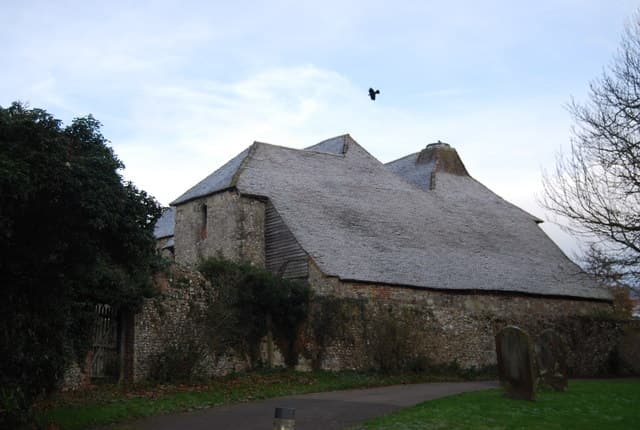
Image of Archbishop's Palace, Charing. Image source
Visit essentials
A quick read before you go
- Duration
- A brief stop of perhaps 15–30 minutes as part of a Pilgrims' Way walk; there is no interior…
- Access
- The palace stands in Charing village, Kent, immediately beside the Pilgrims' Way / North Downs…
Overview
From the road, the Archbishop’s Palace at Charing resembles a working farm barn until its medieval Great Hall emerges. For roughly three centuries after the Reformation, the Archbishops of Canterbury’s timber roof and stone walls sheltered livestock and hay; agricultural usefulness inadvertently preserved them. Earlier, Charing was one of the archbishops’ diocesan manors and, directly on the Pilgrims’ Way, the last substantial stop before Canterbury.
Thomas Becket stayed here; Henry VIII and Catherine of Aragon passed through in 1520 toward the Field of the Cloth of Gold. Crown seizure in 1545 ended ecclesiastical life. Now a fragile scheduled monument and Grade I listed structure, it suffered partial collapse of the Great Hall’s north wall in 1996 and entered Historic England’s Heritage at Risk Register in the most urgent category. The Spitalfields Trust assumed custodianship in 2023 and began ongoing structural repairs.
Why this place is sacred
There is no cult of veneration attached to Charing, and the research locates no relic, well, or apparition tradition here. What the site offers instead is a different, more structural kind of significance: it was infrastructure for sanctity elsewhere.
Every archbishop who slept here was en route to or from the seat of his office in Canterbury; every pilgrim who broke their journey here did so because the final stretch to Becket's shrine deserved to be walked fresh, in daylight, without the fatigue of the road still in the legs.
The more recent layer of meaning is almost the inverse of the medieval one. Where the palace once mattered because of where it stood in a network of ecclesiastical power, it now matters because of how nearly it was lost without anyone noticing what it was.
A structure built to receive archbishops spent longer as a cattle shed than it ever spent as a palace, and the sense of incongruity that visitors report — the discovery that this barn wall is in fact a Grade I medieval hall — is now part of the site's character as much as any pilgrim history.
A residence and administrative stopping point for the Archbishops of Canterbury travelling between Canterbury and Lambeth Palace, and, by virtue of its position on the Pilgrims' Way, the customary last overnight halt for pilgrims before completing their journey to Becket's shrine.
From archiepiscopal palace (medieval period, rebuilt substantially under Archbishop John Morton) to Crown property after the 1545 seizure, to farm outbuilding for roughly three centuries, to scheduled monument recognised in 1952, to a structurally endangered ruin by the 1990s, to an active conservation project under the Spitalfields Trust since 2023.
Experience and orientation
Walkers on the Pilgrims' Way / North Downs Way reach Charing Palace almost incidentally, the footpath running close by the boundary of what looks, from a distance, like an ordinary cluster of farm buildings on the edge of the village. That first impression is the point: nothing announces a former archbishop's residence.
The barn roofline, the scale of the door openings, and the surviving stone fabric of the Great Hall only resolve into something more significant once attention is paid — a gatehouse arch here, a lancet window there, proportions too generous for agricultural use.
At present the interior is not open to casual visitors; the palace remains under repair, and its Heritage at Risk status means safe access is limited to what can be seen from the footpath and village lane. Visitors describe the experience less as touring a monument and more as witnessing a rescue in progress — scaffolding, new roof timbers, and the visible evidence of the Spitalfields Trust's ongoing structural work sit alongside genuinely medieval walls.
The adjacent parish church of St Peter and St Paul offers a quieter, fully accessible counterpoint for anyone wanting to sit with the site's history without navigating an active building project.
The palace sits directly beside the Pilgrims' Way / North Downs Way footpath at the edge of Charing village, Kent. There is no visitor centre or marked entrance for the general public; the practical approach is on foot along the long-distance path or via the village itself, viewing the exterior from public rights of way.
Context and lineage
Kenulph's grant of land at Charing to Christ Church Priory, Canterbury, in AD 788 began the site's long association with the see of Canterbury. The core of the surviving palace dates to the late thirteenth century, with the most substantial rebuilding carried out under Archbishop John Morton in the closing years of the fifteenth century — the work that produced the Great Hall whose timber roof still stands.
Thomas Becket is recorded as having stayed at Charing, and Henry VIII and Catherine of Aragon lodged there in 1520 on their journey to the Field of the Cloth of Gold, corroborated independently by accounts of that Anglo-French summit.
The palace's ecclesiastical life ended abruptly in 1545, when the Crown seized it following the Dissolution; it passed into private and agricultural use soon after, and the exact sequence of owners between the Crown seizure and later tenancies by families such as the Honywoods and Whelers is only partially documented in accessible sources.
Land grant to Christ Church Priory (AD 788) → late-13th-century core structure → major rebuilding under Archbishop John Morton (late 15th century) → royal visit of Henry VIII and Catherine of Aragon (1520) → Crown seizure (1545) → conversion to farm use → scheduling as ancient monument and Grade I listing (1952) → partial collapse of the Great Hall's north wall (1996) → Spitalfields Trust custodianship and structural repair (2023–present).
Kenulph
Donor
Archbishop John Morton
Rebuilder
Thomas Becket
Recorded resident
Henry VIII and Catherine of Aragon
Royal visitors
The Spitalfields Trust
Modern custodian
Traditions and practice
In its working life, the palace's central practice was hospitality of a specifically archiepiscopal kind: sheltering the archbishop's household during its seasonal movements between Canterbury and Lambeth, and, for those travelling the Pilgrims' Way, offering the last substantial lodging before completing the journey to Becket's shrine the following day.
The only regular activity at the site today is conservation work — roof timber repair, wall stabilisation, and archaeological recording carried out by the Spitalfields Trust with Historic England, SPAB, and the Historic Houses Foundation. There is no ongoing devotional or ceremonial practice attached to the ruin itself.
Approach on foot along the Pilgrims' Way rather than by car, and take the time before arriving to notice how the path narrows the world down to hedgerow and sky in the way it must have for medieval travellers on the same final stretch toward Canterbury.
At the palace boundary, look for the disproportion between a farm building's usual modesty and this one's height and window openings — that mismatch is the clearest way to feel the hall's original purpose without stepping inside it. If the adjacent parish church is open, sit there afterward; it offers the stillness the palace itself, mid-repair, cannot yet provide.
Medieval English Christianity (Pilgrimage to Canterbury)
HistoricalCharing was one of a string of palaces belonging to the Archbishops of Canterbury and, sitting on the Pilgrims' Way, functioned as the last major stopping point before pilgrims completed their journey into Canterbury to venerate the shrine of Thomas Becket.
Overnight lodging for travellers and pilgrims en route to Canterbury Cathedral; archiepiscopal household stays during travel between Canterbury and London.
Heritage conservation and archaeological stewardship
ActiveSince the Spitalfields Trust took on custodianship in 2023, Charing Palace has become an active conservation project, with Historic England, SPAB, and the Historic Houses Foundation supporting structural repair of a Great Hall that had reached Priority Category A on the Heritage at Risk Register.
Roof timber and wall repair, archaeological recording, and the gradual reopening of the site's history to public understanding through the Charing Palace Project.
Perspectives and open questions
Charing Palace is read primarily through architectural-historical and heritage-conservation lenses, with its pilgrimage-road role adding a further, more circumstantial layer of significance.
Scholarly perspective
Historic England and architectural historians regard Charing as one of the most significant surviving examples of a medieval archiepiscopal palace precisely because of what survived by accident: a largely intact Great Hall roof structure, preserved not through deliberate conservation but through centuries of undemanding agricultural reuse. Its documented role in the itinerant lifestyle of the Archbishops of Canterbury — one stop among several manors used on journeys between Canterbury and Lambeth — is well attested in the historical record.
Living and traditional perspectives
Within the framework of the Becket pilgrimage tradition, Charing is remembered as the last resting point before the shrine — a place where the anticipation of arrival at Canterbury the following day would have shaped the character of an overnight stay differently from any other stop on the route.
Open questions
The exact scale and internal arrangement of the palace at the height of its medieval use, before Dissolution-era stripping of fixtures, cannot be fully reconstructed from what survives; nor is there primary-source documentation of individual named pilgrims recorded staying overnight — the stopover role is attested as a general historical pattern by historians and heritage bodies rather than by surviving pilgrim diaries.
Plan your visit
Access and arrival
The palace stands in Charing village, Kent, immediately beside the Pilgrims' Way / North Downs Way footpath. It is privately owned, with no general public admission to the ruin itself at time of writing. No mobile phone signal information specific to the site was available in research; Charing village itself has ordinary rural mobile coverage, and the palace boundary is a short walk from the village centre, which has shops and services.
For current access arrangements, open days, or volunteering with the restoration, contact the Spitalfields Trust or the Charing Palace Project directly.
No accommodation exists at the palace itself. Charing village offers ordinary rural amenities for Pilgrims' Way walkers; Canterbury, a short final day's walk away, has the fuller range of pilgrim accommodation.
Respectful visit
No specific attire required; ordinary walking clothing suitable for the Pilgrims' Way is appropriate.
No specific restriction has been identified. Photography of the exterior from the footpath or village lane is the accepted practice, given the site's private ownership.
The ruin's Heritage at Risk (Priority Category A) status means the interior is not safe for casual access; respect any fencing or signage and view only from public paths. As a privately owned site under the Spitalfields Trust's custodianship, deference to that ownership and to the active conservation work is expected.
The palace interior is not generally open to the public and its Heritage at Risk status (Priority Category A) means unauthorised entry to the ruin is genuinely dangerous, not merely discouraged. Treat all viewing as exterior and from public rights of way.
Location
Map loads as you approach this section.
Pilgrim reflections
A portrait of encounter, not a score
Pilgrims describe what they felt, how present they could become, and whether the place would shape a journey. There are no stars and no ranking of traditions.
No reviewed reflections yet
The first pilgrims can help describe the character of being here.
Share a reflection
Available after an account-backed “Been there.” Every reflection is reviewed before publication.
Nearby sacred places
Explore other sacred places in the region. Proximity does not establish access or travel time; check each place’s guidance.


References
Sources consulted for this page. Source categories describe the publication, not a guarantee that every claim is verified. Traditional accounts and outside interpretations may differ.
- 01Archbishop's Palace, Charing — Wikipedia — Wikipedia contributorsacademicCore facts: 8th-century origin, late-13th-century core structure, John Morton's late-15th-century rebuilding, Dunstan and Becket associations, 1545 Crown seizure, farm conversion, 1952 scheduling and Grade I listing, Henry VIII/Catherine of Aragon 1520 visit.
- 02The archbishop's palace, Charing — List Entry 1011028 — Historic EnglandofficialOfficial statutory listing record confirming scheduled monument / Grade I status (page returned 403 on direct fetch but title and listing existence confirmed via search results).
- 03Charing Palace: Historic England Grant Helps Save Exceptional Medieval Hall in Kent — Historic EnglandofficialConfirms Heritage at Risk Register Priority Category A status, 1996 partial collapse of the Great Hall's north elevation, and recent structural repair grant funded with SPAB, Historic Houses Foundation and The Pilgrims Trust.
- 04Field of the Cloth of Gold — Wikipedia — Wikipedia contributorsacademicCorroborates the 1520 Henry VIII / Catherine of Aragon journey through Kent en route to the Anglo-French summit.
- 05The Archbishop's Palace, Charing — The Spitalfields TrustSource contextCurrent custodian organisation (took on the site in 2023); details ongoing conservation project and near-total dereliction prior to intervention.
- 06At The Archbishops' Palace In Charing — Spitalfields LifeSource contextFirst-person account and photography of the site's current ruined/restored state, 2025.
- 07Charing Palace: A Palace Hidden in a Barn — Country Houses FoundationSource contextNarrative history of the palace-to-barn conversion after the Dissolution and its rediscovery as a heritage asset.
- 08Charing Bishop's Palace — Great Barns (greatbarns.org.uk)Source contextSpecialist historic-barns resource confirming the Great Hall's post-Dissolution use as a farm barn and describing its medieval fabric.
- 09Charing Palace Project — Charing Palace Project / Spitalfields TrustofficialProject site for the ongoing restoration; timeline of works to Great Hall, lodgings, and stables.
- 10Charing and the Pilgrims' Way — AA RatedTrips.comSource contextStates Charing was the last stopping-off point before Canterbury on the Pilgrims' Way and that pilgrims of all classes would break their journey there before the final leg.
Share a photo
Help visitors recognize Archbishop's Palace, Charing. Every submission is reviewed before publication.