St Peter & St Paul's Church, Charing
The last waypoint before Canterbury — where pilgrims rested within a day's walk of Becket's shrine
Understand sacred places, explore living traditions, and learn how to engage respectfully with Pilgrim Map.
Access has not been verified. Check current local guidance before planning a visit.
Charing, England, United Kingdom
Read the sources
Visit essentials
A quick read before you go
- Duration
- Allow 30 to 60 minutes for the church interior and a walk through the adjacent Archbishop's…
- Access
- The church is at the end of The Market Place, off the High Street, Charing, Kent, TN27 0LP.
Overview
At Charing, the North Downs escarpment that shaped the route from Winchester relents and land opens east toward Canterbury. Medieval pilgrims knew one day's walk remained: the village was a threshold.
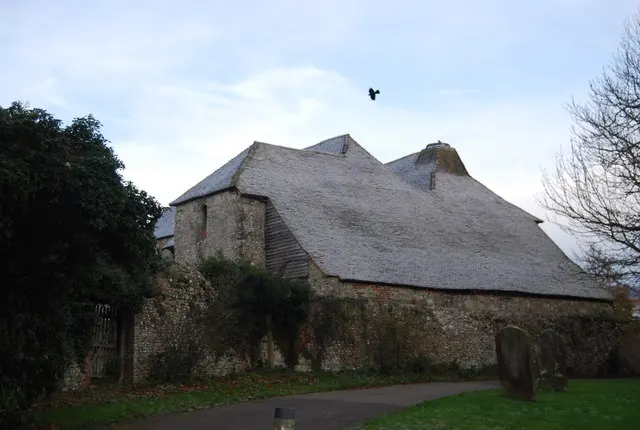
Saints Peter and Paul stands at the Market Place's end, its 15th-century flint tower above the high street. Beside it are substantial ruins of the Archbishop's Palace, a residence documented since the 8th century, favored by Archbishop Dunstan and visited by Thomas Becket. Together they made Canterbury's authority physically present on the pilgrim road.
According to 18th-century antiquarian Edward Hasted, the church kept as an object of veneration a stone said to be St John the Baptist's beheading block, brought to England during Richard II's reign; it vanished at the Reformation. Surviving fabric includes a 13th-century nave and chancel, 14th-century transepts, post-fire roof timbers from the 1590s, a 17th-century pulpit, and, in the vestry, one of only a handful of surviving vamping horns in English churches. Centuries of modification feel inhabited rather than preserved.
The active Anglican parish opens to visitors and is a named North Downs Way and Pilgrim's Way stop. The medieval pattern persists: walkers arrive, pause, and continue to Canterbury.
Why this place is sacred
The sacredness of Charing is accumulated rather than singular. No founding miracle, no vision, no spring marks the spot — instead, meaning has layered here across different periods and different purposes, each one reinforcing what was already present.
The North Downs trackway that threads through the village predates Christianity by millennia, running along the escarpment edge as a route of movement since at least the Iron Age and possibly earlier. When medieval pilgrims walked to Canterbury, they were unknowingly following a path worn by generations whose names and purposes are entirely lost. The threshold quality of Charing — where the Downs open and Canterbury becomes reachable — may have been recognised long before Becket.
The Archbishop's Palace beside the church amplifies this effect. Gifted by Offa, the Saxon King of Mercia, to Christchurch Canterbury in the 8th century, it became a favoured residence along the episcopal road between Canterbury and London. More than fifty Archbishops of Canterbury are known to have stayed here. Thomas Becket himself — the man whose murder in 1170 created the pilgrimage Charing would later serve — walked these grounds as Archbishop.
The pilgrimage route therefore passed through a place where its own origin story had once physically unfolded.
The relic of the beheading stone, if it existed, deepened Charing's standing further: not merely a waypoint en route to a saint's shrine, but a site of veneration in its own right. Pilgrims arriving here could pray before a relic before continuing to pray before another.
Whether the stone was genuine, translated, or entirely fabricated by an ambitious community seeking pilgrim revenue, its presence — or its claimed presence — shaped the experience of the place for as long as it remained.
What makes Charing feel thin, in the traditional sense, is this multiplication of sacred registers: prehistoric passage, episcopal power, relic veneration, and the emotional weight of being one day from the destination. The accumulation is the point.
The church served as the parish church of Charing from at least the 13th century, providing liturgical services to the local community. Alongside this parish function, its position adjacent to the Archbishop's Palace made it part of an ecclesiastical complex that hosted both resident clergy and travelling dignitaries on the Canterbury road.
The building grew in phases across three centuries: 13th-century nave and chancel, 14th-century transepts, 15th-century stone tower replacing an earlier timber structure funded by local bequests. A significant fire in 1590 destroyed the roof; reconstruction was completed by the 1620s, as dates carved into the tie-beams record. The Reformation ended relic veneration and the pilgrimage traffic that had made Charing a node on the Canterbury road.
The church continued as an Anglican parish through the subsequent centuries, acquiring a 17th-century pulpit, 18th-century tablet monuments, a font dated 1630, and a royal coat of arms from 1716. The medieval pilgrimage dimension has found renewed life in modern long-distance walking, with the North Downs Way passing through the village.
Experience and orientation
The approach from the North Downs Way leads into the village from the west, dropping off the ridge into the high street. The church announces itself by tower before anything else — 15th-century flint, solid and unhurried, rising at the end of the Market Place. The palace ruins alongside it, a roofless great hall open to the sky, prepare you for a building that has existed in relation to power and movement for a very long time.
Inside, the scale is generous for a village church — 13th-century nave and chancel with 14th-century transepts giving the interior a crossing-plan quality unusual for Kent. The post-fire roof timbers are later, but the stone fabric is medieval throughout. The rood screen survives, marking the threshold between nave and chancel with carved woodwork.
In the chancel wall, the sedilia and piscina — stone seating and a small basin for the priest — are set into the fabric in the way that medieval fittings often are: modest but precise, worn to a polish by centuries of use.
The vestry holds the vamping horn, one of the rarest objects in any English church: a large brass instrument, approximately 1.5 metres long, used to sustain bass notes while the congregation sang, before organs became universal. The number of survivors is uncertain — sources cite between six and eight in England — but each one is a tangible connection to a parish musical tradition that has entirely vanished.
Charing's is housed and displayed rather than played; viewing it requires asking the churchwardens or arranging a visit.
For walkers arriving on the Pilgrim's Way, the experience carries an additional register. Sitting in the nave after a day's walking, knowing that this was precisely what medieval pilgrims did — rested here, prayed here, slept in the village before the final stage — produces a kind of temporal compression. The same journey, the same threshold, the same direction.
Enter from the Market Place end. The nave opens immediately on entry; take time with the rood screen before moving into the chancel. The sedilia and piscina are in the south chancel wall. Ask at the vestry about the vamping horn — it is not always visible from the nave. The palace ruins are accessible separately through a gate from the churchyard and are worth walking through before or after the church visit.
Context and lineage
The present church dates from the 13th century, when the nave and chancel were built in stone. But the ecclesiastical weight of Charing is older. The land beside the church was part of an archiepiscopal estate documented from the 8th century: Offa, Saxon King of Mercia, gave the manor to Christchurch Canterbury, and the Archbishop's Palace on the site became a favoured residence along the road between Canterbury and London.
Archbishop Dunstan (959–988) is recorded as having stayed here; Thomas Becket (Archbishop 1162–1170) used the palace before his murder in Canterbury Cathedral in December 1170. The pilgrimage route that was subsequently established in Becket's honour therefore passed through a place where Becket himself had lived and travelled.
The relic tradition adds another layer. According to the 18th-century Kentish historian Edward Hasted, a stone said to be the block upon which St John the Baptist was beheaded was housed at Charing Church, brought to England during the reign of Richard II (1377–1400). The stone was an object of pilgrimage veneration in its own right — one of several significant relics on the Canterbury road that gave pilgrims reason to stop and pray before reaching Becket's shrine.
A 1552 church inventory does not record it, suggesting it disappeared at the Reformation, though its ultimate fate remains undocumented. One modern speculation — unverified — holds that a fragment may have been incorporated into the church fabric.
The building grew across the 14th and 15th centuries: transepts were added, and the original timber tower was rebuilt in stone in the 15th century, funded by bequests from local families. The fire of 1590 destroyed the roof; the dates 1592 and 1620 carved into surviving tie-beams mark the stages of reconstruction.
Henry VIII stayed at the adjacent palace in 1520 on his way to the Field of the Cloth of Gold — by which point the pilgrimage had been suppressed and the palace's hospitality function was waning. The palace fell into ruin; the church continued.
The church's Christian lineage is continuous from at least the 13th century, with archiepiscopal associations on the same ground reaching back to the 8th century. It passed from medieval Catholic parish to post-Reformation Anglican use and has functioned as a Church of England parish church since the 16th century. The pilgrimage tradition, suppressed at the Reformation, has re-emerged in modern form through the revival of long-distance walking routes.
Thomas Becket
Archbishop of Canterbury (1162–1170); patron of the pilgrimage route that made Charing significant
Archbishop Dunstan
Archbishop of Canterbury (959–988)
Offa, King of Mercia
8th-century Anglo-Saxon king
Edward Hasted
18th-century Kentish historian and antiquarian
Hugh and Amy Brent
15th-century local patrons
Henry VIII
King of England
Traditions and practice
Medieval pilgrims arriving at Charing from the west would have prayed at the church, possibly venerated the John the Baptist beheading stone, and rested overnight — the village was described by historical sources as a place where 'practically all pilgrims, whether rich or poor, would have stopped here for the night.' The Archbishop's Palace provided hospitality for high-status travellers; parish accommodation or inns served the rest. Morning would have brought the final stage to Canterbury, approximately 22 km east.
St Peter & St Paul's holds regular Sunday services and occasional weekday services as an active Church of England parish. The church is open to visitors at most times, though without fixed advertised hours. Modern walkers completing the North Downs Way or Pilgrim's Way long-distance routes use Charing as a natural rest point, often ending a day's stage here as their medieval predecessors did. The National Churches Trust and local community maintain the building.
For walkers arriving on the Pilgrim's Way, the most resonant practice is simply pausing inside the nave before continuing — taking the same rest that the route has always afforded at this point. If the church is open, find the rood screen and stand at the boundary between nave and chancel: this threshold, between the congregation's space and the sanctuary, is one of the oldest physical markers of sacred division in English parish churches.
Ask at the vestry about the vamping horn if you have not seen one before — the object is worth the conversation. If arriving late in the day, walk through the palace ruins before the light fails: the roofless great hall, open to the sky, holds a different quality of stillness than the church.
Anglican / Church of England
ActiveSt Peter & St Paul's is the ancient parish church of Charing, in continuous liturgical use since the 13th century. It is a Grade I listed building of national architectural and historical importance, and remains an active Church of England parish serving the local community.
Medieval Roman Catholic Pilgrimage
HistoricalCharing was the last major overnight halt on the Pilgrim's Way before Canterbury — approximately one day's walk from the shrine of Thomas Becket. The church and adjacent Archbishop's Palace together formed the primary pilgrim node in the village. The church also held a relic, the stone said to be the block of St John the Baptist's beheading, making it an object of veneration in its own right rather than merely a waypoint. The practice ended at the Reformation.
Perspectives and open questions
Charing draws several overlapping interpretive frameworks, from art-historical analysis of its surviving medieval fabric to the continuing theological significance it holds for Anglican Christianity. Each lens illuminates a different aspect of why this unremarkable-looking village church has accumulated more than 800 years of recorded religious association.
Scholarly perspective
From an architectural and historical perspective, St Peter & St Paul's is a well-documented example of a Kent flint parish church built across three medieval centuries, with a subsequent post-fire reconstruction that left datable timber evidence in the roof. Its Grade I listing reflects the survival of significant medieval fabric — the 13th-century nave and chancel, 14th-century transepts, the rood screen — within a building that has remained in continuous use.
The adjacent Archbishop's Palace is of equal or greater scholarly interest: one of 17 medieval archiepiscopal palaces, it has been the subject of archaeological investigation, and its documented history from the 8th century to the Reformation provides a continuous record of ecclesiastical land use unusual in English medieval studies.
The vamping horn is the church's most academically singular object — instruments of this type are documented but rarely survive, and their use in pre-organ parish worship is a subject of ongoing musicological interest.
Living and traditional perspectives
The Church of England tradition regards St Peter & St Paul's as a parish church of great antiquity, rooted in a community that has maintained Christian worship on this site since the 13th century and is connected to the broader ecclesiastical history of the Diocese of Canterbury since the 8th century.
The medieval pilgrimage tradition — though belonging to a Catholic rather than Anglican expression of Christianity — is acknowledged as part of England's shared Christian heritage, and the contemporary revival of Pilgrim's Way walking is welcomed by the parish as a continuation of the site's long relationship with travellers on a spiritual journey.
Alternative interpretations
The North Downs trackway that underlies the medieval pilgrimage route is measurably older than the Christian use of the road. Archaeological evidence suggests it was in use as a route of movement since at least the Iron Age, following the dry ridge of the Downs above the Weald Clay that would have been impassable in wetter seasons.
Some researchers working in the tradition of Alfred Watkins and later ley-line investigators have proposed that the Pilgrims' Way follows a prehistoric alignment connecting sacred sites across the landscape. While mainstream archaeology does not support a single designed prehistoric sacred corridor, the practical logic of following the Downs ridge would have concentrated movement — and therefore any associated ritual activity — along the same path across multiple millennia.
Charing's position at the foot of the escarpment, where the land threshold toward Canterbury becomes visible, may have marked a moment of transition in pre-Christian movement across this landscape as well.
Open questions
The ultimate fate of the John the Baptist beheading stone relic is undocumented. It does not appear in the 1552 church inventory, and no subsequent record of it survives. Whether it was removed, destroyed, sold, or incorporated into the building fabric during the Reformation — a not uncommon fate for relics — remains unknown. The precise date and circumstances of the original church's founding and its early dedication to Saints Peter and Paul are also unrecorded.
The relationship between the parish church and the Archbishop's Palace in the centuries before the surviving building was constructed — whether there was an earlier structure on the same ground — has not been established from available sources.
Plan your visit
Access and arrival
The church is at the end of The Market Place, off the High Street, Charing, Kent, TN27 0LP. It is directly on the North Downs Way and Pilgrim's Way long-distance footpath routes. Charing railway station (Ashford to Maidstone East line) is approximately 1 km from the church, making the site accessible without a car. Village car parking is available on the high street.
No fixed opening hours are published; the church is generally open during daylight hours but this is not guaranteed. Mobile phone signal is generally available in Charing village. No advance booking is required for a casual visit.
Charing village has limited accommodation; Ashford, 12 km to the south-east, offers a wider range of hotels and B&Bs. Several Pilgrim's Way walking guides recommend Charing as a natural overnight stop, and local B&B accommodation is periodically available in the village — current options should be checked through walking route organisations such as the North Downs Way National Trail office.
Respectful visit
Respectful, modest attire is appropriate. There is no formal dress code, but clothing suitable for entering a working church is expected.
Photography is generally permitted in Anglican churches outside of services. Discretion is appropriate if other visitors are present for prayer.
A donation box is typically present near the entrance. Contributions toward the maintenance of the building are welcomed.
If a service or private ceremony is in progress, casual visiting is not appropriate. Checking locally in advance is advisable if you need to visit at a specific time.
The church is an active place of worship; unannounced visits during services are possible and require appropriate quiet and discretion. The vamping horn is stored in the vestry rather than on permanent display — access depends on whether a churchwarden is present.
Location
Map loads as you approach this section.
Pilgrim reflections
A portrait of encounter, not a score
Pilgrims describe what they felt, how present they could become, and whether the place would shape a journey. There are no stars and no ranking of traditions.
No reviewed reflections yet
The first pilgrims can help describe the character of being here.
Share a reflection
Available after an account-backed “Been there.” Every reflection is reviewed before publication.
Nearby sacred places
Explore other sacred places in the region. Proximity does not establish access or travel time; check each place’s guidance.


References
Sources consulted for this page. Source categories describe the publication, not a guarantee that every claim is verified. Traditional accounts and outside interpretations may differ.
- 01Church of St Peter and St Paul, Charing — Historic England Listed Building Entry 1362985 — Historic EnglandofficialGrade I listed building. Official statutory listing confirming architectural significance. Page returned HTTP 403 during research session but URL is confirmed valid from search results.
- 02St Peter & St Paul — Charing, Kent — National Churches Trust — National Churches TrustofficialConfirms church as active Anglican parish, Grade I listed, with brief architectural summary
- 03Charing — Wikipedia — Wikipedia contributorsacademicConfirms church location, pilgrimage route role, Archbishop's Palace connection, the John the Baptist relic stone, and Henry VIII's visit to the adjacent palace
- 04Charing, St Peter and St Paul — Britain Express — Britain ExpressSource contextDetailed architectural survey: 13th-century nave and chancel, 14th-century transepts, 15th-century stone tower, 1590 fire, font dated 1630, royal coat of arms 1716, vamping horn, rood screen, sedilia and piscina
- 05Ss Peter And Paul, Charing, Kent — Kent Churches Info — Kent Churches InfoSource contextRecords 17th-century pulpit, 18th-century tablet monuments, 14th-century south nave window design, 1592 and 1620 roof dates on tie-beams, and seating data from 1851 census
- 06Archbishop's Palace, Charing — Wikipedia — Wikipedia contributorsacademicDocuments palace origins in 8th century, Archbishop Dunstan and Becket's visits, Henry VIII's 1520 stay, and the palace's role as the first in a chain of archiepiscopal stops between Canterbury and London
- 07Pilgrims' Way — Wikipedia — Wikipedia contributorsacademicConfirms Charing as a stop on the Pilgrims' Way from Winchester to Canterbury, the route following a prehistoric North Downs trackway used since at least the Iron Age
- 08Vamping Horn — Geograph Britain and Ireland — Richard Croft via GeographSource contextPhotographic documentation of the vamping horn at Charing Church; confirms it is housed in the vestry and is one of a small number of surviving examples in English churches
Share a photo
Help visitors recognize St Peter & St Paul's Church, Charing. Every submission is reviewed before publication.