St Christopher's Chapel, Boughton Lees
A medieval hall house turned pilgrim sanctuary on the final approach to Canterbury
Understand sacred places, explore living traditions, and learn how to engage respectfully with Pilgrim Map.
Access has not been verified. Check current local guidance before planning a visit.
Boughton Lees, England, United Kingdom
Read the sources
Visit essentials
A quick read before you go
- Duration
- Allow 15 to 30 minutes for a daytime visit to the chapel.
- Access
- Boughton Lees is a small village near Ashford, Kent, accessible directly from the North Downs…
Overview
The building began as a secular medieval hall house whose original inhabitants are unknown. It later served as a barn and then a school, which closed in 1938 before the War Office requisitioned the building during the Second World War. In the early 1950s it became a chapel of ease dedicated to Saint Christopher, patron of travellers and pilgrims.
The chapel stands directly on the Pilgrims' Way, followed for centuries from Winchester to Canterbury and Thomas Becket's shrine. Pilgrims fervently invoked St Christopher at a journey's threshold, believing that gazing on his image before departure protected them from sudden death on the road. His dedication here carries that accumulated tradition.
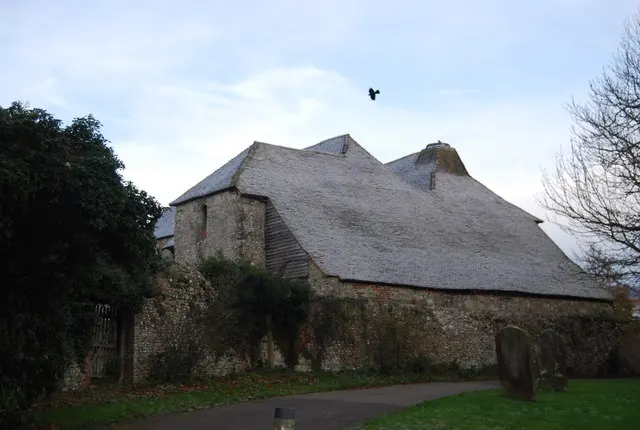
Modest and hospitable, the chapel retains a spectacular intact timber roof whose original medieval beams immediately convey its age. For walkers descending from the chalk downland, it offers what its dedication promises: shelter, rest, and blessing at a threshold on the journey.
Why this place is sacred
The thinness of this place is not in its age alone but in the density of uses a single structure has absorbed. The hall house began as someone's home — wattle and daub construction still visible in sections revealed during recent repairs — and was pressed into new service with each generation that inherited it.
What the Victorians made of a former barn, and what the parish made of a former school, and what pilgrims now make of a chapel, all overlap inside the same beamed space.
The dedication to Saint Christopher brings a specific kind of sacred geography into focus. Historically, Christopher was not merely a saint venerated inside church walls: his image was placed at entrances, on bridges, at river crossings — liminal points where danger of the journey concentrated. The chapel's position at the edge of Boughton Lees, where the route descends towards the River Stour and the final approach to Canterbury, mirrors that function precisely.
It is a threshold marker, not a destination in itself.
Constructed as a medieval hall house, function domestic. Later adapted for agricultural storage and then as a village school before conversion to Anglican chapel of ease c.1951.
The building's arc — hall house, barn, school, chapel — reflects the pragmatic reuse of vernacular medieval structures common in rural Kent. The St Christopher dedication appears to have been chosen upon conversion to chapel use, though no documentary record confirms this. The building was listed Grade II by Historic England in 1984, recognising the significance of its surviving medieval fabric.
Experience and orientation
The approach to Boughton Lees from the North Downs drops gradually — the open exposure of the chalk ridge gives way to hedgerows, a village green, and the particular quiet of a small settlement in the Stour valley. The chapel itself is unassuming from outside, a modest converted building that makes no claim on the landscape.
Inside, the medieval timber roof asserts itself immediately. The frame is intact, close above the space, and the quality of the interior — compressed, human-scaled, clearly old — is at odds with the building's modest exterior. The wattle and daub sections visible in the walls are not museum exhibits; they are simply the material the original builders used, still present because the structure survived. This is ordinary medieval vernacular architecture preserved by accident rather than by plan.
For pilgrims arriving in the late afternoon, the overnight sanctuary changes the character of the visit. Sleeping beneath a medieval roof on the Pilgrims' Way, with Canterbury eighteen kilometres to the northeast, draws the historical and the present-tense journey into a single experience. The Hardy Room and kitchen are functional, not atmospheric — which is precisely what exhausted walkers require.
The chapel is in Boughton Lees village, accessible from the Pilgrims' Way / North Downs Way footpath. On arriving, check the noticeboard for service times and sanctuary booking details. For overnight stays, keys must be arranged in advance through the British Pilgrimage Trust; they cannot be collected on arrival without prior arrangement.
Context and lineage
The exact date of construction for the original hall house is not documented in surviving records, though wattle and daub sections in the walls indicate medieval origins consistent with the surrounding landscape. The building subsequently served as a barn and then as a village school, closing in 1938. During the Second World War, the War Office requisitioned it for military use.
After the war, when All Saints' Church, Boughton Aluph — the main parish church, approximately one kilometre to the east — was declared structurally unsafe, the hall house was converted and consecrated as a chapel of ease, with worship resuming there in 1951. The building received its Grade II listing from Historic England on 13 August 1984.
The legend of Saint Christopher, to whom the chapel is dedicated, describes a powerful giant who sought to serve the mightiest king in the world. Having served an earthly king, then the devil, he finally offered his strength to Christ and was instructed to carry travellers across a dangerous river. One night, a child asked to cross; as Christopher carried him, the weight grew almost unbearable.
When he reached the far bank, the child revealed himself as Christ, bearing the weight of the whole world. The story made Christopher the preeminent protector of those on dangerous journeys — an image medieval Christians sought at church doors before departing, in the belief that seeing his face guarded against sudden death on the road.
The chapel belongs to the joint parish of Boughton Lees and Boughton Aluph, Diocese of Canterbury. Regular Sunday services are shared fortnightly between St Christopher's and the partner church, All Saints', which holds a Grade I listing and retains a medieval pilgrims' porch with a Tudor fireplace. The two buildings together form a parish with an unusually direct, continuous relationship with pilgrimage culture — All Saints preserving the physical evidence of medieval hospitality, St Christopher's actively continuing it.
Saint Christopher
Patron saint of travellers and pilgrims; dedicatee of the chapel
Thomas Becket
Archbishop of Canterbury, subject of the pilgrimage the chapel's route serves
British Pilgrimage Trust
Current manager of the overnight sanctuary and Sanctuary Network
Traditions and practice
In medieval English Christianity, images of Saint Christopher were placed prominently at church entrances — often as large wall paintings visible immediately upon entering — so that travellers departing on a journey would see his image before setting out. The protective power was believed to lie in the act of seeing: a glimpse of Christopher meant safe travel that day.
Chapels and wayside shelters dedicated to him along pilgrimage routes served as physical pause points where pilgrims could invoke his intercession. Whether a Christopher image or wall painting was ever present in this building is not known.
The Church of England parish holds Eucharist and Morning Prayer services on alternating Sundays, October through May, at 9:30am. The chapel's primary contemporary practice beyond formal worship is its function within the British Pilgrimage Trust Sanctuary Network: providing overnight accommodation to pilgrims walking the Winchester to Canterbury route. Up to ten people can sleep in the chapel space, with access to the Hardy Room, kitchen, and toilet facilities.
Bookings are managed through the BPT with a minimum three days' notice and a suggested donation of £10 per person per night.
Pilgrims arriving during the day will find the chapel open for rest and quiet reflection. Those walking the Pilgrims' Way are encouraged to simply enter and sit beneath the timber roof for a few minutes — the contrast between the exposure of the downland walk and the enclosure of the medieval interior is itself a form of arrival.
If arriving for an overnight stay, the act of sleeping beneath the same beamed roof that has sheltered people for centuries is worth pausing to register before sleep.
Anglican Christianity
ActiveThe chapel serves as the winter place of worship for the joint parish of Boughton Lees and Boughton Aluph, and as a year-round sanctuary for pilgrims walking the Winchester to Canterbury Pilgrims' Way. Its dedication to Saint Christopher — patron saint of travellers and pilgrims — gives the active parish tradition a direct connection to the medieval pilgrimage culture the route embodies.
Regular Sunday Eucharist and Morning Prayer services, alternating fortnightly, 9:30am, October through May. Pilgrim overnight sanctuary accommodating up to ten people, with kitchen and toilet facilities, managed through the British Pilgrimage Trust Sanctuary Network at a suggested donation of £10 per person per night.
Catholic pilgrimage (historical)
HistoricalPrior to the English Reformation, the route through Boughton Lees formed part of the great medieval pilgrimage to Thomas Becket's shrine at Canterbury Cathedral, active from Becket's canonisation in 1173 until the shrine's destruction by Henry VIII in 1538. A chapel dedicated to St Christopher at this threshold point on the route would have been a natural stopping place for pilgrims seeking his protection.
Medieval pilgrims moving east along the North Downs ridge route used the area as a rest stop. The sister church at Boughton Aluph retains a pilgrims' porch with a Tudor fireplace built specifically to shelter and warm travellers, offering the most direct surviving evidence of the hospitality function the area once served.
Perspectives and open questions
The chapel reads differently depending on the frame brought to it: a curiosity of adaptive reuse for the architectural historian, a living link in an unbroken hospitality tradition for the parish, and a threshold node in an older sacred landscape for those who follow alternative accounts of the downland route.
Scholarly perspective
Historians and architectural historians regard St Christopher's primarily as an unusual survival — a medieval vernacular structure, a hall house rather than a purpose-built ecclesiastical building, that has persisted through a succession of secular and religious uses into the present. The Grade II listing recognises the significance of its surviving fabric, including the intact medieval roof and the wattle and daub construction sections uncovered during repairs.
The Pilgrims' Way association is well-attested for this section of Kent, and the sister church at Boughton Aluph provides unusually concrete physical evidence of the medieval pilgrimage hospitality tradition — the pilgrims' porch with its Tudor fireplace is among the clearest surviving examples on the route.
Living and traditional perspectives
For the Church of England parish and for the British Pilgrimage Trust, the chapel represents an active continuation of something that was interrupted but not extinguished. The medieval pilgrimage to Becket's shrine was suppressed during the Reformation, and with it the culture of wayside hospitality that sustained pilgrims.
The Sanctuary Network's revival of that hospitality — a medieval hall house again offering shelter to wayfarers at a known threshold on the Canterbury route — is understood within the parish as genuine continuity rather than mere heritage tourism. The pilgrims arriving from Sweden, Taiwan, and Australia are different in origin from those who came in the 14th century, but the dedication to Saint Christopher encompasses them equally.
Alternative interpretations
Some walkers and pilgrimage writers understand the North Downs ridge route as following a much older trackway than the medieval pilgrimage — a prehistoric corridor, possibly Neolithic or Iron Age, running along the chalk downs between the Hampshire basin and the Kent coast. In this reading, the chapels along the route, including St Christopher's, mark nodes in a sacred geography that predates Christianity by millennia.
The particular significance of the Christopher dedication adds weight to this interpretation: the saint is traditionally associated with liminal threshold points — bridges, river crossings, gates — and the chapel sits precisely at the descent into the Stour valley, the last major natural threshold before Canterbury.
Open questions
The original construction date and function of the medieval hall house remain undocumented. Whether the St Christopher dedication existed before the 1950s conversion, or was chosen at that time, is not known.
No evidence has been found of a medieval wall painting of Christopher in the chapel — such images were ubiquitous in English parish churches and would have been directly relevant to a site on a pilgrimage route — but their absence from the record does not confirm they never existed.
Plan your visit
Access and arrival
Boughton Lees is a small village near Ashford, Kent, accessible directly from the North Downs Way / Pilgrims' Way footpath. The nearest rail station is Wye, approximately 3km (2 miles) away; Ashford International is approximately 8km. There is no on-site car park; roadside parking is available in the village. The building has basic kitchen and toilet facilities accessible to overnight sanctuary guests.
Mobile phone signal in the village is generally available, though coverage may be intermittent on the downland sections of the walk approaching from the west; verify signal before leaving the route. In case of emergency, Ashford is the nearest town with full services.
The chapel's overnight Sanctuary Network accommodation sleeps up to 10 pilgrims in the chapel space, with access to the Hardy Room, kitchen, and toilet. Suggested donation £10 per person per night. Book through the British Pilgrimage Trust website with a minimum three days' notice. Keys must be collected before 8pm. Additional accommodation is available in Ashford and in villages along the North Downs Way.
Respectful visit
Respectful dress appropriate for a working church. There is no formal dress code, but clothing that acknowledges the sacred function of the space is appropriate.
Photography is permitted in the grounds and interior under normal circumstances. If a service is in progress, exercise discretion and ask before photographing.
A suggested donation of £10 per person per night applies to overnight pilgrim sanctuary use, cash preferred. Voluntary donations for daytime visits are welcomed.
Overnight sanctuary use requires a minimum three days' notice through the British Pilgrimage Trust. Keys must be collected before 8pm on the day of arrival; no on-site keyholder is available after that time.
The chapel is a working church and pilgrim sanctuary, not a tourist attraction. Visitors attending during services should be prepared to participate respectfully or wait outside. Overnight bookings require advance arrangement through the BPT; do not arrive expecting accommodation without a prior confirmed booking.
Location
Map loads as you approach this section.
Pilgrim reflections
A portrait of encounter, not a score
Pilgrims describe what they felt, how present they could become, and whether the place would shape a journey. There are no stars and no ranking of traditions.
No reviewed reflections yet
The first pilgrims can help describe the character of being here.
Share a reflection
Available after an account-backed “Been there.” Every reflection is reviewed before publication.
Nearby sacred places
Explore other sacred places in the region. Proximity does not establish access or travel time; check each place’s guidance.

All Saints' Church, Boughton Aluph
Boughton Aluph, England, United Kingdom
1.0 km away

St Lawrence the Martyr Church, Godmersham
Godmersham, England, United Kingdom
4.9 km away
Archbishop's Palace, Charing
Charing, England, United Kingdom
7.3 km away

St Peter & St Paul's Church, Charing
Charing, England, United Kingdom
7.4 km away
References
Sources consulted for this page. Source categories describe the publication, not a guarantee that every claim is verified. Traditional accounts and outside interpretations may differ.
- 01St Christophers Chapel, Boughton Lees — British Pilgrimage Trust — British Pilgrimage TrustofficialOfficial Sanctuary Network listing; confirms overnight capacity of 10 pilgrims, £10 suggested donation, 3 days' notice required, spectacular beamed roof, and position between Stage 13 and 14 of the Pilgrims' Way.
- 02About Us — All Saints Church, Boughton Aluph — All Saints Boughton Aluph PCCofficialParish website giving detailed history of both churches. Confirms wattle and daub sections found during recent repairs, Victorian modifications (inserted windows, teacher's porch, Hardy Room), WWII wartime use by War Office, and resumption of worship in 1951 after All Saints was declared unsafe.
- 03All Saints / St Christophers — A Church Near You — Church of EnglandofficialChurch of England official directory entry, confirming joint parish status, Diocese of Canterbury, and contact details.
- 04The Sanctuary Network — British Pilgrimage Trust — British Pilgrimage TrustofficialExplains the Sanctuary Network to which St Christopher's belongs, confirming the model of affordable overnight shelter for pilgrims (average £10/night) along the Pilgrims' Way.
- 05Saint Christopher's Church, Boughton Lees — Wikipedia — Wikipedia contributorsacademicConfirms Grade II listing date (13 August 1984), original medieval hall house construction, subsequent uses as barn and school, school closure 1938, adoption as chapel of ease in the 1950s, and seasonal worship schedule.
- 06Saint Christopher — Wikipedia — Wikipedia contributorsacademicBackground on the patron saint's legend, medieval significance for travellers and pilgrims, and tradition of placing his image at church entrances so travellers would see it before setting out.
- 07All Saints' Church, Boughton Aluph — Wikipedia — Wikipedia contributorsacademicContext on the partner church in the same parish, including its Grade I listing, 13th-century origins, pilgrims' porch with Tudor fireplace, and history of serving Pilgrims' Way travellers.
Share a photo
Help visitors recognize St Christopher's Chapel, Boughton Lees. Every submission is reviewed before publication.