Anta da Herdade da Comenda da Igreja
A working farm's dolmen holds one of Iberia's richest troves of votive plaques
Understand sacred places, explore living traditions, and learn how to engage respectfully with Pilgrim Map.
Access has not been verified. Check current local guidance before planning a visit.
Montemor-o-Novo, Évora, Portugal
Read the sources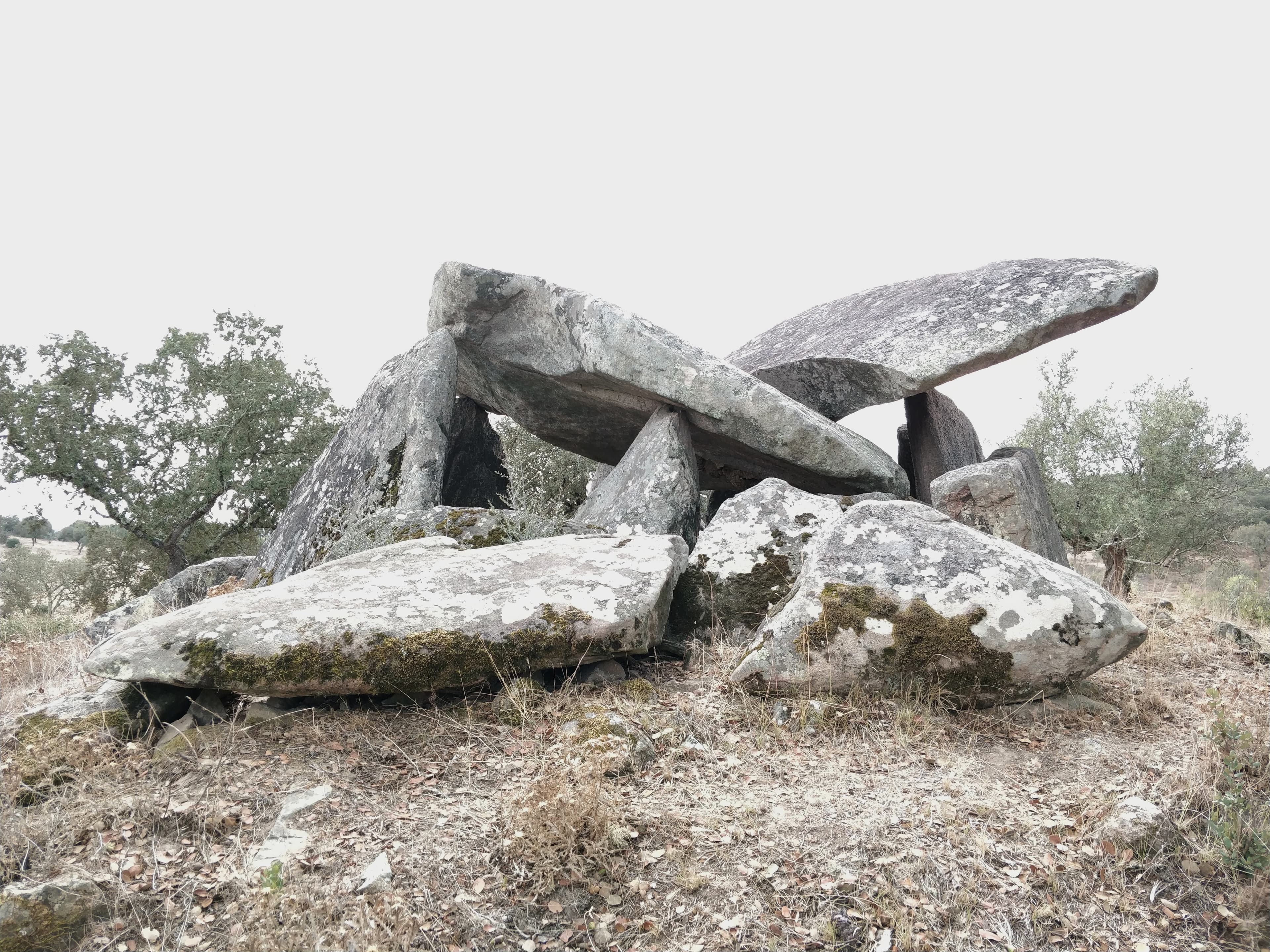
Image of Anta da Herdade da Comenda da Igreja. Image source
Visit essentials
A quick read before you go
- Duration
- 30 to 45 minutes, including the walk in from the road or from the village of São Geraldo.
- Access
- Located in the parish of Nossa Senhora do Bispo, municipality of Montemor-o-Novo, central…
Overview
A dirt path across working farmland and two cattle gates leads to Anta da Herdade da Comenda da Igreja, usually without staff, interpretation, or other visitors. The passage tomb is exceptional even among Évora’s megaliths: a polygonal chamber about four metres wide with walls reaching six metres, joined to a ten-metre corridor. Built and intensively used between roughly 3645 and 2925 BCE, it yielded more than 1,500 registered artefacts, including over one hundred engraved schist and sandstone plaques.
Their chevron and zig-zag motifs have been compared with funerary art at Fourknocks in Ireland, suggesting a wider Neolithic visual language but not direct contact. The unstaffed farmland setting now holds one of the region’s richest votive records.
Why this place is sacred
This dolmen has no confirmed solstice or equinox alignment in available sources; its longitudinal orientation runs west to east, architecturally consistent with the broader Évora passage-tomb tradition, but no source confirms this was a deliberate astronomical target. What sets Comenda da Igreja apart instead is the sheer density of its votive record.
Excavation and subsequent artefact analysis recovered more than 1,500 registered objects from the tomb, including over one hundred engraved schist and sandstone plaques and crosier-shaped objects. Some of these plaques carry chevron and zig-zag motifs that specialists have compared to funerary art at the Fourknocks passage tomb in Ireland — a resemblance suggestive of a shared, continent-wide Neolithic funerary visual language, though not evidence of direct contact between such distant communities.
The monument's architecture reinforces this sense of significance: an unusually large chamber and a well-preserved, largely intact corridor that some sources describe as a 'prototype' of Évora-region megalithism. One architectural detail remains genuinely unsettled — whether the tomb features a rare second, higher passage above the main corridor, as one source suggests, or a single corridor as described elsewhere; both readings are presented here without resolution, since the available record does not settle the question.
Archaeologists read Comenda da Igreja as a major collective funerary and votive site, its exceptionally rich artefact record indicating unusually intensive and sustained ritual or funerary use across several centuries by the megalithic communities of the ancient Évora region. What is not recoverable is any specific account of the ceremonies performed here — the votive plaques speak to sustained ritual return, but their exact meaning within that ritual is inferred rather than documented.
The dolmen was classified as a Portuguese national monument in 1936, following study reaching back into the late nineteenth century. Its most significant scholarly attention came from the German archaeologist couple Georg and Vera Leisner, whose multi-decade twentieth-century survey of Iberian megaliths gave the site its most detailed early documentation, cited in their 1956 publication.
Recovered material from the site is held primarily by the National Archaeological Museum in Lisbon, and more recent academic analysis of the engraved votive plaques has continued to refine understanding of the tomb's ritual significance. Today the monument sits on private agricultural land — a herdade, or rural estate — with informal, unstaffed public access.
Experience and orientation
The approach itself shapes the experience before the dolmen is even visible. A small blue roadside marker reading 'Anta 1 km' is the only signage most visitors will find; from there, a dirt path crosses roughly a kilometer of working farmland, through two gates that exist to keep cattle contained rather than to guide tourists.
That remoteness and lack of staffing heighten what visitors describe as a genuine sense of discovery — an encounter with a five-thousand-year-old funerary space that has not been smoothed into a managed heritage attraction. Compared to Almendres or Zambujeiro, both of which see meaningful visitor traffic, Comenda da Igreja is visited mainly by people who specifically sought it out, often having read about its votive-plaque record in advance rather than stumbling across it as part of a broader day trip.
Plan for the walk itself as part of the visit rather than an inconvenience before it — roughly a kilometer each way from the road, or about 500m if you park in the village of São Geraldo instead. Close each livestock gate behind you as you pass through; the working farm depends on it.
Once at the tomb, take time with the corridor before the chamber — its ten-meter length and the scale of its slabs are easy to underappreciate if you move straight to the main chamber without registering the approach the original builders designed.
Context and lineage
No mythological or oral tradition survives from the community that built this passage tomb; what is known comes from artefact analysis rather than any surviving account. Some sources give the structure's dating as around 3000 BCE per infobox figures; others, based on artefact analysis of the votive material, place intensive funerary use specifically between roughly 3645 and 2925 BCE, within a broader occupation window running from the fourth millennium BCE to the mid-third millennium BCE.
What distinguishes this tomb in the historical record is less its construction date than what was deposited within it over those centuries: more than 1,500 registered artefacts, including over one hundred engraved schist and sandstone plaques and crosier-shaped objects, some bearing motifs comparable to funerary art at the Fourknocks tomb in Ireland. That scale of votive deposition suggests a community returning to this tomb repeatedly across generations, rather than treating it as a single closed burial event.
No continuous ritual community survives from the tomb's Chalcolithic and Late Neolithic builders. Formal stewardship began with the 1936 national monument classification, continued through the Leisners' survey work and later synthesis by SIPA (Branco & Nunes, 1994) and IGESPAR (Martins, 2011), and persists today through the National Archaeological Museum in Lisbon, which holds most of the recovered votive material.
The land itself, meanwhile, has remained in continuous private agricultural use — a rural estate whose owners now share informal, unstaffed access with the occasional visitor who makes the walk to find it.
Georg and Vera Leisner
excavator
German archaeologist couple whose roughly three-decade twentieth-century survey of Portuguese megaliths included intensive investigation of this site, cited in their 1956 publication and remaining a foundational reference for the tomb's documentation.
Traditions and practice
Prehistoric practice at Comenda da Igreja involved sustained collective burial and extensive votive offering — engraved schist and sandstone plaques, crosier-shaped objects — deposited over multiple centuries, indicating regular ceremonial return to the tomb by the community. The precise content of these ceremonies is not documented and is inferred entirely from the artefact record left behind.
No organized ceremonial practice or heritage event occurs at the site today. It is preserved purely as an archaeological monument, visited on a self-guided, unstaffed basis by those who make the walk through the farm gates to reach it.
Walk the corridor's full ten-meter length before entering the main chamber, noting the size of the orthostats along the way — the scale here is unusually well preserved for a passage tomb of this age. Once at the chamber, consider that more than 1,500 objects were recovered from a space this size: over a hundred engraved plaques alone, each placed here deliberately across centuries of use.
Take the walk back through the farmland slowly; the remoteness that makes this site harder to reach is also what has kept it quiet enough to sit with for a while without interruption.
Chalcolithic/Late Neolithic Funerary Cult
HistoricalBuilt and used c. 3645–2925 BCE, with the structure itself dated to roughly 3000 BCE, this passage tomb served the megalithic communities of the ancient Évora region as a major collective funerary and votive site, renowned for having yielded one of the richest votive assemblages of any Iberian megalith — over 1,500 registered artefacts, including more than 100 engraved schist and sandstone plaques and crosier-shaped objects.
Collective burial across many generations and extensive votive-offering deposition, including engraved plaques and crosiers, likely accompanied by ancestor-veneration ceremonies given the intensity and duration of ritual use documented archaeologically.
Archaeological Heritage and Scholarly Stewardship
ActiveClassified as a Portuguese national monument in 1936, the dolmen has been studied since the late nineteenth century, most notably by the German archaeologist team of Georg and Vera Leisner during their multi-decade survey of Iberian megaliths, and remains a reference site for understanding the central Alentejo, one of the two great concentrations of Neolithic megalithism in western Iberia.
Long-running archaeological documentation and artefact analysis, with recovered material held primarily by the National Archaeological Museum in Lisbon.
Perspectives and open questions
Comenda da Igreja is more settled in its basic identification as a major funerary monument than in some of its architectural details — a site where the votive record is exceptionally rich even as a few structural questions remain genuinely unresolved.
Scholarly perspective
Archaeologists agree Comenda da Igreja was a major collective funerary monument of the central Alentejo megalithic tradition, notable above all for its unusually large votive-artefact corpus, which offers rich material for understanding Chalcolithic ritual and symbolic practice in the region. Some sources cite the dating as c.
3000 BCE per the site's infobox figure; other sources place it more precisely at 3645–2925 BCE based on artefact analysis of the votive material — this account treats the artefact-based range as the more specific figure. Whether the tomb has a genuine second, higher passage above its main corridor, as noted on one architectural source, or a single corridor as described elsewhere, remains an open question not resolved across the available sources.
Living and traditional perspectives
No continuous indigenous or traditional custodial community exists at Comenda da Igreja; Portuguese national heritage authorities, via SIPA and IGESPAR documentation, serve as the formal record-keepers, while the land itself remains in private agricultural use.
Alternative interpretations
No significant distinct alternative or esoteric interpretive tradition specific to this site was found in available sources, in contrast to more widely visited sites like Almendres; it remains understood primarily through the archaeological and academic lens.
Open questions
Whether the tomb genuinely features a rare double-passage arrangement or a single corridor remains unresolved in available documentation. The precise meaning of the engraved chevron and zig-zag motifs on its votive plaques, and their apparent stylistic connection to distant sites like Fourknocks in Ireland, remain open questions for comparative megalithic research.
Plan your visit
Access and arrival
Located in the parish of Nossa Senhora do Bispo, municipality of Montemor-o-Novo, central Alentejo. From Montemor-o-Novo, take the N2 road north toward Mora to the village of São Geraldo; a small blue sign marked 'Anta 1 km' points to a dirt path requiring passage through two livestock gates, or park in São Geraldo and walk roughly 500m south. No public transport serves the site directly; a car is effectively required.
No mobile-signal information was available at time of writing for this specific farmland approach; check with the Montemor-o-Novo municipality for current access conditions before visiting, particularly if traveling alone in this remote stretch of countryside.
No lodging exists at or near the site itself. Montemor-o-Novo and Évora, both within a 25km drive, offer accommodation options suited to a visit combining this dolmen with the region's better-known megaliths.
Respectful visit
No dress requirements; sturdy footwear is strongly recommended for the roughly one-kilometer dirt-path approach across farmland terrain.
Personal photography is permitted, with no restrictions documented for this site.
There is no tradition of offerings at this site, and visitors should not leave objects at the tomb.
Visitors must open and carefully re-close the two metal livestock gates encountered on the approach, out of respect for the working farm on which the monument sits, and should avoid disturbing any livestock present.
Take care when opening and closing the two metal livestock gates on the approach, and avoid disturbing any cattle present on the farmland. Do not touch or attempt to move any stonework at the tomb itself.
Location
Map loads as you approach this section.
Pilgrim reflections
A portrait of encounter, not a score
Pilgrims describe what they felt, how present they could become, and whether the place would shape a journey. There are no stars and no ranking of traditions.
No reviewed reflections yet
The first pilgrims can help describe the character of being here.
Share a reflection
Available after an account-backed “Been there.” Every reflection is reviewed before publication.
Nearby sacred places
Explore other sacred places in the region. Proximity does not establish access or travel time; check each place’s guidance.


References
Sources consulted for this page. Source categories describe the publication, not a guarantee that every claim is verified. Traditional accounts and outside interpretations may differ.
- 01Anta Grande da Comenda da Igreja / Anta Grande da Herdade da Comenda — SIPA — Direção-Geral do Património Cultural / SIPA (Sistema de Informação para o Património Arquitectónico)officialOfficial Portuguese architectural heritage information system record
- 02Anta da Comenda da Igrejar, Nossa Senhora do Bispo/San Giraldo Parish, Evora, Portugal — Neolithic Studies — Stetson University Neolithic StudiesacademicAcademic passage-tomb reference; details Leisner excavation legacy and votive-plaque corpus
- 03A propósito de algumas placas votivas da Anta Grande da Comenda da Igreja (Montemor-o-Novo, Alentejo médio) — ResearchGate (academic paper)academicPeer-reviewed archaeological analysis of the site's engraved votive plaques
- 04Great Dolmen of Comenda da Igreja — Wikipedia — Wikipedia contributorsSource contextCites Branco & Nunes (1994, SIPA) and Martins (2011, IGESPAR) institutional sources
- 05Anta Grande da Comenda da Igreja, Évora — The Megalithic Portal — The Megalithic PortalacademicDetailed architectural notes including double-passage observation and 1936 national monument classification
- 06Anta Grande da Comenda da Igreja — Turismo do Alentejo — Turismo do Alentejo (regional tourism board)Source contextRegional tourism board listing
- 07Anta Grande da Comenda da Igreja (Montemor-o-Novo) — Arca de Darwin — Arca de Darwin (travel blog)Source contextPersonal travel blog; used only for practical access/directions detail (gates, dirt path), cross-referenced against other sources
Share a photo
Help visitors recognize Anta da Herdade da Comenda da Igreja. Every submission is reviewed before publication.