Anta de Pavia - Chapel of S. Dinis
A Neolithic tomb still standing as a village chapel in Pavia
Understand sacred places, explore living traditions, and learn how to engage respectfully with Pilgrim Map.
Access has not been verified. Check current local guidance before planning a visit.
Mora, Évora, Portugal
Read the sources
Visit essentials
A quick read before you go
- Duration
- 15 to 30 minutes, including time to view the exterior and, if accessible, the interior chapel.
- Access
- Located in the main square of Pavia, municipality of Mora, Évora district, Alentejo, roughly 31…
Overview
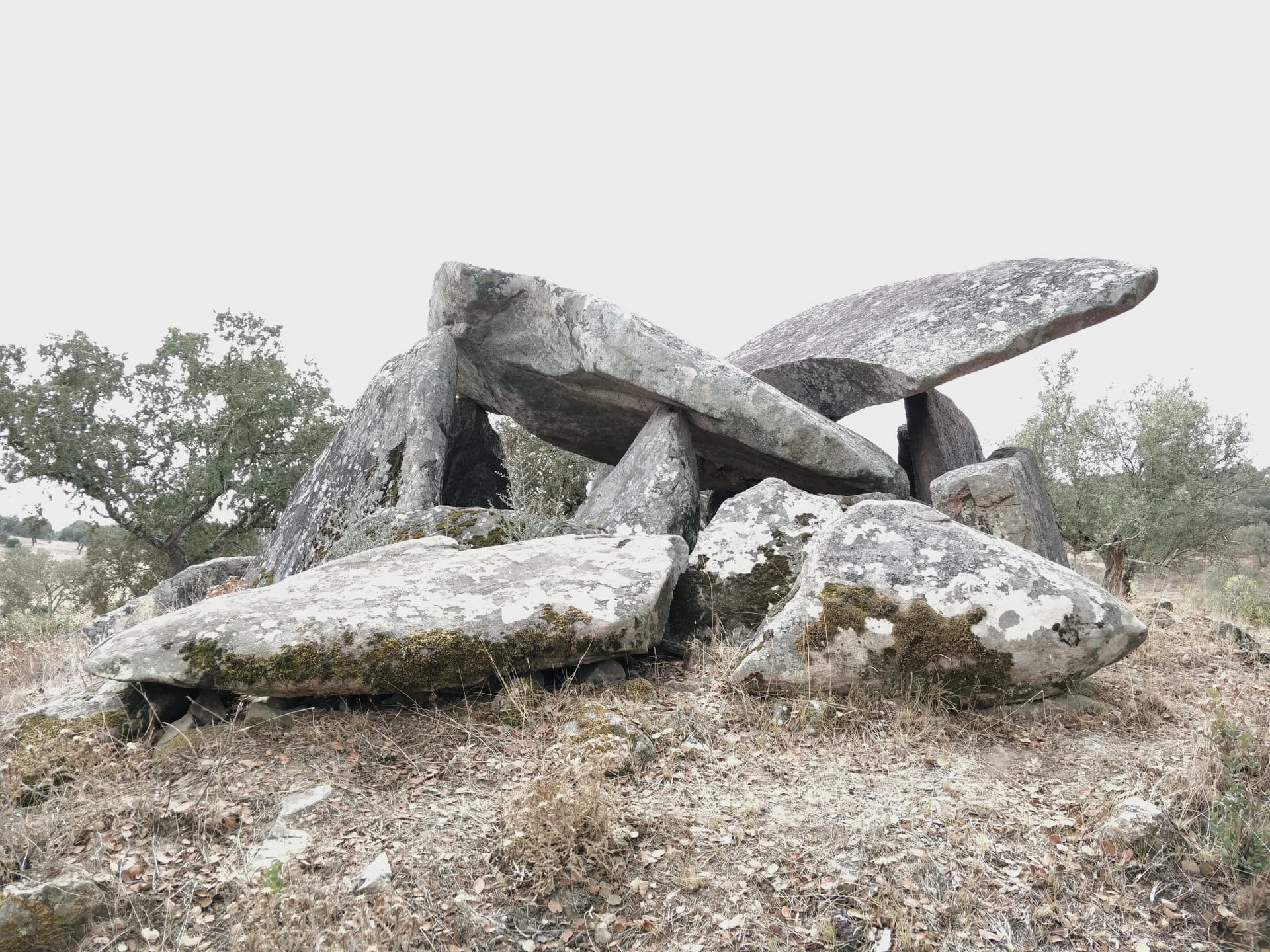
Anta de Pavia survived through conversion rather than abandonment. Its polygonal chamber—seven intact granite pillars and a capstone roughly four and a third metres across—became a Catholic chapel dedicated to São Dinis in 1625. The community removed the original corridor and added a squared stone doorway, cross, and small bell-tower. A blue-tiled altar and painted saint now occupy the nave where Neolithic and Chalcolithic communities buried their dead in the 4th to 3rd millennium BCE.
Set among whitewashed houses in Pavia’s town square, the chapel’s walls remain five-thousand-year-old megaliths. Nearby São Brissos followed a similar Christianizing reuse, but Pavia makes the seam especially direct. Because its corridor was replaced rather than adapted, no confirmed trace of the tomb’s original orientation survives.
Why this place is sacred
What makes the Anta de Pavia unusual is not scale alone — dolmens as large exist elsewhere in Portugal — but the fact that its second life was chosen rather than accidental. When the local community converted the chamber into the Capela de São Dinis in 1625, they kept the seven original granite orthostats and the capstone standing, treating the ancient structure as usable sacred space rather than material to be cleared.
They removed the corridor and replaced it with a squared stone entranceway, adding a cross and bell-tower above — a visible signal that the space now served Christian rather than Neolithic purposes, built directly onto what remained of the older monument rather than beside it.
The result is a structure that holds two very different registers of sacredness in the same small footprint: the funerary weight of a Bronze Age-adjacent collective tomb, and the ongoing, if modest, devotional life of a Catholic chapel dedicated to a specific saint. Neither register cancels the other. The chamber does not stop being what it was in order to become what it is now.
No specific founding legend for the 1625 conversion — a miracle, a vision, a particular reason for choosing São Dinis — has surfaced in the sources reviewed. What is documented is the broader regional pattern: Alentejo communities in this period repurposed several prehistoric monuments as Christian sacred sites rather than treating them as pagan remnants to be erased, a pattern also visible at the nearby São Brissos dolmen-chapel.
Archaeological evidence supports reading the original structure as a major Neolithic to Chalcolithic collective tomb, built between the 4th and 3rd millennium BCE and used for communal funerary practice by Alentejo agro-pastoral communities, rather than a burial reserved for a single individual. Its scale — seven surviving orthostats and a wide chamber — places it among the largest dolmens on the Iberian Peninsula.
The dolmen stood as a funerary monument for millennia before 1625, when the local community consecrated it as the Capela de São Dinis and rebuilt its entrance as a squared stone doorway with a cross and bell-tower — a change that leaves no confirmed record of the tomb's earlier approach. Classified as a Portuguese National Monument in 1910, the site was excavated in 1914-1915, with recovered artefacts deposited in the museum associated with pioneering archaeologist José Leite de Vasconcelos.
Today it functions primarily as a heritage-tourism landmark in the town square of Pavia, its interior often behind locked gates, its exterior freely visible to anyone passing through.
Experience and orientation
You do not have to seek out the Anta de Pavia; it stands in the town square, and the town square is small enough that you will find yourself in front of it within minutes of arriving. What takes longer to register is what you are actually looking at: a cross and modest bell-tower rising from a doorway that leads not into an ordinary chapel interior but into a chamber built of granite pillars considerably older than Christianity itself.
The exterior is unrestricted — anyone can walk the square and view the structure from outside. The interior is less predictable. Sources note the gate is often locked, so whether you can step inside to see the blue-tiled altar and the painted image of São Dinis depends on timing and local circumstance rather than a posted schedule.
If you do get inside, notice the seam between eras: granite pillars that once sealed a tomb now support a whitewashed ceiling and a small votive altar. The corridor that once led into this chamber is entirely gone, replaced by the squared stone entrance you just walked through — there is no physical trace left of how the original approach would have felt.
Approach the chapel as you would any small parish church that happens to be five thousand years old — that is, with the same ordinary respect, adjusted for the extraordinary material. If the interior is open, take the time most visitors don't: sit for a moment in the nave and notice that the walls holding up a Catholic altar were raised long before the saint they honor was born.
Context and lineage
No specific founding legend for the 1625 conversion has been located in the sources reviewed — no miracle or vision explaining why this particular dolmen was chosen, or why the dedication went to São Dinis specifically. What is documented is the wider pattern: this was part of a broader Alentejo practice of converting prehistoric monuments into Christian sacred space, paralleled most closely at the nearby Dolmen-Chapel of São Brissos.
For an unknown number of generations during the 4th to 3rd millennium BCE, Alentejo communities used the chamber for collective burial. What followed before 1625 is not documented in the sources reviewed.
In 1625, the local Catholic community of Pavia consecrated the chamber as the Capela de São Dinis, and it has carried that dedication for four centuries since — a lineage of use that runs directly from prehistoric tomb to Christian nave without an intervening period of ruin, in contrast to most Portuguese dolmens, which were abandoned long before any organized study or reuse began.
José Leite de Vasconcelos
archaeologist
Pioneering figure of Portuguese scientific archaeology; the 1914-1915 excavation finds from the dolmen-chapel were deposited in the museum associated with his name and founding role.
São Dinis (Saint Dionysius)
saint
The saint to whom the chapel was dedicated upon its 1625 consecration; a painted portrait of him hangs within the converted chamber.
Traditions and practice
The original Neolithic to Chalcolithic community practiced collective inhumation within the chamber; the specific rites performed are not detailed in the sources reviewed. Following the 1625 conversion, Catholic devotional practice at the site would have included standard chapel observance — mass, prayer, veneration of the saint's image — though no confirmed regular service schedule or annual feast-day observance for São Dinis at this particular chapel has been located.
Today the chapel functions primarily as a heritage-tourism landmark rather than an actively scheduled place of worship; sources describe the interior as often gated and locked. Atlas Obscura and comparable travel publications frame the site as an evocative illustration of how Christianization absorbed rather than erased pre-Christian sacred sites in this part of Alentejo, a broader interpretive frame rather than a documented current practice.
Stand in the town square first, before approaching the doorway, and take in how ordinary the setting is — whitewashed houses, an unremarkable Alentejo square — against how extraordinary the structure is. If the gate is open, step into the nave slowly. Notice the seam where squared 17th-century stone meets uneven Neolithic granite; that seam is the entire history of the site compressed into a few feet of wall.
Sit for a moment if the space allows it, whether or not you consider yourself a person who prays in chapels — the invitation here is not necessarily religious, only attentive.
Late Neolithic to Chalcolithic funerary-ritual tradition (prehistoric)
HistoricalBuilt between the 4th and 3rd millennium BCE, the Anta de Pavia was one of the largest dolmens on the Iberian Peninsula, its polygonal chamber of seven intact granite pillars and capstone originally serving as a monumental collective tomb for Neolithic and Chalcolithic communities of the Alentejo.
Collective inhumation and associated grave-good deposition; the original entrance corridor, since removed, would have structured ritual access to the chamber.
Roman Catholicism (Capela de São Dinis)
ActiveIn 1625, during a wave of Christianization that repurposed several regional dolmens as chapels — a pattern also seen at the nearby Dolmen-Chapel of São Brissos — the Pavia dolmen's chamber was consecrated as the Capela de São Dinis, with the original corridor replaced by a squared stone entranceway topped by a cross and small bell-tower. The chamber became the chapel's nave, furnished with a blue-tiled altar and a painted portrait of the saint.
Historically, Catholic devotion to São Dinis at this site; contemporary sources note some local Alentejo communities maintain a layered awareness of pre-Christian and Christian devotional practice around such converted monuments, though no confirmed current mass schedule was found.
Perspectives and open questions
The Anta de Pavia sits comfortably in no single interpretive frame. Archaeology, Catholic devotional history, and the broader earth-mysteries reading of 'sacred geography' each have something true to say about it, and the building's own layered structure — Neolithic pillars under a Christian bell-tower — seems to invite exactly that kind of held complexity rather than a single settled account.
Scholarly perspective
Archaeologists and heritage authorities agree the Pavia structure began as a major Neolithic to Chalcolithic collective tomb and was deliberately converted into a Christian chapel in 1625, making it one of Portugal's clearest surviving examples of prehistoric-to-Christian monument repurposing, alongside the nearby São Brissos dolmen-chapel. The specific circumstances and motivations behind the 1625 conversion — why this dolmen, why this saint — remain undocumented in the sources reviewed.
Living and traditional perspectives
No living indigenous tradition attaches to the prehistoric layer of the site. According to regional heritage accounts, the active tradition today is mainstream Portuguese Roman Catholicism, centered on the chapel's dedication to São Dinis. Some sources suggest that certain Alentejo communities maintain a layered awareness of pre-Christian and Christian devotion around converted monuments of this kind, though no specific practice unique to Pavia has been documented.
Alternative interpretations
General earth-mysteries and megalith-tourism writing, including Atlas Obscura's coverage of the site, frames dolmen-chapels like Pavia as evidence of an enduring 'sacred geography' that Christianity absorbed rather than erased. This is a widely repeated interpretive frame applied across many such conversions rather than a claim specific to Pavia's own history.
Open questions
What remains genuinely unresolved: the specific motivations behind the 1625 conversion, whether any written description of the monument exists from before that date, and the full content of the 16th-century sources said to first mention it. None of these questions is settled in the material reviewed.
Plan your visit
Access and arrival
Located in the main square of Pavia, municipality of Mora, Évora district, Alentejo, roughly 31 km west of Évora. Freely visible from the town square; interior access depends on whether the gate is open. Mobile signal in the town itself was not specifically confirmed in available sources but is generally reliable in Alentejo towns of this size, unlike the more remote rural dolmens of the region.
No specific accommodation information for Pavia itself was available at time of writing; the town of Mora and the city of Évora, both within a short drive, offer a wider range of lodging.
Respectful visit
As a consecrated chapel, modest dress is advisable if the interior is accessible, consistent with general Catholic church-visiting norms in Portugal.
No specific photography restriction has been identified; general courtesy toward a place of worship applies, particularly if a service or private prayer is underway.
Standard Catholic votive practices — a lit candle, a quiet prayer — would be typical of an active chapel dedication, though this has not been specifically confirmed for this site. No offering tradition applies to the site's prehistoric layer.
Interior access may be gated and locked at times, with no fixed public schedule confirmed in available sources; the exterior is freely visible from the town square at any time. Respect the site as an active place of worship when the interior is open, not solely as an archaeological monument.
Treat the interior, if accessible, as an active place of worship rather than only an archaeological curiosity — this is a consecrated chapel, not solely a monument. Do not touch or lean on the original granite orthostats, which have carried both a tomb's roof and a chapel's walls for five thousand years.
Location
Map loads as you approach this section.
Pilgrim reflections
A portrait of encounter, not a score
Pilgrims describe what they felt, how present they could become, and whether the place would shape a journey. There are no stars and no ranking of traditions.
No reviewed reflections yet
The first pilgrims can help describe the character of being here.
Share a reflection
Available after an account-backed “Been there.” Every reflection is reviewed before publication.
Nearby sacred places
Explore other sacred places in the region. Proximity does not establish access or travel time; check each place’s guidance.


References
Sources consulted for this page. Source categories describe the publication, not a guarantee that every claim is verified. Traditional accounts and outside interpretations may differ.
- 01Anta de Pavia, Chapel Dolmen, Alentejo, Portugal — Neolithic Studies, Stetson UniversityacademicUniversity-hosted academic archive of European Neolithic dolmen photography and documentation
- 02Anta Capela de Pavia — Turismo de Portugal (visitportugal.com)officialOfficial national tourism authority listing
- 03Anta de Pavia, Évora — The Megalithic Portal and Megalith MapacademicCrowd-sourced but archaeologically literate megalith database entry
- 04Anta-Capela de São Dinis — Prehistoric PortugalSource contextSpecialist Portuguese-megaliths blog with detailed, well-organized coverage of history, conversion to chapel, dimensions, and artifacts
- 05Anta de Pavia (Santa Capilla de San Dinis) — Atlas ObscuraSource contextReputable curated travel/oddities publication; notes syncretism between pre-Christian and Christian devotion in the region
- 06Anta de Pavia / Capela de São Dinis - Mora — All About PortugalSource contextRegional travel guide corroborating classification and history
- 07Dolmen-Chapel of São Brissos — Wikipedia contributorsSource contextComparative source on the closely related regional phenomenon of dolmen-chapels in Alentejo (used for context on the wider dolmen-to-chapel conversion pattern, not as a primary source on Pavia itself)
Share a photo
Help visitors recognize Anta de Pavia - Chapel of S. Dinis. Every submission is reviewed before publication.