Ħal-Tarxien Prehistoric Complex
The apex of Neolithic religious art in Europe, carved in coralline stone and still visible in the open Maltese air
Understand sacred places, explore living traditions, and learn how to engage respectfully with Pilgrim Map.
Access has not been verified. Check current local guidance before planning a visit.
Tarxien, Malta
Read the sources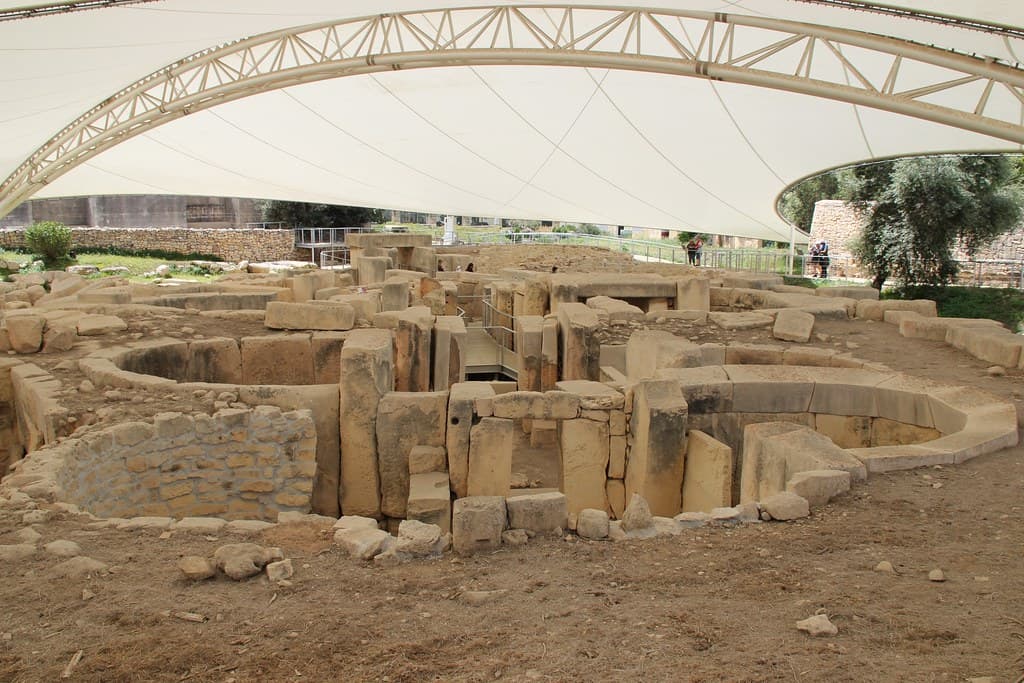
Image of Ħal-Tarxien Prehistoric Complex. Image source
Visit essentials
A quick read before you go
- Duration
- 45–90 minutes with the audio guide.
- Access
- Located in Tarxien village, approximately 5 km south of Valletta.
Overview
In 1913, Tarxien farmer Lorenzo Despott reported the large slab his plough had struck. From 1915, Sir Temi Zammit spent four years uncovering prehistoric Malta's most elaborate religious complex: four megalithic temples spanning the Ġgantija phase (c. 3600 BC) to the Tarxien phase (c. 3150–2500 BC), with carved stone art among the finest Neolithic creative work.
The Tarxien-phase South Temple, the tradition's final and most accomplished period, uses a six-apse plan. Precisely carved orthostat spirals suggest a theological language of order, continuity, and underlying pattern rather than decoration. Reliefs show a sow with piglets, cattle, and a goat; stone basins for libations remain in niches.
At its entrance stands the surviving lower half of a colossal female statue: feet, ankles, and heavy skirted form about 60 cm high. The missing whole may have reached 2.5 metres, making it Malta's largest prehistoric sculpture then and now. Larger than human scale at the archipelago's most elaborate sacred threshold, the figure stood at the ritual world's centre, though its identity is unknown.
After 2500 BC the temple culture vanished. Later Bronze Age people deposited cremation ash-interments in its ruins, suggesting Tarxien's remembered sacred status outlasted the tradition that created it.
Why this place is sacred
Tarxien's thinness lies in the density and legibility of what survived. At most prehistoric sacred sites, the ritual life of the builders is invisible — we have the stone, and that is all.
At Tarxien, more survives: the altars still in their niches, the carved spirals still on the orthostats (in replica — the originals are now in the National Museum of Archaeology, Valletta), the stone basins for libations, the animal bones and flint knives that confirmed what the altars were for. This is as close as the Maltese prehistoric record comes to showing us the inside of a ceremony.
The colossal female statue is the site's most concentrated point of thinness. Her lower half — heavy, still, rooted — sits at the entrance to the South Temple as she has sat, or been placed, for more than 5,000 years. We do not know her name or her nature. We know that the people who built this complex thought it necessary to place her at their most significant threshold at twice human height.
The meaning of that placement has been projected onto her by goddess spirituality movements, academic archaeologists, and alternative researchers with very different assumptions. What none of them disagrees on is that she was central — the most architecturally prominent figure in the most elaborate sacred building in prehistoric Europe.
The Bronze Age reuse of Tarxien as a cremation cemetery adds a further layer: the new people, arriving with different material culture and presumably different beliefs, nevertheless chose to inter their dead in the ruins of the old temple rather than at a new site. The sacred quality of the place transcended the civilisation that created it.
Communal religious and ceremonial use including animal sacrifice, libation offerings, and communal assembly. Cosmological observation is suggested by astronomical analysis, though no single definitive solar or stellar alignment is confirmed for Tarxien. The colossal statue suggests a cultic figure of central importance.
East Temple built during the Ġgantija phase (c. 3600–3000 BC); South Temple (most elaborate) built during the Tarxien phase (c. 3150 BC); two additional structures added in the same period. Temple culture collapsed c. 2500 BC. Site reused as Bronze Age cremation cemetery (Tarxien Cemetery phase) c. 2500–1500 BC. Discovered 1913 by Lorenzo Despott. Excavated by Sir Temi Zammit 1915–1919. UNESCO inscription 1992, extended 1994, as part of the Megalithic Temples of Malta cluster (#132).
Now managed by Heritage Malta; fully wheelchair accessible.
Experience and orientation
Approach Tarxien from the street-level entrance in the modern village of Tarxien and move through the site from east to west, following the temporal sequence: oldest temple first, most elaborate last. The East Temple is the one to begin with, not the most dramatic but the first — it roots the sequence in time and scale before the South Temple expands both.
Move through the connecting spaces and enter the South Temple's forecourt. The monumental facade is partially reconstructed, but the threshold stones are original. Pause at the entrance. The lower half of the colossal female statue is installed here, or nearby — read the site plan to locate her exactly on your day. When you find her, notice the scale: the carved feet and ankles are wider than a human hand.
The skirted form rising from them is deliberately heavy, planted, impossible to move. Whatever deity or ancestral being was represented here was not a figure of ethereal transcendence but of earthbound authority. Stand with that for a moment before proceeding.
Inside the South Temple, the replica carved orthostats present themselves as you enter each apse: the spirals first, then the animal reliefs. The spirals require close attention — they are not simple repeated curves but carefully calibrated forms whose execution required years of practice and a governing aesthetic intelligence.
The sow-with-piglets relief is the most immediately legible: unmistakably a nursing animal, carved with a fluency of observation that speaks directly across 5,000 years to any viewer who has watched an animal feed its young.
Find the stone altar niches. Several survive in approximately original position, the basins that held offerings still hollowed and stained. Animal bones — cattle, sheep, goat, pig — were found here in excavation, along with flint knives. This is confirmed animal sacrifice. The altars are not symbolic; they are functional.
Stand at one and consider what you understand, across a distance of 5,000 years, about a community that organised itself around an altar at which it regularly killed the animals it depended on and placed the killing in front of whatever it considered most sacred.
Audio guides are available in multiple languages and are genuinely useful at Tarxien, given the four-structure complexity and the need to distinguish originals from replicas. Take one. The site is fully wheelchair accessible — an unusual and commendable provision for an ancient open-air monument.
Open Wednesday–Sunday 10:00–18:00, Fridays until 21:00. Adult admission approximately €6. Audio guides available at the ticket office. Fully wheelchair accessible. Approximately 45–90 minutes for the full site. The Ħal Saflieni Hypogeum is 1 km away and makes a natural companion visit if booked in advance.
Context and lineage
No mythology survives. The colossal female statue fragment — the lower half of a figure estimated at 2.5 metres — has led modern writers to posit a 'Fat Lady' or Earth Mother goddess cult as the centrepiece of Tarxien's religious life.
This is an interpretive extrapolation from the archaeological evidence rather than documented belief, but it is an extrapolation the evidence strongly invites: a colossal female figure at the entrance to the most elaborate sacred building in prehistoric Malta is not ambiguous in its statement of priority, even if the theological details are lost.
The site's discovery was agricultural and accidental. Lorenzo Despott, a farmer, encountered large stones while ploughing in 1913 and reported them to the Malta Museum. Sir Temi Zammit recognised the scale of the find and conducted extensive excavations from 1915 to 1919, uncovering the full complex and the carved stones, altars, and figurines that made Tarxien the most information-rich prehistoric site in Malta.
The Tarxien phase (c. 3150–2500 BC) was the apex of the Maltese temple-building tradition and takes its name from this site. The phase is characterised by the most elaborate architecture, the finest carved art, and the clearest evidence of sacrificial ritual in the entire tradition. The tradition ended around 2500 BC. The site was later used by Bronze Age cremation burials (Tarxien Cemetery phase, c. 2500–1500 BC), demonstrating the persistence of the location's sacred power across cultural discontinuity.
Traditions and practice
Animal sacrifice at Tarxien is confirmed by osteological evidence: animal bones identified as cattle, sheep, goat, and pig were found at the altar stones, together with flint knives. Stone basins in the apse niches held liquid offerings — libations whose substance is unknown. The forecourt could accommodate substantial communal gatherings.
A 2025 peer-reviewed study in Archaeological and Anthropological Sciences identified possible stellar alignments in the temple orientations — specifically the stars Hadar, Gacrux, and Avior, which were significant horizon events in the Ġgantija phase — though the precise astronomical role of Tarxien's axes remains debated rather than established.
No active religious practices. Heritage Malta manages for conservation and public access. Some contemporary practitioners within goddess-spirituality traditions visit the site to honour the colossal female statue, regarding it as a manifestation of an Earth Mother tradition that predates patriarchal religious structures. These visits are informal and private.
Come on a Friday evening when the site is open until 21:00. The quality of late afternoon and early evening light on coralline limestone is unlike any other time of day, and the lower sun angle reveals the depth of the carved spirals in ways that flat midday light cannot.
Spend more time in the South Temple than anywhere else — the East and other structures provide important context, but the South Temple is where the tradition's peak imagination is concentrated. At the colossal statue, crouch to see her from below rather than looking down: this changes the experience of the scale relationship considerably.
With the altar stones, allow yourself to think specifically rather than generally about what sacrifice means — not as an ancient abstraction but as a community decision about what to give away, what to kill, what to place in front of the sacred as an act of relationship. The Tarxien people did this regularly, across generations, at these particular altars. That repetition is what a tradition is.
Neolithic Temple Culture (Tarxien Phase)
HistoricalTarxien is the largest and most artistically elaborate of Malta's megalithic temples, giving its name to the final phase of the Maltese temple-building tradition. Its spiral carvings, animal reliefs, and colossal statue represent the apex of Neolithic religious art in the Mediterranean.
Animal sacrifice (confirmed by altar stones and osteological deposits); libation offerings; communal assembly in the forecourt; possible cosmological observation
Bronze Age Funerary Cremation
HistoricalAfter the temple culture's collapse around 2500 BC, Tarxien was reused as a cremation cemetery by incoming Bronze Age people (Tarxien Cemetery phase), demonstrating the enduring sacred power of the location across cultural transitions.
Cremation burial; interment of ash deposits in ruined temple spaces
Archaeological Heritage
ActiveUNESCO World Heritage Site; origin of the 'Tarxien phase' chronological label; subject of continuous scholarly study; represented on Maltese euro coins.
Guided tours, scholarly visits, audio guide interpretation, conservation management by Heritage Malta
Perspectives and open questions
Tarxien is interpreted through at least three lenses that do not always speak to each other: mainstream prehistoric archaeology, goddess-spirituality traditions that regard the colossal statue as primary evidence of a pre-patriarchal religion, and a growing archaeoastronomical literature on temple orientations.
Scholarly perspective
Tarxien is accepted by archaeologists as the most artistically sophisticated Maltese megalithic site and the apex of the Tarxien phase (c. 3150–2500 BC). Animal sacrifice is confirmed by osteological evidence — a rarity in European prehistory where sacrificial interpretation is often projected without material evidence. The colossal statue is interpreted as a significant cultic figure, probably a deity or ancestral being, though the specific theology is irrecoverable.
A 2025 peer-reviewed study in Archaeological and Anthropological Sciences identified stellar alignments in Maltese temple orientations with particular significance for Ġgantija-phase temples; Tarxien's axes show possible alignment but are less precisely documented than Mnajdra's solar orientations. The site appears on Maltese euro coins, reflecting its status as the most widely recognised symbol of Malta's prehistoric heritage.
Living and traditional perspectives
No living tradition is directly attached to Tarxien. Maltese regard the site as a central expression of national prehistoric identity. The site is featured on Maltese euro coins. The colossal statue is the most widely reproduced image from Maltese prehistory — a symbol of the islands' cultural depth.
Alternative interpretations
The colossal female statue has been widely adopted by goddess-spirituality movements as primary evidence of a 'Great Mother' cult that predated and was displaced by patriarchal religious structures. Within this interpretive tradition, Tarxien is a pilgrimage destination of the first order — not for the spirals or the altars but for the goddess at the threshold. The spiral motifs connect to broader pan-European sacred spiral traditions interpreted as cosmic, seasonal, or feminine in character.
Some alternative researchers place Tarxien within Atlantis or lost-civilisation frameworks, a connection the mainstream evidence does not support but which reflects the site's genuine exceptionality.
Open questions
The precise deities or supernatural forces venerated; the meaning of the spiral and animal reliefs as a visual language rather than decoration; why the temple culture collapsed suddenly around 2500 BC when it had sustained itself for over a thousand years; the relationship between the temple builders and the Bronze Age cremation culture that followed them; what happened to the upper portions of the colossal statue; whether any oral tradition of the site persisted among later Maltese populations.
Plan your visit
Access and arrival
Located in Tarxien village, approximately 5 km south of Valletta. Bus routes from Valletta: 82, 85 (alight at Tarxien). Taxi from Valletta approximately 10 minutes. Adult admission approximately €6; reduced rates for seniors, students; free for children under six and Heritage Malta Passport holders. Fully wheelchair accessible.
No accommodation in Tarxien village itself. Valletta (5 km) is the most convenient base, with a wide range of options. Sliema and St Julian's are also well-positioned.
Respectful visit
No requirements. Comfortable, flat shoes are advisable on the uneven ancient surfaces.
Photography is permitted throughout the site.
The site has no tradition of offerings and no infrastructure for them.
Do not touch the carved stones or replicas. Keep to designated pathways. Wheelchair-accessible routes are marked.
Do not touch the carved stones or their replicas. Keep to designated pathways on the uneven ancient surfaces. Audio guides are recommended given the complexity of the four-structure layout.
Location
Map loads as you approach this section.
Pilgrim reflections
A portrait of encounter, not a score
Pilgrims describe what they felt, how present they could become, and whether the place would shape a journey. There are no stars and no ranking of traditions.
No reviewed reflections yet
The first pilgrims can help describe the character of being here.
Share a reflection
Available after an account-backed “Been there.” Every reflection is reviewed before publication.
Nearby sacred places
Explore other sacred places in the region. Proximity does not establish access or travel time; check each place’s guidance.


References
Sources consulted for this page. Source categories describe the publication, not a guarantee that every claim is verified. Traditional accounts and outside interpretations may differ.
- 01Tarxien Temples - Wikipedia — Wikipedia contributorsencyclopediaComprehensive overview of all four structures, excavation, finds, UNESCO status
- 02Ħal Tarxien Prehistoric Complex - Heritage Malta — Heritage MaltaofficialOfficial site manager; visitor info and opening hours
- 03Megalithic Temples of Malta - UNESCO World Heritage Centre — UNESCOofficialUNESCO Outstanding Universal Value statement for the Megalithic Temples cluster including Tarxien
- 04'No easy way from the earth to the stars': a new statistical approach to the orientation of the Maltese temples - Archaeological and Anthropological Sciences (Springer) — Magli, G. et al.academicPeer-reviewed 2025 study on astronomical alignments of Maltese temples including Tarxien; stellar alignments (Hadar, Gacrux, Avior) significant for Ġgantija phase
- 05Malta Archaeology Periods - Tarxien - Bradshaw Foundation — Bradshaw FoundationacademicStrong academic detail on the Tarxien phase and temple art
- 06Historical Places - Hal Tarxien - Tarxien Local Council — Tarxien Local CouncilofficialLocal government overview of the site's significance to the community
- 07The Tarxien Temples: The Largest of Malta's Megalithic Temples Explored - Malta Uncovered — Malta UncoveredguideGood architectural description and visitor context
- 08Tarxien Temples Malta: Complete Visitor Guide - Take Me To Europe Tours — Take Me To Europe ToursguidePractical visitor guide; admission prices and logistics
- 09The Axis and the Perimeter of the Temple - arXiv — arXiv preprintacademicMathematical analysis of temple axis orientations; includes Tarxien
Share a photo
Help visitors recognize Ħal-Tarxien Prehistoric Complex. Every submission is reviewed before publication.