Ahu Nau Nau
Seven moai on the beach where Rapa Nui's first king came ashore
Understand sacred places, explore living traditions, and learn how to engage respectfully with Pilgrim Map.
Access has not been verified. Check current local guidance before planning a visit.
Anakena, Rapa Nui, Valparaíso Region, Valparaíso, Chile
Read the sources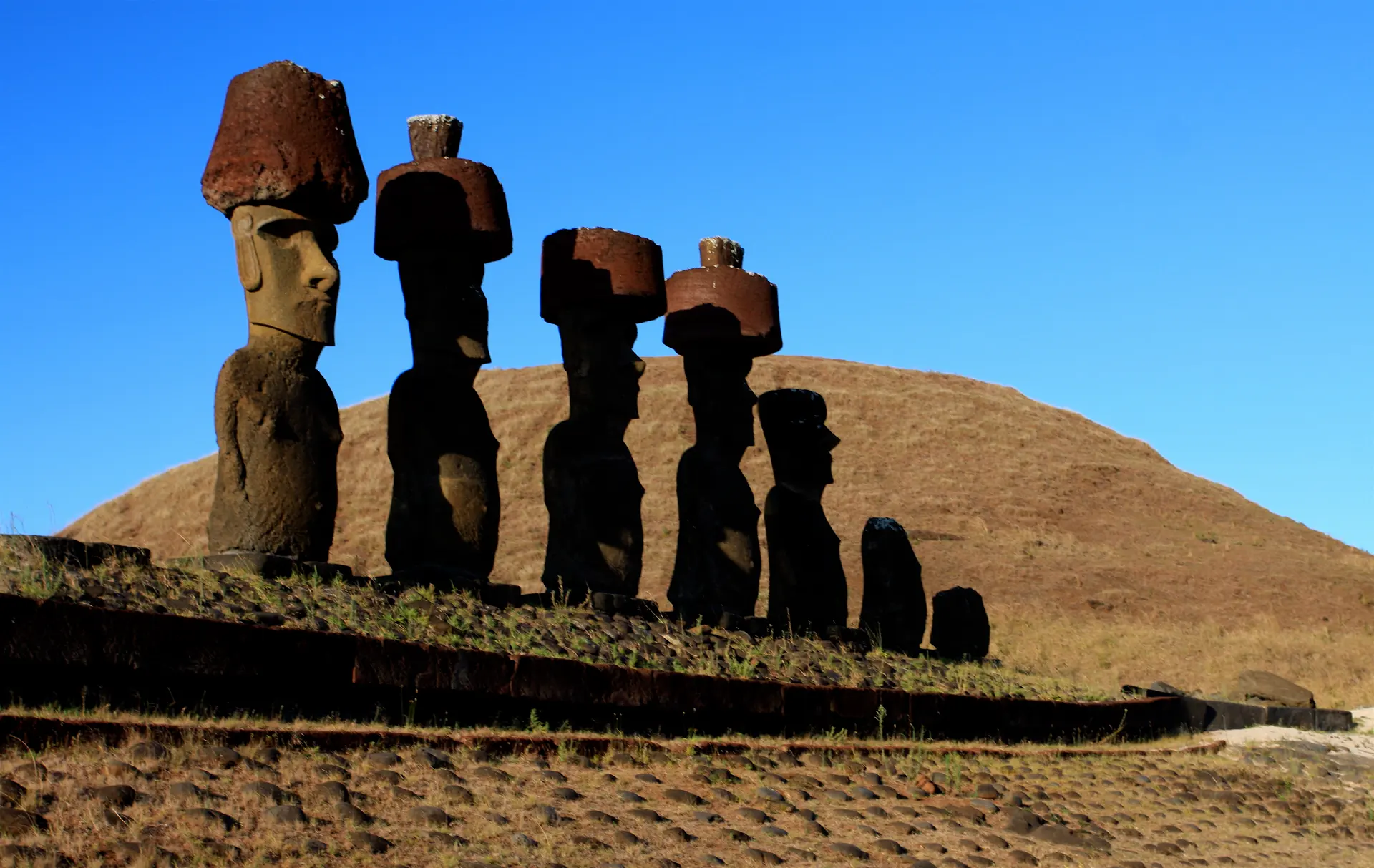
Image of Ahu Nau Nau. Image source
Visit essentials
A quick read before you go
- Duration
- A relatively brief visit to the platform itself, typically extended by time spent at the beach.
- Access
- Located approximately 150 meters inland from Anakena Beach on Rapa Nui (Easter Island), Chile.
Overview
Ahu Nau Nau stands a short walk inland from Anakena, which Rapa Nui oral tradition names as the island's first-arrival place. Seven inward-facing moai turn their carved backs to the sea; some wear cylindrical pukao, and their preservation follows Sergio Rapu's 1978–1980 restoration. The platform developed in three phases from roughly 1100 to 1400 CE.
Oral tradition holds that Hotu Matu'a, the legendary first king, arrived by canoe from Hiva and founded the settlement from which more than a thousand years of Rapa Nui culture unfolded. Some travel sources call the ahu his wife's tomb, but academic sources do not corroborate this, so it remains popular tradition rather than settled fact. Its sheltered, warm, swimmable white-sand beach contrasts with the exposed volcanic coast of most other ahu.
The gravity of a founding-story landscape and an afternoon's beach use coexist without contradiction.
Why this place is sacred
What gives Ahu Nau Nau its particular charge is the doubling of registers at Anakena. This is, first, an ahu — a ceremonial platform on which moai were raised to embody ancestors and watch over the living. That alone would place it within the same tradition as hundreds of other platforms scattered across the island.
But Anakena carries a second, older weight: Rapa Nui oral tradition names this beach as the place where Hotu Matu'a's canoes first touched land, the founding moment from which the island's entire subsequent history is understood to flow. A platform built to honor ancestors, sited at the spot the ancestors themselves are said to have arrived — the layering is not accidental in feeling, whatever the exact chronology of legend versus construction turns out to be.
The moai's number and condition matter here too. Seven statues stand at Ahu Nau Nau, several retaining their pukao, and archaeologists point to their unusually good preservation as a direct result of the careful 1978-1980 restoration. Where many of the island's moai stand weathered, eyeless, or toppled, Nau Nau's figures read as more complete — closer, perhaps, to how they were meant to be seen by the community that raised them.
The platform was built, across three identified construction phases spanning roughly 1100 to 1400 CE, to serve as a ceremonial ahu on which carved moai stood as embodiments of ancestral presence — structures for a community's ongoing relationship with its dead rather than static monuments.
Like most of Rapa Nui's ceremonial architecture, Ahu Nau Nau's moai were toppled during the island's period of internal conflict (the huri moai era), though the precise circumstances of this particular platform's fall are not detailed in available sources. The site's current standing form is a 20th-century restoration, completed by a team led by archaeologist Sergio Rapu between 1978 and 1980, which returned the fallen statues to their platform and re-set several of their pukao.
Experience and orientation
The walk to Ahu Nau Nau begins at the sand. Anakena is one of Rapa Nui's only real swimming beaches, and the approach to the ahu carries that mood — bare feet, salt air, the ordinary business of a day at the coast — right up until the moai come into view, standing on their platform a short distance back from the water.
The seven figures face inland, away from the sea, in keeping with the island-wide convention that moai look toward the community they were raised to watch over rather than out toward the horizon. Up close, the restoration work is visible in the completeness of the carving: eye sockets, ear forms, the subtle curve of the pukao where they survive.
Walking the length of the platform, notice how the moai vary slightly in height and finish despite being built across overlapping construction phases — a reminder that this is not a single gesture but an accumulation, built up over roughly three centuries by different hands. The setting rewards slowness.
Because Anakena draws visitors for swimming as much as for the ahu, there is less of the hushed, single-purpose atmosphere of Rapa Nui's more remote ceremonial sites; people move between sand and stone, and the ahu holds its own gravity within that mixed use rather than demanding total isolation to be felt.
Ahu Nau Nau stands roughly 150 meters inland from Anakena beach, reached by a short, flat walk from the sand. There is no climb and no technical approach — the site is among the most physically accessible ceremonial platforms on Rapa Nui.
Context and lineage
According to Rapa Nui oral tradition, the island's first king, Hotu Matu'a, sailed from a homeland called Hiva and made landfall at Anakena beach with his followers, founding the settlement from which Rapa Nui culture developed over the following centuries.
The platform's name, Nau Nau, is linked by several sources to an extinct native shrub of the sandalwood family said in legend to have sustained Hotu Matu'a's people during the settlement's early months — though this etymology has not been independently verified against a linguistic or botanical academic source and should be held with some caution.
Some travel sources additionally associate the ahu with the tomb of Hotu Matu'a's wife, a claim not corroborated by academic sources in the research behind this content.
Ahu Nau Nau belongs to the island-wide ahu-moai ceremonial tradition, in which platforms were raised across many generations to hold statues understood as ancestral embodiments; its own construction spans three identified phases across roughly three centuries, reflecting ongoing use and expansion by successive generations of the same community.
Hotu Matu'a
Legendary first king and founding ancestor
According to Rapa Nui tradition, Hotu Matu'a led the first Polynesian settlers to the island by canoe from a homeland called Hiva, landing at Anakena and founding the community from which Rapa Nui culture developed.
Sergio Rapu
Archaeologist and restoration lead
Led the 1978-1980 restoration that returned Ahu Nau Nau's fallen moai to standing position, work credited with the platform's present, unusually well-preserved condition.
Traditions and practice
Historical practices tied to ahu construction and ancestor veneration are not documented in site-specific detail for Ahu Nau Nau in available sources, though the broader Rapa Nui tradition understood moai as vessels of ancestral mana requiring ongoing communal regard.
No organized contemporary ceremonial practice is documented at the site. Ma'u Henua's role here, as at other Rapa Nui platforms, is limited to conservation stewardship and the enforcement of visitor conduct rules rather than facilitating ritual.
Walk the platform slowly and from more than one angle — the moai's slight variations in height and carving finish are easiest to notice moving along the row rather than viewing head-on. Spend time at the beach itself before or after visiting the ahu; Anakena's identity as a landing-place tradition is easier to feel with sand and water still part of the immediate experience, rather than treating the ahu as a stop separate from its setting.
Rapa Nui ancestor/moai veneration
HistoricalThe moai of Ahu Nau Nau are understood within Rapa Nui tradition as embodiments of deified ancestors, carrying mana rather than functioning as mere commemorative sculpture.
Historical practices associated with ahu/moai veneration are not documented in detail for this specific site; the tradition is understood as historical rather than actively practiced today.
Hotu Matu'a founding narrative
ActiveAnakena, and Ahu Nau Nau within it, is traditionally regarded as the site of the first Polynesian settlement on Rapa Nui, led by the legendary first king Hotu Matu'a.
Maintained through oral tradition, heritage interpretation, and general Rapa Nui cultural education rather than through site-specific ceremony.
Ma'u Henua heritage stewardship
ActiveMa'u Henua, the indigenous community organization managing Rapa Nui National Park since 2017, oversees Ahu Nau Nau's conservation and public access.
Conservation management and enforcement of visitor conduct rules, including the no-touching and no-climbing standards applied across the park.
Perspectives and open questions
Ahu Nau Nau is understood through an archaeological lens focused on construction phasing and restoration, and through a Rapa Nui traditional lens centered on the founding-arrival narrative — two readings that reinforce rather than compete with each other, though several specific claims popular in visitor-facing sources remain uncorroborated.
Scholarly perspective
Archaeologists date the platform's construction across three distinct phases spanning roughly 1100 to 1400 CE based on excavation evidence, and credit the 1978-1980 restoration led by Sergio Rapu's team for the site's current, well-preserved appearance relative to many other Rapa Nui platforms.
Living and traditional perspectives
Rapa Nui oral tradition associates Anakena broadly with Hotu Matu'a's founding settlement of the island.
No site-specific interpretive statement from Ma'u Henua, the indigenous community that has managed Rapa Nui National Park since 2017, was located beyond its general procedural and conservation guidance — a gap consistent with the pattern found across other Rapa Nui sites, where published indigenous-authored material tends toward governance rather than spiritual interpretation, and one that should be read as an absence of documentation rather than an absence of meaning.
Open questions
The specific attribution of the platform to the tomb of Hotu Matu'a's wife, repeated in some travel sources, has not been corroborated by an academic source and should be treated as a popularly circulated but unestablished claim. The etymology linking 'Nau Nau' to an extinct sandalwood-family shrub carries similar uncertainty. The precise circumstances of the statues' toppling prior to 20th-century restoration are also not detailed in available sources.
Plan your visit
Access and arrival
Located approximately 150 meters inland from Anakena Beach on Rapa Nui (Easter Island), Chile. Unlike most Rapa Nui National Park sites, a mandatory accredited guide is not required to visit Anakena or Ahu Nau Nau specifically, per Ma'u Henua's published visitor rules — an exception that has applied since the park's August 2022 post-pandemic reopening for most other sites.
No specific accommodation information was located for this site in available sources; visitors typically stay in Hanga Roa, the island's main town, and reach Anakena by car or organized tour.
Respectful visit
No specific dress code is documented; ordinary beach-and-heat-appropriate clothing is standard, given Anakena's dual role as swimming beach and archaeological site.
No specific photography restriction is documented in available sources.
No offering practice is documented at this site.
Do not touch or climb on the moai, the ahu platform, or any archaeological feature. Do not remove stones or objects from the site.
Treat the wife's-tomb attribution and the sandalwood-shrub etymology as popular tradition rather than settled fact — both circulate widely in visitor-facing sources without academic corroboration.
Location
Map loads as you approach this section.
Pilgrim reflections
A portrait of encounter, not a score
Pilgrims describe what they felt, how present they could become, and whether the place would shape a journey. There are no stars and no ranking of traditions.
No reviewed reflections yet
The first pilgrims can help describe the character of being here.
Share a reflection
Available after an account-backed “Been there.” Every reflection is reviewed before publication.
Nearby sacred places
Explore other sacred places in the region. Proximity does not establish access or travel time; check each place’s guidance.

Easter Island
Easter Island, Valparaíso, Chile
5.0 km away

Rano Raraku
Hanga Roa / Hanga Nui area, Rapa Nui, Valparaíso Region, Valparaíso, Chile
6.7 km away

Ahu Tongariki
Hanga Nui, Rapa Nui, Valparaíso Region, Valparaíso, Chile
7.7 km away

Ahu Akivi
Hanga Roa interior, Rapa Nui, Valparaíso Region, Valparaíso, Chile
9.8 km away
References
Sources consulted for this page. Source categories describe the publication, not a guarantee that every claim is verified. Traditional accounts and outside interpretations may differ.
- 01AHU NAU NAU | The moai statues on Anakena beach - Easter Island — Imagina Rapa NuiSource contextDetailed tourism/heritage-interpretation source covering the Hotu Matu'a landing legend, restoration history, and construction phases
- 02Ahu Nau Nau - The Tomb Of The Wife Of King Hotu Matu'a — Rapa Nui Travel GuideSource contextLocal travel-guide source with specific detail on the platform's association with Hotu Matu'a's wife
- 03ANAKENA - moeVarua Rapa Nui — moeVaruaSource contextLocal Rapa Nui tourism/cultural information site
- 04Ma'u Henua Indigenous Community — moeVaruaofficialOverview of Ma'u Henua's role administering Rapa Nui National Park since 2017
- 05Anakena — Wikipedia contributorsacademicGeneral encyclopedia background on Anakena beach and its role in Rapa Nui settlement history
- 06Rapa Nui mythology — Wikipedia contributorsacademicBackground on the Hotu Matu'a origin narrative within the broader Rapa Nui mythological corpus
- 07EASTER ISLAND HISTORY — Imagina Rapa NuiSource contextGeneral historical context for Rapa Nui settlement, used to cross-check the Hotu Matu'a landing narrative
Share a photo
Help visitors recognize Ahu Nau Nau. Every submission is reviewed before publication.