Rano Raraku
The quarry where nearly every moai on Rapa Nui was born
Understand sacred places, explore living traditions, and learn how to engage respectfully with Pilgrim Map.
Access has not been verified. Check current local guidance before planning a visit.
Hanga Roa / Hanga Nui area, Rapa Nui, Valparaíso Region, Valparaíso, Chile
Read the sources
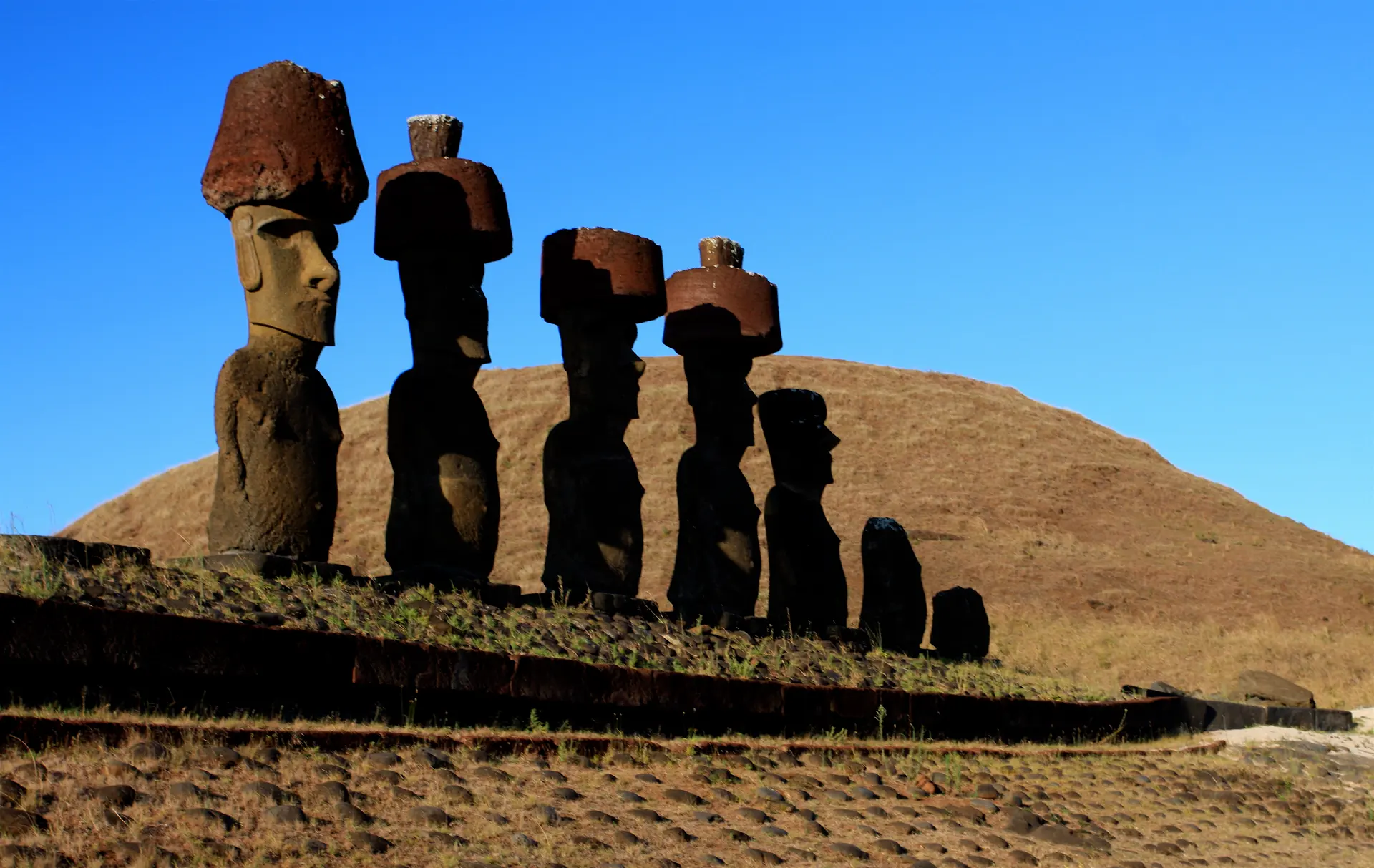
Image of Rano Raraku. Image source
Visit essentials
A quick read before you go
- Duration
- Travel guides typically describe a visit of roughly 1.5 to 2 hours for the exterior and interior…
- Access
- Reachable by road from Hanga Roa; entry requires a Ma'u Henua park pass, purchasable at the…
Overview
Nearly every moai on Rapa Nui took form from Rano Raraku's volcanic tuff. Clan-based groups quarried here for roughly five centuries, from the eleventh or thirteenth century through the early eighteenth, leaving hundreds of statues upright, tilted, unfinished, or still joined to the rock face.
A popular account, largely following Jared Diamond's “Collapse,” treated them as work abandoned when Rapanui society destroyed its environment and collapsed. A 2024 ancient-DNA study found no genetic signature of pre-contact population collapse: Rapanui numbers grew until the 1860s, when European disease and Peruvian slave raids caused genuine demographic catastrophe.
A 2025 high-resolution photogrammetric survey authorized by Rapanui stewards identified at least thirty quarrying areas, supporting decentralized clan production rather than one workforce fleeing disaster. The unfinished moai can instead be read as ordinary traces of continuous, distributed work—some abandoned after striking hard rock, others perhaps deliberately left standing to preserve the quarry's sanctity.
Why this place is sacred
The crater's sacredness rests on its role as origin point: this is where the moai, understood in Rapanui cosmology as living embodiments of deified ancestors, came into being. Oral tradition describes the finished statues as having walked to their destinations across the island, animated by the mana of the ariki they represented — a claim that sits in an unusual relationship to modern engineering research.
Experimental studies testing a physical 'walking' method, in which an upright moai is rocked side to side with ropes, have shown the technique works mechanically; the tradition and the experiment converge on the vocabulary of walking while diverging on what's actually doing the moving, spiritual animation in one account, controlled rocking in the other.
How exactly finished statues were transported from the quarry to ahu platforms elsewhere on the island remains genuinely unresolved between sledges, rollers, and the walking method, and this file does not claim otherwise. Researchers have also described Rano Raraku as a possible axis-mundi-like center of the island's cosmology, tied to agricultural and marine fertility — though most of that detailed interpretation comes from academic reconstruction rather than documented first-person Rapanui devotional testimony, a gap worth naming rather than papering over.
The crater's old name, Maunga Eo, 'perfumed hill,' and its role as the near-exclusive source of moai stone tie it to island-wide ancestor and clan narratives; it functioned as the near-total point of origin for the moai — 895 or 887 depending on which source's count you follow — that populate ahu platforms across the island.
Quarrying activity ran roughly from the eleventh or thirteenth century through the early eighteenth, ending gradually rather than in a single catastrophic event. Since December 2017, Rapa Nui National Park, including Rano Raraku, has been administered by Ma'u Henua, a Rapanui indigenous community organization, under a fifty-year renewable agreement with the Chilean state.
Ma'u Henua authorized the 2025 drone photogrammetric survey that produced the first high-resolution 3D model of the quarry, with Rapanui researcher Gina Pakarati contributing local expertise — a case of indigenous stewardship directly shaping how the site's own history gets rewritten.
Experience and orientation
Nothing quite prepares a first-time visitor for the density of it: statues embedded at every angle in the slope, some barely emerged from the rock, others standing fully free, the whole hillside reading less like a construction site abandoned than like a population caught mid-gesture.
The 'abandoned mid-carving' framing is extremely common in travel writing and is precisely the framing current scholarship is revising — worth knowing before arriving, since it changes what the stillness of the place is actually communicating. This is a guided, single-entry visit like Orongo elsewhere in the park; the roughly ninety-minute to two-hour circuit covers both the exterior quarry slope and, where accessible, the interior crater.
The quarry sits within Rapa Nui National Park on the island's eastern side, its slopes holding both the exterior face — where most of the visible standing and half-buried moai are concentrated — and an interior crater basin. A single Ma'u Henua park pass permits one visit here; the standard circuit runs roughly ninety minutes to two hours.
Context and lineage
Rapanui oral tradition holds that moai carved at Rano Raraku walked to their platforms elsewhere on the island through the mana of the ancestral chiefs they represented, rather than being dragged or rolled by ordinary labor — a claim about ancestral agency and sacred continuity, not a literal engineering account in the tradition's own terms. The quarry's old name, Maunga Eo, ties it to broader island cosmology predating any specific written record.
Quarrying and carving at Rano Raraku were carried out by clan-based Rapa Nui work groups across generations, with the 2025 photogrammetric study identifying at least 30 separate quarrying foci suggesting parallel, decentralized production rather than one centralized workforce. Today's stewardship runs through Ma'u Henua, which took over park administration from the Chilean state agency CONAF in 2017-2018.
Terry Hunt
Archaeologist, revisionist scholarship
Co-author with Carl Lipo of the foundational research program challenging the ecocide/collapse narrative, arguing Rapanui demographic catastrophe followed European contact rather than self-inflicted ecological collapse.
Carl Lipo
Archaeologist, quarry photogrammetry study
Co-led the 2025 high-resolution 3D photogrammetric survey of the quarry, identifying at least 30 distinct quarrying foci evidencing decentralized, clan-based production.
Gina Pakarati
Rapanui local-expertise contributor
Credited as a named Rapanui collaborator contributing local expertise to the 2025 PLOS ONE quarry study — the clearest indigenous input identified in this research, though not an independently authored indigenous interpretive source.
Ma'u Henua
Indigenous park administrator
The Rapanui community organization that has administered Rapa Nui National Park, including Rano Raraku, since December 2017, and which authorized the 2025 drone survey of the quarry.
Traditions and practice
Moai were carved directly from the crater's volcanic tuff by clan-based work groups and, per oral tradition, 'walked' to ahu platforms elsewhere on the island through the mana of the ancestors they depicted. Some completed, upright moai were deliberately left in place at Rano Raraku itself, associated with preserving the quarry's own sanctity rather than representing interrupted work.
Possible ties to the tangata manu (birdman) cult are suggested by the kneeling Tukuturi moai, though direct primary-source description of specific ceremonies performed at the quarry is limited.
No organized ceremonial or ritual practice is documented at Rano Raraku today. What is genuinely active is Rapanui community stewardship: Ma'u Henua's management of the site since 2017 is framed explicitly as protection of ancestral patrimony rather than mere conservation of ruins, and the 2025 photogrammetric study — authorized by Ma'u Henua and incorporating Rapanui researcher Gina Pakarati's expertise — represents indigenous involvement in actively rewriting the site's own scholarly record.
Walk the quarry slope slowly enough to notice the range of completion states — a half-carved figure still fused to the rock face tells a different story than a standing, finished one, and the difference matters more than it might first appear. Hold the popular 'abandoned mid-carving' narrative loosely rather than as settled fact, and let the site's genuine stillness register as continuity and craft across centuries rather than as evidence of catastrophe.
Rapanui ancestor veneration and mana cosmology
ActiveMoai are traditionally understood as embodiments of deceased ariki, imbued with mana. Rano Raraku, as the source of nearly all moai, occupies a central cosmological role, sometimes described by researchers as an axis mundi linked to agricultural and marine fertility.
Historically, moai were carved at the quarry and, per oral tradition, walked to ahu platforms across the island via their mana; some completed and upright moai were deliberately left in place at Rano Raraku itself, associated with preserving the sanctity of the quarry.
Contemporary Rapanui stewardship (Ma'u Henua)
ActiveSince December 2017, Rapa Nui National Park, including Rano Raraku, has been administered by Ma'u Henua, a Rapanui indigenous community organization, under a 50-year renewable agreement with the Chilean state — reframing the site's management from foreign or state conservation to indigenous-led protection of ancestral patrimony.
Ma'u Henua issues park entry passes, requires accredited local or Rapa Nui guides for most sites, enforces conduct rules, and authorizes or restricts research and commercial activity, including the 2025 drone photogrammetry survey of the quarry.
Perspectives and open questions
The site sits at the center of one of Pacific archaeology's most consequential recent revisions — a popular narrative of self-inflicted collapse giving way, in the peer-reviewed record, to a more measured and more damning account of what actually happened to the Rapanui population.
Scholarly perspective
There is broad agreement that Rano Raraku was the near-exclusive quarry source for the island's moai over roughly five centuries, and that production was organized by multiple distinct clan-based groups rather than one centralized authority, per the 2025 Lipo, Hunt, and Pakarati photogrammetric study. There is not full consensus on why quarrying ceased or on the transport method used to move finished statues.
The once-dominant 'ecocide' framing — that Rapanui society self-destructively deforested the island and collapsed catastrophically, leaving carving suddenly abandoned — has been substantially challenged by the Hunt and Lipo research program and reinforced by a 2024 ancient-DNA study showing population growth continuing until the 1860s.
Current leading interpretations attribute the demographic collapse and eventual halt of moai production primarily to nineteenth-century European contact — introduced disease and Peruvian slave raids — rather than pre-contact ecological self-destruction, though this remains an actively debated area of Pacific archaeology rather than a fully closed question.
Living and traditional perspectives
Rapanui oral tradition holds that moai were animated by the mana of the ancestral chiefs they depicted and that the statues walked from the quarry to their platforms through this spiritual power — a framing about ancestral agency and sacred continuity, not mechanical transport or catastrophic failure.
Ma'u Henua's assumption of park management in 2017 frames the site explicitly as returned ancestral patrimony under indigenous protection, implicitly pushing back against externally authored narratives, including the ecocide story, that cast Rapanui ancestors as reckless destroyers of their own environment.
This research was unable to locate a specific indigenous-authored essay or oral-history transcript addressing the abandonment narrative directly; the clearest indigenous input identified is Gina Pakarati's role as a named contributor of local expertise to the 2025 academic study, which is a real but partial substitute for an independently authored indigenous interpretive source, and that gap is worth stating plainly rather than filling with invented confidence.
Alternative interpretations
Popular and esoteric literature sometimes frames Rano Raraku and the moai within speculative narratives about the statues' meaning or transport; these were not the focus of this research and no reliable esoteric sources were gathered or should be treated as credible without separate, clearly labeled treatment.
Open questions
The precise method by which completed moai were transported from the quarry to ahu platforms elsewhere on the island remains scientifically unresolved — sledges, ropes, and log rollers compete with the experimentally tested walking method, with no current scientific consensus. The exact social and political process by which quarrying wound down in the early eighteenth century, gradual disuse versus specific triggering events, is still being actively researched, most recently via the 2025 photogrammetric survey.
Plan your visit
Access and arrival
Reachable by road from Hanga Roa; entry requires a Ma'u Henua park pass, purchasable at the airport or Ma'u Henua offices in Hanga Roa, and for most visitors an accredited guide. The standard multi-day pass permits a single visit to Rano Raraku.
No specific on-site accommodations exist given the site's protected status; nearly all visitors base in Hanga Roa and visit as a day trip, often combined with Ahu Tongariki.
Respectful visit
No specific dress code is documented beyond general sun and heat preparedness recommended by travel guides.
Personal photography is permitted; commercial photography or filming requires prior authorization from the Ma'u Henua Community.
No documented tradition of visitor offerings at this site.
Do not touch or climb on moai or other archaeological remains; stay on marked and authorized trails; no drones, camping, open fires, smoking, or alcohol. Most of the park, including Rano Raraku, requires an accredited local guide or Rapa Nui host for entry, and the standard pass allows only one visit each to Rano Raraku and to Orongo.
No visitor ritual participation is offered or appropriate; this is regulated sightseeing under mandatory guide supervision, and touching or climbing on moai is strictly prohibited.
Location
Map loads as you approach this section.
Pilgrim reflections
A portrait of encounter, not a score
Pilgrims describe what they felt, how present they could become, and whether the place would shape a journey. There are no stars and no ranking of traditions.
No reviewed reflections yet
The first pilgrims can help describe the character of being here.
Share a reflection
Available after an account-backed “Been there.” Every reflection is reviewed before publication.
Nearby sacred places
Explore other sacred places in the region. Proximity does not establish access or travel time; check each place’s guidance.

Ahu Tongariki
Hanga Nui, Rapa Nui, Valparaíso Region, Valparaíso, Chile
1.5 km away
Ahu Nau Nau
Anakena, Rapa Nui, Valparaíso Region, Valparaíso, Chile
6.7 km away

Easter Island
Easter Island, Valparaíso, Chile
7.6 km away

Vinapu Ceremonial Complex
Hanga Roa, Rapa Nui, Valparaíso Region, Valparaíso, Chile
13.0 km away
References
Sources consulted for this page. Source categories describe the publication, not a guarantee that every claim is verified. Traditional accounts and outside interpretations may differ.
- 01Ecological Catastrophe and Collapse: The Myth of 'Ecocide' on Rapa Nui (Easter Island) — Terry Hunt, Carl LipoacademicFoundational revisionist paper challenging the ecocide/collapse narrative.
- 02Revisiting Rapa Nui (Easter Island) 'Ecocide' — Terry Hunt, Carl LipoacademicPeer-reviewed elaboration of the revisionist argument; published academic journal source.
- 03Study Challenges Popular Idea That Easter Islanders Committed 'Ecocide'academicUniversity of Arizona news summary of Hunt/Lipo research program.
- 04Ancient DNA debunks Rapa Nui 'ecological suicide' theoryacademic2024 genetic study finding population growth (not pre-contact collapse) until 1860s Peruvian slave raids and epidemics.
- 05Megalithic statue (moai) production on Rapa Nui (Easter Island, Chile) — Carl Philipp Lipo, Terry L. Hunt, Gina Pakarati (local expertise)academic2025 PLOS ONE study; first high-resolution 3D photogrammetric model of quarry (11,000+ drone images, authorized by Ma'u Henua); identifies 426 moai, 30 quarrying foci, decentralized clan-based production. Gina Pakarati (Rapanui) credited as local-expertise collaborator.
- 06Unearthing the mystery of the meaning of Easter Island's MoaiacademicUCLA research summary on moai/fertility/agricultural cosmology connections.
- 07Rano RarakuacademicGeneral overview of quarry history, moai counts, dimensions; cites Englert and Van Tilburg but presents limited scholarly debate.
- 08Rapa Nui National ParkofficialUNESCO designation date (1996) and Ma'u Henua management transfer (2017) details.
- 09Easter Island quarry reveals how Polynesians made enigmatic stone statuesSource contextNews coverage of the Lipo et al. 2025 study; confirms Ma'u Henua authorization of drone survey.
- 10Rano Raraku, Easter Island: The Moai Quarry Complete Visitor GuideSource contextLocal Rapa Nui publication (moeVarua) summarizing visitor rules and Ma'u Henua access pass system.
- 11Visiting The Rapa Nui Archaeological Parks InformationSource contextDetails mandatory guide requirement, prohibited activities, photography/filming restrictions, single-entry pass rules.
- 12Rano RarakuSource contextGeneral site summary, used for corroborating basic facts only.
Share a photo
Help visitors recognize Rano Raraku. Every submission is reviewed before publication.